
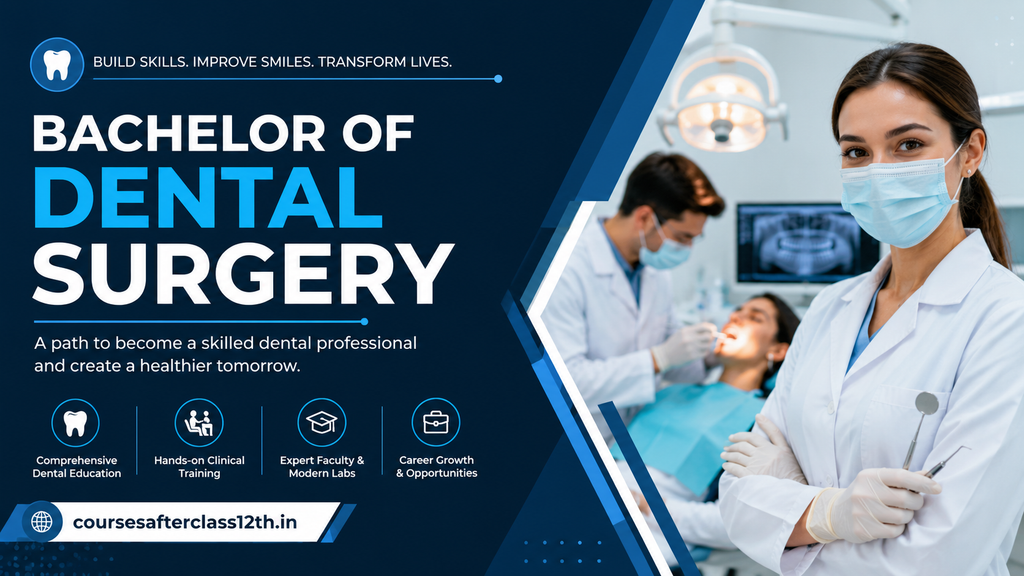
Bachelor of Dental Surgery (BDS) is the primary undergraduate dental programme for students who want to build a career in dentistry and oral healthcare. The programme combines biological sciences, medical knowledge, dental sciences, laboratory work, clinical training, patient care and preventive dentistry. Therefore, BDS is suitable for students who are interested in healthcare but want to specialise in oral and dental health.
For students who have completed Class 12 with Physics, Chemistry and Biology (PCB), BDS can be considered among the professional healthcare courses after 12th. Admission requirements, counselling procedures, fees and seat availability can vary by institution, state, category and admission route. In India, NEET-UG is the key national entrance examination used for undergraduate medical and dental admissions, while counselling determines seat allocation. The current 2026 NEET-UG and UG counselling information is published by the National Testing Agency and Medical Counselling Committee (MCC).
This guide explains BDS after 12th, including eligibility, NEET, admission process, course duration, subjects, clinical training, fees, skills, internships, career options, salary factors, government jobs, private practice, higher education, specialisations, digital dentistry and future scope.
Table of Contents
What Is Bachelor of Dental Surgery?
This course, commonly called BDS, is an undergraduate professional degree focused on the prevention, diagnosis and management of diseases and conditions affecting the teeth, gums, mouth and related oral structures.
Unlike a general science degree, BDS combines classroom learning with practical laboratory work and clinical exposure. Students gradually move from basic subjects such as anatomy and physiology to dental subjects involving diagnosis, restorative treatment, oral surgery, prosthetic rehabilitation and preventive care.
The programme is therefore designed to develop both theoretical understanding and clinical competence. Students learn about the structure of the human body, oral tissues, dental diseases, dental materials, radiographic procedures, treatment planning and patient management.
In addition, dental education includes communication with patients and community-oriented oral healthcare. The revised BDS curriculum places significant emphasis on practical skills and clinical training rather than relying only on classroom teaching.
A student completing BDS may later work in a dental clinic, hospital, community health programme, academic institution, research organisation or dental industry. Alternatively, graduates can pursue postgraduate education such as MDS in a chosen dental speciality.
BDS After 12th
For students who have completed Class 12 with the required science subjects, BDS provides a professional pathway into dentistry.
The course is particularly relevant for students who enjoy biology, healthcare, clinical procedures and patient interaction. However, choosing BDS should involve more than simply comparing it with other healthcare courses.
Students should consider factors such as:
- Interest in dentistry and oral healthcare
- Comfort with clinical and hands-on work
- Interest in patient interaction
- Ability to study biological and medical subjects
- Willingness to develop practical skills
- Interest in surgical and restorative procedures
- Long-term plans for employment or private practice
- Financial considerations
- College infrastructure and clinical patient exposure
- Opportunities for postgraduate education
Therefore, students should research the curriculum, teaching hospital, clinical facilities, faculty, internship structure, recognition status and placement or career support before selecting a dental college.
Why Choose BDS After 12th?
BDS can be an attractive option for students who want a healthcare profession with a specialised focus on oral health.
Dentistry involves more than treating cavities. A dental professional may work with preventive care, restorative dentistry, prosthetic rehabilitation, oral surgery, periodontal conditions, children’s dental health, orthodontic treatment and oral diagnosis.
Furthermore, modern dentistry increasingly uses digital technologies. Digital radiography, intraoral scanners, CAD/CAM systems, digital impressions, computer-assisted treatment planning and other technologies are changing how dental professionals work.
As a result, students entering BDS today may encounter both traditional clinical methods and technology-assisted dentistry.
Key reasons students consider BDS
| Factor | Relevance |
|---|---|
| Professional healthcare degree | Provides structured education in dentistry |
| Clinical exposure | Students develop practical patient-care skills |
| Specialisation options | Graduates can pursue MDS specialities |
| Private practice | Entrepreneurship is possible after meeting applicable professional requirements |
| Hospital careers | Dental graduates can work in hospitals and healthcare settings |
| Public-sector opportunities | Recruitment may occur through government organisations and examinations |
| Academic careers | Higher education can lead towards teaching and research |
| Digital dentistry | Technology is increasingly integrated into dental practice |
| Community dentistry | Graduates can contribute to oral-health programmes |
BDS Eligibility After 12th
Eligibility requirements can vary according to applicable regulations and admission rules. Generally, students seeking Bachelor of Dental Surgery admission need to have completed the required senior-secondary education with the relevant science subjects.
Physics, Chemistry and Biology/Biotechnology are important subjects for the undergraduate medical and dental admission pathway. Candidates should always check the current NEET information bulletin and the applicable counselling rules before applying.
The exact requirements can also differ according to category, institution and admission authority.
General eligibility overview
| Requirement | General information |
|---|---|
| Educational qualification | Class 12 or equivalent qualification |
| Core subjects | Physics, Chemistry and Biology/Biotechnology |
| Entrance examination | NEET-UG |
| Age requirement | As specified in the current NEET rules |
| Medical requirements | As applicable under current regulations |
| Admission basis | NEET merit followed by applicable counselling |
| Documents | Academic, identity and category-related documents as applicable |
The above table is a general guide rather than a substitute for the current official admission notification.
Admission Process
The admission process generally begins with eligibility for NEET-UG, followed by examination, result declaration, counselling and seat allotment.
The process can differ depending on whether the candidate is applying through All India Quota, a state counselling authority, a deemed university or another permitted admission category.
MCC currently conducts online undergraduate counselling for applicable MBBS and BDS seats, and its 2026 portal provides information on participating institutes, seat matrices, schedules and counselling instructions.
Admission Process
1. Complete Class 12
Students should complete the required science subjects and satisfy the applicable academic conditions.
2. Register for NEET-UG
Candidates need to follow the current NTA notification and information bulletin for application dates, eligibility, examination pattern and other requirements.
3. Appear for NEET-UG
The candidate takes the national undergraduate medical entrance examination.
4. Check the result
After the result is announced, students can assess their qualifying status and understand the counselling options available to them.
5. Register for counselling
Eligible candidates participate in the relevant counselling process.
6. Fill choices
Candidates select preferred dental colleges according to their eligibility, priorities and available seats.
7. Seat allotment
Seats are allotted according to the applicable counselling rules, merit, category, choices and seat availability.
8. Report to the college
Students must complete reporting, document verification and admission formalities within the prescribed timeline.
Because counselling schedules and seat matrices can change, students should rely on official notices rather than outdated admission calendars. The 2026 MCC counselling portal, for example, has published revised schedules, seat matrices and allotment updates during the ongoing counselling process.
NEET for BDS Admission
NEET-UG is an important part of the undergraduate medical and dental admission process in India.
Students preparing for BDS admission should therefore treat NEET preparation seriously. The examination requires strong understanding of the prescribed syllabus, particularly Biology, Chemistry and Physics.
However, students should not assume that a single NEET score guarantees admission to a particular dental college. Admission depends on factors such as:
- NEET performance
- Category
- Counselling rules
- Seat availability
- College preferences
- Quota
- State-specific requirements
- Institutional eligibility
- Competition during a particular admission cycle
MCC’s current UG counselling portal specifically includes Bachelor of Dental Surgery seats in its undergraduate counselling information and publishes participating institutes and seat matrices.
BDS Course Duration
The Dental Degree programme is structured around four academic years followed by one year of compulsory rotating internship under the revised regulations. The internship is an important component of professional training, and the degree is linked to completion of the required internship.
Therefore, students should generally plan for approximately five years of undergraduate dental education and training.
BDS duration structure
| Stage | Approximate duration |
|---|---|
| BDS academic training | 4 years |
| Compulsory rotating internship | 1 year |
| Total | About 5 years |
The exact implementation of academic requirements, examinations and internship postings should be checked against the applicable current rules of the institution and regulator.
BDS Course Structure
The BDS curriculum progresses from foundational biomedical sciences to pre-clinical and clinical dental education.
In the early stages, students learn about the human body and biological systems. Later, they develop knowledge of oral diseases, dental materials, diagnosis, treatment planning and clinical procedures.
During the clinical years, students spend increasing amounts of time working with patients under supervision.
Broad BDS learning areas
| Area | What students learn |
|---|---|
| Basic sciences | Anatomy, physiology and biochemistry |
| Dental anatomy | Structure and morphology of teeth |
| Oral pathology | Diseases affecting oral tissues |
| Pharmacology | Medicines and their clinical use |
| Dental materials | Materials used in dental procedures |
| Conservative dentistry | Restoration of damaged teeth |
| Prosthodontics | Replacement of missing teeth and oral structures |
| Periodontics | Gums and supporting tissues |
| Oral surgery | Surgical management of oral conditions |
| Orthodontics | Diagnosis and correction of malocclusion |
| Pedodontics | Dental care for children |
| Oral medicine | Diagnosis and management of oral conditions |
| Community dentistry | Population-based oral healthcare |
BDS Subjects
BDS subjects vary somewhat according to the curriculum and institution, but students generally encounter a combination of basic medical sciences, dental sciences, laboratory training and clinical subjects.
Common BDS subjects include
- Human Anatomy
- Physiology
- Biochemistry
- Dental Anatomy
- Oral Histology
- General Pathology
- Microbiology
- Pharmacology
- Dental Materials
- Pre-clinical Conservative Dentistry
- Pre-clinical Prosthodontics
- Oral Pathology
- Oral Medicine and Radiology
- Conservative Dentistry and Endodontics
- Prosthodontics
- Periodontology
- Oral and Maxillofacial Surgery
- Orthodontics
- Pediatric and Preventive Dentistry
- Public Health Dentistry
The purpose of these subjects is not simply to help students pass examinations. Instead, they provide the scientific and clinical foundation needed to understand dental diseases and provide appropriate patient care.
Clinical Training in BDS
Clinical training is one of the most important aspects of The Dental Degree.
Students gradually move from simulated and laboratory-based learning to supervised patient care. This transition helps them understand how theoretical knowledge is applied in real clinical situations.
Clinical education can involve:
- Patient history
- Oral examination
- Diagnosis
- Radiographic interpretation
- Treatment planning
- Dental restorations
- Preventive procedures
- Periodontal procedures
- Prosthetic procedures
- Oral surgical procedures
- Pediatric dental care
- Patient counselling
The revised BDS regulations emphasise chair-side teaching, small-group learning, tutorials, seminars, clinical postings, laboratory postings and field visits.
Therefore, students should pay close attention to the quality and volume of clinical exposure offered by a college.
BDS Internship
The compulsory rotating internship gives students an opportunity to strengthen their practical skills after the academic portion of the programme.
The internship can expose students to different dental departments, allowing them to understand how clinical services operate in professional settings.
The revised internship framework includes postings across areas such as Oral Medicine and Radiology, Oral and Maxillofacial Surgery, Prosthodontics, Periodontics, Conservative Dentistry and Pedodontics.
In addition, the regulator continues to issue directions concerning internship implementation. A June 2026 notice called for strict adherence to the revised internship programme.
BDS Fees in India
The cost of BDS varies considerably across colleges.
Government dental colleges generally have different fee structures from private or deemed-university institutions. Fees can also differ according to state, category, quota, hostel requirements and institutional policies.
Therefore, it would be misleading to provide one fixed The Dental Degree fee applicable to every student.
Major expenses can include
| Expense | Possible component |
|---|---|
| Tuition fee | Academic education |
| Examination fee | University or examination charges |
| Hostel fee | Accommodation where applicable |
| Laboratory charges | Practical training |
| Equipment | Dental instruments and materials |
| Books | Academic resources |
| Clinical materials | Consumables used during training |
| Registration-related charges | Applicable professional/academic fees |
| Miscellaneous | Institutional and student-service charges |
Before accepting a seat, students should request the complete fee structure directly from the college and verify whether additional charges apply.
How to Choose a BDS College
Choosing a dental college requires more than comparing tuition fees.
A college with strong clinical exposure can provide valuable experience that may help students develop confidence and practical competence.
Students should therefore evaluate:
1. Recognition and approval
Verify that the programme and institution have the required regulatory approvals.
The National Dental Commission’s current portal provides regulatory notices and information concerning dental education institutions.
2. Patient flow
Clinical exposure depends significantly on the number and diversity of patients visiting the teaching hospital.
3. Dental departments
Check whether the college has functioning departments and adequate clinical facilities.
4. Faculty
Review faculty strength and academic experience.
5. Internship
Understand the structure of the compulsory internship and the clinical exposure provided.
6. Infrastructure
Consider dental chairs, laboratories, radiology facilities, simulation facilities and digital equipment.
7. Hostel and location
Students should also evaluate accommodation, transportation and living expenses.
8. Total cost
Compare the complete cost rather than tuition fees alone.
Skills Required for BDS
Success in dentistry requires both academic knowledge and practical ability.
Students can gradually develop:
- Hand-eye coordination
- Fine motor skills
- Observation
- Clinical reasoning
- Communication
- Patient management
- Time management
- Attention to detail
- Problem-solving
- Professional ethics
- Teamwork
- Digital technology skills
Dentistry can involve delicate and precise procedures. Therefore, patience and controlled hand movements can be particularly valuable.
At the same time, communication matters because dental anxiety is common among patients. A dentist needs to explain procedures clearly, listen to concerns and build trust.
Career Options After BDS
After completing BDS and meeting applicable registration and professional requirements, graduates can explore different career pathways.
Major career options
| Career path | Typical work |
|---|---|
| General dental practice | Diagnosis and routine dental care |
| Hospital dentistry | Dental services within hospitals |
| Private clinic | Patient treatment and clinical practice |
| Dental chain | Clinical dental services |
| Public health dentistry | Community oral-health programmes |
| Government sector | Dental roles through applicable recruitment |
| Dental research | Research and clinical studies |
| Dental education | Teaching after meeting qualification requirements |
| Dental industry | Product, clinical support or technical roles |
| Medical/dental content | Healthcare communication and education |
| Dental administration | Healthcare operations and management |
| Higher education | MDS and other advanced programmes |
Career options depend on professional registration, qualifications, experience, employer requirements and applicable regulations.
BDS Government Jobs
Government employment can be an option for The Dental Degree graduates, although vacancies and eligibility requirements vary.
Recruitment may occur through:
- Government hospitals
- State health departments
- Public health organisations
- Defence-related healthcare services
- Municipal health departments
- Public-sector healthcare institutions
- Government recruitment examinations
- Other approved recruitment processes
Students should monitor official notifications because eligibility, age limits, vacancies, selection procedures and examination patterns can change.
It is therefore better to evaluate government opportunities using current recruitment advertisements rather than relying on old vacancy information.
BDS Private-Sector Careers
Private-sector opportunities can include dental clinics, hospital groups, dental chains, healthcare organisations and dental product companies.
A graduate’s career development may depend on clinical competence, communication skills, patient handling, location, experience and further qualifications.
Some graduates may initially work under experienced dentists to gain practical exposure. Others may eventually establish their own practice after fulfilling applicable professional and legal requirements.
However, opening a clinic should not be viewed simply as a guaranteed outcome of completing BDS. It requires clinical confidence, financial planning, regulatory compliance, equipment, staff, patient acquisition and business management.
Private Dental Practice After BDS
Private practice is one of the career paths associated with dentistry.
A dentist interested in practice management may need to understand:
- Clinic infrastructure
- Dental equipment
- Infection control
- Patient records
- Appointment management
- Billing
- Staff management
- Patient communication
- Digital marketing
- Regulatory requirements
- Professional ethics
A successful practice depends on clinical quality and patient trust rather than advertising alone.
Therefore, students interested in entrepreneurship should develop both clinical and management skills.
BDS Salary in India
It is not advisable to present one fixed salary figure as applicable to every Dental Degree.
Earnings can vary according to:
- Location
- Clinical experience
- Employer
- Job role
- Qualification
- Specialisation
- Patient volume
- Practice ownership
- Working hours
- Skills
- Reputation
- Additional certifications
A fresh graduate working in a clinic may have a different income from a dentist working in a hospital, government organisation or established private practice.
Similarly, a dentist who eventually builds a successful practice may have an income structure very different from that of a salaried employee.
Salary comparison factors
| Factor | Effect on career earnings |
|---|---|
| Experience | Usually increases professional capability |
| Clinical skills | Can improve employability |
| Location | Local demand and competition vary |
| Specialisation | Advanced qualifications can create specialised opportunities |
| Practice ownership | Income depends on business performance |
| Patient base | Important for independent practice |
| Employer | Compensation structures differ |
| Communication | Can influence patient relationships |
| Technology skills | Increasingly useful in modern dentistry |
Students should compare reliable salary data and distinguish between starting salary, average salary, median salary and maximum reported package.
MDS After BDS
Students who want advanced knowledge in a particular dental field can consider postgraduate education.
This course provides specialised training in areas of dentistry.
Depending on the available programme and applicable admission rules, specialisations may include:
- Prosthodontics
- Conservative Dentistry and Endodontics
- Orthodontics
- Periodontology
- Oral and Maxillofacial Surgery
- Pediatric Dentistry
- Oral Medicine and Radiology
- Oral Pathology
- Public Health Dentistry
- Oral and Maxillofacial Pathology-related areas
MDS can be particularly useful for students who want deeper clinical expertise, academic careers, specialised practice or research opportunities.
Admission to postgraduate dental programmes is governed by applicable national examination and counselling rules.
BDS vs MDS
| Factor | BDS | MDS |
|---|---|---|
| Level | Undergraduate | Postgraduate |
| Purpose | Foundation in dentistry | Advanced specialisation |
| Clinical exposure | Broad | Specialised |
| Career stage | Entry into dental profession | Advanced professional development |
| Duration | About 4 academic years + internship | Depends on applicable programme rules |
| Specialisation | General dental education | Specific dental speciality |
Students should not view MDS as compulsory for every BDS graduate. The decision depends on career goals, financial considerations and preferred professional pathway.
BDS Research Opportunities
Dentistry also offers opportunities in research.
Research areas can include:
- Oral diseases
- Dental materials
- Biomaterials
- Preventive dentistry
- Oral cancer
- Periodontal disease
- Dental implants
- Prosthodontic materials
- Digital dentistry
- Epidemiology
- Community oral health
- Artificial intelligence in diagnosis
- Dental imaging
- Regenerative dentistry
Students interested in research should develop skills in scientific reading, data interpretation, research methodology and academic writing.
Digital Dentistry
Technology is increasingly becoming part of modern dental practice.
Digital dentistry can include:
- Digital radiography
- Intraoral scanning
- Digital impressions
- CAD/CAM
- Digital treatment planning
- 3D printing
- Computer-assisted design
- Digital patient records
- Imaging software
- Artificial intelligence-assisted applications
These technologies do not eliminate the need for clinical knowledge. Instead, they can support diagnosis, planning, documentation and treatment workflows.
Therefore, future dentists may benefit from combining traditional clinical competence with digital literacy.
Artificial Intelligence in Dentistry
Artificial intelligence is also emerging in areas such as dental imaging, pattern recognition, treatment planning and clinical decision support.
However, students should understand that AI tools are not replacements for professional judgement.
A dentist remains responsible for interpreting patient information, conducting clinical examinations and making appropriate treatment decisions according to professional standards.
Consequently, future dental education may increasingly involve understanding how technology can support, rather than replace, clinical expertise.
BDS and Public Health
Dentistry also has an important public-health dimension.
Many oral diseases can be influenced by preventive practices, diet, hygiene, tobacco exposure, access to care and health awareness.
Community dentistry therefore focuses on improving oral health at the population level.
Students may participate in:
- Oral-health awareness programmes
- School dental programmes
- Community screening
- Preventive education
- Rural health activities
- Tobacco-awareness initiatives
- Oral hygiene campaigns
The BDS curriculum includes community-oriented training, and the revised regulations describe rural and community activities as part of dental education.
Advantages of BDS
The Dental Degree offers several potential advantages for students interested in dentistry.
Professional healthcare education
Students receive structured education in oral and dental healthcare.
Clinical exposure
The programme includes practical and clinical training.
Multiple career paths
Graduates can explore clinics, hospitals, public health, research, education and industry.
Specialisation
Postgraduate education can provide deeper expertise.
Entrepreneurship
Private dental practice can provide an entrepreneurial pathway after meeting applicable professional requirements.
Technology
Modern dentistry increasingly integrates digital tools and advanced equipment.
Patient impact
Dentists can contribute to pain management, oral health, prevention, function and quality of life.
Challenges of BDS
Students should also understand the challenges before selecting the programme.
BDS requires considerable academic and practical commitment. Clinical work can involve long hours, patient management and repetitive skill development.
Other challenges may include:
- Competition for desirable jobs
- Significant education costs at some institutions
- Need for continuous learning
- Investment required for private practice
- Patient-management challenges
- Requirement for professional registration
- Need to maintain clinical competence
- Competition in urban markets
Therefore, students should select the Dental Degree because they are genuinely interested in dentistry rather than simply because it is considered a healthcare career.
BDS vs MBBS
Students frequently compare BDS with MBBS.
| Factor | BDS | MBBS |
|---|---|---|
| Primary focus | Oral and dental healthcare | General medicine and surgery |
| Degree | BDS | Bachelor of Medicine, Bachelor of Surgery |
| Clinical area | Dentistry and oral health | Broader medical care |
| Patient interaction | Dental and oral healthcare | General healthcare |
| Specialisation | MDS pathways | Multiple medical postgraduate pathways |
| Practice | Dental practice subject to applicable rules | Medical practice subject to applicable rules |
Neither course is universally better.
The better option depends on whether the student’s interests align more closely with dentistry or broader medical care.
BDS vs Other Courses After 12th
Students can also compare The Dental Degree with other healthcare and science programmes.
Potential alternatives may include:
- MBBS
- BAMS
- BHMS
- BPT
- B.Sc Nursing
- Pharmacy
- Biotechnology
- Biomedical sciences
- Allied healthcare programmes
The comparison should consider course content, duration, professional responsibilities, admission requirements, cost, clinical exposure and long-term career goals.
Internship and Practical Experience
Practical experience is particularly important in dentistry because many professional skills cannot be mastered through textbooks alone.
Students should use clinical postings and internships to improve:
- Patient communication
- Diagnosis
- Treatment planning
- Instrument handling
- Infection-control practices
- Clinical documentation
- Chair-side assistance
- Time management
- Professional behaviour
The revised Dental Degree framework emphasises practical and competency-based training during the internship period.
Documents Required for BDS Admission
The exact list depends on the counselling authority and college.
Common documents may include:
| Document | Purpose |
|---|---|
| Class 10 certificate | Date of birth/academic record |
| Class 12 certificate | Educational qualification |
| NEET scorecard | Entrance qualification |
| NEET admit card | Examination record |
| Identity proof | Candidate verification |
| Passport-size photographs | Admission documentation |
| Category certificate | Applicable reservation |
| Domicile certificate | State-specific eligibility |
| Migration certificate | Where applicable |
| Medical certificate | Where required |
| Counselling allotment letter | Seat allocation |
| Other declarations | As specified by authority |
Students should always check the current counselling instructions because document requirements can change.
How to Prepare for BDS
Students preparing for BDS admission should first focus on NEET preparation.
A practical preparation strategy can include:
Build strong Biology fundamentals
Biology carries significant importance in NEET preparation. Students should understand concepts rather than rely entirely on memorisation.
Strengthen Chemistry
Regular practice can help students improve both conceptual understanding and accuracy.
Practise Physics
Physics requires consistent problem-solving practice.
Revise Regularly
Short revision cycles can help students retain information.
Take mock tests
Mock tests can help identify weak areas and improve time management.
Review mistakes
Instead of only counting marks, students should analyse why questions were answered incorrectly.
Career Growth
Career development after BDS is not always linear.
A graduate may begin by gaining experience in a clinic and later move towards:
Clinical practice → Advanced training → Specialisation → Senior clinical role or private practice
Another pathway could be:
BDS → Research → Higher education → Academic career
A graduate interested in management may explore:
BDS → Healthcare management → Dental operations → Administrative roles
Therefore, the degree can support different career directions depending on the skills and qualifications developed after graduation.
Future Scope of The Dental Degree
The future of dentistry is influenced by healthcare demand, preventive dentistry, technology, demographics, patient awareness and changes in clinical practice.
Modern dentistry is increasingly connected with:
- Digital workflows
- Artificial intelligence
- 3D printing
- Advanced dental materials
- Implantology
- Cosmetic dentistry
- Preventive healthcare
- Teledentistry-related services
- Digital records
- Computer-assisted diagnosis
- Precision treatment planning
However, technology alone does not determine career success.
The strongest professional prospects are generally associated with candidates who combine recognised qualifications with clinical competence, communication skills, practical exposure, ethical practice and continuous learning.
Is BDS a Good Career After 12th?
BDS can be a suitable career for students who genuinely want to work in dentistry and oral healthcare.
It may be particularly appropriate for students who enjoy:
- Biology
- Healthcare
- Clinical procedures
- Patient interaction
- Practical work
- Fine-detail tasks
- Medical sciences
- Technology-assisted healthcare
However, students should not choose BDS only because they want a “doctor” title or because they assume it guarantees high income.
Instead, they should evaluate the profession realistically, including education costs, clinical responsibilities, competition, postgraduate opportunities and the possibility of private practice.
What to Check Before Taking Bachelor of Dental Surgery Admission
Before accepting admission, students should verify:
- Whether the college is appropriately recognised.
- Whether the BDS programme has the required approval.
- The current fee structure.
- Hostel and additional charges.
- Teaching-hospital facilities.
- Patient flow.
- Clinical departments.
- Internship arrangements.
- Faculty availability.
- Equipment and laboratories.
- Location and living expenses.
- Available postgraduate pathways.
- Recent official counselling information.
- Any applicable bond or service conditions.
- Registration-related requirements.
The National Dental Commission’s official information portal contains current regulatory notices, while MCC publishes current undergraduate counselling information and participating institute details.
Course Quick Overview
| Particular | Details |
|---|---|
| Full form | BDS |
| Level | Undergraduate |
| Field | Dentistry and oral healthcare |
| Typical eligibility | Class 12 with required science subjects |
| Entrance | NEET-UG |
| Academic duration | 4 years |
| Internship | 1 year compulsory rotating internship |
| Total training period | About 5 years |
| Major focus | Oral health, diagnosis, prevention and treatment |
| Practical training | Yes |
| Clinical exposure | Yes |
| Higher study | MDS and other relevant programmes |
| Career areas | Clinics, hospitals, government, public health, research, education and industry |
| Practice | Subject to applicable professional registration and regulations |
Frequently Asked Questions
BDS stands for Bachelor of Dental Surgery. It is an undergraduate professional programme focused on dental and oral healthcare.
NEET-UG is used for undergraduate medical and dental admissions in India. Students should check the current NTA and counselling notifications for applicable rules.
The Dental Doctor programme consists of four academic years followed by a compulsory one-year rotating internship under the applicable revised framework.
Yes, students who meet the applicable academic and entrance requirements can seek BDS admission after Class 12.
Students generally need the required combination of Physics, Chemistry and Biology/Biotechnology under the applicable admission rules.
BDS requires consistent study, practical training, clinical skills and patient interaction. Students need to manage both theoretical and hands-on learning.
A BDS graduate may pursue dental practice after fulfilling applicable professional registration, licensing and other legal requirements.
Yes, government dental opportunities can arise through applicable recruitment processes. However, vacancies, eligibility and selection procedures vary.
No. MDS is not automatically compulsory for every career pathway. However, postgraduate education can be valuable for students seeking specialised clinical, academic or research careers.
Postgraduate dental specialisations include areas such as Orthodontics, Prosthodontics, Periodontology, Conservative Dentistry and Endodontics, Oral and Maxillofacial Surgery, Pediatric Dentistry, Oral Medicine and Radiology and Public Health Dentistry.
BDS graduates can explore clinical practice, hospitals, government services, public health, research, education, dental companies and entrepreneurship, depending on qualifications and applicable regulations.
What salary can a BDS graduate expect?
There is no single salary applicable to every BDS graduate. Earnings vary by location, experience, employer, clinical skills, specialisation and whether the dentist is salaried or operates a practice.
Is BDS better than MBBS?
Neither programme is universally better. BDS focuses on dentistry and oral healthcare, while MBBS provides broader medical education. Students should choose according to their interests and career goals.
Can BDS graduates work in hospitals?
Yes. Dental graduates can work in hospitals and healthcare organisations in appropriate dental roles, subject to professional requirements and employer eligibility.
Does Dental Doctor include practical training?
Yes. Practical and clinical training form an important part of BDS education. The curriculum includes laboratory, clinical and internship-based learning.
Is the Dental Degree suitable for students interested in private practice?
Yes, private practice can be one possible career pathway. However, successful practice requires clinical competence, patient management, financial planning, infrastructure and compliance with applicable professional requirements.