
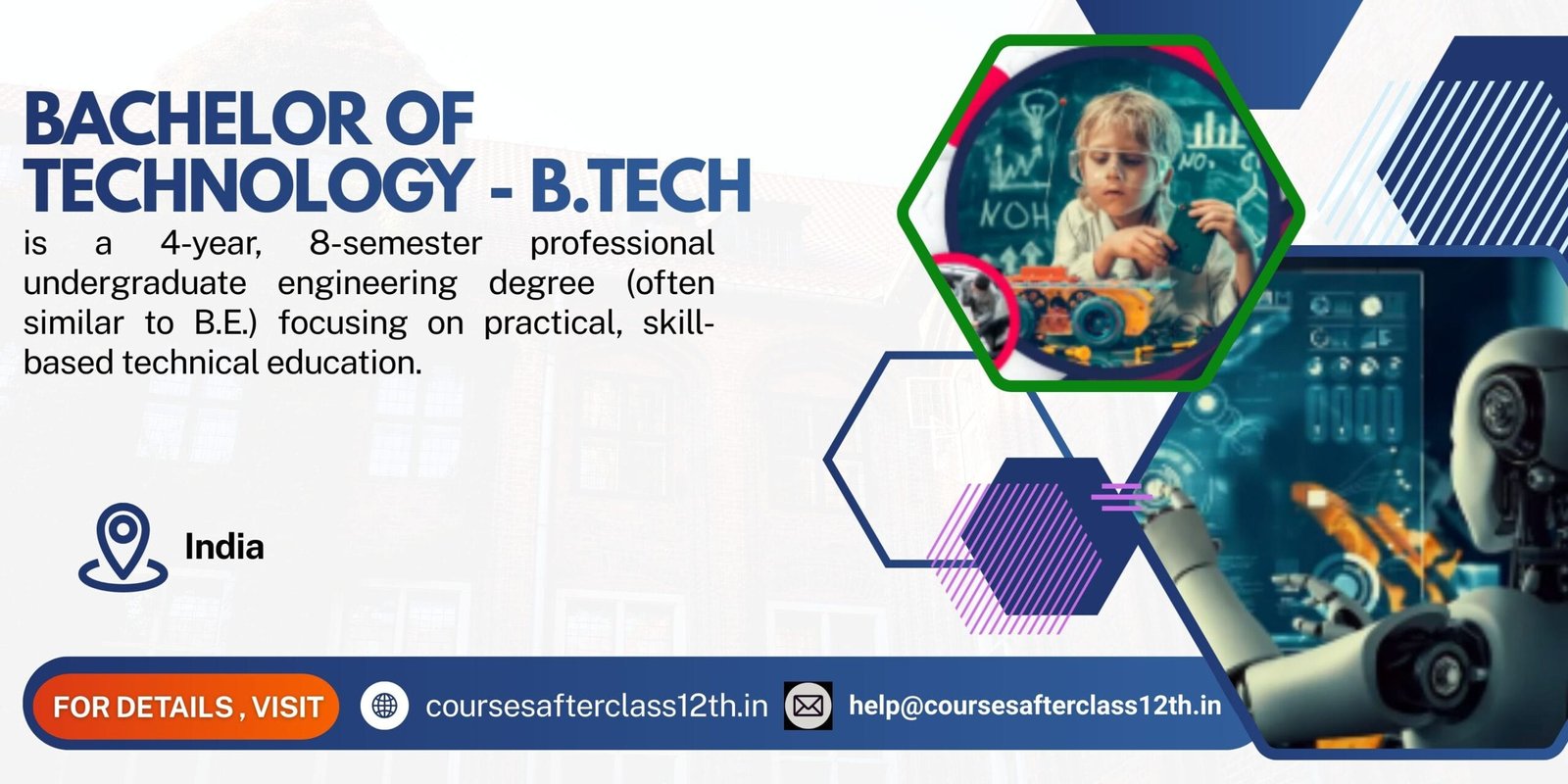
The Bachelor of Technology (B.Tech) is India’s most sought-after undergraduate engineering degree, designed to develop practical engineering skills, problem-solving ability, and industry readiness. With strong alignment to modern technology and applied learning, B.Tech is the preferred pathway for students aiming for careers in software, core engineering, product development, startups, and global tech firms.
B.Tech programs in India are offered under academic frameworks and quality norms prescribed by statutory bodies such as AICTE and UGC.
What Is B.Tech?
B.Tech is a 4-year undergraduate professional degree divided into 8 semesters, combining engineering fundamentals, laboratory training, design projects, and internships. Compared to traditional engineering programs, B.Tech places stronger emphasis on hands-on learning, industry exposure, and application-oriented curricula.
The degree is offered by IITs, NITs, IIITs, state universities, and private universities across India.
Key Highlights of B.Tech Course
| Particular | Details |
|---|---|
| Course Name | Bachelor of Technology (B.Tech) |
| Course Level | Undergraduate |
| Duration | 4 Years (8 Semesters) |
| Eligibility | 10+2 with Physics, Chemistry & Mathematics |
| Admission Mode | Entrance Exam Based |
| Governing Bodies | AICTE / UGC |
| Popular Branches | CSE, IT, Mechanical, Civil, ECE, Electrical |
| Career Scope | IT, Core Engineering, PSU, Higher Studies |
B.Tech Syllabus – Semester Wise (General Structure)
Important: Exact subjects vary by branch and university. Below is a standard semester-wise structure commonly followed.
1 Semester
- Engineering Mathematics I
- Engineering Physics
- Engineering Chemistry
- Basic Electrical / Electronics Engineering
- Engineering Graphics
- Physics / Chemistry Lab
2 Semester
- Engineering Mathematics II
- Programming in C / Python
- Engineering Mechanics
- Environmental Studies
- Programming Lab
3 Semester
- Engineering Mathematics III
- Core Branch Subject I
- Core Branch Subject II
- Digital Logic
- Core Lab I
4 Semester
- Core Branch Subject III
- Core Branch Subject IV
- Signals & Systems / Control Systems
- Core Lab II
5 Semester
- Advanced Core Subject I
- Advanced Core Subject II
- Open Elective
- Mini Project
6 Semester
- Professional Elective I
- Professional Elective II
- Internship / Industrial Training
7 Semester
- Advanced Elective
- Engineering Management / Ethics
- Major Project (Phase I)
8 Semester
- Major Project (Phase II)
- Seminar / Viva
Top B.Tech Colleges in India – State Wise
B.Tech programs are offered by central institutes, state universities, and reputed private universities. Below is a state-wise indicative list.
Delhi / NCR
- Indian Institute of Technology Delhi
- Delhi Technological University
- Netaji Subhas University of Technology
Maharashtra
- Indian Institute of Technology Bombay
- College of Engineering Pune (COEP)
- Veermata Jijabai Technological Institute (VJTI)
Tamil Nadu
- Indian Institute of Technology Madras
- Anna University affiliated colleges
- PSG College of Technology
Karnataka
- Indian Institute of Science (B.Tech programs)
- National Institute of Technology Surathkal
- RV College of Engineering
Uttar Pradesh
- Indian Institute of Technology Kanpur
- Indian Institute of Technology BHU
- Harcourt Butler Technical University
West Bengal
- Indian Institute of Technology Kharagpur
- Jadavpur University
- Kalyani Government Engineering College
Admission Channels
- JEE Main / JEE Advanced
- State engineering entrance exams
- University-level counseling
B.Tech vs B.E: Which Should You Choose?
| Factor | B.Tech | B.E |
|---|---|---|
| Curriculum Focus | Practical & industry-oriented | Theory-oriented |
| Preferred Institutes | IITs, NITs, IIITs, private universities | State & govt universities |
| Skill Exposure | Higher (projects, internships) | Moderate |
| Private Sector Hiring | Strong | Strong |
| Academic Equivalence | Yes | Yes |
Career After B.Tech
- Software Engineer
- Product / Systems Engineer
- Data Engineer
- Core Engineering Roles
- Startup & Entrepreneurship
Career After B.E
- Design Engineer
- PSU Engineer
- Research Assistant
- Higher Studies (M.E / M.Tech)
Advisory Insight:
B.Tech and B.E are academically equivalent degrees. Career success depends more on skills, internships, projects, and institution quality than on the degree title.
Courses After Class 12 – Engineering Pathways (B.Tech Focus)
Students completing Class 12 with PCM can explore the following paths:
Degree Courses
- B.Tech (all branches)
- B.E
- Integrated B.Tech + M.Tech
- B.Sc Engineering
Alternative Routes
- Polytechnic Diploma → Lateral Entry to B.Tech
- Applied Science & Technology Degrees
Career Mapping
| Goal | Recommended Path |
|---|---|
| IT & Software Jobs | B.Tech (CSE / IT) |
| Core Engineering | B.Tech → M.Tech |
| PSU Jobs | B.Tech → GATE |
| Management Roles | B.Tech → MBA |
| Research | B.Tech → M.Tech / PhD |
SEO Cluster Articles for coursesafterclass12th.in (B.Tech)
High-Intent Cluster Topics
- Is B.Tech good after Class 12?
- B.Tech branches and career scope
- B.Tech syllabus semester wise
- B.Tech vs B.E which is better?
- Best B.Tech colleges in India
- Government jobs after B.Tech
- B.Tech salary in India 2025
- What to do after B.Tech?
- B.Tech admission process explained
- B.Tech without JEE – is it possible?
Internal Linking Strategy
- Engineering hub → B.Tech, B.E, Diploma
- B.Tech main page → syllabus, colleges, comparison
- Career pages → GATE, PSU jobs, MBA
FAQ Section
B.Tech stands for Bachelor of Technology.
Both are equivalent. B.Tech focuses more on practical and industry-oriented learning.
Most colleges accept JEE Main / JEE Advanced or state engineering entrance exams.
Entry-level salaries typically range from ₹4–10 LPA, depending on branch and skills.
Yes. B.Tech graduates are eligible for PSUs, engineering services, and technical government posts.