
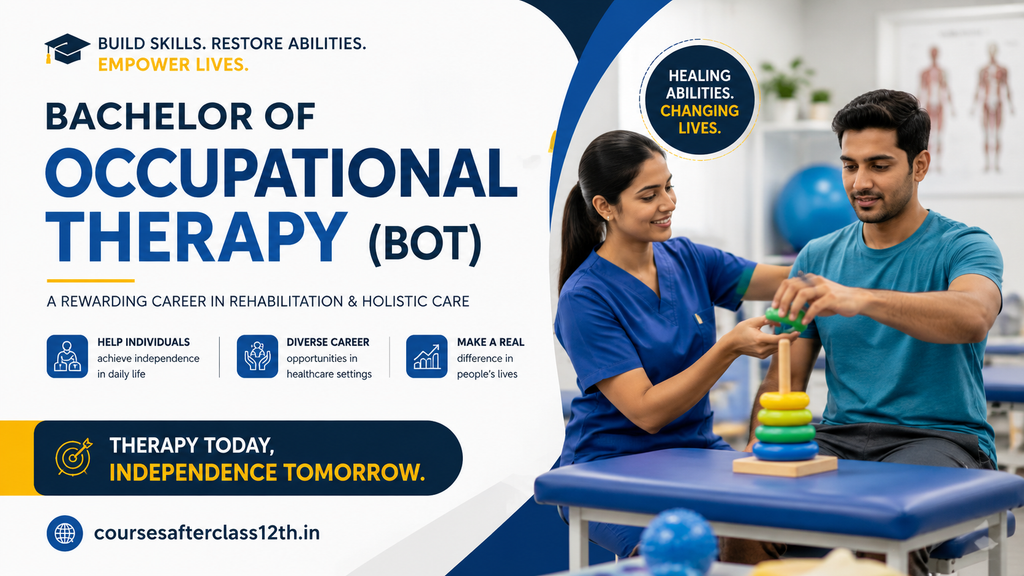
Bachelor of Occupational Therapy (BOT) is an undergraduate healthcare programme that focuses on helping people participate in daily activities, improve functional abilities and achieve greater independence after illness, injury, disability or other health-related challenges. The field combines knowledge of human anatomy, physiology, psychology, rehabilitation, activity analysis and therapeutic techniques.
For students who have completed Class 12 with Physics, Chemistry and Biology (PCB) and are interested in healthcare, rehabilitation, human behaviour, functional independence and patient care, becoming an occupational therapist after 12th can be a suitable undergraduate career option.
Occupational therapy is different from physiotherapy because its focus extends beyond physical movement. Occupational therapists consider how a person’s health condition affects everyday activities such as dressing, eating, writing, studying, working, communicating, playing and participating in society. Depending on the patient’s needs, occupational therapy may involve activity-based interventions, functional training, environmental modifications and assistive approaches.
The exact BOT eligibility, admission process, course duration, internship requirements, fees and professional requirements can vary according to the institution, university and applicable regulations. Students should therefore verify current information with the relevant college or authority before applying.
This guide explains Bachelor of Occupational Therapy after 12th, including eligibility, admission, entrance examinations, course duration, subjects, fees, practical training, internship, skills, career opportunities, government and private jobs, salary factors, higher studies, specialisations, technology and future scope.
Table of Contents
What Is Bachelor of Occupational Therapy?
Bachelor of Occupational Therapy, commonly called BOT, is an undergraduate healthcare programme focused on occupational therapy and rehabilitation.
Here, the word “occupation” refers to meaningful everyday activities rather than only employment. These activities can include personal care, education, household tasks, work, leisure, social participation and other activities that form part of a person’s daily life.
Occupational therapy aims to support people whose ability to perform these activities has been affected by illness, injury, disability, developmental conditions or other health-related circumstances.
Students therefore learn about both the human body and human activity.
The programme generally combines classroom education with laboratory work, practical training and clinical exposure.
Bachelor of Occupational Therapy After 12th
Students interested in healthcare and rehabilitation can consider a Bachelor of Occupational Therapy after 12th.
A science background with Biology can provide useful preparation because students study anatomy, physiology and other health-science subjects during the programme.
Students who are interested in building a career in occupational therapy may enjoy:
- Biology
- Human anatomy
- Psychology
- Rehabilitation
- Child development
- Disability support
- Human activities
- Patient care
- Healthcare
- Functional independence
However, occupational therapy is a patient-oriented profession. Therefore, students should be comfortable communicating with different types of patients and working as part of a healthcare team.
Why Choose Bachelor of Occupational Therapy After 12th?
Occupational therapy has applications across different stages of life.
An occupational therapist may work with:
- Children with developmental challenges
- Adults recovering from injuries
- Patients recovering from neurological conditions
- People with physical disabilities
- Older adults
- Individuals requiring rehabilitation after illness
- People experiencing difficulties with everyday activities
The profession can therefore provide exposure to a wide range of healthcare and rehabilitation situations.
Students should nevertheless select BOT because they are interested in occupational therapy and rehabilitation rather than choosing the programme solely because they expect a particular salary or job outcome.
BOT Course Overview
| Particular | Details |
|---|---|
| Full form | Bachelor of Occupational Therapy |
| Abbreviation | BOT |
| Level | Undergraduate |
| Field | Occupational therapy and rehabilitation |
| Common eligibility | Class 12 with required science subjects |
| Core science subjects | Physics, Chemistry and Biology |
| Learning pattern | Theory, practical and clinical education |
| Internship | As prescribed by the institution/applicable requirements |
| Work areas | Hospitals, rehabilitation centres, clinics, schools and community settings |
| Higher studies | Postgraduate and specialised programmes |
BOT Eligibility After 12th
The eligibility requirements for BOT can differ between institutions.
Generally, students need to complete Class 12 or an equivalent examination with the prescribed subjects.
Physics, Chemistry and Biology are commonly relevant for healthcare-related undergraduate programmes, but students should check the exact requirements of the institution they wish to join.
Some colleges may specify:
- Minimum qualifying marks
- Required subjects
- Age criteria
- Entrance examination requirements
- Medical fitness requirements
- State-specific conditions
General BOT Eligibility
| Requirement | General Information |
|---|---|
| Educational qualification | Class 12 or equivalent |
| Stream | Science |
| Common subjects | Physics, Chemistry and Biology |
| Programme level | Undergraduate |
| Entrance test | Institution/state dependent |
| Minimum marks | Institution-specific |
| Other conditions | As prescribed by the admission authority |
Students should always refer to the latest admission notification before submitting an application.
Is NEET Required for Bachelor of Occupational Therapy?
Students should not assume that the admission process for every occupational therapy programme is identical.
NEET requirements can vary depending on the institution, state and applicable admission rules.
Some institutions may use an entrance examination, while others may use qualifying examination marks or another admission mechanism.
Before applying, students should check:
- Whether NEET is required.
- Whether a state-level entrance examination applies.
- Whether the university conducts its own test.
- Whether admission is merit-based.
- Whether counselling is required.
- Whether additional eligibility conditions apply.
The latest official admission notification should be treated as the final source for admission requirements.
BOT Admission Process
The admission process can differ between universities and colleges.
A typical process may involve several stages.
1. Complete Class 12
Students should complete the required senior-secondary education.
2. Check eligibility
Review the college’s current eligibility requirements.
3. Submit the application
Apply through the prescribed admission portal or process.
4. Appear for an entrance examination
This step applies where an entrance test is required.
5. Check merit or examination results
Candidates can check their qualifying status.
6. Participate in counselling
Where applicable, students may participate in counselling and select institutions.
7. Complete document verification
Academic and identity documents are verified.
8. Pay the required fees
Selected candidates complete the admission process by paying applicable fees.
Because procedures can change, students should verify the latest admission instructions.
BOT Course Duration
The exact BOT course duration can vary by institution and curriculum.
Many Bachelor of Occupational Therapy programmes are structured around four years of academic education followed by practical or internship training, although the exact structure and duration should be confirmed with the institution.
Clinical learning is an important component of occupational therapy education.
BOT Duration
| Component | General Information |
|---|---|
| Academic education | Often around four years |
| Practical education | Included |
| Clinical exposure | Included |
| Internship | As prescribed by the programme |
| Total duration | Institution-specific |
Students should check the current university curriculum for the precise duration.
BOT Course Structure
The BOT curriculum combines basic medical sciences with occupational therapy and rehabilitation subjects.
Students may study:
- Anatomy
- Physiology
- Biochemistry
- Psychology
- Sociology
- Pathology
- Pharmacology
- Biomechanics
- Human development
- Occupational therapy fundamentals
- Activity analysis
- Therapeutic activities
- Rehabilitation
- Neurology
- Orthopaedics
- Paediatrics
- Mental health
- Community-based rehabilitation
- Research methodology
The precise subject list differs between universities.
Bachelor of Occupational Therapy Subjects
| Subject | Main Focus |
|---|---|
| Anatomy | Structure of the human body |
| Physiology | Functions of body systems |
| Biochemistry | Chemical processes in the body |
| Psychology | Human behaviour and mental processes |
| Sociology | Individuals and society |
| Pathology | Disease processes |
| Pharmacology | Medicines and their effects |
| Biomechanics | Movement and physical principles |
| Occupational Therapy | Principles and practice of OT |
| Activity Analysis | Understanding activities and their therapeutic use |
| Rehabilitation | Functional recovery and participation |
| Neurology | Neurological conditions |
| Orthopaedics | Musculoskeletal conditions |
| Paediatrics | Child development and rehabilitation |
| Mental Health | Occupational therapy in mental health |
| Community Rehabilitation | Rehabilitation in community settings |
| Research Methodology | Research and evidence evaluation |
Anatomy in Occupational Therapy
Anatomy provides a foundation for understanding the human body.
BOT students study structures such as:
- Bones
- Muscles
- Joints
- Nerves
- Organs
- Connective tissues
Knowledge of anatomy helps students understand how physical conditions can affect movement and daily activities.
This foundation becomes particularly useful when studying rehabilitation and occupational therapy interventions.
Physiology in BOT
Physiology focuses on the normal functioning of the human body.
Students learn about systems such as:
- Nervous system
- Musculoskeletal system
- Cardiovascular system
- Respiratory system
- Digestive system
Understanding normal body function helps students recognise how illness or injury can influence functional abilities.
Psychology in Occupational Therapy
Psychology can be particularly relevant to occupational therapy because human behaviour, motivation and emotional well-being can influence participation in everyday activities.
Students may study:
- Human behaviour
- Development
- Learning
- Motivation
- Psychological conditions
- Social interaction
This knowledge can support communication and patient-centred approaches.
Activity Analysis in BOT
Activity analysis is an important concept in occupational therapy.
Students learn to examine activities according to their physical, cognitive, emotional and environmental demands.
For example, preparing a meal may require:
- Standing
- Hand coordination
- Memory
- Sequencing
- Attention
- Safe handling of objects
An occupational therapist can analyse such activities to understand where a person may experience difficulty.
This helps inform appropriate rehabilitation planning.
Therapeutic Activities
Occupational therapy may use meaningful activities as part of rehabilitation.
Depending on the individual’s condition and professional assessment, activities may support:
- Motor skills
- Coordination
- Cognitive abilities
- Functional independence
- Social participation
- Daily living skills
The selected activity should be appropriate to the person’s needs and rehabilitation goals.
Activities of Daily Living
One important area of occupational therapy is activities of daily living (ADLs).
These can include:
- Eating
- Dressing
- Bathing
- Grooming
- Toileting
- Mobility
- Personal care
Occupational therapy may help people develop or regain skills required for greater independence.
Instrumental Activities of Daily Living
Occupational therapy can also consider more complex everyday activities, commonly referred to as instrumental activities of daily living.
Examples include:
- Cooking
- Shopping
- Managing household activities
- Using transportation
- Managing routines
- Handling certain daily responsibilities
These activities are particularly relevant when rehabilitation focuses on independent living.
Neurological Occupational Therapy
Neurological rehabilitation is an important area of occupational therapy.
Occupational therapists may work with individuals affected by conditions involving the nervous system.
Examples can include:
- Stroke
- Traumatic brain injury
- Spinal cord conditions
- Neurological disorders
- Movement-related difficulties
The rehabilitation process may focus on improving functional participation and adapting activities according to individual needs.
Paediatric Occupational Therapy
Paediatric occupational therapy focuses on children.
Children may require occupational therapy support for various developmental, physical, sensory, behavioural or functional challenges.
Areas may include:
- Fine motor skills
- School activities
- Handwriting
- Self-care
- Play
- Coordination
- Sensory-related difficulties
Occupational therapists may work with children, parents, teachers and other healthcare professionals.
Mental Health Occupational Therapy
Occupational therapy can also have applications in mental health.
Occupational therapists may support people experiencing difficulties that affect:
- Daily routines
- Social participation
- Work
- Education
- Self-care
- Meaningful activities
Mental health occupational therapy can involve structured activities and participation-focused approaches.
Geriatric Occupational Therapy
Older adults can experience changes in mobility, cognition, strength and independence.
Occupational therapy can support older adults in maintaining participation in meaningful daily activities.
Areas may include:
- Self-care
- Home safety
- Mobility
- Daily routines
- Cognitive activities
- Environmental modifications
- Independent living
As populations age, rehabilitation and functional-support services can become increasingly important.
Orthopaedic Occupational Therapy
Occupational therapists may work with people experiencing musculoskeletal or orthopaedic problems.
Rehabilitation can focus on functional activities following:
- Injury
- Surgery
- Fracture
- Hand problems
- Upper-limb conditions
The goal may be to help individuals return to meaningful daily activities while following appropriate clinical guidance.
Hand Therapy
Hand function is important for many daily activities.
Occupational therapists with relevant specialised training may work in areas involving:
- Hand injuries
- Fine motor skills
- Upper-limb rehabilitation
- Functional hand use
- Post-surgical rehabilitation
Specialised hand therapy may require additional education and clinical experience.
Sensory Integration and Occupational Therapy
Some occupational therapy settings involve sensory-related interventions, particularly in paediatric practice.
Students may learn about how sensory processing can relate to:
- Movement
- Attention
- Participation
- Behaviour
- Daily activities
Clinical application should be based on appropriate assessment and professional practice.
Community-Based Occupational Therapy
Occupational therapy is not limited to hospitals.
Professionals may work in:
- Community rehabilitation
- Schools
- Elder-care facilities
- Non-governmental organisations
- Rehabilitation centres
- Home-care settings
Community-based occupational therapy can focus on improving participation and independence in real-world environments.
Occupational Therapy in Schools
Children spend a significant amount of time in educational environments.
Occupational therapists may support school participation in areas such as:
- Classroom activities
- Handwriting
- Fine motor skills
- Self-care
- Accessibility
- Assistive strategies
They may work with teachers, families and other professionals where appropriate.
Occupational Therapy in Rehabilitation Centres
Rehabilitation centres can provide opportunities for occupational therapists to work with people recovering from different conditions.
The work can involve:
- Functional assessment
- Activity-based rehabilitation
- Daily living skills
- Assistive strategies
- Patient education
- Family education
Multidisciplinary teamwork is often important in rehabilitation.
Clinical Training in BOT
Clinical training allows students to apply classroom concepts in practical environments.
Students can develop experience in:
- Patient interaction
- Functional assessment
- Activity analysis
- Documentation
- Communication
- Professional ethics
- Rehabilitation planning
- Teamwork
The quality of clinical exposure can vary between institutions.
Therefore, students should investigate hospital affiliations and clinical facilities before selecting a college.
BOT Internship
Internship provides an opportunity for students to gain supervised practical experience.
Depending on the programme, students may rotate through areas such as:
- Orthopaedics
- Neurology
- Paediatrics
- Mental health
- Rehabilitation
- Community-based care
Internship can help students understand how occupational therapy knowledge is applied in professional environments.
The exact internship structure should be confirmed with the institution.
BOT Fees in India
There is no single fee applicable to all Bachelor of Occupational Therapy colleges.
Fees depend on factors such as:
- Institution type
- University
- Location
- Facilities
- Hostel
- Clinical infrastructure
- Other institutional charges
BOT Fee Components
| Expense | Possible Component |
|---|---|
| Tuition | Academic education |
| Examination | Examination-related charges |
| Laboratory | Practical education |
| Clinical training | Where applicable |
| Hostel | Accommodation |
| Library | Academic resources |
| Miscellaneous | Other institutional expenses |
Students should obtain the latest official fee structure before taking admission.
Government vs Private BOT Colleges
| Factor | Government College | Private College |
|---|---|---|
| Fees | Often comparatively lower | Can be higher |
| Competition | May be higher | Varies |
| Admission | May involve central/state processes | Institution-specific |
| Infrastructure | Varies | Varies |
| Clinical exposure | Depends on affiliation | Depends on affiliation |
| Hostel | Depends on institution | Depends on institution |
A government institution is not automatically better in every aspect, and a private college is not automatically inferior.
Students should compare actual facilities, recognition, faculty and clinical exposure.
How to Choose the Best BOT College
Students should evaluate more than college advertisements.
1. Recognition and regulatory status
Check the current status of the programme and institution.
2. Faculty
Review faculty qualifications and experience.
3. Clinical affiliation
Find out which hospitals or rehabilitation centres provide clinical exposure.
4. Patient exposure
Practical experience is important for developing clinical competence.
5. Infrastructure
Check laboratories, classrooms, libraries and therapy facilities.
6. Internship
Understand the internship structure and placement location.
7. Fees
Compare the complete cost of education.
8. Location
Consider accommodation and transportation.
Skills Required for Occupational Therapy
A successful occupational therapist needs both technical and interpersonal abilities.
Students should develop:
- Communication
- Observation
- Empathy
- Clinical reasoning
- Activity analysis
- Patient handling
- Documentation
- Teamwork
- Problem-solving
- Time management
- Digital literacy
- Research skills
Because occupational therapy often involves long-term rehabilitation, patience and effective communication can be particularly valuable.
Career Options After BOT
BOT graduates can explore different career environments, subject to applicable professional requirements.
| Career Area | Possible Work |
|---|---|
| Hospitals | Occupational therapy and rehabilitation |
| Rehabilitation centres | Functional rehabilitation |
| Clinics | Patient assessment and therapy |
| Schools | Child-focused occupational therapy |
| Mental health settings | Participation and routine-based support |
| Community programmes | Community rehabilitation |
| Home healthcare | Home-based services |
| Research | Healthcare and rehabilitation research |
| Teaching | Academic roles with appropriate qualifications |
| Entrepreneurship | Professional practice where permitted |
Government Jobs After BOT
Government healthcare organisations may recruit occupational therapists when vacancies are available.
Potential workplaces can include:
- Government hospitals
- Rehabilitation centres
- Medical colleges
- Public healthcare programmes
- Community rehabilitation services
- Government institutions
Recruitment conditions can include:
- Educational qualification
- Registration where applicable
- Age limits
- Experience
- Examination
- Interview
- Other department-specific conditions
Students should monitor official recruitment notifications because vacancies and eligibility conditions change.
Private Jobs After BOT
Private-sector opportunities can exist in:
- Hospitals
- Rehabilitation centres
- Special education centres
- Paediatric centres
- Mental health settings
- Private clinics
- Home healthcare
- Community organisations
Fresh graduates may initially work in entry-level roles before developing specialised experience.
Career progression depends on professional skills, experience, location, employer and additional qualifications.
Occupational Therapy in Paediatric Settings
Paediatric occupational therapy can provide career opportunities for professionals interested in working with children.
Work may involve children with difficulties affecting:
- Fine motor skills
- Self-care
- School participation
- Coordination
- Sensory processing
- Daily routines
Professionals may work with families and educational teams to support participation.
Occupational Therapy in Mental Healthcare
Occupational therapy can contribute to mental-health rehabilitation by focusing on meaningful activities and daily participation.
Professionals may help individuals establish:
- Daily routines
- Social participation
- Self-care
- Work-related activities
- Leisure activities
The exact responsibilities depend on the clinical setting and professional role.
Occupational Therapy and Disability Rehabilitation
Occupational therapy can play a role in disability rehabilitation.
The focus may include:
- Functional independence
- Assistive devices
- Activity adaptation
- Environmental modification
- Self-care
- Community participation
The approach is generally centred on the person’s functional goals and participation.
Occupational Therapy and Assistive Technology
Technology can support occupational therapy in several ways.
Examples include:
- Adaptive equipment
- Communication technologies
- Mobility aids
- Digital assessment tools
- Environmental-control systems
- Computer-based accessibility tools
Assistive technology can help individuals perform activities more independently when appropriately selected.
Occupational Therapy and Technology
Digital technology is increasingly becoming part of healthcare and rehabilitation.
Occupational therapists may encounter:
- Electronic health records
- Tele-rehabilitation
- Digital assessment
- Wearable devices
- Assistive technologies
- Virtual rehabilitation tools
Technology can support clinical practice, but professional judgement remains important.
Tele-Occupational Therapy
Telehealth can allow certain occupational therapy services to be delivered remotely.
It may be useful for selected patients who have difficulty travelling.
However, remote services may not be suitable for every patient or every assessment.
Professionals need to consider:
- Patient safety
- Privacy
- Clinical suitability
- Digital accessibility
- Professional requirements
- Need for physical assessment
Applicable professional and legal requirements should always be followed.
Bachelors in Occupational Therapy and Research
Research is important for improving rehabilitation practice.
Students can explore topics such as:
- Functional rehabilitation
- Paediatric therapy
- Neurological rehabilitation
- Mental health
- Disability
- Assistive technology
- Ageing
- Community rehabilitation
- Occupational performance
Research-oriented students should develop skills in:
- Literature review
- Research methodology
- Data interpretation
- Scientific writing
- Critical evaluation
Evidence-Based Occupational Therapy
Modern healthcare increasingly emphasises evidence-informed practice.
Occupational therapists should consider appropriate scientific evidence together with professional expertise and individual patient needs.
Students should learn to:
- Search research literature
- Evaluate study quality
- Understand research methods
- Interpret findings
- Apply evidence appropriately
This approach can support responsible clinical decision-making.
Higher Studies After BOT
Students who want advanced knowledge can explore postgraduate education after completing BOT.
Depending on eligibility and institution, postgraduate opportunities may include master’s-level programmes in occupational therapy or related rehabilitation areas.
Possible areas can include:
- Paediatrics
- Neurology
- Mental health
- Rehabilitation
- Hand therapy
- Community health
- Geriatrics
Students should check the eligibility requirements of individual postgraduate programmes.
Teaching After BOT
Graduates interested in education can pursue academic careers after obtaining the qualifications required for the relevant teaching position.
Academic roles may involve:
- Classroom teaching
- Practical demonstrations
- Student supervision
- Research
- Academic administration
Higher qualifications can be important for career progression in higher education.
Research Career After BOT
Students interested in research can pursue opportunities in:
- Universities
- Rehabilitation institutions
- Healthcare organisations
- Research projects
- Academic institutions
Advanced qualifications may improve access to research-oriented positions.
Entrepreneurship After BOT
Occupational therapy can also offer entrepreneurship opportunities where professional practice is legally permitted.
A professional may establish or participate in services such as:
- Occupational therapy clinics
- Paediatric therapy centres
- Rehabilitation services
- Home-based therapy services
- Community rehabilitation programmes
Running a service requires more than clinical knowledge.
Professionals also need to understand:
- Business management
- Documentation
- Patient communication
- Scheduling
- Professional ethics
- Applicable regulations
- Financial management
BOT Salary in India
There is no fixed salary for every Bachelor of Occupational Therapy graduate.
Salary can vary according to:
- Experience
- Employer
- Location
- Clinical setting
- Specialisation
- Additional qualifications
- Skills
- Job responsibilities
A fresh graduate may receive a different salary from an experienced occupational therapist working in a specialised clinical setting.
Similarly, private practice income can vary significantly depending on patient volume, location, services and operating costs.
Students should compare reliable salary information by distinguishing between starting salary, average salary, median salary and maximum reported package.
Factors Affecting BOT Salary
| Factor | Possible Impact |
|---|---|
| Experience | Can improve professional opportunities |
| Location | Demand and salaries vary |
| Employer | Organisations use different pay structures |
| Specialisation | Advanced expertise may create specialised opportunities |
| Qualifications | Higher education may support career progression |
| Clinical skills | Competence influences employability |
| Private practice | Income depends on practice performance |
| Communication | Important in patient-facing roles |
Is Bachelor of Occupational Therapy a Good Career?
Bachelor of Occupational Therapy can be a suitable career choice for students who are interested in healthcare, rehabilitation, human behaviour and helping people become more independent in daily life.
The field is particularly relevant to students who enjoy working directly with patients and are interested in combining healthcare knowledge with meaningful activities.
However, students should understand that occupational therapy involves clinical education, patient interaction and continuous professional development.
Before choosing BOT, students should compare it with related programmes such as:
- Bachelor of Physiotherapy
- Bachelor of Nursing
- Bachelor of Occupational Therapy
- Bachelor of Dental Surgery
- BAMS
- BHMS
- BUMS
- Other healthcare programmes
The best choice depends on the student’s interests, academic strengths and long-term career goals.
BOT vs BPT
| Factor | BOT | BPT |
|---|---|---|
| Full form | Bachelor of Occupational Therapy | Bachelor of Physiotherapy |
| Main focus | Daily activities, participation and functional independence | Movement and physical rehabilitation |
| Rehabilitation | Yes | Yes |
| Patient interaction | High | High |
| Paediatric work | Yes | Yes |
| Neurological care | Yes | Yes |
| Sports | Less central | Major potential area |
| Daily living skills | Major focus | Can be addressed as part of rehabilitation |
| Higher studies | Master’s and specialised programmes | MPT and related programmes |
The two professions overlap in rehabilitation but have different primary areas of focus.
BOT vs BAMS
| Factor | BOT | BAMS |
|---|---|---|
| Main field | Occupational therapy | Ayurveda |
| Primary focus | Functional participation and rehabilitation | Ayurvedic medicine |
| Clinical training | Yes | Yes |
| Healthcare interaction | Yes | Yes |
| Career areas | Rehabilitation, hospitals, clinics, schools | Clinics, hospitals and Ayurveda-related settings |
| Higher studies | Postgraduate OT/related fields | Postgraduate Ayurveda programmes |
BOT vs BHMS
| Factor | BOT | BHMS |
|---|---|---|
| Main field | Occupational therapy | Homoeopathic medicine |
| Focus | Rehabilitation and functional independence | Homoeopathic healthcare |
| Practical education | Yes | Yes |
| Career settings | Hospitals, clinics, rehabilitation and schools | Clinics, hospitals and healthcare settings |
| Higher education | Postgraduate OT/related fields | Postgraduate homoeopathic programmes |
Bachelor of Occupational Therapy vs BUMS
| Factor | BOT | BUMS |
|---|---|---|
| Main field | Occupational therapy | Unani medicine |
| Focus | Functional rehabilitation | Unani healthcare |
| Clinical training | Yes | Yes |
| Career settings | Rehabilitation, hospitals, clinics and community care | Clinics, hospitals and related healthcare settings |
| Higher education | Postgraduate OT/related programmes | Postgraduate Unani programmes |
Documents Required for BOT Admission
The required documents vary by institution.
Common documents can include:
- Class 10 certificate
- Class 12 certificate
- Identity proof
- Passport photographs
- Entrance examination result, where applicable
- Category certificate, where applicable
- Domicile certificate, where required
- Migration certificate, where required
- Medical certificate, where required
- Other institution-specific documents
Students should obtain the official document checklist before admission.
How to Prepare for BOT Admission
If the relevant admission process includes an entrance examination, students should prepare according to the official syllabus.
Biology
Revise fundamental concepts of human biology and life sciences.
Physics
Develop conceptual understanding and practise numerical questions where applicable.
Chemistry
Revise core concepts and practise examination questions.
General preparation
Students can also:
- Review previous papers
- Take mock tests
- Create a revision schedule
- Analyse mistakes
- Practise time management
Preparation should always follow the examination requirements of the relevant admission authority.
Advantages of Bachelor of Occupational Therapy
1. Healthcare career
BOT provides a professional pathway into occupational therapy and rehabilitation.
2. Multiple work settings
Graduates may work in hospitals, clinics, schools, rehabilitation centres and community settings.
3. Diverse patient groups
Occupational therapists can work with children, adults and older people.
4. Specialisation opportunities
Postgraduate education can allow students to develop expertise in selected areas.
5. Rehabilitation-focused work
The profession focuses strongly on functional independence and participation.
6. Research opportunities
Graduates can explore research and academic pathways with suitable qualifications.
7. Entrepreneurship
Professional practice may provide opportunities for independent services where permitted.
Challenges of Bachelor of Occupational Therapy
Students should also understand the challenges associated with the profession.
Occupational therapy can involve:
- Regular patient interaction
- Physically demanding activities
- Emotional challenges
- Long clinical hours
- Documentation
- Continuous learning
- Competition for desirable positions
- Need for specialised skills
Therefore, students should select BOT after understanding the actual nature of the profession.
Future Scope of Bachelor of Occupational Therapy
The future scope of occupational therapy is influenced by rehabilitation needs, disability care, ageing populations, paediatric services, mental-health awareness and developments in healthcare technology.
Potential areas include:
- Hospital rehabilitation
- Paediatric occupational therapy
- Neurological rehabilitation
- Mental health
- Geriatric care
- Disability rehabilitation
- Community healthcare
- Home healthcare
- School-based services
- Assistive technology
- Research
- Teaching
- Private practice
The profession may also be influenced by digital healthcare, tele-rehabilitation and technology-assisted rehabilitation.
Strong career development generally requires a combination of recognised education, clinical exposure, communication skills, specialised knowledge and continuing professional development.
What Should Students Check Before Taking BOT Admission?
Before selecting a college, students should verify:
- Current institutional recognition.
- Programme status.
- Eligibility criteria.
- Admission route.
- Entrance examination requirements.
- Course duration.
- Tuition fees.
- Hostel expenses.
- Faculty qualifications.
- Laboratory facilities.
- Clinical affiliations.
- Patient exposure.
- Internship structure.
- Higher-study opportunities.
- Location and living costs.
Students should rely on current official information instead of outdated admission websites.
BOT Course Quick Summary
| Particular | Details |
|---|---|
| Course | Bachelor of Occupational Therapy |
| Short name | BOT |
| Level | Undergraduate |
| Field | Occupational therapy and rehabilitation |
| Common stream | PCB |
| Admission | Institution/state-specific |
| Duration | Institution-specific; commonly structured around four academic years plus practical/internship training |
| Core subjects | Anatomy, physiology, psychology, occupational therapy, activity analysis and rehabilitation |
| Practical training | Yes |
| Internship | As prescribed by the programme |
| Career areas | Hospitals, clinics, schools, rehabilitation and community settings |
| Higher studies | Master’s and specialised programmes |
| Salary | Depends on experience, employer, location and skills |
Frequently Asked Questions About Bachelor of Occupational Therapy
What is Bachelor of Occupational Therapy?
Bachelor of Occupational Therapy, or BOT, is an undergraduate healthcare programme focused on occupational therapy, rehabilitation, functional independence and participation in everyday activities.
Can I pursue Bachelor of Occupational Therapy after Class 12?
Yes. Students who meet the applicable eligibility requirements can pursue BOT after Class 12.
Which stream is required for BOT?
Science students with Physics, Chemistry and Biology are commonly eligible, although exact requirements depend on the institution.
Is NEET required for Bachelor of Occupational Therapy?
NEET requirements can vary by institution and state. Students should check the latest official admission notification for their chosen college.
What is the duration of BOT?
The exact duration varies by institution. Many programmes are structured around four years of academic education followed by practical or internship training.
What are the main BOT subjects?
Subjects can include anatomy, physiology, psychology, biochemistry, pathology, biomechanics, occupational therapy, activity analysis, rehabilitation, neurology, orthopaedics, paediatrics and mental health.
Is occupational therapy the same as physiotherapy?
No. Both are rehabilitation professions, but their primary focus differs. Physiotherapy focuses strongly on movement and physical rehabilitation, while occupational therapy focuses on participation in meaningful daily activities and functional independence.
Can BOT graduates work in hospitals?
Yes. Eligible occupational therapists can work in hospitals and rehabilitation settings, subject to applicable professional requirements.
Can BOT graduates work with children?
Yes. Paediatric occupational therapy is an important area in which professionals can work with children and families.
Can BOT graduates work in schools?
Occupational therapists may work in school-based settings where such services are available and permitted.
Can BOT graduates work in mental health?
Yes. Occupational therapy has applications in mental-health rehabilitation and participation-focused care.
What are the career options after BOT?
Career areas can include hospitals, rehabilitation centres, clinics, schools, community programmes, home healthcare, research and teaching.
What is the salary after BOT?
There is no fixed salary for all BOT graduates. Earnings depend on experience, location, employer, specialisation, qualifications and professional skills.
Can BOT graduates pursue higher studies?
Yes. Graduates can explore postgraduate and specialised programmes according to their eligibility and career goals.
Can a BOT graduate open a clinic?
Professional practice may be possible subject to applicable registration, legal, regulatory and institutional requirements.
Is BOT a good career after 12th?
BOT can be a suitable career for students interested in healthcare, rehabilitation, daily living activities, disability support and patient care.
What is the future scope of occupational therapy?
Future opportunities can exist in hospitals, rehabilitation, paediatric care, mental health, geriatric care, community healthcare, assistive technology, research, teaching and private practice.