
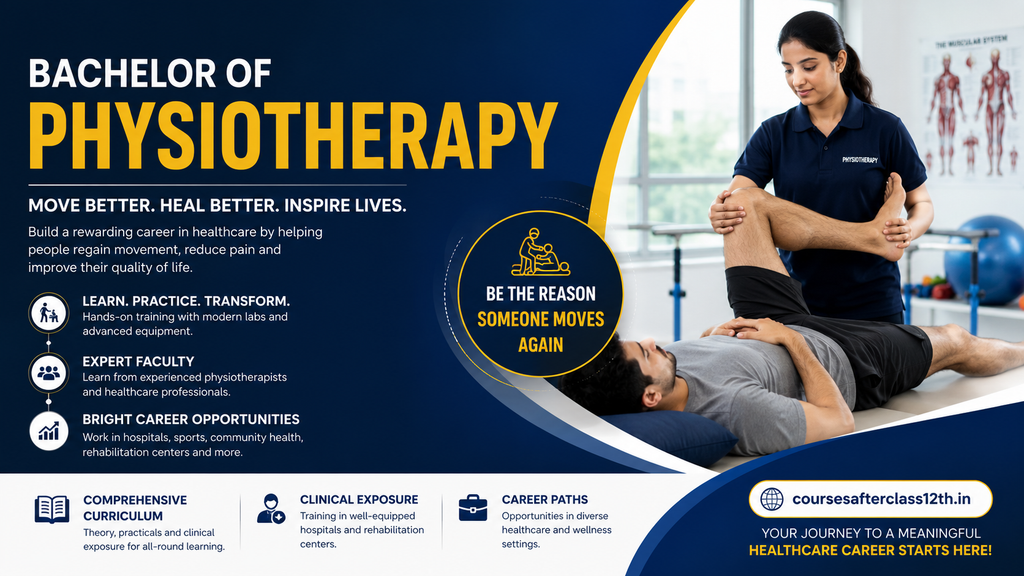
Bachelor of Physiotherapy (BPT) is an undergraduate healthcare programme that focuses on human movement, physical rehabilitation, exercise therapy, therapeutic techniques, musculoskeletal health, neurological rehabilitation, cardiopulmonary rehabilitation and functional recovery. The programme combines theoretical knowledge with practical and clinical education to help students understand how physical therapy can support patients with movement and functional difficulties.
For students who have completed Class 12 with Physics, Chemistry and Biology (PCB) and are interested in healthcare, rehabilitation, exercise, human anatomy and patient care, Bachelor of Physiotherapy after 12th can be a suitable undergraduate career pathway.
Physiotherapy is relevant across hospitals, rehabilitation centres, clinics, sports settings, community healthcare and other healthcare environments. Physiotherapists may work with patients recovering from injuries, surgery, neurological conditions, musculoskeletal problems and other conditions that affect movement and physical function.
The exact eligibility criteria, admission process, course duration, internship requirements, fees and professional registration rules can vary according to the institution, state and applicable regulations. Students should therefore verify current requirements before applying.
This guide explains Bachelor of Physiotherapy after 12th, including eligibility, entrance examinations, admission process, course duration, subjects, fees, practical training, internship, skills, career options, government jobs, private-sector opportunities, salary factors, higher studies, specialisations, research, technology and future scope.
Table of Contents
What Is Bachelor of Physiotherapy?
Bachelor of Physiotherapy, commonly abbreviated as BPT, is an undergraduate professional healthcare programme focused on physical rehabilitation and human movement.
The programme introduces students to subjects such as anatomy, physiology, biomechanics, exercise therapy, electrotherapy, pathology, pharmacology, orthopaedics, neurology, cardiopulmonary physiotherapy and rehabilitation.
Students learn how physical assessment and therapeutic interventions can be used within the professional scope of physiotherapy to support mobility, function and rehabilitation.
Unlike programmes that focus mainly on medicines or laboratory science, physiotherapy education places considerable emphasis on movement, physical function, rehabilitation and patient participation.
As a result, become physiotherapist students require both scientific knowledge and practical skills.
Bachelor of Physiotherapy After 12th
Students who have completed Class 12 with the required science subjects can consider Bachelor of Physiotherapy after 12th as a healthcare career option.
Biology is particularly useful because physiotherapy students study the human body’s structure and function.
Students interested in BPT may have an interest in:
- Human anatomy
- Biology
- Exercise
- Rehabilitation
- Sports
- Healthcare
- Patient interaction
- Physical recovery
- Human movement
- Clinical practice
However, students should understand that physiotherapy is a patient-facing healthcare profession.
Therefore, the course requires communication skills, practical learning, professional behaviour and the ability to work with patients over a period of rehabilitation.
Why Choose Bachelor of Physiotherapy After 12th?
BPT can be considered by students who want to work in rehabilitation and movement-related healthcare.
Physiotherapy has applications in several areas, including:
- Orthopaedics
- Sports rehabilitation
- Neurological rehabilitation
- Cardiopulmonary care
- Paediatric rehabilitation
- Geriatric care
- Post-operative rehabilitation
- Musculoskeletal care
- Community rehabilitation
The profession can offer opportunities across hospitals, clinics, rehabilitation centres, sports organisations and other healthcare settings.
However, students should not select BPT solely because they expect high salaries or easy employment. Career outcomes can depend on education, clinical skills, experience, location, specialisation and demand.
Bachelor of Physiotherapy Course Overview
| Feature | Details |
|---|---|
| Full form | Bachelor of Physiotherapy |
| Abbreviation | BPT |
| Level | Undergraduate |
| Field | Physiotherapy and rehabilitation |
| Eligibility | Class 12 with required science subjects |
| Core subjects | Physics, Chemistry and Biology |
| Learning | Theory, practical and clinical education |
| Internship | As prescribed by applicable requirements |
| Career areas | Hospitals, clinics, rehabilitation, sports and community care |
| Higher studies | Master’s and other advanced programmes |
Bachelor of Physiotherapy Eligibility After 12th
Eligibility requirements vary according to the institution and applicable admission regulations.
Generally, candidates need to complete Class 12 or an equivalent examination with the prescribed science subjects.
Physics, Chemistry and Biology are commonly required or relevant for BPT admissions.
Some institutions may have specific minimum marks, age requirements, entrance examinations or other admission conditions.
General Bachelor of Physiotherapy Eligibility
| Requirement | General information |
|---|---|
| Educational qualification | Class 12 or equivalent |
| Stream | Science |
| Common subjects | Physics, Chemistry and Biology |
| Course level | Undergraduate |
| Entrance test | Depends on institution/state |
| Minimum marks | Institution/regulation specific |
| Age requirement | As specified by applicable rules |
Students should check the latest admission notification of the college or counselling authority before applying.
Is NEET Required for Bachelor of Physiotherapy?
Unlike programmes where NEET is universally associated with admission, BPT admission requirements can vary by institution and state.
Some institutions or admission systems may use entrance examinations, while others may offer admission based on qualifying examination performance or their prescribed process.
Therefore, students should not assume that the same admission process applies to every BPT college.
Before applying, students should check:
- Whether NEET is required
- Whether a state entrance examination applies
- Whether the college conducts its own entrance test
- Whether admission is merit-based
- Counselling requirements
- Eligibility conditions
The safest approach is to follow the latest official admission notification of the relevant institution or authority.
Admission Process
The admission process depends on the college, university and state.
A general admission pathway can include the following steps.
Step 1: Complete Class 12
Students should complete Class 12 with the required subjects.
Step 2: Check eligibility
Review the current academic and other admission requirements.
Step 3: Apply through the relevant route
Depending on the institution, candidates may apply through:
- University admission
- State counselling
- Entrance examination
- Merit-based admission
- Institutional admission
Step 4: Complete entrance examination
Where applicable, students appear for the prescribed entrance test.
Step 5: Check merit or result
Candidates check their examination result or merit status.
Step 6: Select the institution
Students choose colleges according to their eligibility and available options.
Step 7: Document verification
Required educational and identity documents are verified.
Step 8: Complete admission
Students pay applicable fees and complete the admission formalities.
Because admission rules vary, students should verify the current process before applying.
Bachelor of Physiotherapy Course Duration
The duration of a Bachelor of Physiotherapy programme can vary according to the institution and current curriculum.
Many BPT programmes are structured as approximately four years of academic education followed by a compulsory internship, although the exact structure should be confirmed with the institution.
Clinical and practical training form an important part of the programme.
Bachelor of Physiotherapy Duration
| Component | General structure |
|---|---|
| Academic education | Approximately four years in many programmes |
| Practical training | Included throughout the course |
| Clinical training | Included |
| Internship | Generally included |
| Total duration | Often around 4½ years |
The exact duration and internship structure may vary according to the applicable curriculum.
Bachelor of Physiotherapy Course Structure
BPT includes basic medical sciences, physiotherapy subjects and clinical education.
Students generally start with foundational subjects before progressing to more specialised areas.
The curriculum may include:
- Anatomy
- Physiology
- Biochemistry
- Biomechanics
- Exercise therapy
- Electrotherapy
- Pathology
- Pharmacology
- Psychology
- Orthopaedics
- Neurology
- Cardiopulmonary physiotherapy
- Sports physiotherapy
- Paediatric physiotherapy
- Community-based rehabilitation
- Research methodology
- Clinical training
The exact subject structure varies among institutions.
Bachelor of Physiotherapy Subjects
Students study several subjects during the programme.
| Subject | Main area |
|---|---|
| Anatomy | Structure of the human body |
| Physiology | Body functions |
| Biochemistry | Chemical processes in the body |
| Biomechanics | Movement and mechanical principles |
| Exercise Therapy | Therapeutic exercise |
| Electrotherapy | Therapeutic use of electrical modalities |
| Pathology | Disease processes |
| Pharmacology | Medicines and their effects |
| Orthopaedics | Musculoskeletal conditions |
| Neurology | Neurological conditions |
| Cardiopulmonary Physiotherapy | Heart and respiratory rehabilitation |
| Paediatrics | Children’s rehabilitation |
| Sports Physiotherapy | Sports injuries and performance |
| Community Rehabilitation | Rehabilitation in community settings |
| Research Methodology | Research and evidence evaluation |
Anatomy in Bachelor of Physiotherapy
Anatomy is one of the fundamental subjects in physiotherapy education.
Students study the structure of the human body, including:
- Bones
- Muscles
- Joints
- Nerves
- Organs
- Connective tissues
- Musculoskeletal structures
Strong knowledge of anatomy helps students understand human movement and the relationship between body structures.
This foundation becomes important when students study orthopaedics, neurology, exercise therapy and other clinical areas.
Physiology in Bachelor of Physiotherapy
Physiology focuses on how the human body functions.
Students learn about:
- Muscular function
- Nervous system
- Cardiovascular system
- Respiratory system
- Exercise responses
- Body regulation
Physiology provides an important foundation for understanding rehabilitation and physical activity.
For example, students need to understand normal physiological responses before they can appropriately study exercise and cardiopulmonary rehabilitation.
Biomechanics in Bachelor of Physiotherapy
Biomechanics focuses on movement and the mechanical principles involved in human motion.
Students may study:
- Joint movement
- Forces
- Balance
- Posture
- Gait
- Muscle function
- Body mechanics
Biomechanics is useful in understanding movement patterns and physical dysfunction.
It also provides a foundation for rehabilitation planning and exercise-based interventions within professional scope.
Exercise Therapy in Bachelor of Physiotherapy
Exercise therapy is a major component of physiotherapy education.
Students learn about exercises that may be used in rehabilitation under appropriate professional assessment and supervision.
Areas can include:
- Strengthening
- Flexibility
- Mobility
- Balance
- Coordination
- Endurance
- Functional training
Students learn how exercise programmes can be selected and progressed according to patient needs and professional assessment.
Electrotherapy in Bachelor of Physiotherapy
Electrotherapy introduces students to therapeutic modalities that use electrical or physical energy.
Students may learn about:
- Therapeutic electrical stimulation
- Ultrasound
- Heat
- Cold
- Other physical modalities
The purpose is to understand appropriate applications, precautions and contraindications.
Practical training is particularly important because these techniques need appropriate professional judgement and patient safety considerations.
Orthopaedic Physiotherapy
Orthopaedic physiotherapy focuses on conditions involving the musculoskeletal system.
Physiotherapists may work with patients experiencing:
- Joint problems
- Muscle injuries
- Sports injuries
- Fracture rehabilitation
- Post-operative rehabilitation
- Back pain
- Neck pain
- Movement limitations
Students learn assessment and rehabilitation principles within their professional scope.
Neurological Physiotherapy
Neurological physiotherapy focuses on rehabilitation for conditions affecting the nervous system.
Students may encounter areas involving:
- Stroke rehabilitation
- Spinal cord conditions
- Movement disorders
- Neurological injuries
- Balance problems
- Functional limitations
Neurological rehabilitation can require long-term patient participation and teamwork with other healthcare professionals.
Cardiopulmonary Physiotherapy
Cardiopulmonary physiotherapy focuses on physical rehabilitation related to the cardiovascular and respiratory systems.
Students learn relevant concepts concerning:
- Breathing
- Exercise tolerance
- Cardiovascular function
- Respiratory rehabilitation
- Post-operative recovery
Clinical training helps students understand how physiotherapy contributes to multidisciplinary patient care.
Sports Physiotherapy
Sports physiotherapy is an area of interest for students who enjoy sports and physical activity.
Professionals may work with:
- Athletes
- Sports teams
- Fitness organisations
- Sports academies
- Rehabilitation centres
Areas can include injury rehabilitation, mobility, strength, return-to-activity programmes and injury prevention.
Students interested in this pathway may later pursue specialised education in sports physiotherapy.
Paediatric Physiotherapy
Paediatric physiotherapy focuses on rehabilitation for children.
Children may require physiotherapy for various developmental, neurological, musculoskeletal or functional conditions.
The work requires:
- Patience
- Communication
- Family interaction
- Observation
- Age-appropriate techniques
- Teamwork
Professionals may work with parents, doctors, educators and other healthcare professionals.
Geriatric Physiotherapy
Geriatric physiotherapy focuses on physical function among older adults.
It may involve areas such as:
- Mobility
- Balance
- Strength
- Fall prevention
- Functional independence
- Rehabilitation
An ageing population can increase the need for rehabilitation and mobility-focused healthcare services.
Community Physiotherapy
Community physiotherapy focuses on rehabilitation outside traditional hospital settings.
Professionals may work in:
- Community centres
- Rehabilitation programmes
- Schools
- Elder-care settings
- Home-based services
- Public-health initiatives
Community-based rehabilitation can help improve access to physical therapy services for people who face mobility or healthcare-access challenges.
Clinical Training in Bachelor of Physiotherapy
Clinical education is one of the most important parts of BPT.
Students need opportunities to observe and participate in patient care under appropriate supervision.
Clinical training can help develop:
- Patient assessment
- Communication
- Documentation
- Exercise instruction
- Professional behaviour
- Clinical reasoning
- Teamwork
- Patient education
The quality of clinical exposure varies among institutions.
Therefore, students should check affiliated hospitals and rehabilitation facilities before choosing a college.
Bachelor of Physiotherapy Internship
Internship provides practical exposure after the academic component of the programme.
During internship, students can gain experience in relevant clinical areas under supervision.
Possible areas may include:
- Orthopaedics
- Neurology
- Cardiopulmonary care
- Paediatrics
- General rehabilitation
- Sports rehabilitation
- Community rehabilitation
The internship helps students transition from classroom learning to professional healthcare practice.
Students should confirm the current internship duration and requirements with their institution.
Bachelor of Physiotherapy Fees in India
BPT fees vary considerably among colleges.
Government institutions may have different fee structures from private institutions.
The total cost may include:
- Tuition
- Examination
- Laboratory
- Hostel
- Library
- Clinical training
- Other institutional charges
BPT Fee Components
| Expense | Description |
|---|---|
| Tuition fee | Academic education |
| Hostel | Accommodation |
| Examination fee | Examination-related charges |
| Laboratory charges | Practical learning |
| Library fee | Academic resources |
| Clinical charges | Where applicable |
| Miscellaneous | Other institutional costs |
Students should obtain the latest fee structure directly from the college before admission.
How to Choose a Bachelor of Physiotherapy College
Students should compare colleges carefully.
Recognition and approval
Check the institution’s current recognition and applicable regulatory status.
Faculty
Review faculty qualifications and teaching experience.
Clinical exposure
Check the availability of hospitals and rehabilitation centres.
Patient volume
Practical exposure can be important for developing clinical confidence.
Infrastructure
Evaluate laboratories, classrooms, library and physiotherapy facilities.
Internship
Understand where internship training takes place.
Fees
Compare the complete cost rather than tuition alone.
Location
Consider accommodation, transportation and living expenses.
Skills Required for Physiotherapy
Successful physiotherapy practice requires both technical and interpersonal skills.
Students can develop:
- Communication
- Observation
- Patient handling
- Clinical reasoning
- Exercise instruction
- Documentation
- Teamwork
- Empathy
- Time management
- Digital literacy
- Research skills
Physiotherapy often involves repeated interaction with patients, so communication and motivation can be especially important.
Career Options After Bachelor of Physiotherapy
BPT graduates can explore several career pathways after meeting applicable professional requirements.
Career opportunities
| Career Area | Possible Work |
|---|---|
| Hospitals | Rehabilitation and physiotherapy services |
| Private clinics | Physiotherapy practice |
| Rehabilitation centres | Physical rehabilitation |
| Sports | Sports rehabilitation |
| Community healthcare | Community-based rehabilitation |
| Home healthcare | Home-based physiotherapy |
| Research | Healthcare research |
| Teaching | Academic roles with appropriate qualifications |
| Healthcare administration | Management |
| Entrepreneurship | Physiotherapy clinic or service |
Career opportunities depend on qualifications, experience, skills, location and professional requirements.
Government Jobs After Bachelor of Physiotherapy
Government healthcare organisations can provide opportunities for eligible physiotherapists.
Potential workplaces may include:
- Government hospitals
- Public health departments
- Rehabilitation institutions
- Government medical colleges
- Community health programmes
- Defence-related healthcare services
- Public-sector healthcare organisations
Recruitment depends on:
- Vacancies
- Eligibility
- Age requirements
- Recruitment examinations
- Experience
- Registration
- Department-specific conditions
Students should monitor official recruitment notifications rather than relying on old job advertisements.
Private Jobs After Bachelor of Physiotherapy
Private-sector opportunities may be available in:
- Hospitals
- Private clinics
- Rehabilitation centres
- Sports organisations
- Fitness and wellness settings
- Home healthcare
- Corporate wellness programmes
Fresh graduates may begin with entry-level positions and build experience.
Career growth can depend on:
- Clinical skills
- Experience
- Specialisation
- Communication
- Employer
- Location
- Professional reputation
Private Physiotherapy Practice
After completing the required qualification and professional requirements, graduates may consider establishing a physiotherapy practice where permitted.
Running a clinic requires knowledge beyond physiotherapy.
Professionals may need to understand:
- Patient management
- Documentation
- Appointment systems
- Professional ethics
- Healthcare regulations
- Business management
- Digital records
- Patient communication
A successful practice can require time to build a patient base and professional reputation.
Bachelor of Physiotherapy Salary in India
There is no single salary applicable to every BPT graduate.
Income varies according to:
- Experience
- Location
- Employer
- Job role
- Specialisation
- Clinical skills
- Additional qualifications
- Private practice
A fresh graduate working in an entry-level hospital position may have different earnings from an experienced physiotherapist or clinic owner.
Factors Affecting Bachelor of Physiotherapy Salary
| Factor | Influence |
|---|---|
| Experience | Can improve career opportunities |
| Location | Demand varies between regions |
| Employer | Salary structures differ |
| Specialisation | Can support specialised roles |
| Skills | Clinical competence affects opportunities |
| Private practice | Income depends on patient base and operations |
| Additional qualification | Can support advanced career pathways |
Students should compare starting, average, median and maximum reported salaries separately.
Higher Studies After BPT
Students interested in advanced education can pursue postgraduate programmes after BPT, subject to applicable eligibility criteria.
A common pathway is a Master of Physiotherapy (MPT) or equivalent postgraduate education.
Possible areas of specialisation can include:
- Orthopaedics
- Neurology
- Sports
- Cardiopulmonary physiotherapy
- Paediatrics
- Geriatrics
- Community physiotherapy
- Musculoskeletal physiotherapy
Higher education can help students develop advanced knowledge and pursue specialised, academic or research-oriented careers.
Master of Physiotherapy
An MPT can provide advanced education in a selected physiotherapy area.
Postgraduate study may involve:
- Advanced clinical knowledge
- Research methodology
- Clinical assessment
- Specialised rehabilitation
- Evidence evaluation
- Academic work
Students interested in teaching or research may benefit from postgraduate education.
The exact specialisations available depend on the university.
BPT and Research
Research plays an important role in modern healthcare.
Physiotherapy students can explore research areas such as:
- Rehabilitation outcomes
- Exercise
- Musculoskeletal health
- Neurological rehabilitation
- Sports injuries
- Public health
- Geriatric rehabilitation
- Paediatric rehabilitation
- Healthcare technology
Students interested in research should develop:
- Scientific reading
- Research methodology
- Data interpretation
- Academic writing
- Critical thinking
- Literature review
Evidence-based practice is important for responsible healthcare decision-making.
Evidence-Based Physiotherapy
Modern physiotherapy increasingly emphasises evidence-informed clinical practice.
Physiotherapists should consider appropriate scientific evidence along with clinical expertise and patient needs.
Evidence-based practice can involve:
- Research literature
- Clinical guidelines
- Patient preferences
- Professional expertise
- Safety
- Treatment outcomes
Students should learn to evaluate research quality instead of accepting every health claim published online.
Bachelor of Physiotherapy and Technology
Technology is increasingly influencing physiotherapy.
Professionals may encounter:
- Digital patient records
- Tele-rehabilitation
- Motion analysis
- Wearable devices
- Exercise-tracking applications
- Rehabilitation equipment
- Digital assessment tools
Technology can support assessment, monitoring and patient engagement.
However, digital tools should complement professional assessment rather than replace clinical judgement.
Tele-Rehabilitation
Tele-rehabilitation allows certain physiotherapy services to be delivered remotely through digital communication.
It may be useful for selected patients who have difficulty travelling to a clinic.
However, not every condition is suitable for remote physiotherapy.
Professionals need to consider:
- Patient safety
- Privacy
- Clinical suitability
- Digital access
- Professional regulations
- Need for physical assessment
The applicable rules should be followed when providing remote services.
BPT and Sports Industry
Sports is an important area for physiotherapists interested in athletic performance and injury rehabilitation.
Physiotherapists may work with:
- Sports academies
- Professional teams
- Fitness centres
- Athletes
- Schools
- Sports rehabilitation centres
Career development in sports may benefit from additional education and practical experience in sports rehabilitation.
BPT and Rehabilitation Centres
Rehabilitation centres provide another potential career environment.
Patients may require rehabilitation after:
- Injury
- Surgery
- Neurological events
- Musculoskeletal conditions
- Long-term illness
Physiotherapists can work as part of multidisciplinary teams that may include doctors, nurses, occupational therapists and other professionals.
BPT and Home Healthcare
Home-based physiotherapy can provide rehabilitation services to patients who cannot easily travel.
It may be relevant to:
- Older adults
- Post-operative patients
- People with mobility limitations
- Patients requiring long-term rehabilitation
Home healthcare requires strong communication, safety awareness and professional responsibility.
BPT and Community Healthcare
Physiotherapy can contribute to community healthcare through rehabilitation and health-promotion activities.
Possible areas include:
- Disability rehabilitation
- Elderly care
- Workplace health
- School health
- Community awareness
- Mobility support
Community physiotherapy can help address rehabilitation needs outside major hospitals.
Documents Required for Bachelor of Physiotherapy Admission
The exact documents depend on the institution.
Common documents can include:
| Document | Purpose |
|---|---|
| Class 10 certificate | Academic/date-of-birth verification |
| Class 12 certificate | Educational qualification |
| Identity proof | Verification |
| Entrance result | Where applicable |
| Passport photographs | Admission |
| Category certificate | Where applicable |
| Domicile certificate | State-specific requirement |
| Migration certificate | Where required |
| Medical certificate | Where required |
| Other forms | Institution-specific |
Students should confirm the latest checklist before admission.
How to Prepare for Bachelor of Physiotherapy Admission
If the admission route includes an entrance examination, students should prepare according to the prescribed syllabus.
Biology
Focus on human biology and fundamental concepts.
Physics
Build conceptual understanding and practise numerical questions where relevant.
Chemistry
Revise core concepts and practise questions.
General preparation
Students should also:
- Review the official syllabus
- Practise sample papers
- Take mock tests
- Analyse mistakes
- Revise regularly
Admission requirements differ, so preparation should match the relevant examination.
Advantages of BPT
Healthcare career
BPT provides a professional pathway into physiotherapy and rehabilitation.
Practical education
Students receive practical and clinical training.
Multiple work environments
Graduates can explore hospitals, clinics, rehabilitation centres, sports and community healthcare.
Specialisation
Higher education allows students to focus on selected physiotherapy areas.
Entrepreneurship
Graduates may establish professional practices where permitted.
Research
Students can explore academic and research careers.
Challenges of BPT
Students should also understand the challenges.
Physiotherapy can involve physically demanding work and regular patient interaction.
Potential challenges include:
- Long clinical hours
- Physical workload
- Patient management
- Competition for desirable jobs
- Need for continuous learning
- Building clinical confidence
- Need for additional qualifications for some specialised careers
- Establishing a private practice
Therefore, students should choose BPT based on genuine interest in rehabilitation and patient care.
Future Scope of Bachelor of Physiotherapy
The future of physiotherapy is influenced by healthcare demand, rehabilitation needs, sports participation, ageing populations, digital health and increasing awareness of physical rehabilitation.
Potential areas include:
- Hospital rehabilitation
- Sports physiotherapy
- Neurological rehabilitation
- Orthopaedic rehabilitation
- Cardiopulmonary care
- Paediatric care
- Geriatric care
- Community rehabilitation
- Home healthcare
- Tele-rehabilitation
- Research
- Teaching
- Healthcare entrepreneurship
Technology may also create new opportunities in movement analysis, remote rehabilitation and digital patient monitoring.
The strongest career prospects are generally associated with professionals who combine recognised education with clinical experience, specialised knowledge, communication skills and continuous professional development.
Is Bachelor of Physiotherapy a Good Career After 12th?
Bachelor of Physiotherapy can be a suitable option for students who are genuinely interested in healthcare, human movement, rehabilitation and patient care.
The course combines medical sciences with physiotherapy-specific education and clinical training.
Students who enjoy biology, exercise, anatomy and working directly with patients may find the field interesting.
However, students should not select BPT simply because it is a healthcare course.
They should understand the actual nature of physiotherapy work, including patient interaction, practical training, clinical responsibilities and career development.
Students should also compare BPT with other healthcare programmes before making a final decision.
BPT vs BAMS
| Factor | BPT | BAMS |
|---|---|---|
| Full form | Bachelor of Physiotherapy | Bachelor of Ayurvedic Medicine and Surgery |
| Main focus | Physiotherapy and rehabilitation | Ayurveda |
| Core education | Human movement and physical rehabilitation | Ayurvedic medicine |
| Clinical training | Yes | Yes |
| Career areas | Hospitals, clinics, rehabilitation, sports | Clinics, hospitals, government, research |
| Higher studies | MPT and other applicable programmes | MD/MS Ayurveda and other programmes |
The two programmes have different professional focuses, so students should choose according to their interests.
BPT vs BHMS
| Factor | BPT | BHMS |
|---|---|---|
| Full form | Bachelor of Physiotherapy | Bachelor of Homeopathic Medicine and Surgery |
| Main focus | Physical rehabilitation | Homoeopathic medicine |
| Patient interaction | High | High |
| Clinical training | Yes | Yes |
| Career settings | Hospitals, clinics, rehabilitation and sports | Clinics, hospitals and healthcare organisations |
| Higher studies | MPT and related programmes | Applicable postgraduate homoeopathic programmes |
BPT vs BUMS
| Factor | BPT | BUMS |
|---|---|---|
| Main field | Physiotherapy | Unani medicine |
| Primary focus | Movement and rehabilitation | Unani healthcare |
| Clinical education | Yes | Yes |
| Career settings | Hospitals, clinics, sports and rehabilitation | Clinics, hospitals and healthcare organisations |
| Higher studies | MPT and related programmes | Applicable postgraduate Unani programmes |
What to Check Before BPT Admission
Before choosing a BPT college, students should check:
- Current recognition and approval.
- Eligibility criteria.
- Admission route.
- Entrance examination requirements.
- Course duration.
- Tuition fees.
- Hostel costs.
- Faculty.
- Laboratories.
- Clinical facilities.
- Hospital affiliation.
- Patient exposure.
- Internship structure.
- Higher-study opportunities.
- Location and living costs.
Students should compare colleges based on overall educational quality rather than only advertisements.
Course Quick Overview
| Particular | Details |
|---|---|
| Full form | Bachelor of Physiotherapy |
| Abbreviation | BPT |
| Level | Undergraduate |
| Field | Physiotherapy and rehabilitation |
| Eligibility | Class 12 with required science subjects |
| Core subjects | Physics, Chemistry and Biology |
| Admission | Institution/state-specific |
| Duration | Often around 4½ years including internship |
| Major areas | Anatomy, physiology, exercise therapy, electrotherapy and clinical physiotherapy |
| Practical training | Yes |
| Internship | Generally included |
| Higher studies | MPT and other applicable programmes |
| Career options | Hospitals, clinics, rehabilitation, sports, research and teaching |
Frequently Asked Questions
Bachelor of Physiotherapy, or BPT, is an undergraduate healthcare programme focused on human movement, physical rehabilitation and physiotherapy.
Yes. Students who meet the applicable eligibility requirements can pursue BPT after Class 12.
Physics, Chemistry and Biology are commonly required or relevant for BPT admission, although exact requirements vary by institution.
NEET requirements for BPT can vary by institution and state. Students should check the latest admission notification for the specific college.
Many BPT programmes are structured as approximately four years of academic education followed by an internship, making the total duration around 4½ years. The exact structure varies by institution.
BPT subjects can include anatomy, physiology, biomechanics, exercise therapy, electrotherapy, pathology, pharmacology, orthopaedics, neurology, cardiopulmonary physiotherapy and other clinical subjects.
BPT is a professional healthcare degree focused on physiotherapy and rehabilitation. It is distinct from medical degrees such as MBBS.
Yes. Eligible physiotherapists can work in hospitals and other healthcare settings, subject to applicable professional requirements.
Yes. Physiotherapists can explore sports rehabilitation and related roles in sports organisations, academies and rehabilitation settings.
Graduates may pursue professional physiotherapy practice subject to applicable registration, legal and regulatory requirements.
What are the career options after becoming a physiotherapist?
Career options can include hospitals, private clinics, rehabilitation centres, sports organisations, community healthcare, home healthcare, research and teaching.
What is the salary after studying physiotherapy?
There is no fixed salary for every BPT graduate. Income varies according to experience, employer, location, specialisation, qualifications and practice model.
Can BPT graduates pursue higher studies?
Yes. Graduates can pursue MPT and other applicable postgraduate or advanced programmes.
Which MPT specialisation is best?
There is no single best specialisation for everyone. Options can include orthopaedics, neurology, sports, cardiopulmonary physiotherapy, paediatrics and other areas.
Is becoming a physiotherapist difficult?
BPT requires consistent study and practical training. Students need to understand medical sciences, human movement, rehabilitation techniques and clinical concepts.
Does BPT include an internship?
Most professional BPT programmes include practical and clinical training and an internship. Students should confirm the current structure of their chosen institution.
What is the future scope of study Physiotherapy?
BPT graduates can explore hospitals, rehabilitation centres, sports, clinics, community healthcare, home healthcare, research, teaching and specialised physiotherapy.