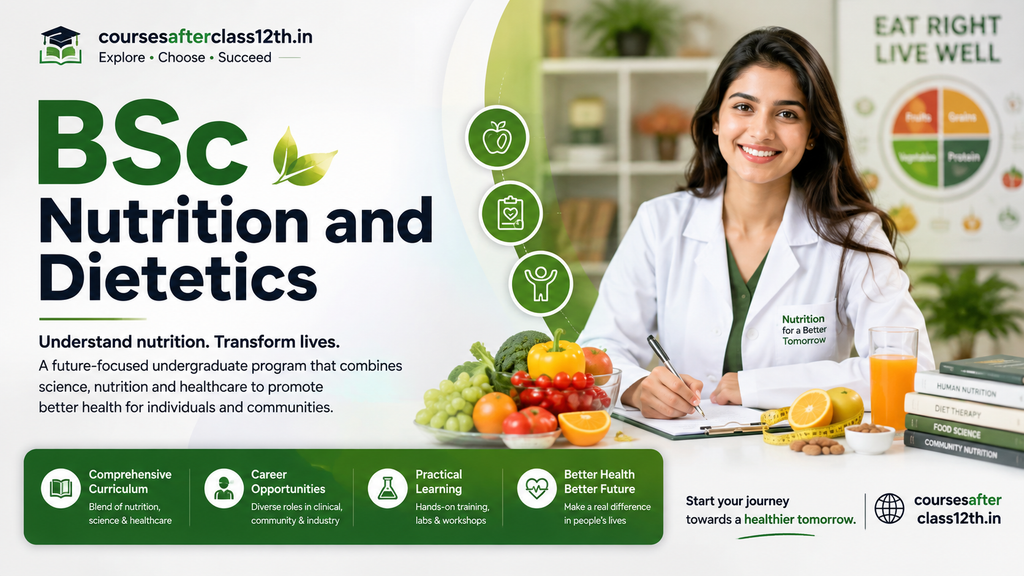
BSc Nutrition and Dietetics, also known as the Bachelor of Science in Nutrition and Dietetics, is an undergraduate programme focused on food, nutrition, human health, diet planning and the scientific relationship between dietary intake and wellbeing. The course combines concepts from biology, chemistry, food science, physiology and health sciences to help students understand how nutrients influence the human body and how appropriate dietary practices can support health.
Nutrition has an important role throughout the human life cycle. Nutritional requirements can vary according to age, physical activity, physiological condition, lifestyle and health status. Consequently, nutrition professionals need a strong understanding of nutrients, food composition, meal planning, nutritional assessment and dietary behaviour.
A B.Sc. Nutrition and Dietetics programme generally introduces students to subjects such as human nutrition, food science, biochemistry, physiology, community nutrition, therapeutic nutrition, dietetics, food microbiology and nutrition education. Depending on the university, students may also receive practical exposure through laboratories, hospitals, clinics, community programmes and internships.
The programme can be suitable for students who have completed Class 12 and are interested in science, food, health and human wellbeing. However, eligibility requirements, subjects, minimum marks, course duration, fees and admission procedures vary between institutions. Students should therefore check the latest admission information issued by the college or university before applying.
Table of Contents
What is BSc Nutrition and Dietetics course?
B.Sc. Nutrition and Dietetics is an undergraduate science programme that studies food, nutrients, human nutrition, dietary planning and the application of nutrition knowledge in healthcare and community settings.
Nutrition focuses on how food and nutrients interact with the body, while dietetics involves applying nutrition knowledge to dietary planning and professional practice.
During the programme, students may learn about:
- Macronutrients
- Micronutrients
- Human metabolism
- Food composition
- Nutritional assessment
- Meal planning
- Therapeutic diets
- Community nutrition
- Food safety
- Food microbiology
- Nutrition education
- Public health nutrition
- Research methodology
The precise professional responsibilities of a nutrition or dietetics graduate depend on their qualification, training, employer and applicable regulations.
Why is Nutrition Important?
Food provides energy and nutrients required for normal body functions. Nutrients such as carbohydrates, proteins, fats, vitamins and minerals have different roles in the body.
Nutrition is relevant at every stage of life, from infancy through childhood and adolescence to adulthood and older age.
Poor dietary patterns can be associated with nutritional deficiencies and can also contribute to various health risks when combined with other factors. Therefore, nutrition education and evidence-based dietary practices are important components of healthcare and public health.
A nutrition professional may work with individuals, communities, institutions or healthcare teams to promote appropriate dietary practices within their professional scope.
BSc Nutrition and Dietetics Course Highlights
| Particular | Details |
|---|---|
| Course Name | Bachelor of Science in Nutrition and Dietetics |
| Common Name | B.Sc. Nutrition and Dietetics |
| Course Level | Undergraduate |
| Field | Nutrition, Dietetics and Health Sciences |
| Course Type | Science-based programme |
| Eligibility | Usually 10+2 with prescribed subjects |
| Common Stream | Science |
| Duration | Generally 3–4 years depending on institution |
| Learning | Theory + practical + clinical/community exposure |
| Major Areas | Nutrition, food science and dietetics |
| Practical Training | Laboratories, hospitals/community settings depending on college |
| Admission | Merit and/or entrance based |
| Career Areas | Hospitals, clinics, wellness, food industry, community nutrition and research |
| Higher Studies | M.Sc. and related postgraduate programmes |
BSc Nutrition and Dietetics Eligibility
Eligibility criteria vary between universities and colleges.
Generally, students must have completed Class 12 or an equivalent examination from a recognised board. Many institutions prefer or require students to have studied science subjects.
Depending on the programme, the required subjects may include:
- Biology
- Chemistry
- Physics
- Home Science or related subjects in some institutions
Some universities may accept different combinations. Minimum qualifying marks can also differ.
Typical eligibility requirements
| Requirement | Common Pattern |
|---|---|
| Educational Qualification | 10+2/equivalent |
| Stream | Usually Science |
| Biology | Required by many institutions |
| Chemistry | Commonly required |
| Physics | May be required |
| Minimum Marks | Institution-specific |
| Entrance Exam | May apply |
| Age Criteria | Institution-specific |
| Medical Fitness | Where applicable |
Students should verify the exact eligibility criteria before applying because the same course title can have different requirements at different universities.
Can PCB Students Pursue BSc Nutrition and Dietetics?
Yes. PCB students are commonly eligible for BSc Nutrition and Dietetics programmes where Biology, Physics and Chemistry are prescribed.
PCB students already have a foundation in biology and chemistry, which can be helpful when studying:
- Human physiology
- Biochemistry
- Metabolism
- Nutrient functions
- Human anatomy
- Food science
However, eligibility must always be checked against the specific institution.
Can PCM Students Pursue BSc Nutrition and Dietetics?
PCM eligibility depends on the university.
Some institutions may require Biology because the course involves human nutrition and biological sciences. Others may allow alternative subject combinations.
Therefore, PCM students should not assume that every B.Sc. Nutrition and Dietetics programme will accept their Class 12 subject combination.
BSc Nutrition and Dietetics Admission Process
Admission procedures can differ between colleges.
Some universities offer admission based on Class 12 merit, while others may conduct entrance examinations or follow university-specific selection procedures.
General admission steps
1. Check eligibility:
Confirm the required Class 12 subjects and minimum marks.
2. Research colleges:
Compare curriculum, faculty, laboratories, clinical exposure, internships, fees and placement information.
3. Submit application:
Complete the official application form.
4. Entrance examination:
Appear for the entrance test if required.
5. Merit or selection:
Candidates may be shortlisted according to merit or entrance scores.
6. Document verification:
Submit academic and identification documents.
7. Fee payment:
Pay the required admission fee to confirm the seat.
Documents Required for Admission
Students may commonly be asked to submit:
| Document | Purpose |
|---|---|
| Class 10 Mark Sheet | Academic verification |
| Class 10 Certificate | Date-of-birth/academic record |
| Class 12 Mark Sheet | Eligibility verification |
| Class 12 Certificate | Passing proof |
| Transfer Certificate | Institutional requirement |
| Migration Certificate | Where applicable |
| Identity Proof | Student verification |
| Passport Photographs | Admission records |
| Category Certificate | Where applicable |
| Domicile Certificate | If required |
| Entrance Score Card | Where applicable |
| Medical Certificate | If required |
The exact document list varies by institution.
BSc Nutrition and Dietetics Course Duration
The course duration depends on the university and its academic structure.
Many programmes are structured over three or four years, with practical work, projects, clinical training or internships incorporated into the curriculum.
Students should check:
- Total semesters
- Practical hours
- Internship duration
- Clinical exposure
- Project requirements
- Credit structure
- Examination pattern
A longer programme is not automatically better. The quality and depth of practical education should also be considered.
BSc Nutrition and Dietetics Syllabus
The syllabus generally progresses from basic science to applied nutrition and dietetics.
Students first develop a foundation in human biology, chemistry and food science. They then progress towards nutritional assessment, diet planning, therapeutic nutrition and community nutrition.
Major subjects
| Subject | What Students Learn |
|---|---|
| Human Anatomy | Structure of the human body |
| Physiology | Functions of body systems |
| Biochemistry | Chemical processes in the body |
| Food Science | Composition and properties of food |
| Human Nutrition | Nutrients and their functions |
| Nutritional Biochemistry | Nutrient metabolism |
| Food Microbiology | Microorganisms associated with food |
| Community Nutrition | Nutrition at population level |
| Dietetics | Application of nutrition in dietary planning |
| Therapeutic Nutrition | Dietary approaches used in clinical settings |
| Food Safety | Safe handling and storage of food |
| Nutrition Education | Communicating nutrition information |
| Research Methodology | Fundamentals of nutrition research |
The exact semester-wise syllabus differs among institutions.
BSc Nutrition and Dietetics First-Year Syllabus
The first year generally provides the scientific foundation for the programme.
Students may study:
- Human anatomy
- Physiology
- Basic biochemistry
- Introduction to nutrition
- Food science
- Food preparation
- Fundamentals of dietetics
- Communication skills
- Basic computer applications
The purpose is to help students understand both the human body and the basic characteristics of food.
BSc Nutrition and Dietetics Second-Year Syllabus
The second year may move into more specialised nutrition topics.
Possible subjects include:
- Nutritional biochemistry
- Macronutrients
- Micronutrients
- Human metabolism
- Community nutrition
- Food microbiology
- Nutritional assessment
- Meal planning
- Lifecycle nutrition
- Food preservation
- Dietetics
Students may also begin practical exercises involving dietary calculations and nutritional evaluation.
BSc Nutrition and Dietetics Third-Year Syllabus
The final year may focus more heavily on applied dietetics and professional practice.
Possible areas include:
- Therapeutic nutrition
- Clinical dietetics
- Public health nutrition
- Nutrition counselling
- Nutrition education
- Food service management
- Research methodology
- Internship
- Project work
Some institutions may include specialised subjects in sports nutrition, child nutrition, geriatric nutrition or other areas.
Human Nutrition
Human nutrition is a central component of the programme.
Students learn how nutrients support different biological functions.
Major nutrient categories
Carbohydrates provide an important source of energy.
Proteins are essential for growth, maintenance and numerous physiological processes.
Fats provide energy and participate in various biological functions.
Vitamins and minerals support numerous physiological processes.
Water is essential for hydration and normal body functions.
The course also introduces concepts such as energy balance, nutrient requirements and dietary patterns.
Macronutrients in Nutrition
Macronutrients are nutrients generally required in larger quantities.
The primary macronutrients include:
- Carbohydrates
- Proteins
- Fats
Students learn about their:
- Sources
- Digestion
- Absorption
- Metabolism
- Functions
- Dietary significance
Understanding macronutrients is fundamental to meal planning and dietary assessment.
Micronutrients
Micronutrients include vitamins and minerals required in relatively small amounts but are important for numerous physiological processes.
Students may study:
- Vitamins
- Minerals
- Their sources
- Absorption
- Biological functions
- Deficiency-related concerns
- Dietary recommendations
Nutrition students must understand that nutritional requirements differ among individuals.
Food Science
Food science examines the physical, chemical and biological characteristics of food.
Students may learn about:
- Food composition
- Food preparation
- Food processing
- Food preservation
- Food storage
- Food quality
- Food safety
This knowledge can be valuable for careers extending beyond clinical dietetics.
Nutritional Assessment
Nutritional assessment helps professionals understand an individual’s nutritional status.
Students may learn about assessment approaches involving:
- Dietary history
- Anthropometric measurements
- Clinical information
- Biochemical data
- Food frequency methods
- Dietary recall
Assessment should be interpreted in context rather than relying on a single measurement.
Diet Planning
Diet planning is an important practical component.
Students learn how to consider factors such as:
- Age
- Gender
- Activity level
- Food preferences
- Cultural practices
- Nutritional requirements
- Health conditions
- Dietary restrictions
A suitable diet plan should be realistic and appropriate for the individual rather than based on generic internet advice.
Therapeutic Nutrition
Therapeutic nutrition involves applying nutrition knowledge to dietary management in clinical contexts.
Students may study nutrition considerations related to conditions such as:
- Diabetes
- Cardiovascular conditions
- Gastrointestinal disorders
- Kidney-related conditions
- Liver disorders
- Obesity
- Malnutrition
- Certain metabolic disorders
The exact professional scope of graduates depends on qualification, clinical training, employer and applicable regulations.
Clinical Dietetics
Clinical dietetics focuses on applying nutrition science in healthcare environments.
Students may receive exposure to:
- Patient assessment
- Dietary history
- Meal planning
- Hospital diets
- Therapeutic diets
- Patient counselling
- Nutrition education
- Documentation
Hospital-based training can help students understand how nutrition services integrate with broader healthcare.
Community Nutrition
Community nutrition focuses on nutrition at a population level.
Students may study:
- Public health nutrition
- Nutritional deficiencies
- Maternal and child nutrition
- School nutrition
- Community surveys
- Nutrition education
- Food security
- Health awareness
Career opportunities in this area may exist within NGOs, public-health projects, community organisations and research programmes.
Nutrition Across the Life Cycle
Nutritional needs change throughout life.
Students may study nutrition requirements during:
- Infancy
- Childhood
- Adolescence
- Adulthood
- Pregnancy
- Lactation
- Older age
Understanding these differences helps students appreciate why a single diet cannot be appropriate for everyone.
Sports Nutrition
Some B.Sc. Nutrition and Dietetics programmes include sports nutrition as an elective or specialised subject.
Sports nutrition can cover:
- Energy requirements
- Hydration
- Pre-exercise nutrition
- Post-exercise nutrition
- Macronutrient requirements
- Performance considerations
Students interested in sports nutrition may later pursue specialised education in the area.
Food Safety and Hygiene
Food safety is an important part of nutrition education.
Students may learn about:
- Food contamination
- Foodborne microorganisms
- Personal hygiene
- Food storage
- Cross-contamination
- Food handling
- Sanitation
Nutrition professionals working in food services need to understand how food safety affects public health.
Internship in BSc Nutrition and Dietetics
Internship or practical training can be an important bridge between classroom learning and professional practice.
Depending on the institution, students may receive exposure to:
- Hospitals
- Clinics
- Community nutrition programmes
- Food service departments
- Wellness centres
- Research organisations
- Food companies
Before choosing a college, students should ask whether internships are compulsory and whether the institution provides structured placements.
Hospital Training
Hospital exposure can introduce students to practical aspects of clinical nutrition.
Students may observe or participate under supervision in areas such as:
- Dietary assessment
- Hospital meal planning
- Therapeutic diet preparation
- Patient counselling
- Nutrition documentation
- Food service management
Students should receive appropriate supervision when dealing with patients.
Skills Required for Nutrition and Dietetics
| Skill | Importance |
|---|---|
| Communication | Important for counselling |
| Nutrition Science | Core professional knowledge |
| Analytical Thinking | Useful for dietary assessment |
| Research Skills | Important for evidence-based practice |
| Food Knowledge | Supports meal planning |
| Counselling | Helps communicate dietary recommendations |
| Computer Skills | Useful for records and analysis |
| Empathy | Important in patient interaction |
| Documentation | Relevant to professional practice |
| Time Management | Useful in hospitals and clinics |
| Public Speaking | Helpful for nutrition education |
| Critical Thinking | Helps evaluate nutrition claims |
Career Options After BSc Nutrition and Dietetics
Graduates can explore several career areas.
Possible roles include:
- Nutritionist
- Dietetics-related roles
- Clinical Nutrition Assistant
- Nutrition Counsellor
- Community Nutrition Worker
- Food Service Professional
- Wellness Nutrition Professional
- Sports Nutrition-related roles
- Research Assistant
- Nutrition Educator
- Food Industry Professional
Exact job titles depend on the employer and the graduate’s qualifications.
Where Can B.Sc. Nutrition Graduates Work?
Hospitals
Hospitals can employ nutrition and dietetics professionals in clinical and food-service settings.
Clinics
Nutrition professionals may work in outpatient settings depending on qualifications and scope.
Wellness Centres
Wellness organisations may employ nutrition professionals for lifestyle and dietary programmes.
Fitness Centres
Some fitness facilities employ nutrition professionals to support general nutrition programmes.
Food Industry
Food companies may employ graduates in:
- Product development
- Quality
- Food safety
- Nutrition communication
- Consumer education
NGOs
Community organisations may recruit nutrition graduates for public-health and awareness projects.
Research Organisations
Graduates may assist with nutrition research and data collection.
B.Sc. Nutrition and Dietetics Salary in India
Salary after B.Sc. Nutrition and Dietetics varies significantly.
Factors include:
- Qualification
- Experience
- Job role
- Employer
- City
- Specialisation
- Clinical exposure
- Additional certifications
Fresh graduates generally start in entry-level roles, while professionals with experience or advanced qualifications may progress into specialised positions.
Factors affecting salary
| Factor | Effect |
|---|---|
| Experience | Can influence career progression |
| Specialisation | May create specialised opportunities |
| Employer | Pay structures vary |
| Location | Salaries differ between cities |
| Higher Education | Can expand career pathways |
| Clinical Experience | Useful for healthcare roles |
| Communication Skills | Important in counselling roles |
Students should be cautious about colleges advertising guaranteed high salaries without providing verifiable placement data.
Government Jobs After BSc Nutrition and Dietetics
Graduates may be eligible for certain government-sector positions when their qualification matches the recruitment requirements.
Possible employment environments include:
- Government hospitals
- Public health programmes
- Community nutrition projects
- Government institutions
- Research organisations
- Food and nutrition programmes
Government employment is vacancy-dependent.
Candidates may need to satisfy requirements related to:
- Qualification
- Experience
- Age
- Registration
- Examination
- Reservation
- Other recruitment conditions
Students should always read the official recruitment notification.
Private Jobs After B.Sc. Nutrition
Private-sector opportunities may exist in:
- Hospitals
- Clinics
- Wellness centres
- Nutrition companies
- Fitness organisations
- Food companies
- Healthcare organisations
- Research companies
The responsibilities and eligibility requirements can vary considerably.
Higher Studies After BSc Nutrition and Dietetics
Students interested in advanced education can consider relevant postgraduate programmes.
Possible options include:
- M.Sc. Nutrition
- M.Sc. Food and Nutrition
- M.Sc. Clinical Nutrition
- M.Sc. Dietetics
- Public Health
- Food Science
- Food Technology
- Hospital Administration
- Healthcare Management
- Research programmes
Eligibility differs by institution.
B.Sc. Nutrition and Dietetics vs B.Sc. Food Technology
These programmes overlap in some areas but have different primary objectives.
| Feature | B.Sc. Nutrition & Dietetics | B.Sc. Food Technology |
|---|---|---|
| Main Focus | Nutrition and human health | Food production and processing |
| Human Nutrition | Major component | May be limited |
| Diet Planning | Included | Usually not central |
| Food Processing | Basic/Moderate | Major component |
| Clinical Exposure | Possible | Usually limited |
| Career Areas | Healthcare, wellness, nutrition | Food industry, processing, quality |
B.Sc. Nutrition and Dietetics vs B.Sc. Home Science
| Feature | Nutrition & Dietetics | Home Science |
|---|---|---|
| Nutrition | Core area | One component |
| Dietetics | Major focus | May be included |
| Food Science | Included | Included |
| Family Studies | Limited | Often broader |
| Healthcare | Stronger focus | Broader discipline |
| Career Scope | Nutrition-focused | Multidisciplinary |
B.Sc. Nutrition and Dietetics vs B.Sc. Biology
| Feature | Nutrition & Dietetics | Biology |
|---|---|---|
| Nutrition | Core | Limited |
| Food | Major component | Limited |
| Human Health | Strong | General |
| Diet Planning | Included | Generally not central |
| Clinical Application | Possible | Usually limited |
| Research | Possible | Strong |
Is BSc Nutrition and Dietetics a Good Course After 12th?
B.Sc. Nutrition and Dietetics can be a good option for students interested in food, nutrition, science, health and human wellbeing.
It can be particularly suitable for students who enjoy:
- Biology
- Chemistry
- Food science
- Human physiology
- Health education
- Counselling
- Research
- Community health
Students should understand that nutrition is an evidence-based science. The course involves considerably more than simply learning about healthy foods or creating weight-loss diets.
Who Should Choose BSc Nutrition and Dietetics?
The programme may suit students who:
- Have completed Class 12 with the required subjects
- Are interested in nutrition
- Enjoy Biology and Chemistry
- Like learning about food
- Want a health-related career
- Enjoy communication and counselling
- Are interested in research
- Like working with people
- Have an interest in public health
Who Should Not Choose BSc Nutrition and Dietetics?
Students should think carefully before choosing this course if they:
- Dislike Biology or Chemistry
- Do not enjoy science-based study
- Are uninterested in food and health
- Prefer purely technical careers
- Do not like communication or counselling
- Expect nutrition to be only about weight loss
The actual curriculum is science-oriented and can include substantial theoretical and practical study.
Advantages of BSc Nutrition and Dietetics
| Advantage | Explanation |
|---|---|
| Health-Oriented | Connected to nutrition and wellbeing |
| Science-Based | Strong foundation in biological sciences |
| Multiple Career Areas | Healthcare, wellness, food industry and research |
| Practical Learning | May include laboratory and clinical training |
| Higher Studies | Multiple postgraduate pathways |
| Community Work | Opportunities in public health |
| Research | Nutrition research opportunities |
| Specialisation | Potential areas such as clinical or sports nutrition |
Challenges of BSc Nutrition and Dietetics
Students should also consider the challenges.
The programme can involve:
- Biology
- Chemistry
- Biochemistry
- Human physiology
- Food science
- Practical work
- Research
- Patient communication
Professional practice may also require students to distinguish evidence-based nutrition from popular but unsupported dietary claims.
How to Choose the Best BSc Nutrition and Dietetics College
Students should compare colleges carefully instead of relying solely on advertisements.
| Factor | What to Check |
|---|---|
| University | Degree-awarding institution |
| Recognition | Relevant recognition/approval |
| Curriculum | Subjects and practical components |
| Faculty | Qualifications and experience |
| Laboratories | Nutrition and food science facilities |
| Hospital Exposure | Clinical training opportunities |
| Internship | Duration and structure |
| Research | Projects and facilities |
| Placement | Actual placement information |
| Fees | Total programme cost |
| Location | Accessibility |
| Hostel | Availability and cost |
Questions to Ask Before Taking Admission
Before enrolling, ask the college:
- What is the exact course duration?
- What Class 12 subjects are required?
- What is the minimum percentage?
- Is admission merit-based or entrance-based?
- Which university awards the degree?
- Is clinical training included?
- Is internship compulsory?
- Which hospitals or organisations provide training?
- How much practical training is included?
- Are nutrition laboratories available?
- What are the total fees?
- What are the higher-study options?
- What are the actual placement outcomes?
- Which organisations recruit graduates?
- Are students supported with research projects?
Future Scope of BSc Nutrition and Dietetics
Nutrition is increasingly relevant to healthcare, public health, wellness and food systems.
The future scope of the field can be viewed across several areas:
Clinical Nutrition
Hospitals and healthcare organisations can require nutrition professionals for appropriate services.
Public Health
Nutrition education and community programmes remain important components of public health.
Wellness
The wellness sector provides opportunities for nutrition education and lifestyle support.
Food Industry
Food companies require professionals with knowledge of food, nutrition and consumer needs.
Research
Nutrition research can contribute to better understanding of diet, health and disease.
Sports Nutrition
Students can pursue additional training for sports-related nutrition careers.
Technology and Nutrition
Technology is increasingly influencing the nutrition field.
Professionals may use:
- Nutrition analysis software
- Digital dietary records
- Mobile health applications
- Electronic patient records
- Online consultation platforms
- Food databases
- Data analysis tools
Students can benefit from developing basic digital skills alongside nutrition knowledge.
Artificial Intelligence and Nutrition
AI can support certain nutrition-related activities, including data analysis, meal recommendation systems and health technology applications.
However, AI-generated dietary recommendations should not automatically be treated as professional medical advice.
Human professionals remain important for:
- Assessing individual circumstances
- Understanding medical history
- Interpreting clinical information
- Considering cultural and lifestyle factors
- Communicating with clients
- Applying professional judgement
Students should learn to use technology responsibly rather than relying on automated recommendations without evaluation.
Research in Nutrition and Dietetics
Nutrition research covers a wide range of subjects.
Students may explore:
- Dietary patterns
- Nutritional deficiencies
- Public health nutrition
- Childhood nutrition
- Maternal nutrition
- Sports nutrition
- Obesity
- Metabolic health
- Food safety
- Nutrition education
Research skills can be developed through:
- Literature reviews
- Data collection
- Surveys
- Statistical analysis
- Research projects
- Scientific presentations
Professional Ethics in Nutrition
Nutrition professionals may work with sensitive health and lifestyle information.
Professional practice should therefore emphasise:
- Confidentiality
- Evidence-based recommendations
- Respect for individual preferences
- Appropriate documentation
- Professional boundaries
- Accurate communication
- Avoidance of misleading claims
Students should understand that responsible nutrition practice requires evidence rather than trends.
Nutrition Counselling Skills
Nutrition counselling involves more than providing a food list.
A professional may need to understand:
- Eating habits
- Lifestyle
- Food preferences
- Cultural practices
- Financial considerations
- Motivation
- Barriers to dietary change
Good communication can help individuals understand realistic and sustainable dietary strategies.
Career Roadmap After B.Sc. Nutrition and Dietetics
A possible career pathway is:
Class 12 Science
↓
B.Sc. Nutrition and Dietetics
↓
Practical Training / Internship
↓
Entry-Level Nutrition Role
↓
Clinical / Community / Wellness Experience
↓
Specialisation or Higher Education
↓
Senior Professional / Specialist Role
Students interested in research or academics can pursue postgraduate education and potentially doctoral research.
BSc Nutrition and Dietetics Admission Checklist
| Question | Check Before Admission |
|---|---|
| Required Class 12 subjects | ✓ |
| Minimum percentage | ✓ |
| Entrance requirement | ✓ |
| Course duration | ✓ |
| University recognition | ✓ |
| Practical laboratories | ✓ |
| Clinical exposure | ✓ |
| Internship | ✓ |
| Total fees | ✓ |
| Hostel costs | ✓ |
| Placement record | ✓ |
| Higher-study options | ✓ |
BSc Nutrition and Dietetics: Quick Comparison
| Course Aspect | Details |
|---|---|
| Level | Undergraduate |
| Duration | Usually 3–4 years depending on institution |
| Stream | Usually Science |
| Main Subjects | Nutrition, food science, biochemistry, physiology, dietetics |
| Practical Work | Laboratories and clinical/community training depending on programme |
| Career Areas | Healthcare, wellness, food industry, community nutrition, research |
| Higher Study | M.Sc. and related programmes |
| Key Skills | Nutrition science, communication, assessment, research |
| Work Settings | Hospitals, clinics, wellness centres, food companies, NGOs and research organisation |