
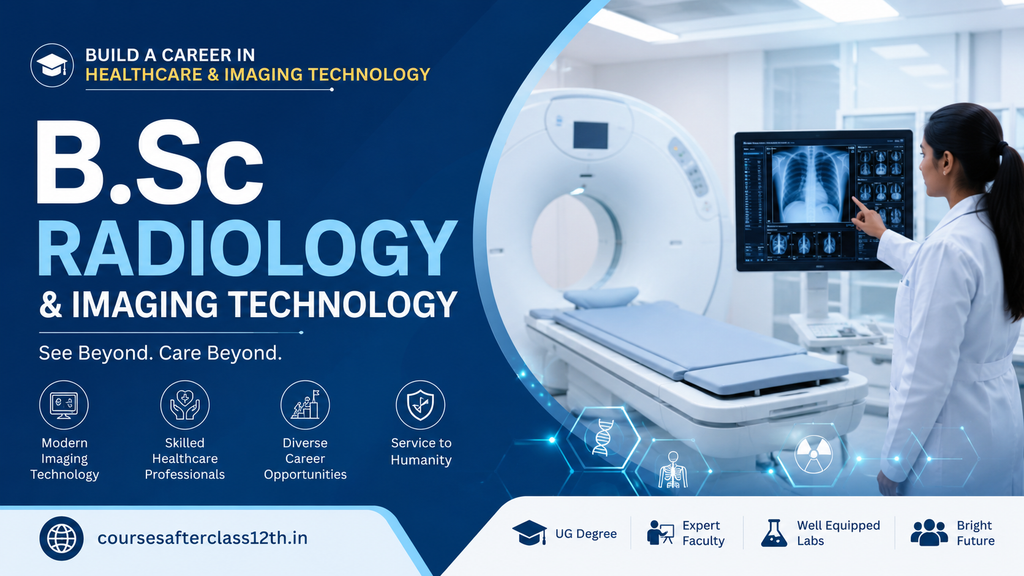
BSc Radiology and Imaging Technology is an undergraduate allied healthcare programme designed for students interested in medical imaging, diagnostic procedures, radiographic technology and patient care. BSc Radiology and Imaging Technology provides students with theoretical and practical knowledge of human anatomy, imaging equipment, radiographic techniques, radiation safety and clinical practices.
Medical imaging is an important part of modern healthcare because it helps healthcare professionals obtain visual information about structures inside the human body. Depending on the clinical requirement, different imaging techniques can be used to examine bones, organs, soft tissues, blood vessels and other anatomical structures. Professionals trained in radiology and imaging technology support these services by preparing patients, operating or assisting with imaging equipment within their professional scope, following safety procedures and producing technically appropriate images.
The field is much broader than conventional X-ray technology. Modern imaging departments can include digital X-ray, computed tomography (CT), magnetic resonance imaging (MRI), mammography, fluoroscopy, ultrasound and other specialised technologies. The exact modalities covered in a B.Sc. programme depend on the institution and curriculum.
Students usually study subjects such as anatomy, physiology, pathology, radiographic physics, radiographic techniques, radiation protection, patient care, image processing, equipment technology and quality assurance. Advanced semesters may introduce CT, MRI and specialised imaging procedures. Practical sessions and clinical training are particularly important because imaging technology requires students to connect theoretical concepts with real-world procedures.
The course can be suitable for students who have completed Class 12 with the required science subjects and are interested in combining healthcare with technology. However, eligibility, course duration, fees, admission procedures and internship requirements differ among colleges and universities. Students should therefore verify the current information from the official institution before applying.
Table of Contents
What is BSc Radiology and Imaging Technology?
B.Sc. Radiology and Imaging Technology is a bachelor’s degree programme focused on the scientific and technical aspects of medical imaging. It prepares students to understand imaging equipment, radiographic techniques, patient positioning, image acquisition, radiation protection, image quality and professional healthcare practices.
The programme is interdisciplinary because it brings together concepts from:
- Biology
- Anatomy
- Physiology
- Physics
- Pathology
- Medical technology
- Healthcare management
- Patient care
- Computer and digital imaging systems
A radiology and imaging professional works as part of a healthcare team. Depending on the role and workplace, professionals may work alongside radiologists, doctors, nurses, technicians and other healthcare personnel.
One important distinction is that a radiologist is a medical doctor, while a radiology or imaging technologist is an allied healthcare professional trained in the technical aspects of diagnostic imaging. B.Sc. Radiology does not qualify a student to become a medical doctor.
Why Choose BSc Radiology and Imaging Technology?
Diagnostic imaging plays an important role in healthcare. A doctor may need information about a patient’s internal anatomy that cannot be obtained through physical examination alone. Imaging can provide additional information that may support diagnosis, treatment planning or monitoring.
For example, X-ray imaging can be useful for examining many bone-related conditions and chest structures. CT can provide cross-sectional images and is widely used in emergency and diagnostic settings. MRI provides detailed soft-tissue imaging without using ionising radiation. Ultrasound uses sound waves and is used in many clinical applications.
Every modality has a different operating principle and clinical application. Therefore, imaging professionals require appropriate education and practical training.
Major imaging technologies
| Technology | Basic Principle | General Application |
|---|---|---|
| X-Ray | Uses ionising radiation to create images | Bones, chest and other examinations |
| CT | Uses X-rays and computer processing | Cross-sectional body imaging |
| MRI | Uses magnetic fields and radiofrequency energy | Soft-tissue and structural imaging |
| Ultrasound | Uses high-frequency sound waves | Abdominal and other examinations |
| Mammography | Specialised X-ray imaging | Breast imaging |
| Fluoroscopy | Real-time X-ray imaging | Dynamic examinations and procedures |
The availability and training requirements for each modality vary between institutions.
BSc Radiology and Imaging Technology Course Highlights
| Particular | Details |
|---|---|
| Course Name | Bachelor of Science in Radiology and Imaging Technology |
| Common Short Form | B.Sc. Radiology / B.Sc. RIT |
| Course Level | Undergraduate |
| Field | Allied Healthcare |
| Course Type | Science and technology-oriented healthcare programme |
| Eligibility | Usually 10+2 with prescribed science subjects |
| Common Subjects | Physics, Chemistry and Biology, depending on institution |
| Duration | Generally 3–4 years depending on institution |
| Training | Theory, practical and clinical training |
| Major Area | Medical imaging and radiographic technology |
| Imaging Areas | X-ray, CT, MRI and other modalities depending on programme |
| Admission | Merit and/or entrance based |
| Workplaces | Hospitals, diagnostic centres and imaging facilities |
| Career | Radiographer, Imaging Technologist and related roles |
| Higher Studies | M.Sc. and relevant postgraduate programmes |
BSc Radiology and Imaging Technology Eligibility
The eligibility requirements for B.Sc. Radiology and Imaging Technology are not identical across all colleges. Students should therefore check the admission brochure of the institution they want to join.
Generally, applicants are expected to have completed Class 12 or an equivalent examination from a recognised board. Science subjects are commonly required because the course involves medical science and imaging physics.
Depending on the institution, students may need to have studied:
- Physics
- Chemistry
- Biology
Some institutions may prescribe Mathematics or alternative combinations. Minimum marks may also differ.
Common eligibility requirements
| Eligibility Requirement | Typical Requirement |
|---|---|
| Qualification | 10+2 or equivalent |
| Stream | Science |
| Physics | Commonly required |
| Chemistry | Commonly required |
| Biology | Commonly required by many institutions |
| Minimum Percentage | College-specific |
| Entrance Test | May be applicable |
| Age Limit | Institution-specific |
| Medical Fitness | May be required |
| Other Requirements | As specified by university |
Students should verify the latest criteria before submitting an application.
Can PCB Students Apply for BSc Radiology?
Yes. Students who have completed Physics, Chemistry and Biology (PCB) in Class 12 are commonly eligible for B.Sc. Radiology and Imaging Technology programmes where PCB is the prescribed combination.
PCB students may find the course particularly relevant because it combines human biology and healthcare with technology and physics.
However, eligibility differs between institutions, so students should check the official admission notification.
Can PCM Students Apply for BSc Radiology?
PCM students may be eligible for some B.Sc. Radiology and Imaging Technology programmes, but this is not universal.
Some institutions require Biology because the curriculum contains subjects such as anatomy, physiology and pathology. Other institutions may specify alternative subject combinations.
Therefore, PCM students should check the individual college’s requirements before applying.
BSc Radiology and Imaging Technology Admission Process
Admission procedures vary between universities.
Some colleges offer admission based on Class 12 merit, while others conduct entrance examinations or follow university/state counselling procedures.
General admission process
Step 1 – Check Eligibility
Confirm the required subjects, minimum marks and other admission requirements.
Step 2 – Select Colleges
Compare colleges based on curriculum, clinical exposure, laboratory facilities, imaging equipment, internship, fees and placement information.
Step 3 – Apply
Submit the application through the institution’s official admission portal.
Step 4 – Entrance Examination
Appear for an entrance test if the college requires one.
Step 5 – Merit/Counselling
Candidates may be shortlisted through merit, entrance scores or counselling.
Step 6 – Document Verification
Submit the required academic and identity documents.
Step 7 – Admission Fee
Pay the prescribed fee within the deadline to confirm admission.
Documents Required for BSc Radiology
Students may commonly need the following documents:
| Document | Purpose |
|---|---|
| Class 10 Mark Sheet | Academic record |
| Class 10 Certificate | Date-of-birth/academic verification |
| Class 12 Mark Sheet | Qualification proof |
| Class 12 Certificate | Passing proof |
| Transfer Certificate | Admission requirement |
| Migration Certificate | Where applicable |
| Identity Proof | Verification |
| Passport Photographs | Institutional records |
| Category Certificate | Where applicable |
| Domicile Certificate | Where required |
| Entrance Score Card | Where applicable |
| Medical Certificate | Where required |
| Gap Certificate | If applicable |
The exact list should be obtained from the college.
BSc Radiology Course Duration
The duration of B.Sc. Radiology and Imaging Technology can vary depending on the university and programme structure.
Many institutions structure undergraduate programmes over three or four years, with some programmes incorporating internship or clinical training.
Students should not assume that every course with the same or similar name has identical duration.
Before admission, verify:
- Number of semesters
- Total academic years
- Practical hours
- Clinical postings
- Internship duration
- Total credits
- Examination system
- Project requirements
The programme structure is an important factor when comparing colleges.
BSc Radiology Syllabus
The syllabus generally progresses from basic medical sciences to specialised imaging technology.
Students first need to understand the human body before learning how different imaging systems represent anatomical structures.
Major BSc Radiology subjects
| Subject | Description |
|---|---|
| Human Anatomy | Structure of the human body |
| Human Physiology | Functions of body systems |
| Biochemistry | Chemical processes in the body |
| Pathology | Disease processes |
| Radiographic Physics | Physical principles behind radiography |
| Radiographic Techniques | Techniques used for X-ray imaging |
| Radiation Protection | Safe use of ionising radiation |
| Imaging Equipment | Operation and components of equipment |
| Image Processing | Digital image creation and optimisation |
| CT Technology | Principles of computed tomography |
| MRI Technology | Principles of magnetic resonance imaging |
| Patient Care | Patient preparation and communication |
| Quality Assurance | Maintaining imaging quality and safety |
| Research Methodology | Fundamentals of scientific research |
The exact semester-wise syllabus differs between universities.
BSc Radiology First-Year Syllabus
The first year generally focuses on the scientific foundation needed for further study.
Students may study:
- Anatomy
- Physiology
- Biochemistry
- Basic pathology
- Basic physics
- Medical terminology
- Introduction to radiology
- Healthcare communication
- Computer applications
- Basic laboratory/practical subjects
Importance of first year
The first year establishes the foundation for later imaging subjects.
For example, students cannot effectively understand radiographic positioning without knowing anatomy. Similarly, understanding radiation requires a basic knowledge of physics.
BSc Radiology and Imaging Technology Syllabus
The second year usually moves towards specialised radiography.
Students may study:
- Radiographic techniques
- Radiographic positioning
- Radiation physics
- Radiation protection
- Imaging equipment
- Digital radiography
- Image processing
- Contrast studies
- Clinical radiography
- Patient care
- Pathology
Practical training becomes increasingly important.
BSc Radiology Third-Year Syllabus
The final academic stage may introduce advanced imaging technologies.
Depending on the college, students may study:
- CT
- MRI
- Mammography
- Fluoroscopy
- Special radiographic procedures
- Advanced image processing
- Quality assurance
- Imaging department management
- Research methodology
- Clinical training
- Internship
Some colleges may distribute these subjects differently across semesters.
Practical Training in BSc Radiology
Practical training is one of the most important components of imaging education.
Students need to understand how equipment works and how imaging procedures are performed safely.
Practical exposure may include:
- Patient positioning
- X-ray equipment
- Digital radiography
- Exposure parameters
- Image quality
- Radiation protection
- Patient preparation
- Contrast procedure principles
- CT workflow
- MRI safety
- Imaging documentation
- Infection-control procedures
Students should receive proper supervision during clinical training.
Clinical Training and Hospital Exposure
Clinical training helps students understand how imaging departments operate in real healthcare environments.
A hospital imaging department can be very different from a classroom because patients may be:
- Injured
- In pain
- Elderly
- Children
- Anxious
- Unable to move easily
- Requiring emergency imaging
Students therefore need to develop technical and communication skills simultaneously.
Clinical exposure may help students understand:
- Patient registration.
- Examination preparation.
- Patient identification.
- Positioning.
- Imaging protocols.
- Equipment operation.
- Image acquisition.
- Image quality.
- Safety procedures.
- Documentation.
BSc Radiology Internship
Internship or supervised clinical training can help bridge the gap between academic education and professional practice.
Depending on the programme, students may receive exposure to different imaging departments.
Possible areas include:
- General X-ray
- CT
- MRI
- Mammography
- Fluoroscopy
- Emergency imaging
- Special procedures
The internship structure depends on the college.
Before admission, students should ask:
- Is internship compulsory?
- How long is it?
- Where does it take place?
- Is the internship supervised?
- Is clinical exposure guaranteed?
- Are students rotated through different modalities?
X-Ray Technology in B.Sc. Radiology
X-ray is one of the fundamental areas of radiology education.
Students learn how X-rays are produced, how they interact with tissues and how those interactions result in images.
Topics can include:
- X-ray production
- X-ray tube
- Exposure factors
- Image receptors
- Digital radiography
- Radiographic positioning
- Image quality
- Radiation protection
A strong foundation in X-ray technology can support understanding of more advanced imaging systems.
CT Scan Technology
Computed Tomography (CT) uses X-rays and computer processing to create cross-sectional images.
CT can provide detailed anatomical information and is widely used in many clinical environments.
B.Sc. Radiology students may study:
- CT principles
- CT equipment
- Image acquisition
- Patient positioning
- Image reconstruction
- CT protocols
- Radiation dose
- Contrast-related concepts
- CT safety
Actual responsibilities depend on professional training and workplace policies.
MRI Technology
Magnetic Resonance Imaging (MRI) uses a strong magnetic field and radiofrequency energy to generate images.
Unlike X-ray and CT, MRI does not use ionising radiation.
Students may learn:
- MRI principles
- Magnetic fields
- Radiofrequency concepts
- MRI equipment
- Patient positioning
- MRI sequences
- Image quality
- Artefacts
- MRI safety
- Patient screening
MRI safety is particularly important because strong magnetic fields can create serious hazards around certain metallic objects and implanted devices.
Ultrasound Technology
Ultrasound uses high-frequency sound waves to create images.
The exact extent of ultrasound training within B.Sc. Radiology programmes varies.
Students may learn basic principles involving:
- Sound waves
- Transducers
- Image formation
- Ultrasound equipment
- Patient preparation
- Image quality
The professional scope of ultrasound practice depends on training, regulations and the role assigned by the employer.
Mammography
Mammography is specialised X-ray imaging used primarily for breast imaging.
Students who receive mammography training may learn:
- Mammography equipment
- Positioning
- Image quality
- Radiation protection
- Patient communication
- Basic mammographic procedures
Because patients may feel anxious or uncomfortable, communication and respectful patient handling are important.
Fluoroscopy
Fluoroscopy provides real-time X-ray imaging.
It may be used for selected diagnostic examinations and procedures.
Students can learn about:
- Fluoroscopic equipment
- Real-time imaging
- Contrast procedures
- Patient positioning
- Radiation safety
- Image quality
Because fluoroscopy may involve radiation exposure over a longer procedure, appropriate safety practices are essential.
Radiation Safety
Radiation safety is a central part of radiology education.
X-rays and CT use ionising radiation. Imaging professionals must understand how to minimise unnecessary exposure while obtaining appropriate diagnostic images.
Important principles include:
- Time
- Distance
- Shielding
- Appropriate exposure factors
- Equipment safety
- Patient protection
- Occupational protection
- Quality assurance
Radiation safety is not simply about protective clothing. It involves understanding how equipment settings, patient positioning and imaging protocols influence exposure.
Patient Care in BSc Radiology and Imaging Technology
Although B.Sc. Radiology is highly technical, patient care remains an important part of the profession.
Patients may not understand what an imaging examination involves. They may also be anxious about the procedure.
An imaging professional may need to explain:
- What will happen
- How the patient should position themselves
- Whether they need to remain still
- How long the examination may take
- What preparation is required
Professional communication can improve patient cooperation and reduce anxiety.
Role of a Radiology Technologist
The responsibilities of a radiology technologist depend on qualification, workplace, professional scope and local requirements.
Depending on the role, responsibilities may include:
- Preparing imaging equipment
- Preparing examination rooms
- Confirming patient information
- Positioning patients
- Performing authorised imaging procedures
- Operating equipment
- Following radiation-safety protocols
- Assessing technical image quality
- Maintaining records
- Following quality-control procedures
- Supporting the radiology team
A radiology technologist does not perform the same role as a radiologist.
Skills Required for BSc Radiology and Imaging Technology
A successful imaging professional needs technical and interpersonal skills.
| Skill | Importance |
|---|---|
| Anatomy | Helps understand body structures |
| Patient Positioning | Important for appropriate imaging |
| Technical Knowledge | Required for equipment and procedures |
| Radiation Safety | Protects patients and staff |
| Observation | Helps identify technical issues |
| Communication | Helps patients understand procedures |
| Computer Skills | Important for digital imaging |
| Teamwork | Imaging is multidisciplinary |
| Time Management | Important in busy departments |
| Attention to Detail | Supports technical accuracy |
| Professional Ethics | Important for patient privacy |
| Adaptability | Imaging technology changes over time |
Career Options After BSc Radiology
Graduates can explore several career areas depending on their qualification and practical training.
Potential roles include:
- Radiographer
- Radiology Technologist
- Radiologic Technologist
- Medical Imaging Technologist
- X-Ray Technologist
- CT Technologist
- MRI Technologist
- Imaging Department Technician
- Radiology Department Assistant
- Imaging Research Assistant
- Technical Support roles in medical imaging companies
Job titles and responsibilities vary between employers.
Where Can BSc Radiology and Imaging Technology Graduates Work?
Hospitals
Hospitals have imaging departments that support emergency, inpatient and outpatient care.
Diagnostic Centres
Diagnostic centres may provide X-ray, CT, MRI, ultrasound and other imaging services.
Imaging Centres
Specialised centres may focus primarily on diagnostic imaging.
Medical Colleges
Teaching hospitals can provide clinical and academic environments.
Trauma Centres
Trauma facilities often require imaging services for emergency assessment.
Research Institutions
Imaging technologies may be used in clinical and biomedical research.
Healthcare Technology Companies
Medical equipment and healthcare technology companies may have technical or application-related roles.
BSc Radiology Career Specialisations
| Specialisation | Area of Work |
|---|---|
| General Radiography | Conventional and digital X-ray |
| CT | Computed tomography |
| MRI | Magnetic resonance imaging |
| Mammography | Breast imaging |
| Fluoroscopy | Dynamic X-ray imaging |
| Imaging Quality | Quality-control processes |
| Research | Medical imaging research |
| Healthcare Technology | Medical equipment and applications |
Students can develop specialised expertise through clinical experience, additional training and higher education.
BSc Radiology and Imaging Technology Salary in India
The salary after B.Sc. Radiology varies considerably.
There is no single salary figure that applies to every graduate because compensation depends on multiple factors.
These can include:
- Employer
- City
- Experience
- Qualification
- Job role
- Imaging specialisation
- Hospital type
- Shift pattern
- Technical skills
- Additional training
A fresh graduate generally enters an entry-level role. With experience and specialised skills, professionals may progress to senior or supervisory positions.
Factors affecting salary
| Factor | Possible Impact |
|---|---|
| Experience | Can support career progression |
| CT/MRI Skills | May create specialised opportunities |
| Location | Salaries vary by city |
| Employer | Pay structures differ |
| Qualification | Further education may support advancement |
| Role | Senior positions generally have greater responsibility |
| Shift Work | Some imaging departments operate continuously |
| Technical Skills | Equipment competence is important |
Students should avoid choosing a college based only on advertised salary packages. Verified placement data and actual job roles are more useful indicators.
Government Jobs After BSc Radiology
Graduates may explore government-sector employment when their qualification matches the requirements of a specific vacancy.
Potential employers can include:
- Government hospitals
- Medical colleges
- Public health institutions
- Government diagnostic centres
- Research organisations
- Public-sector healthcare facilities
Government jobs are vacancy-based. Candidates must satisfy the eligibility requirements specified in the recruitment notification.
These may include:
- Educational qualification
- Experience
- Age
- Registration
- Entrance examination
- Skill test
- Reservation requirements
Students should always refer to the official recruitment notice.
Private Jobs After B.Sc. Radiology
The private healthcare sector offers opportunities in:
- Corporate hospitals
- Private hospitals
- Diagnostic chains
- Imaging centres
- Trauma centres
- Specialty hospitals
- Medical imaging companies
Private employers may have different requirements depending on the imaging modality and position.
Higher Studies After B.Sc. Radiology
Students who want to continue their education can explore postgraduate options.
Potential pathways may include:
- M.Sc. Radiology and Imaging Technology
- M.Sc. Medical Imaging Technology
- M.Sc. Radiography
- M.Sc. Medical Radiology
- Relevant allied healthcare postgraduate programmes
- Healthcare management
- Hospital administration
- Research programmes
Eligibility differs between universities. Students should check whether their B.Sc. qualification is accepted for the particular postgraduate course.
B.Sc. Radiology vs B.Sc. Medical Laboratory Technology
Both programmes belong to allied healthcare but focus on different areas.
| Feature | B.Sc. Radiology | B.Sc. MLT |
|---|---|---|
| Primary Focus | Medical imaging | Laboratory diagnostics |
| Main Technology | X-ray, CT, MRI and imaging systems | Laboratory analysers and diagnostic equipment |
| Main Subjects | Anatomy, imaging physics, radiography | Biochemistry, microbiology, pathology |
| Patient Contact | Usually procedure-based | Generally limited |
| Work Environment | Imaging departments | Medical laboratories |
| Radiation | Relevant to some modalities | Not central |
| Main Skill | Imaging and equipment operation | Sample processing and testing |
B.Sc. Radiology vs B.Sc. Nursing
| Feature | B.Sc. Radiology | B.Sc. Nursing |
|---|---|---|
| Main Focus | Medical imaging | Patient care |
| Work Environment | Imaging departments | Hospitals, wards and clinics |
| Patient Contact | Moderate/procedure-based | Extensive |
| Technology | High | Moderate to high |
| Key Skills | Imaging and equipment | Nursing and clinical care |
| Suitable For | Technology-oriented students | Patient-care-oriented students |
Neither course is universally better. The appropriate choice depends on the student’s interests.
B.Sc. Radiology vs MBBS
B.Sc. Radiology and MBBS lead to completely different professional pathways.
MBBS is a medical degree that prepares students for the medical profession subject to applicable regulatory requirements.
B.Sc. Radiology and Imaging Technology is an allied healthcare degree focused on diagnostic imaging technology.
Students who want to become doctors should research the MBBS admission pathway. Students interested in medical imaging technology may consider B.Sc. Radiology.
Advantages of B.Sc. Radiology
Healthcare-Oriented Career
The course provides a pathway into diagnostic imaging and allied healthcare.
Technology-Based Profession
Students learn to work with medical imaging technologies.
Multiple Career Areas
Graduates can explore general radiography and specialised imaging environments.
Practical Education
The programme normally includes practical and clinical components.
Specialisation Opportunities
Students may develop expertise in areas such as CT and MRI.
Research Opportunities
Imaging technology is also relevant to healthcare and biomedical research.
Higher Education
Graduates can explore postgraduate programmes depending on eligibility.
Challenges of B.Sc. Radiology
Students should also understand the challenges.
Radiology professionals may need to:
- Work around complex equipment
- Follow strict safety protocols
- Position patients carefully
- Work in busy departments
- Handle emergency situations
- Work shifts
- Maintain technical accuracy
- Communicate with anxious patients
- Keep learning new technologies
Students should consider these factors before choosing the course.
Is B.Sc. Radiology a Good Course After 12th?
B.Sc. Radiology and Imaging Technology can be a suitable course after Class 12 for students interested in healthcare, medical imaging and technology.
It may suit students who enjoy:
- Biology
- Physics
- Anatomy
- Medical technology
- Practical learning
- Diagnostic procedures
- Healthcare environments
Students who prefer direct patient care may want to compare it with nursing or physiotherapy.
Students should choose the course based on genuine interest and career objectives rather than salary claims alone.
Who Should Choose B.Sc. Radiology?
The course may suit students who:
- Have completed Class 12 with required science subjects
- Enjoy Biology and/or Physics
- Have an interest in medical technology
- Like practical work
- Have good observation skills
- Are comfortable working with equipment
- Can follow safety procedures
- Communicate well with patients
- Have attention to detail
- Are interested in diagnostic imaging
Who Should Not Choose B.Sc. Radiology?
The programme may not be suitable for students who strongly dislike:
- Physics
- Medical technology
- Hospital environments
- Technical equipment
- Patient positioning
- Safety procedures
- Detail-oriented work
Students seeking extensive direct patient-care responsibilities may prefer other healthcare programmes.
How to Choose the Best B.Sc. Radiology College
The quality of practical and clinical training is particularly important.
Students should compare:
| Factor | What to Check |
|---|---|
| University | Degree-awarding university |
| Recognition | Relevant approval/recognition |
| Faculty | Qualifications and experience |
| Imaging Equipment | Available equipment |
| Clinical Training | Hospital/imaging centre exposure |
| Internship | Duration and location |
| Curriculum | Theory and practical balance |
| CT/MRI Exposure | Actual student access |
| Fees | Complete cost |
| Placement | Verified outcomes |
| Infrastructure | Classrooms and laboratories |
| Location | Travel and accommodation |
A college should be able to clearly explain what practical facilities students actually receive.
B.Sc. Radiology Fees
There is no single fee applicable to every B.Sc. Radiology programme.
Fees depend on:
- Government/private institution
- University
- Location
- Infrastructure
- Imaging facilities
- Clinical training
- Hostel
- Laboratory charges
- Examination fees
Possible expenses
| Expense | Description |
|---|---|
| Tuition | Main academic fee |
| Admission Fee | Initial payment |
| Laboratory Fee | Practical training |
| Examination Fee | Examination charges |
| Registration | University registration |
| Hostel | Accommodation |
| Transport | Daily travel |
| Books | Study resources |
| Uniform | Where applicable |
Students should calculate the complete cost rather than comparing only tuition fees.
Government vs Private B.Sc. Radiology Colleges
| Factor | Government College | Private College |
|---|---|---|
| Fees | Often comparatively lower | Often comparatively higher |
| Admission | Merit/entrance based | Institution-specific |
| Competition | Can be high | Varies |
| Infrastructure | College-specific | College-specific |
| Clinical Exposure | Depends on hospital | Depends on tie-up |
| Placement | Verify actual data | Verify actual data |
| Hostel | Institution-specific | Institution-specific |
A private institution is not automatically better or worse than a government institution. Students should evaluate the actual educational experience.
Role of Technology in Radiology
Technology is continuously changing medical imaging.
Modern imaging departments can use:
- Digital radiography
- Advanced CT
- High-field MRI
- PACS
- Radiology information systems
- Automated workflows
- Digital image processing
- AI-assisted imaging tools
As technology changes, professionals need to continue developing their technical knowledge.
Artificial Intelligence in Medical Imaging
Artificial intelligence is increasingly being explored in medical imaging.
AI applications may support tasks such as:
- Image analysis
- Pattern recognition
- Workflow optimisation
- Image prioritisation
- Quality assessment
However, AI should not be viewed as a universal replacement for healthcare professionals.
Human expertise remains important for patient preparation, equipment operation, safety, quality assurance, communication and professional decision-making within the appropriate scope.
Students entering radiology can benefit from developing basic awareness of:
- AI
- Digital imaging
- Data
- Image processing
- Healthcare IT
- Quality management
PACS and Digital Imaging
PACS, or Picture Archiving and Communication System, is associated with the digital storage, retrieval and communication of medical images.
Students may encounter concepts related to:
- Digital image storage
- Image retrieval
- Image transfer
- Patient identification
- Digital workflow
- Data privacy
- Image communication
Understanding digital systems can help graduates adapt to modern imaging departments.
Quality Assurance in Radiology
Quality assurance is important because imaging examinations need to produce technically appropriate images while maintaining safety.
Quality-related activities may include:
- Equipment performance checks
- Image-quality monitoring
- Exposure optimisation
- Preventive maintenance
- Radiation monitoring
- Documentation
- Protocol review
Poor image quality can sometimes result in repeat examinations, so technical accuracy and quality management are important.
Patient Safety in Radiology
Patient safety is central to imaging practice.
Professionals may need to confirm:
- Patient identity
- Examination requested
- Relevant preparation
- Correct positioning
- Safety requirements
MRI requires particular attention to metallic objects and certain implants because of its powerful magnetic field.
Procedures involving contrast agents require appropriate clinical protocols and supervision.
Students should therefore develop a safety-first approach throughout their education.
Research Opportunities After B.Sc. Radiology
Students interested in research can explore areas such as:
- Medical imaging
- Image quality
- Radiation dose optimisation
- CT technology
- MRI technology
- Digital radiography
- AI in imaging
- Image processing
- Patient safety
- Imaging workflow
Research-oriented students should develop:
- Scientific reading
- Research methodology
- Statistics
- Data analysis
- Scientific writing
- Presentation skills
Postgraduate education can be particularly useful for students targeting research careers.
B.Sc. Radiology and Medical Imaging Research
Medical imaging research can contribute to improvements in technology, efficiency and patient safety.
Research may examine:
- How to reduce unnecessary radiation exposure
- How to improve image quality
- How to optimise imaging protocols
- How AI can support image analysis
- How digital workflows can improve efficiency
- How imaging technology can support earlier detection
Students with an interest in innovation may find this aspect of the field particularly attractive.
B.Sc. Radiology and Professional Ethics
Radiology professionals may handle confidential patient information.
Professional ethics include:
- Patient privacy
- Confidentiality
- Respectful communication
- Accurate documentation
- Following safety procedures
- Working within professional scope
- Avoiding discrimination
- Maintaining competence
Technical knowledge and professional behaviour are equally important in healthcare.
B.Sc. Radiology and Communication Skills
Communication is sometimes underestimated in technology-focused courses.
A patient may be nervous about entering an MRI scanner or may be experiencing pain during positioning for an X-ray.
A trained professional needs to communicate clearly and respectfully.
Useful communication skills include:
- Explaining procedures
- Giving positioning instructions
- Listening to patient concerns
- Maintaining privacy
- Communicating with healthcare teams
- Responding professionally to difficult situations
Good communication can improve the overall patient experience.
Is B.Sc. Radiology Difficult?
B.Sc. Radiology can be academically challenging because it combines medical science with physics and technology.
Students need to understand:
- Human anatomy
- Physiology
- Pathology
- Physics
- Imaging principles
- Equipment
- Radiation safety
The course becomes easier when students study consistently and take practical sessions seriously.
Tips for managing the course
- Revise anatomy regularly.
- Understand Physics concepts rather than memorising them.
- Attend practical classes.
- Learn imaging terminology.
- Practise positioning concepts.
- Understand safety procedures.
- Improve computer skills.
- Ask questions during clinical training.
- Maintain organised notes.
- Follow current developments in imaging technology.
How to Build a Successful Career After B.Sc. Radiology
A degree provides the academic foundation, but employability depends on additional factors.
Students should focus on:
Practical Competence
Develop confidence in authorised procedures and equipment.
Clinical Exposure
Use internships and clinical postings to understand real workflows.
Technical Specialisation
Develop knowledge in areas such as CT or MRI where appropriate.
Communication
Learn to interact professionally with patients and healthcare teams.
Computer Skills
Become comfortable with digital imaging and healthcare systems.
Quality and Safety
Understand why quality assurance and radiation protection matter.
Continuous Learning
Imaging technology changes rapidly, so continuing education is valuable.
B.Sc. Radiology Career Roadmap
A broad career roadmap can be represented as:
Class 12 Science
↓
B.Sc. Radiology and Imaging Technology
↓
Practical Training
↓
Clinical Training / Internship
↓
Entry-Level Imaging Position
↓
Experience + Specialised Skills
↓
CT/MRI/Advanced Imaging Role
↓
Senior Technologist
↓
Supervisor / Coordinator / Management
Students interested in academics or research can pursue postgraduate education after graduation.
Future Scope of B.Sc. Radiology and Imaging Technology
The future of medical imaging is closely connected with technological development in healthcare.
Imaging departments are becoming increasingly digital and automated. Professionals may therefore need knowledge of both traditional radiography and modern imaging technologies.
Future-relevant skills can include:
- Digital radiography
- CT
- MRI
- Image processing
- PACS
- Radiation safety
- Quality assurance
- Healthcare IT
- AI awareness
- Data management
Professionals who continue learning may be better prepared to adapt to changing workplace requirements.
Scope of B.Sc. Radiology in India
Graduates can explore opportunities across India’s healthcare sector.
Potential work environments include:
- Government hospitals
- Private hospitals
- Corporate hospitals
- Diagnostic centres
- Imaging centres
- Medical colleges
- Trauma centres
- Research organisations
- Healthcare technology companies
Career growth depends on education, experience, technical skills, employer and location.
Scope of B.Sc. Radiology Abroad
International career opportunities may be available, but an Indian B.Sc. Radiology qualification does not automatically guarantee the right to work as an imaging professional in another country.
Different countries may require:
- Credential assessment
- Professional registration
- Licensing
- Competency examination
- English-language proficiency
- Work experience
- Additional education
Students planning an overseas career should research the regulatory requirements of their chosen country before making career decisions.
B.Sc. Radiology for Students Interested in Physics
Physics is an important component of medical imaging.
Students may learn about:
- Radiation
- X-ray production
- Electricity
- Magnetism
- Image formation
- Radiation dose
- Magnetic resonance
- Ultrasound physics
Students who enjoy Physics can find the technical side of radiology particularly interesting.
B.Sc. Radiology for Students Interested in Biology
Biology is equally important.
Medical imaging professionals need to understand the human body’s:
- Bones
- Muscles
- Organs
- Blood vessels
- Soft tissues
- Anatomical relationships
Strong anatomy knowledge is particularly valuable when learning positioning and image evaluation.
B.Sc. Radiology and Healthcare Technology
Radiology is one of the strongest examples of technology being integrated into healthcare.
Students can work with sophisticated equipment while also interacting with patients.
This combination makes the field different from many conventional science degrees.
The course can be attractive to students who want:
Healthcare + Science + Technology + Practical Work
B.Sc. Radiology Admission Checklist
Before taking admission, students should verify:
| Question | Status |
|---|---|
| Is the university recognised? | Verify |
| What is the exact course duration? | Verify |
| What are the Class 12 subject requirements? | Verify |
| What is the minimum percentage? | Verify |
| Is an entrance examination required? | Verify |
| Is internship included? | Verify |
| What is the clinical training structure? | Verify |
| Which imaging equipment is available? | Verify |
| Do students receive CT/MRI exposure? | Verify |
| What is the complete fee? | Verify |
| What is the placement record? | Verify |
| Where do students complete clinical training? | Verify |
Questions to Ask Before Joining a B.Sc. Radiology College
Before paying admission fees, students can ask the college:
- What is the exact duration of the programme?
- Which university awards the degree?
- What are the eligibility requirements?
- Which Class 12 subjects are required?
- Is there an entrance examination?
- What imaging equipment is available?
- Do students receive practical exposure to X-ray?
- Is CT training included?
- Is MRI training included?
- Is internship compulsory?
- Where is the internship conducted?
- How many practical hours are included?
- What is the complete programme fee?
- What hospitals are associated with the programme?
- What are the actual placement outcomes?
- What higher-study options are available?