
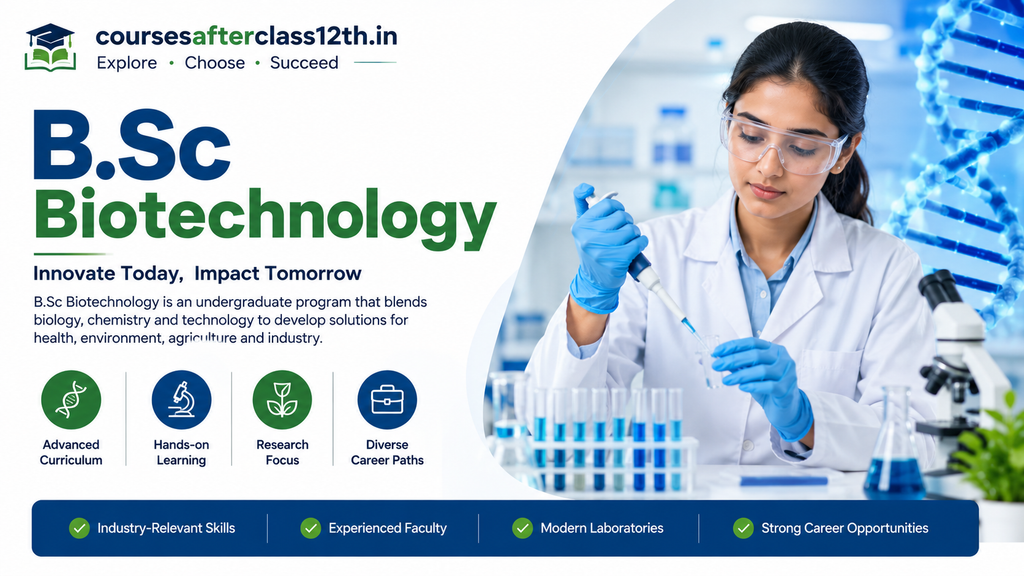
B.Sc Biotechnology is a three-year undergraduate science degree that combines biology with technology to understand, develop and apply biological processes for practical purposes. The course introduces students to subjects such as cell biology, genetics, microbiology, biochemistry, molecular biology, biotechnology techniques, bioinformatics and laboratory methods.
Biotechnology has become an important field because biological knowledge is increasingly being used to solve problems in healthcare, agriculture, food production, environmental management, industrial manufacturing and scientific research. A B.Sc Biotechnology programme therefore provides students with a foundation in both theoretical science and practical laboratory work.
Students pursuing B.Sc Biotechnology learn how biological systems function at the cellular and molecular levels and how scientific techniques can be used to study, modify or utilise those systems. Depending on the university or college, the curriculum may include laboratory experiments, project work, seminars, internships and exposure to modern biotechnology applications.
For students who enjoy Biology and are interested in laboratory science, research, genetics, microorganisms, healthcare technologies or life sciences, B.Sc Biotechnology can be a suitable undergraduate option after Class 12.
Table of Contents
Quick Answer: What is B.Sc Biotechnology?
B.Sc Biotechnology is a three-year undergraduate degree that combines biological sciences with technological and laboratory-based applications. It covers areas such as genetics, microbiology, molecular biology, biochemistry, cell biology, bioinformatics and biotechnology techniques. After completing the course, graduates can explore opportunities in biotechnology companies, pharmaceutical organisations, diagnostic laboratories, food industries, agricultural biotechnology, research laboratories and related life-science sectors. Students may also pursue M.Sc Biotechnology, M.Sc Microbiology, M.Sc Biochemistry, bioinformatics or other postgraduate programmes.
B.Sc Biotechnology Highlights
| Particular | Details |
| Course Name | Bachelor of Science in Biotechnology |
| Common Name | B.Sc Biotechnology |
| Level | Undergraduate |
| Course Duration | Usually 3 years |
| Academic Pattern | Semester or annual system, depending on institution |
| Eligibility | Generally Class 12 with Science subjects |
| Preferred Subjects | Biology and/or related science subjects, as prescribed by the institution |
| Admission | Merit, entrance examination or institution-specific process |
| Main Areas | Genetics, microbiology, molecular biology, biochemistry, cell biology and biotechnology |
| Learning Mode | Primarily classroom and laboratory-based |
| Practical Training | Laboratory experiments, projects and potentially internships |
| Higher Studies | M.Sc, postgraduate diplomas, specialised life-science programmes and related fields |
| Career Areas | Biotechnology, pharmaceuticals, diagnostics, food, agriculture, research and environmental science |
What is Biotechnology?
Biotechnology is an interdisciplinary field that uses biological organisms, cells, cellular components or biological processes to develop products, technologies and solutions. Although humans have used biological processes for centuries—for example, fermentation in food production—modern biotechnology uses scientific knowledge and laboratory techniques to understand and manipulate biological systems in much greater detail.
Modern biotechnology is closely connected with molecular biology, genetics, microbiology, biochemistry, cell biology and computational science. Scientists use these disciplines to investigate biological mechanisms and develop applications across different industries.
Healthcare is one of the most visible areas of biotechnology. Biotechnology contributes to the development and production of vaccines, therapeutic products, diagnostic technologies and biological medicines. However, biotechnology is much broader than healthcare.
Agricultural biotechnology can support crop improvement, disease management and the development of useful biological products. Industrial biotechnology uses microorganisms, enzymes and biological processes in manufacturing. Environmental biotechnology applies biological systems to waste management, pollution control and environmental monitoring. Food biotechnology contributes to fermentation, food processing, quality control and the development of new food products.
Because of this wide application, students studying B.Sc Biotechnology are exposed to several areas of biological science rather than focusing on only one discipline.
Why Choose This Course?
Choosing an undergraduate programme is an important decision because it can influence future academic and professional opportunities. B.Sc Biotechnology can be considered by students who want to build a career around biological sciences while gaining exposure to technology and laboratory applications.
One major advantage of biotechnology is its interdisciplinary nature. Students do not study biology in isolation. Instead, they gradually learn how genetics, microorganisms, cells, proteins, biochemical reactions and laboratory techniques connect with real-world applications.
Another important aspect is practical learning. Biotechnology is a laboratory-oriented field, so undergraduate programmes generally include practical sessions alongside theoretical subjects. Students may learn laboratory procedures, sample handling, basic analytical techniques, experimental methods and scientific documentation.
The course can also provide a foundation for postgraduate education. Students who want to move towards specialised careers or research may continue with an M.Sc or another relevant postgraduate programme.
Major Reasons to Choose B.Sc Biotechnology
| Reason | Explanation |
| Interdisciplinary learning | Combines biology with technology and laboratory science |
| Practical exposure | Includes laboratory-based learning |
| Diverse applications | Biotechnology is used in healthcare, agriculture, food, industry and environment |
| Research foundation | Provides basic knowledge useful for further scientific study |
| Higher-study opportunities | Graduates can pursue postgraduate programmes in life sciences |
| Multiple career areas | Opportunities exist across several biotechnology-related sectors |
| Emerging technologies | Students can eventually explore areas such as genomics, bioinformatics and molecular biotechnology |
Eligibility and Admission Process
The eligibility criteria for B.Sc Biotechnology vary between universities, colleges and admission systems. In general, students who have completed Class 12 or an equivalent qualification with relevant Science subjects can apply.
Many institutions prefer or require Biology as one of the subjects studied in Class 12. Some colleges may accept combinations involving Physics, Chemistry, Biology, Mathematics or other science subjects depending on their specific admission rules.
The minimum percentage requirement can also vary. Some institutions admit students based on merit, while others may use an entrance examination or another selection process.
Students should always check the latest eligibility requirements published by the college or university before applying because subject combinations, minimum marks, entrance requirements and reservation policies may differ.
General Eligibility for B.Sc Biotechnology
| Eligibility Factor | General Requirement |
| Educational Qualification | Class 12 or equivalent |
| Stream | Science |
| Important Subject | Biology is commonly preferred or required |
| Other Subjects | May include Physics, Chemistry, Mathematics or related subjects |
| Minimum Marks | Varies by institution |
| Entrance Test | Required by some institutions |
| Age Requirement | Depends on institution and applicable admission rules |
Important: The above represents common eligibility patterns. Individual institutions may have different requirements.
Eligibility and Admission Process
The admission process for B.Sc Biotechnology depends on the institution. Some colleges provide admission based on Class 12 marks, while others may conduct an entrance examination or use a combination of academic performance and entrance scores.
Students should first identify colleges offering B.Sc Biotechnology and check whether the programme is available for the desired academic session. The next step is to review eligibility requirements, application deadlines and admission criteria.
If the institution conducts an entrance examination, candidates need to complete the registration process and appear for the examination. Depending on the admission system, shortlisted candidates may then participate in counselling, choice filling or document verification.
For merit-based admission, the institution may prepare a merit list using qualifying examination marks.
Typical B.Sc Biotechnology Admission Steps
- Complete Class 12 with the required Science subjects.
- Research colleges offering B.Sc Biotechnology.
- Check the institution’s eligibility requirements.
- Determine whether admission is merit-based or entrance-based.
- Complete the application form.
- Upload or submit the required documents.
- Appear for an entrance examination, if applicable.
- Check the merit list or selection result.
- Complete counselling or seat-allocation procedures where applicable.
- Verify original documents.
- Pay the prescribed admission or tuition fee.
- Begin the academic programme.
Documents Required for B.Sc Biotechnology Admission
The documents required can vary by college. However, applicants commonly need educational certificates, identification documents and photographs.
| Document | Purpose |
| Class 10 certificate | Date of birth and academic verification |
| Class 12 mark sheet | Verification of qualifying examination |
| Class 12 certificate | Educational qualification |
| Transfer certificate | Institution-related documentation |
| Migration certificate | Required in some cases |
| Identity proof | Applicant identification |
| Passport-size photographs | Application and admission records |
| Category certificate | Where applicable |
| Entrance examination scorecard | Where applicable |
| Domicile certificate | Where required by admission rules |
Students should keep both physical and digital copies of important documents to make the application process easier.
Course Duration and Structure
B.Sc Biotechnology is generally a three-year undergraduate programme in the conventional structure. However, the exact academic framework can vary according to the university and applicable higher-education regulations.
The programme is normally divided into multiple semesters. During the initial stages, students are introduced to fundamental biological and chemical concepts. As they progress, they study more specialised subjects related to biotechnology and laboratory science.
Practical work usually becomes increasingly important as students progress through the programme. The final part of the degree may include project work, seminars, internships or research-oriented activities depending on the curriculum.
Subjects and Syllabus
The B.Sc Biotechnology syllabus is designed to provide students with a foundation in biological sciences and gradually introduce them to biotechnology applications.
The exact syllabus differs among universities. However, common areas may include cell biology, microbiology, genetics, biochemistry, molecular biology, biotechnology, immunology, bioinformatics and laboratory techniques.
Common B.Sc Biotechnology Subjects
| Subject Area | What Students Learn |
| Cell Biology | Structure and functions of cells |
| Genetics | Principles of heredity and genetic variation |
| Microbiology | Microorganisms and their characteristics |
| Biochemistry | Chemical processes occurring in living organisms |
| Molecular Biology | DNA, RNA and protein-related biological processes |
| Immunology | Immune system and immune responses |
| Biotechnology | Applications of biological systems and techniques |
| Bioinformatics | Use of computational tools in biological sciences |
| Plant Biotechnology | Biotechnology applications involving plants |
| Animal Biotechnology | Applications involving animal cells and systems |
| Environmental Biotechnology | Biological approaches to environmental problems |
| Industrial Biotechnology | Use of biological processes in industry |
| Laboratory Techniques | Basic practical and analytical methods |
| Research Methodology | Scientific investigation and research practices |
Subjects and Syllabus
The following is a representative structure. Universities can arrange subjects differently.
First Year
The first year generally focuses on foundational science.
Students may study:
- Cell Biology
- General Biology
- Basic Chemistry
- Biochemistry
- Microbiology
- Mathematics or statistics for life sciences
- Basic biotechnology
- Laboratory practicals
The purpose of the first year is to help students understand the fundamental principles required for advanced biotechnology subjects.
Second Year
The second year generally introduces more specialised areas.
Possible subjects include:
- Genetics
- Molecular Biology
- Microbial Biotechnology
- Immunology
- Plant Biotechnology
- Animal Biotechnology
- Biophysical techniques
- Molecular techniques
- Bioinformatics
- Practical laboratory work
At this stage, students begin to understand how biological processes can be studied and applied using biotechnology methods.
Third Year
The final year generally focuses on advanced applications and practical exposure.
Possible subjects include:
- Genetic Engineering
- Industrial Biotechnology
- Environmental Biotechnology
- Pharmaceutical Biotechnology
- Recombinant DNA Technology
- Advanced Molecular Biology
- Bioinformatics
- Research Methodology
- Project Work
- Internship or practical training
The actual third-year syllabus depends on the university and may include specialised electives.
Practical Training in B.Sc Biotechnology
Laboratory work is an important component of biotechnology education. Biotechnology is not limited to memorising biological concepts; students need to understand how scientific methods are applied in practical settings.
During laboratory sessions, students may learn basic procedures related to microbiology, biochemistry, molecular biology and other areas. Depending on institutional facilities and curriculum, students may receive exposure to techniques involving sample preparation, microscopy, biological analysis and laboratory documentation.
Practical learning also teaches students how to follow laboratory protocols, maintain records, interpret experimental observations and work responsibly in a scientific environment.
The quality of practical exposure can vary considerably between institutions. Therefore, students comparing colleges should look beyond the course title and investigate laboratory infrastructure, faculty expertise, project opportunities and internship exposure.
Skills Developed During B.Sc Biotechnology
A biotechnology graduate needs more than subject knowledge. The course can help develop a combination of scientific, analytical, practical and communication skills.
Important Skills
Laboratory skills: Students learn how to follow experimental procedures and maintain laboratory records.
Analytical thinking: Biotechnology requires interpretation of experimental observations and biological data.
Scientific communication: Students may prepare laboratory reports, project reports, presentations and seminars.
Research skills: Students learn the basic principles of scientific investigation.
Problem-solving: Laboratory and research activities require students to identify problems and consider appropriate solutions.
Teamwork: Biotechnology projects frequently involve collaboration.
Data interpretation: Students may work with biological observations, experimental results and basic datasets.
Technical awareness: Depending on the curriculum, students may gain introductory exposure to biotechnology instruments and computational tools.
Career Opportunities After Graduation
A B.Sc Biotechnology degree can lead to entry-level opportunities across several life-science sectors. However, the exact roles available to a graduate depend on skills, practical experience, employer requirements and educational qualifications.
Graduates may explore roles in biotechnology companies, pharmaceutical organisations, diagnostic laboratories, food and beverage industries, agricultural biotechnology, environmental organisations and research institutions.
Career Areas After B.Sc Biotechnology
| Sector | Possible Work Areas |
| Biotechnology | Laboratory and biotechnology operations |
| Pharmaceuticals | Quality control, laboratory support and related functions |
| Diagnostics | Laboratory testing and technical support |
| Food Industry | Quality testing and food biotechnology |
| Agriculture | Plant biotechnology and agricultural research support |
| Research | Research assistance and laboratory work |
| Environmental Science | Environmental monitoring and biotechnology applications |
| Clinical Research | Entry-level research-support functions |
| Bioinformatics | Data-oriented roles with appropriate additional skills |
| Education | Academic support and teaching-related pathways with required qualifications |
| Sales & Technical Support | Scientific product and laboratory equipment support |
Job Profiles After B.Sc Biotechnology
Graduates can consider a range of job titles, although employers may use different names for similar roles.
1. Laboratory Technician
A laboratory technician may support routine laboratory operations, sample handling, documentation and testing procedures. The exact responsibilities depend on the organisation and laboratory type.
2. Research Assistant
Research assistants support scientific projects under the supervision of researchers or senior scientists. Their work can involve laboratory procedures, documentation, data collection and research-related activities.
3. Quality Control Executive
Quality control professionals help organisations maintain product and process standards. In pharmaceutical, food and biotechnology environments, quality control can involve laboratory testing and documentation.
4. Microbiology Laboratory Assistant
Graduates with relevant microbiology knowledge may explore laboratory support roles involving microorganisms and related testing procedures.
5. Biotechnology Associate
Some biotechnology organisations recruit graduates for entry-level technical, laboratory or operational positions.
6. Clinical Research Support
Students with relevant additional training may explore entry-level opportunities in clinical research operations and documentation.
7. Bioinformatics Trainee
Students who develop computational, statistics and biological-data skills can explore entry-level bioinformatics opportunities.
8. Technical Sales Executive
Scientific companies also require professionals who understand laboratory products, equipment and biotechnology-related solutions. Graduates with strong communication skills may consider technical sales or business-development roles.
Salary and Career Growth
The salary after B.Sc Biotechnology varies considerably depending on the employer, job profile, location, skills, experience and additional qualifications.
Fresh graduates generally enter at entry-level positions. Salary can increase as professionals gain practical experience, develop specialised skills or complete postgraduate education.
It is better to evaluate salary as a range rather than assume a single fixed figure because biotechnology careers cover many different job functions.
Factors Affecting Biotechnology Salary
| Factor | Impact |
| Job role | Technical and specialised roles may have different salary structures |
| Experience | Compensation generally changes with professional experience |
| Employer | Large organisations and specialised companies may offer different packages |
| Location | Salaries can vary across cities and regions |
| Skills | Laboratory, analytical, computational and technical skills can influence opportunities |
| Higher education | Postgraduate qualifications can expand access to specialised roles |
| Industry | Pharmaceutical, biotech, diagnostics, food and research sectors have different requirements |
Students should therefore avoid choosing a college solely because of advertised salary figures. Placement percentage, median outcomes, job roles, recruiter quality and career progression can provide a more meaningful picture.
Government Jobs After B.Sc Biotechnology
B.Sc Biotechnology graduates may be eligible for certain government, public-sector, laboratory or research-related opportunities depending on the specific recruitment notification.
Government organisations generally define educational qualifications for each position separately. Therefore, a B.Sc Biotechnology degree does not automatically qualify a candidate for every biotechnology or science-related government position.
Students interested in government careers should regularly check official recruitment notifications and verify:
- Required degree
- Subject requirements
- Minimum marks
- Age limit
- Examination requirements
- Experience criteria
- Reservation provisions
- Application deadlines
Relevant opportunities may arise in research organisations, laboratories, public health-related institutions, universities, agricultural institutions and other scientific organisations, depending on recruitment requirements.
Higher Studies and Further Education
Higher education is an important route for students who want to develop specialised knowledge or move towards research-oriented careers.
One of the most common choices is M.Sc Biotechnology. Other possibilities include M.Sc Microbiology, M.Sc Biochemistry, M.Sc Molecular Biology, M.Sc Bioinformatics and other life-science programmes.
Students should choose postgraduate programs according to their interests and long-term career goals.
Popular Higher Study Options
| Course | Suitable For |
| M.Sc Biotechnology | Advanced biotechnology study |
| M.Sc Microbiology | Microorganisms and microbiological research |
| M.Sc Biochemistry | Biological chemistry and biochemical research |
| M.Sc Molecular Biology | Molecular-level biological research |
| M.Sc Bioinformatics | Biology combined with computational analysis |
| M.Sc Genetics | Genetic science and related research |
| M.Sc Life Sciences | Broader life-science education |
| MBA in Healthcare/Pharmaceutical Management | Management and business roles |
| PG Diploma | Specialised professional training |
B.Sc Biotechnology and M.Sc Biotechnology
B.Sc Biotechnology and M.Sc Biotechnology represent two different levels of higher education.
At the undergraduate level, students build foundational knowledge of biotechnology and related life sciences. In contrast, M.Sc Biotechnology provides advanced and specialised study, often with greater emphasis on research, laboratory work and specific areas of biotechnology.
| Feature | B.Sc Biotechnology | M.Sc Biotechnology |
| Level | Undergraduate | Postgraduate |
| Typical Duration | 3 years | Usually 2 years |
| Entry Requirement | Class 12 | Relevant bachelor’s degree |
| Focus | Fundamentals and applications | Advanced and specialised study |
| Laboratory Exposure | Basic to intermediate | More advanced |
| Research Exposure | Introductory | Generally greater |
| Career Level | Entry-level | More specialised opportunities |
Is B.Sc Biotechnology a Good Career Option?
B.Sc Biotechnology can be a good option for students who have a genuine interest in biological sciences and are comfortable with laboratory-based learning.
However, students should have realistic expectations. A bachelor’s degree alone may lead primarily to entry-level opportunities, while specialised scientific and research positions may require postgraduate education or additional technical training.
Students who want to build a stronger career profile can combine their degree with internships, laboratory experience, research projects, computational skills, scientific communication and postgraduate study.
The course can be particularly attractive to students who want to remain connected to Biology but do not want to pursue conventional medical education.
B.Sc Biotechnology vs B.Sc Microbiology
Both programmes belong to the life-science domain, but their academic focus differs.
B.Sc Biotechnology generally covers biological systems along with their technological and industrial applications. B.Sc Microbiology focuses more specifically on microorganisms such as bacteria, fungi, protozoa and other microbial systems.
| Parameter | B.Sc Biotechnology | B.Sc Microbiology |
| Main Focus | Biological technology and applications | Microorganisms |
| Scope | Broad interdisciplinary | More specialised in microbiology |
| Genetics | Important | Important |
| Molecular Biology | Important | Important |
| Industrial Applications | Broad | Strong microbial applications |
| Research Areas | Biotechnology, genetics, molecular biology, etc. | Microbiology and microbial sciences |
| Suitable For | Students wanting interdisciplinary exposure | Students strongly interested in microorganisms |
B.Sc Biotechnology vs B.Sc Biochemistry
Biochemistry focuses primarily on the chemical processes occurring inside living organisms. Biotechnology uses biological systems and scientific techniques to develop applications and products.
| Parameter | B.Sc Biotechnology | B.Sc Biochemistry |
| Core Focus | Biological applications and technology | Chemistry of biological processes |
| Genetics | Strong component | Relevant |
| Molecular Biology | Strong | Strong |
| Chemistry | Important | Very important |
| Industrial Application | Broad | Research and laboratory focused |
| Career Direction | Biotechnology and related industries | Biochemistry, laboratory and research fields |
B.Sc Biotechnology Fees
The B.Sc Biotechnology fees vary significantly depending on the college, university, location, facilities and institutional category.
Government or public institutions may have comparatively lower tuition fees, while private universities and colleges may charge higher fees. Additional expenses can include laboratory charges, examination fees, accommodation, transportation, books and other institutional charges.
Students should therefore calculate the complete cost of education rather than looking only at tuition fees.
Expenses to Consider
| Expense | Possible Cost Component |
| Tuition Fee | Main academic fee |
| Examination Fee | Semester or annual examination |
| Laboratory Fee | Practical and laboratory facilities |
| Hostel | Accommodation where applicable |
| Food | Hostel or personal living expenses |
| Books | Academic resources |
| Transport | Daily commuting |
| Project Expenses | Final-year or practical project costs |
Always verify the latest fee structure directly from the institution before taking admission.
Factors to Consider When Choosing a B.Sc Biotechnology College
Selecting the right college can be as important as selecting the course.
Students should investigate the academic environment, faculty, laboratory facilities, curriculum, internships, project opportunities and placement information.
College Selection Checklist
1. Laboratory Infrastructure
Biotechnology is a practical subject. Students should check whether the college provides appropriate laboratory facilities and practical exposure.
2. Faculty
Experienced and academically qualified faculty can improve the learning experience.
3. Curriculum
Compare the syllabus and identify whether it covers modern biotechnology areas.
4. Project Opportunities
A meaningful project can help students develop practical and research skills.
5. Internship Exposure
Internships can provide exposure to professional laboratory and industrial environments.
6. Placement Information
Check actual placement data, job roles and recruiter details rather than focusing only on the highest package.
7. Higher Education Support
Students planning postgraduate studies can benefit from colleges with strong academic and research environments.
8. Infrastructure
Library resources, laboratories, classrooms and other facilities should also be considered.
B.Sc Biotechnology Internship
Internships can help students understand how biotechnology knowledge is applied outside the classroom.
Depending on availability, students may seek internships in biotechnology companies, research laboratories, pharmaceutical organisations, diagnostic facilities, food companies, agricultural organisations or academic research laboratories.
An internship may provide exposure to laboratory procedures, quality systems, scientific documentation, workplace communication and professional responsibilities.
Students should evaluate internships based on the actual learning opportunity rather than simply collecting certificates.
Project Work in B.Sc Biotechnology
Project work can be an important part of undergraduate biotechnology education. A project gives students an opportunity to apply theoretical concepts to a defined scientific question or practical problem.
Possible project themes can include areas such as microbiology, plant biotechnology, environmental biotechnology, food biotechnology, molecular biology, bioinformatics or basic laboratory analysis.
A good project should involve clear objectives, appropriate methodology, systematic observations, data interpretation and a properly documented conclusion.
Benefits of Project Work
- Improves practical understanding
- Develops research skills
- Builds scientific writing ability
- Improves presentation skills
- Encourages analytical thinking
- Provides experience in scientific documentation
- Can strengthen a postgraduate application
Role of Bioinformatics in Biotechnology
Modern biotechnology increasingly intersects with computational science. Bioinformatics involves using computational methods to manage, analyse and interpret biological information.
Students interested in this area can develop additional skills in statistics, programming, databases and biological-data analysis.
Bioinformatics can be particularly useful for students interested in genomics, molecular biology, computational biology and large biological datasets.
A B.Sc Biotechnology student does not necessarily graduate as a bioinformatics specialist, but developing computational skills can broaden career possibilities.
Biotechnology in Healthcare
Healthcare is one of the most significant application areas of biotechnology.
Biotechnology contributes to areas such as molecular diagnostics, vaccines, therapeutic products, biologics, laboratory testing and biomedical research.
Students studying biotechnology learn the biological principles that support these applications. However, professional responsibilities in clinical and regulated healthcare environments depend on specific qualifications, certifications and institutional requirements.
This distinction is important: a B.Sc Biotechnology degree provides a life-science and biotechnology foundation, but it does not automatically qualify a graduate for every clinical healthcare role.
Biotechnology in Agriculture
Agricultural biotechnology uses biological knowledge to address agricultural challenges and improve plant-related processes.
Areas of application can include crop improvement, plant tissue culture, molecular breeding, biological pest management and research into plant traits.
Students interested in plant science can explore further education and career pathways related to plant biotechnology, agricultural biotechnology and life-science research.
Biotechnology in Food Industry
Biotechnology has a long history in food production. Fermentation is one of the best-known examples of using microorganisms for food-related applications.
Modern food biotechnology extends into areas such as food processing, microbial cultures, enzyme applications, quality testing and development of specialised food products.
Graduates may explore quality control, laboratory testing, production support and related roles depending on their qualifications and employer requirements.
Environmental Biotechnology
Environmental biotechnology applies biological processes to environmental challenges.
Microorganisms and biological systems can be used in areas associated with wastewater treatment, waste management, pollution monitoring and environmental remediation.
This area can interest students who want to combine biological science with environmental sustainability.
Further study in environmental biotechnology, environmental science or related disciplines can provide deeper specialisation.
Industrial Biotechnology
Industrial biotechnology uses biological systems, enzymes or microorganisms to support manufacturing processes.
Applications can occur across areas such as chemicals, food, enzymes, bio-based products and other industrial processes.
The field is particularly relevant to students interested in understanding how laboratory discoveries can be converted into scalable industrial processes.
Pharmaceutical Biotechnology
Pharmaceutical biotechnology involves the use of biotechnology in the development, production or analysis of pharmaceutical and biological products.
B.Sc Biotechnology students may gain foundational knowledge relevant to this area through subjects such as molecular biology, biochemistry, microbiology and genetics.
However, specialised pharmaceutical roles may require additional qualifications and industry-specific training.
Research Opportunities After B.Sc Biotechnology
Students interested in research can begin developing their research profile during undergraduate education.
Participating in academic projects, internships, seminars and laboratory activities can help students understand scientific research.
For advanced research careers, postgraduate education is generally an important step. Students may pursue an M.Sc followed by research training and, depending on their goals, doctoral education.
Typical Academic Research Path
Class 12 Science → B.Sc Biotechnology → M.Sc Biotechnology/Life Sciences → Research Experience → Ph.D. or specialised career
The exact pathway depends on the student’s research interest and the eligibility requirements of the programme or institution.
B.Sc Biotechnology for Students After 12th
Students who have completed Class 12 in the Science stream and have an interest in Biology can consider B.Sc Biotechnology as one of the undergraduate options available after school.
Unlike professional medical programmes, biotechnology focuses primarily on biological science, laboratory technology and industrial or research applications.
It can therefore suit students who enjoy Biology and scientific investigation but are interested in a broader life-science career pathway.
What Do B.Sc Biotechnology Students Study?
A typical biotechnology student studies biological organisation at multiple levels.
At the cellular level, students learn how cells are structured and how they perform essential functions. Genetics introduces principles of heredity and variation. Molecular biology explains biological processes involving DNA, RNA and proteins.
Microbiology introduces microorganisms and their applications, while biochemistry examines the chemical reactions that support life.
As students progress, biotechnology subjects connect these foundational concepts with practical applications and laboratory methods.
Challenges of Studying B.Sc Biotechnology
While biotechnology offers interesting opportunities, students should understand the challenges before selecting the programme.
The course requires regular study of scientific concepts and terminology. Laboratory work requires accuracy, patience and attention to safety procedures.
Students interested in research careers may need to pursue postgraduate education. Entry-level employment can also be competitive, particularly for students without practical experience or specialised skills.
Common Challenges
| Challenge | How Students Can Address It |
| Extensive scientific terminology | Maintain regular study habits |
| Laboratory learning | Practise procedures and maintain proper records |
| Competitive entry-level jobs | Develop practical and technical skills |
| Need for specialisation | Consider postgraduate education |
| Limited industry exposure | Pursue meaningful internships |
| Changing technology | Continue learning after graduation |
How to Build a Strong Career After B.Sc Biotechnology
A degree is the starting point rather than the end of professional development.
Students can strengthen their profile by developing practical laboratory skills and gaining exposure to scientific research. Communication skills are equally important because scientists and biotechnology professionals often need to prepare reports, explain results and work in multidisciplinary teams.
Students interested in computational biotechnology can learn programming and data analysis. Those interested in laboratory careers can focus on practical techniques and quality systems.
Career Development Strategy
- Build strong fundamentals during the degree.
- Take laboratory practicals seriously.
- Participate in academic projects.
- Look for relevant internships.
- Develop scientific communication skills.
- Learn basic data analysis.
- Explore biotechnology software and databases where relevant.
- Attend seminars and academic events.
- Research postgraduate options early.
- Select a specialisation according to career goals.
Future Scope of B.Sc Biotechnology
The future scope of biotechnology is linked to developments across biological research, healthcare, agriculture, food science, environmental sustainability and industrial applications.
Scientific progress is creating new areas of study in genomics, molecular diagnostics, synthetic biology, computational biology, precision medicine and biological manufacturing.
However, future opportunities will depend on both the growth of the industry and the skills developed by individual professionals.
Students should therefore avoid thinking of the B.Sc degree as a guarantee of a particular job. Instead, they should use the undergraduate programme to build a strong foundation and then specialise through experience or higher education.
Emerging Areas in Biotechnology
Biotechnology continues to expand into several advanced areas.
Genomics
Genomics focuses on the study of complete genetic information and has applications in research, medicine and agriculture.
Synthetic Biology
Synthetic biology combines biological knowledge with engineering concepts to design or modify biological systems.
Computational Biology
Computational biology uses computational methods to understand biological systems and datasets.
Precision Medicine
Biological and genetic information can contribute to more personalised approaches to healthcare.
Bioprocessing
Bioprocessing involves the use of biological systems for producing useful products at scale.
Molecular Diagnostics
Modern molecular techniques can help identify biological markers associated with diseases and other conditions.
B.Sc Biotechnology Career Roadmap
A student can follow different career pathways after completing B.Sc Biotechnology.
Path 1: Industry
B.Sc Biotechnology → Internship → Entry-Level Biotechnology/Laboratory Role → Experience → Specialisation → Career Growth
Path 2: Research
B.Sc Biotechnology → Research Project → M.Sc → Research Experience → Ph.D./Research Career
Path 3: Bioinformatics
B.Sc Biotechnology → Programming & Data Skills → Bioinformatics Training → Entry-Level Role → Specialisation
Path 4: Management
B.Sc Biotechnology → Industry Experience or Higher Study → MBA/Management Education → Healthcare/Pharmaceutical/Biotechnology Management
Path 5: Academic Career
B.Sc Biotechnology → M.Sc → Further Academic Qualification → Teaching/Research Pathway as per applicable eligibility requirements
Is B.Sc Biotechnology Suitable for You?
B.Sc Biotechnology may be suitable if you:
- Enjoy Biology and scientific subjects.
- Are interested in laboratory work.
- Want to understand genetics and molecular biology.
- Are interested in biotechnology applications.
- Like scientific experiments and research.
- Are willing to develop technical skills.
- Are open to postgraduate education.
- Want career options beyond conventional medical courses.
It may be less suitable if you strongly dislike laboratory work, scientific study or detailed biological concepts.
Frequently Asked Questions About B.Sc Biotechnology
1. What is B.Sc Biotechnology?
B.Sc Biotechnology is an undergraduate science programme that combines biological sciences with technological and laboratory applications. It covers subjects such as genetics, microbiology, molecular biology, biochemistry, cell biology and biotechnology.
2. What is the duration of B.Sc Biotechnology?
B.Sc Biotechnology is generally a three-year undergraduate programme, although the academic structure can vary between institutions.
3. Can I pursue B.Sc Biotechnology after Class 12?
Yes. Students who meet the Science-subject and other eligibility requirements specified by a college or university can apply for B.Sc Biotechnology.
4. Is Biology compulsory for B.Sc Biotechnology?
Biology is commonly required or preferred, but eligibility varies among institutions. Students should check the exact subject requirements of the college they wish to join.
5. What subjects are taught in B.Sc Biotechnology?
Common subjects include cell biology, genetics, microbiology, biochemistry, molecular biology, immunology, biotechnology, bioinformatics and laboratory techniques.
6. Is B.Sc Biotechnology a medical course?
No. B.Sc Biotechnology is a life-science and biotechnology degree rather than a medical degree. It focuses on biological science, laboratory techniques, biotechnology applications and research.
7. What can I do after B.Sc Biotechnology?
Graduates can explore entry-level opportunities in biotechnology, pharmaceuticals, diagnostics, food, agriculture, environmental science, research support and related sectors. Higher studies can also lead to specialised career pathways.
8. Can I do M.Sc after B.Sc Biotechnology?
Yes. M.Sc Biotechnology is one of the common postgraduate options. Depending on eligibility, students may also consider M.Sc Microbiology, Biochemistry, Molecular Biology, Bioinformatics and other life-science programmes.
9. Is B.Sc Biotechnology good for research?
Yes. The course provides a foundation in biological sciences and laboratory methods that can be useful for students planning to pursue postgraduate education and research.
10. What is the salary after B.Sc Biotechnology?
Salary varies according to job role, employer, location, experience, skills and qualifications. Fresh graduates generally enter at entry-level positions, while specialised skills and higher qualifications can improve career opportunities.
11. Can B.Sc Biotechnology graduates work in pharmaceutical companies?
Yes, graduates may explore eligible entry-level laboratory, quality, technical or support positions in pharmaceutical and biotechnology organisations, subject to employer requirements.
12. Can B.Sc Biotechnology graduates work in hospitals?
Some life-science or laboratory-related positions may be available depending on the organisation and applicable qualification requirements. However, B.Sc Biotechnology does not automatically qualify a graduate for regulated clinical or medical roles.
13. Is B.Sc Biotechnology difficult?
The course requires understanding of Biology, Chemistry and scientific concepts and includes laboratory work. Students who regularly study and develop practical skills can manage the programme effectively.
14. What are the best skills for biotechnology students?
Laboratory skills, analytical thinking, scientific communication, research methodology, data interpretation and basic computational skills can be valuable.
15. Does B.Sc Biotechnology have scope in India?
Yes. Biotechnology has applications across healthcare, pharmaceuticals, diagnostics, agriculture, food, research, industrial processes and environmental science. Career opportunities depend on qualifications, skills and industry demand.
16. Can I work in bioinformatics after B.Sc Biotechnology?
Students can explore bioinformatics after developing additional computational, programming, statistics and biological-data analysis skills. Specialised bioinformatics roles may require further education or training.
17. Is internship important during B.Sc Biotechnology?
An internship can provide useful exposure to professional environments, laboratory procedures, documentation and workplace practices. Students should focus on the actual learning value of an internship.
18. Can I pursue a Ph.D. after B.Sc Biotechnology?
Students generally pursue postgraduate education before entering advanced doctoral research, subject to the eligibility requirements of the relevant institution and programme.
19. Which is better: B.Sc Biotechnology or B.Sc Microbiology?
Neither is universally better. B.Sc Biotechnology is broader and interdisciplinary, while B.Sc Microbiology focuses more specifically on microorganisms. The better choice depends on the student’s interests and career plans.
20. What should I check before choosing a B.Sc Biotechnology college?
Students should compare curriculum, laboratory facilities, faculty, internships, project opportunities, placement information, academic environment, fees and higher-study support.
B.Sc Biotechnology – Key Takeaways
| Question | Short Answer |
| What is B.Sc Biotechnology? | An undergraduate degree combining biological science with biotechnology applications |
| Duration | Generally 3 years |
| Eligibility | Usually Class 12 Science with relevant subjects |
| Main Subjects | Genetics, microbiology, biochemistry, molecular biology, cell biology and biotechnology |
| Practical Work | Laboratory experiments, projects and potentially internships |
| Career Areas | Biotechnology, pharmaceuticals, diagnostics, food, agriculture and research |
| Higher Studies | M.Sc Biotechnology and other life-science programmes |
| Salary | Depends on role, employer, skills and experience |
| Future Scope | Expanding applications across healthcare, agriculture, industry, food and environmental science |