
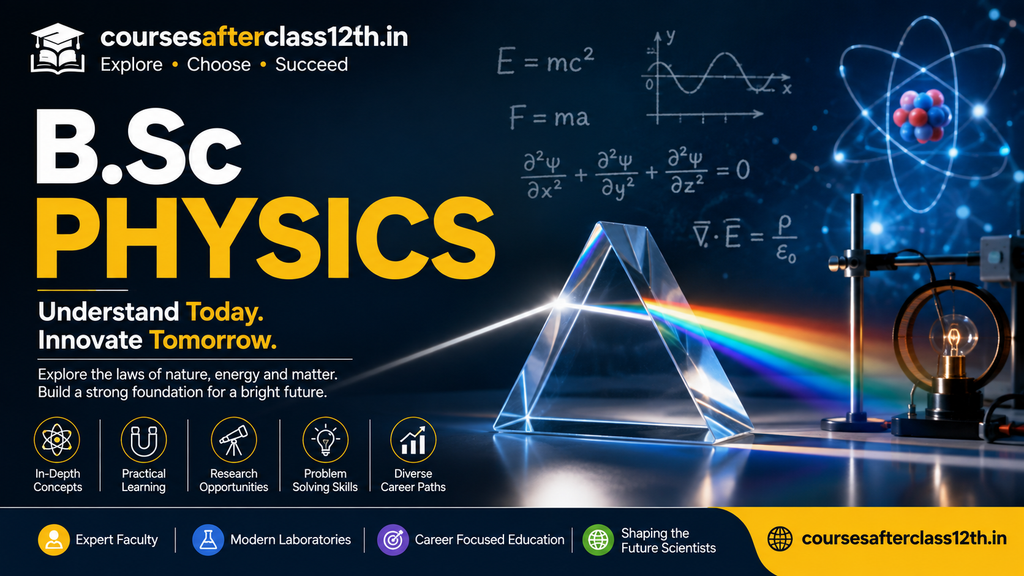
B.Sc Physics is a three-year undergraduate science degree that provides students with a systematic understanding of matter, energy, motion, forces, waves, electricity, magnetism, thermodynamics, optics, electronics and modern physics. The course combines theoretical concepts with mathematical reasoning, laboratory experiments and scientific problem-solving skills.
Physics is one of the fundamental sciences and forms the foundation of several advanced areas such as astrophysics, nuclear physics, quantum physics, materials science, electronics, medical physics, atmospheric science, nanotechnology and computational physics. Students who enjoy mathematics, scientific reasoning, experimentation and understanding how the physical world works can consider B.Sc Physics as a strong undergraduate option.
The course curriculum generally progresses from fundamental concepts to advanced topics. During the programme, students learn how physical laws are developed, tested and applied to real-world situations. Laboratory sessions are an important component of the course because they help students understand how theoretical principles are verified through practical experiments and measurements.
After completing this course, graduates can pursue higher education such as M.Sc Physics, specialised postgraduate programmes, professional certifications and research-oriented programmes. Depending on their qualifications and skills, graduates can explore opportunities in education, laboratories, scientific organisations, electronics, technology, data-related roles, technical services, research support and other industries.
Table of Contents
What is B.Sc Physics?
B.Sc Physics stands for Bachelor of Science in Physics. It is an undergraduate degree programme focused on the scientific study of matter, energy, space, time and the interactions between them.
The programme introduces students to classical and modern physics. Classical physics generally includes mechanics, thermodynamics, optics and electromagnetism, while modern physics introduces concepts such as quantum mechanics, atomic physics, nuclear physics and solid-state physics.
This program is not limited to memorising scientific formulas. Students are expected to develop the ability to interpret physical problems, apply mathematical methods, conduct experiments, analyse observations and reach logical conclusions.
The course can also provide a foundation for students interested in scientific research. Those who want to build a research career may continue with M.Sc, followed by advanced research qualifications and specialised training.
Quick Overview of This Course
| Particular | Details |
| Course Name | Bachelor of Science in Physics |
| Degree | B.Sc |
| Course Level | Undergraduate |
| Duration | Generally 3 years |
| Academic Pattern | Semester/annual system depending on university |
| Eligibility | Usually 10+2 with Science subjects |
| Preferred Background | Physics and Mathematics are commonly required/preferred |
| Admission | Merit, entrance examination or university-specific process |
| Course Type | Theoretical + Practical |
| Main Areas | Mechanics, Optics, Electromagnetism, Thermodynamics, Quantum Physics, Electronics and Modern Physics |
| Higher Study | M.Sc Physics and related programmes |
| Career Areas | Research, Education, Laboratories, Technology, Electronics and Scientific Services |
Why Study This course?
Physics provides a way of understanding natural phenomena through observation, mathematical modelling and experimentation. Studying physics can therefore help students develop transferable analytical and problem-solving skills.
One of the major advantages of this degree is that the knowledge gained during the course can be applied across multiple scientific and technical disciplines. Physics graduates may move towards research, education, technology, electronics, data analysis, scientific computing or specialised postgraduate education.
Another advantage is the strong foundation the course can provide for higher studies. Students who perform well academically can pursue M.Sc Physics and later specialise in areas such as astrophysics, condensed matter physics, nuclear physics, particle physics, materials science, medical physics or other related fields.
This program can also be useful for students preparing for competitive examinations or technical careers because the programme develops mathematical reasoning, quantitative analysis and scientific understanding.
Key Benefits of this Program
| Benefit | Explanation |
| Strong Scientific Foundation | Builds knowledge of fundamental physical principles |
| Analytical Thinking | Develops logical and quantitative problem-solving abilities |
| Practical Exposure | Laboratory work provides experience with experiments and measurements |
| Higher Study Opportunities | Provides a foundation for M.Sc and research-oriented education |
| Interdisciplinary Scope | Physics connects with engineering, computing, electronics and material science |
| Research Orientation | Introduces students to scientific investigation |
| Technical Skills | Laboratory and computational work can develop useful technical abilities |
| Competitive Examination Support | Physics and mathematics knowledge can support several examinations |
Eligibility and Admission Requirements
The eligibility criteria for this course can vary between universities and colleges. In general, students completing Class 12 with a Science background can apply.
Physics is normally an important eligibility subject, while Mathematics may also be required or preferred by many institutions. Some universities may specify minimum marks, subject combinations, entrance examinations or additional conditions.
Students should always check the admission notification and eligibility requirements of the particular college or university before applying because the criteria are not identical across institutions.
General Eligibility
A student generally needs to:
- Complete Class 12 or equivalent education from a recognised board.
- Have studied Physics as a relevant subject.
- Meet the institution’s required subject combination.
- Meet the minimum percentage or grade requirement, where applicable.
- Fulfil any entrance examination requirement specified by the institution.
Eligibility Table
| Requirement | General Expectation |
| Educational Qualification | 10+2 or equivalent |
| Stream | Science |
| Physics | Generally required/preferred |
| Mathematics | Often required or preferred |
| Minimum Marks | Depends on the institution |
| Entrance Test | May be applicable |
| Age Criteria | As prescribed by the institution |
Important: Eligibility requirements can change between universities, colleges and admission cycles. Students should verify the current official admission notification before applying.
Admission Process
The admission process depends on the university, college and admission system. Some institutions offer admission based on Class 12 merit, while others may use entrance examinations or a combination of academic performance and entrance scores.
Students should first identify institutions offering this degree and review their eligibility requirements. After confirming eligibility, applicants generally complete an online or offline application form, submit academic documents and pay the applicable application fee.
Where an entrance examination is required, students may need to register separately, appear for the examination and participate in the subsequent counselling or selection process.
Typical Admission Steps
| Step | Process |
| 1 | Research colleges and universities offering this program |
| 2 | Check eligibility criteria |
| 3 | Review admission dates and requirements |
| 4 | Complete the application form |
| 5 | Submit academic and identity documents |
| 6 | Appear for an entrance examination if applicable |
| 7 | Check merit list/selection result |
| 8 | Participate in counselling or document verification |
| 9 | Pay admission/semester fees |
| 10 | Begin the academic programme |
Course Duration
This Degree is generally a three-year undergraduate programme in India. Depending on the university’s academic framework, the programme may be organised into six semesters.
The exact structure can vary. Some institutions may provide different academic pathways, electives, multidisciplinary courses, skill-development modules, internships or project work.
Students should therefore review the curriculum of the specific institution they are considering.
Subjects and Syllabus
The course syllabus generally begins with foundational concepts and gradually moves towards advanced areas. The exact subjects differ between universities.
Common areas include mechanics, mathematical physics, electricity and magnetism, optics, thermodynamics, waves, electronics, atomic physics, nuclear physics, quantum mechanics and solid-state physics.
Laboratory courses usually accompany theoretical subjects so students can understand measurement techniques and experimental methods.
Common Subjects
| Subject/Area | What Students Learn |
| Mathematical Physics | Mathematical methods used to solve physics problems |
| Mechanics | Motion, forces, momentum and physical systems |
| Properties of Matter | Behaviour and characteristics of physical materials |
| Waves and Oscillations | Wave motion, oscillatory systems and related phenomena |
| Electricity | Electric charge, fields, potential and circuits |
| Magnetism | Magnetic fields and electromagnetic phenomena |
| Electromagnetism | Relationship between electric and magnetic fields |
| Optics | Light, lenses, interference, diffraction and related concepts |
| Thermodynamics | Heat, temperature, energy and thermodynamic systems |
| Statistical Physics | Statistical description of physical systems |
| Atomic Physics | Structure and behaviour of atoms |
| Quantum Physics | Fundamental concepts of quantum phenomena |
| Nuclear Physics | Atomic nuclei, nuclear reactions and radiation |
| Solid State Physics | Physical properties and structures of solids |
| Electronics | Electronic components, circuits and systems |
| Laboratory Physics | Experimental methods, measurements and data analysis |
All Year Syllabus
The syllabus of this course is generally divided across multiple semesters. In the initial stages, students study fundamental principles and mathematical tools. Later semesters introduce advanced and specialised concepts.
A representative structure may include:
First-Year Areas
During the first year, students generally build a foundation in physics and mathematics.
Typical topics can include:
- Mathematical methods
- Mechanics
- Properties of matter
- Waves and oscillations
- Basic electricity
- Basic electronics
- Practical laboratory work
The first year is important because students develop the mathematical and conceptual foundation required for more advanced physics.
Second-Year Areas
The second year generally introduces more advanced physical concepts.
Possible topics include:
- Electromagnetic theory
- Optics
- Thermodynamics
- Statistical physics
- Modern physics
- Electronics
- Experimental physics
Students may also begin working with more sophisticated laboratory instruments and data analysis techniques.
Third-Year Areas
The final year generally focuses on advanced and modern physics.
Possible areas include:
- Quantum mechanics
- Nuclear physics
- Atomic physics
- Solid-state physics
- Semiconductor physics
- Advanced electronics
- Computational methods
- Project work
The exact combination depends on the institution.
Practical Training and Laboratory Work
Practical laboratory work is a significant part of physics education. Physics experiments allow students to connect theoretical concepts with measurable physical observations.
During laboratory sessions, students may learn how to use instruments, record measurements, calculate experimental values, estimate errors and interpret results.
Common laboratory activities may involve optics, electricity, magnetism, mechanics, electronics and other physical measurements.
Laboratory work also develops important professional habits such as accurate observation, documentation, safety awareness, systematic experimentation and interpretation of data.
Skills Developed Through Physics Practicals
- Measurement and observation
- Experimental planning
- Instrument handling
- Data recording
- Error analysis
- Graph preparation
- Scientific documentation
- Logical interpretation
- Laboratory safety
- Problem-solving
Skills You Develop
A graduate student can develop a combination of scientific, mathematical, analytical and practical skills.
Important Skills
| Skill | Application |
| Analytical Thinking | Breaking complex problems into manageable parts |
| Mathematical Reasoning | Applying equations and mathematical models |
| Problem Solving | Finding logical solutions to scientific problems |
| Data Analysis | Understanding experimental observations |
| Experimental Skills | Conducting and documenting laboratory work |
| Research Skills | Collecting and evaluating scientific information |
| Technical Communication | Presenting scientific concepts clearly |
| Computer Skills | Using software for calculations, modelling or data analysis |
| Critical Thinking | Evaluating evidence and assumptions |
| Attention to Detail | Important for experiments and measurements |
B.Sc Physics and Mathematics
Mathematics plays an important role in physics. Many physics concepts are expressed using mathematical equations, models and quantitative relationships.
Students who are comfortable with mathematics may find it easier to understand areas such as mechanics, electromagnetism, quantum mechanics and mathematical physics.
However, students do not need to be experts in advanced mathematics before entering the programme. The course itself generally introduces the mathematical methods needed for physics subjects.
Students should focus on strengthening algebra, trigonometry, calculus, vectors, coordinate geometry and other mathematical concepts relevant to their curriculum.
Career Opportunities
The career scope after completing this degree depends on the graduate’s skills, academic performance, specialisation and additional qualifications.
A bachelor’s degree can provide entry-level opportunities in certain technical, educational, laboratory and support roles. However, many advanced scientific and research positions require postgraduate qualifications.
For students interested in long-term scientific careers, pursuing M.Sc Physics can be an important next step. Postgraduate education allows students to develop deeper knowledge in a chosen specialisation and can open additional research and teaching pathways.
Physics graduates may also develop careers outside traditional physics roles by combining their scientific background with computing, data analysis, communication, management or other professional skills.
Career Options After Graduation
Graduates can explore several career directions.
1. Research Assistant
Research assistants support scientific projects by collecting information, conducting experiments, processing observations and maintaining research records. Specific eligibility requirements vary by organisation and position.
2. Laboratory Technician
Physics graduates with suitable practical skills may explore laboratory-related roles involving equipment, measurements, testing and documentation.
3. Technical Assistant
Technical assistants may support scientific, engineering or technical teams in operational and experimental activities.
4. Science Teacher
Graduates interested in education can explore teaching-related pathways. Formal school-teaching eligibility depends on the educational institution, teaching level and applicable regulations.
5. Scientific Content Writer
Students with strong communication skills can combine physics knowledge with writing to create educational articles, study material and technical content.
6. Data-Related Roles
Physics develops quantitative reasoning and data interpretation skills. Graduates who add programming and data analytics skills may explore entry-level data-oriented opportunities.
7. Electronics and Instrumentation
Students with an interest in electronics can explore technical roles related to electronic equipment, testing and instrumentation after developing the required practical skills.
8. Technical Support
Some organisations hire science graduates for technical support, operations and customer-facing technical positions.
Government Career Opportunities After Graduation
The graduates students can explore government-sector opportunities depending on the eligibility criteria of individual recruitment examinations and organisations.
Government career pathways can include positions related to scientific support, laboratories, education, technical operations, public-sector organisations and administrative services.
However, a this degree does not automatically qualify a candidate for every government position. Each recruitment notification specifies its own educational qualifications, age limits, examination structure and other requirements.
Students interested in government employment should regularly check official recruitment notifications.
Higher Studies and Further Education
Higher education is a popular pathway after B.Sc Physics.
M.Sc Physics
M.Sc Physics is one of the most direct postgraduate options. It provides deeper study of theoretical and experimental physics.
Students can later specialise in areas such as:
- Astrophysics
- Nuclear Physics
- Particle Physics
- Condensed Matter Physics
- Quantum Physics
- Materials Science
- Electronics
- Medical Physics
- Computational Physics
- Atmospheric Physics
Other Higher Study Options
Depending on eligibility, students may also consider:
- M.Sc Applied Physics
- M.Sc Electronics
- M.Sc Materials Science
- M.Sc Astronomy/Astrophysics
- Data Science programmes
- Computer-related postgraduate programmes
- Management programmes
- Education programmes
- Research-oriented programmes
The suitability of each option depends on the student’s academic background and the admission requirements of the institution.
B.Sc Physics to M.Sc Physics
The pathway from B.Sc Physics to M.Sc Physics is one of the most common academic progressions.
B.Sc provides the undergraduate foundation, while M.Sc allows students to study advanced theories, mathematical methods, experiments and specialised areas in greater depth.
After M.Sc Physics, students may explore research, teaching, scientific organisations, technical industries and doctoral-level education, subject to the qualifications required for individual positions.
Research Career
Students interested in scientific research should consider building a strong academic foundation during B.Sc.
Useful steps include:
- Developing strong fundamentals in physics.
- Improving mathematical skills.
- Learning basic scientific programming.
- Participating in laboratory projects.
- Reading scientific literature.
- Developing data-analysis skills.
- Pursuing M.Sc or an appropriate postgraduate qualification.
- Exploring research internships where available.
- Building expertise in a specialised physics area.
Research careers generally require higher academic qualifications and specialised expertise.
B.Sc Physics and Technology
Physics is closely connected with technology. Concepts from physics contribute to areas such as semiconductors, electronics, telecommunications, imaging systems, energy technologies, materials science and instrumentation.
A physics graduate who develops additional technical skills can therefore build an interdisciplinary profile.
For example, learning Python, numerical methods, data analysis and scientific computing can complement traditional physics education.
Useful Additional Skills
| Skill | Why It Can Help |
| Python | Data analysis and scientific programming |
| Excel | Basic data organisation and analysis |
| MATLAB/Scientific Computing | Numerical calculations and modelling |
| Data Visualisation | Presenting experimental or numerical data |
| Basic Electronics | Understanding electronic systems |
| Technical Writing | Scientific and technical communication |
| Research Methods | Academic and scientific work |
| Statistics | Data interpretation |
| Communication | Presentations and professional collaboration |
B.Sc Physics and Data Science
Physics graduates often have experience with mathematical modelling, quantitative analysis and interpreting datasets. These skills can be useful when transitioning into data-related fields.
Students interested in this pathway can learn programming languages, statistics, machine learning fundamentals and data visualisation.
The combination of physics and data skills can create opportunities in areas where quantitative reasoning is important.
However, students should understand that a B.Sc Physics degree alone does not make someone a data scientist. Additional technical training and practical projects are generally required for specialised data roles.
B.Sc Physics and Computer Programming
Programming is increasingly useful for students interested in computational physics, simulations and data analysis.
Python is a commonly learned programming language because it has applications in scientific computing, numerical analysis, visualisation and data processing.
Students can begin with:
- Python fundamentals
- Variables and data types
- Conditional statements
- Loops
- Functions
- Arrays
- Data handling
- Basic plotting
- Numerical calculations
- Introductory scientific libraries
Learning programming during B.Sc can complement theoretical and experimental physics.
B.Sc Physics Fees
The total cost of B.Sc Physics varies considerably depending on the institution.
Government colleges and public institutions may have comparatively lower tuition fees, while private institutions may charge higher fees. Additional expenses can include laboratory charges, examination fees, hostel charges, books, transportation and other institutional costs.
Therefore, students should not assume a single standard fee for all B.Sc Physics colleges.
Factors Affecting B.Sc Physics Fees
- Type of institution
- Government or private status
- Location
- Laboratory facilities
- Hostel availability
- University affiliation
- Scholarship policies
- Additional academic charges
Students should check the official fee structure of the college before admission.
B.Sc Physics Salary
The salary after B.Sc Physics depends on job role, location, employer, experience, technical skills and additional qualifications.
Fresh graduates may enter entry-level positions, while postgraduate qualifications and specialised skills can improve access to advanced roles.
It is more useful to evaluate salary according to the specific career path rather than assuming one fixed salary for every B.Sc Physics graduate.
Factors Affecting Salary
| Factor | Impact |
| Educational Qualification | Higher qualifications can support access to advanced roles |
| Technical Skills | Programming and data skills may expand opportunities |
| Experience | Professional experience generally improves career progression |
| Industry | Compensation varies between sectors |
| Location | Salary levels differ by city and region |
| Specialisation | Certain specialised fields may have different demand |
| Employer | Organisation size and type influence compensation |
Students should treat online salary figures as indicative rather than guaranteed.
B.Sc Physics: Job Roles and Work Areas
| Job Role | Typical Work |
| Laboratory Assistant | Supports laboratory experiments and equipment |
| Research Assistant | Supports scientific research projects |
| Technical Assistant | Provides technical and operational support |
| Physics Tutor | Provides academic instruction |
| Science Content Writer | Creates science-based educational content |
| Technical Support Executive | Supports customers or teams with technical information |
| Data Analyst Trainee | Works with data after acquiring relevant analytics skills |
| Electronics Support Professional | Supports electronic equipment and testing |
| Scientific Sales Executive | Explains technical/scientific products to customers |
| Education Counsellor | Guides students regarding science-related programmes |
Job titles and eligibility vary among employers.
Top Industries for Physics Graduates
Physics graduates can potentially work across several industries, particularly after gaining additional qualifications or technical skills.
Major Areas
- Research and development
- Education
- Scientific laboratories
- Electronics
- Semiconductor-related industries
- Instrumentation
- Energy
- Healthcare technology
- Materials science
- Environmental science
- Aerospace-related organisations
- Data and analytics
- Technology
- Scientific publishing
- Technical services
The actual career options available to an individual depend on qualifications and job-specific eligibility.
B.Sc Physics for Students Interested in Astronomy
Students fascinated by planets, stars, galaxies and the universe can use B.Sc Physics as a foundation for further study in astronomy or astrophysics.
Astronomy and astrophysics involve physics, mathematics, computational techniques and observational methods.
Students interested in this pathway should consider postgraduate specialisation and develop skills in mathematics, programming, statistics and scientific data analysis.
B.Sc Physics for Students Interested in Nuclear Physics
Nuclear physics focuses on atomic nuclei, nuclear interactions, radiation and related phenomena.
Students interested in nuclear physics generally continue with postgraduate study and specialised research training.
Because nuclear science is a specialised field, a bachelor’s degree is usually the starting point rather than the final academic qualification for advanced research positions.
B.Sc Physics for Students Interested in Quantum Physics
Quantum physics deals with physical phenomena at microscopic scales and forms the theoretical foundation for several modern technologies.
Students interested in quantum physics can develop a strong foundation through undergraduate physics and pursue postgraduate study in physics or related fields.
Strong mathematics and conceptual understanding are particularly valuable for this pathway.
B.Sc Physics for Students Interested in Electronics
Physics and electronics have significant overlap, particularly in areas involving semiconductors, electronic circuits, sensors and instrumentation.
Students interested in electronics can use laboratory courses to develop practical understanding and may supplement their education with electronics projects and technical certifications.
Is B.Sc Physics a Good Career Option?
B.Sc Physics can be a good undergraduate option for students who have a genuine interest in science, mathematics, experimentation and analytical problem-solving.
However, students should select the course based on their career goals rather than choosing it only because they have studied Physics in Class 12.
B.Sc Physics is particularly suitable for students who are comfortable with mathematical concepts and are interested in understanding how physical systems work.
For students seeking advanced scientific careers, higher education is often an important part of the career journey.
Who Should Choose B.Sc Physics?
B.Sc Physics may be suitable for students who:
- Enjoy studying Physics.
- Have an interest in Mathematics.
- Like solving numerical problems.
- Want to understand natural phenomena.
- Enjoy laboratory experiments.
- Have curiosity about technology and science.
- Are interested in scientific research.
- Want to pursue M.Sc Physics.
- Are interested in astronomy, quantum physics or nuclear science.
- Want to develop analytical and quantitative skills.
Advantages and Challenges of B.Sc Physics
Advantages
B.Sc Physics offers a strong scientific foundation and can prepare students for several academic and technical pathways. The course encourages analytical thinking, mathematical reasoning and experimental understanding.
It can also serve as a foundation for interdisciplinary careers when combined with programming, data analysis, electronics or communication skills.
Challenges
Physics can be mathematically demanding. Students who avoid numerical problem-solving may initially find certain subjects difficult.
Advanced career opportunities in research and specialised scientific fields often require postgraduate education. Therefore, students should consider their long-term academic plans before selecting the programme.
How to Prepare for B.Sc Physics
Students can start preparing before college by strengthening their Class 11 and 12 Physics and Mathematics fundamentals.
Preparation Tips
- Revise basic mechanics.
- Practise numerical problems regularly.
- Strengthen algebra and trigonometry.
- Understand rather than memorise formulas.
- Learn basic graph interpretation.
- Develop scientific curiosity.
- Start basic Python programming.
- Read introductory physics material.
- Practise laboratory calculations.
- Improve written and verbal communication.
B.Sc Physics: Important Practical Skills
Apart from theoretical knowledge, students should try to develop practical skills during their undergraduate education.
These can include:
- Experimental measurement
- Error calculation
- Graphical analysis
- Data interpretation
- Laboratory documentation
- Instrument handling
- Basic programming
- Scientific presentation
- Research methodology
- Technical communication
These skills can make the graduate profile more versatile.
B.Sc Physics Internship and Project Work
Internships and academic projects can help students understand how physics knowledge is used beyond classroom learning.
A project could involve experimental physics, electronics, computational modelling, data analysis, optics, materials or another area supported by the institution.
Students should choose projects that allow them to demonstrate problem-solving, research and analytical abilities.
A well-documented project can also become part of a student’s academic or professional portfolio.
B.Sc Physics Career Roadmap
A typical career roadmap can look like this:
Class 12 Science → B.Sc Physics → Skill Development → Internship/Project → M.Sc or Entry-Level Career → Specialisation → Advanced Career
Students interested in research may follow:
Class 12 → B.Sc Physics → M.Sc Physics → Research/Advanced Qualification → Specialised Scientific Career
Students interested in technology may follow:
Class 12 → B.Sc Physics → Programming/Data/Electronics Skills → Internship → Technical Career
There is no single career path for every physics graduate.
B.Sc Physics vs B.Sc Chemistry
The B.Sc Physics programme focuses primarily on physical laws, matter-energy interactions, mathematical modelling, mechanics, electromagnetism, optics and modern physics.
In comparison, B.Sc Chemistry places greater emphasis on chemical substances, reactions, molecular structures, organic chemistry, inorganic chemistry and analytical chemistry.
Students should choose based on their interests.
| B.Sc Physics | B.Sc Chemistry |
| Mechanics | Organic Chemistry |
| Electromagnetism | Inorganic Chemistry |
| Optics | Physical Chemistry |
| Quantum Physics | Analytical Chemistry |
| Thermodynamics | Biochemistry-related areas |
| Nuclear Physics | Chemical Reactions |
| Electronics | Molecular Chemistry |
B.Sc. Physics vs B.Sc Mathematics
B.Sc Physics applies mathematical concepts to understand physical systems, whereas B.Sc Mathematics focuses primarily on mathematical structures, theories and methods.
Students who enjoy applying mathematics to real-world physical phenomena may prefer Physics, while students more interested in abstract and theoretical mathematics may prefer Mathematics.
Frequently Asked Questions About B.Sc Physics
What is B.Sc Physics?
B.Sc Physics is an undergraduate science degree focused on the study of matter, energy, motion, forces, waves, electricity, magnetism, optics, thermodynamics and modern physics.
What is the duration of B.Sc Physics?
B.Sc Physics is generally a three-year undergraduate programme, although the academic structure can vary according to the institution and applicable educational framework.
What are the eligibility criteria for B.Sc Physics?
Students generally need to complete 10+2 with a Science background and meet the institution’s required subject combination and minimum marks. Physics and Mathematics are commonly required or preferred.
Is Mathematics compulsory for B.Sc Physics?
Mathematics is required or preferred by many institutions, but eligibility rules vary. Students should check the requirements of the specific university or college.
What subjects are taught in B.Sc Physics?
Common subjects include mechanics, mathematical physics, waves, electricity and magnetism, optics, thermodynamics, quantum physics, atomic physics, nuclear physics, solid-state physics, electronics and laboratory work.
What can I do after B.Sc Physics?
After B.Sc Physics, students can pursue M.Sc Physics or related postgraduate programmes, research-oriented education, teaching pathways, technical roles, laboratory work, data-related careers and other opportunities depending on their additional qualifications and skills.
Is B.Sc. Physics difficult?
B.Sc Physics can be academically challenging because it involves mathematics, theoretical concepts and practical work. Students with consistent practice and a strong conceptual approach can manage the programme effectively.
Can I pursue M.Sc Physics after B.Sc Physics?
Yes, B.Sc Physics is a common undergraduate pathway to M.Sc Physics, subject to the eligibility criteria of the university or institution.
Can a B.Sc Physics graduate work in research?
Yes, but many advanced research positions require postgraduate or higher qualifications. B.Sc Physics can provide the foundation for progressing towards research careers.
Can B.Sc Physics graduates enter the IT industry?
Physics graduates can explore technology and IT-related opportunities after developing relevant skills such as programming, data analysis, software tools or other technical competencies.
Can I pursue data science after B.Sc Physics?
Yes. Physics develops quantitative and analytical skills that can be useful for data science. Students should additionally learn programming, statistics, machine learning and data analysis.
What is the salary after B.Sc Physics?
There is no single fixed salary after B.Sc Physics. Compensation depends on the role, employer, location, experience, skills and qualifications. Higher education and specialised technical skills can expand career opportunities.
Is B.Sc Physics good for astronomy?
Yes. B.Sc Physics can provide a strong foundation for students who later want to specialise in astronomy or astrophysics through higher education.
Is B.Sc Physics useful for competitive examinations?
The mathematical and scientific foundation developed during B.Sc Physics can be useful for certain competitive examinations. However, each examination has its own syllabus and eligibility criteria.
Which is better: B.Sc Physics or Engineering?
Neither is universally better. B.Sc Physics is suitable for students interested in fundamental science, research, higher education and analytical study, while engineering programmes are generally more focused on applying scientific principles to design and technology.
Can I become a teacher after B.Sc Physics?
A B.Sc Physics degree can be a foundation for an education career, but formal teaching eligibility depends on the level of teaching, institution and applicable qualification requirements.
What skills should I learn with B.Sc Physics?
Students can benefit from learning programming, data analysis, scientific computing, statistics, technical communication, electronics and research methods alongside their core physics education.
B.Sc Physics: Frequently Asked Questions With Answers
Q: Is B.Sc Physics a good course after Class 12?
Answer: B.Sc Physics can be a strong choice after Class 12 for students interested in Physics, Mathematics, scientific research, technology, and analytical problem-solving. Career goals and interest in higher education should be considered before choosing the programme.
Q: What is the best career after B.Sc Physics?
Answer: There is no single best career for every graduate. Research, teaching, laboratories, technology, electronics, data analysis and scientific services are among the possible directions. The best option depends on the student’s interests, qualifications and additional skills.
Q: What is the next course after B.Sc Physics?
Answer: M.Sc Physics is one of the most direct higher-study options. Students can also explore related postgraduate programmes depending on their eligibility and career goals.
Q: Can B.Sc Physics lead to a high-paying career?
Answer: Physics can lead to specialised and technically demanding careers, but salary is influenced by qualifications, experience, skills, industry and job role. Developing programming, data analysis or specialised scientific expertise can broaden career options.
Q: Does B.Sc Physics have scope in India?
Answer: Yes. B.Sc Physics provides a foundation for higher education and careers related to education, research support, laboratories, electronics, technology, scientific services and interdisciplinary fields. Advanced scientific careers often require postgraduate qualifications.
B.Sc Physics: Career Scope at a Glance
| Career Path | Recommended Development |
| Research | M.Sc + specialised research experience |
| Teaching | Higher education/teaching qualification as required |
| Data Analytics | Statistics + Python + data tools |
| Scientific Computing | Programming + numerical methods |
| Electronics | Electronics projects + practical training |
| Laboratory Work | Experimental and instrumentation skills |
| Technical Industry | Technical knowledge + communication |
| Scientific Writing | Physics knowledge + writing skills |
| Astrophysics | M.Sc/specialisation in relevant field |
| Materials Science | Postgraduate specialisation |
| Nuclear Physics | Advanced study and specialised training |
| Quantum Physics | Strong mathematics + postgraduate study |
Why B.Sc Physics Can Be a Future-Oriented Choice
The relevance of physics extends beyond traditional scientific research. Modern technology relies on scientific principles related to materials, semiconductors, optics, energy, sensors, imaging and computation.
As technology becomes increasingly data-driven, students with strong quantitative backgrounds can combine physics with programming, data science and computational methods.
At the same time, fundamental research remains important for advancing knowledge and developing new technologies.
Therefore, students should view B.Sc Physics not simply as a degree but as a foundation that can be combined with specialised education and practical skills.
How to Choose the Right B.Sc Physics College
Choosing the right institution is an important decision. Students should look beyond advertisements and compare academic and practical facilities.
Factors to Check
| Factor | Why It Matters |
| Curriculum | Determines the subjects and academic depth |
| Faculty | Experienced faculty can improve learning |
| Laboratories | Important for practical physics education |
| Library | Provides access to books and references |
| Computer Facilities | Useful for computational learning |
| Research Exposure | Can support academic development |
| Internship Opportunities | Provides practical exposure |
| Fees | Should fit the student’s budget |
| Location | Affects living and transportation costs |
| Higher Study Support | Useful for postgraduate preparation |
| Student Reviews | Can provide additional perspectives |
Students should verify information through official institutional sources before making a final admission decision.
Documents Generally Required for B.Sc Physics Admission
The exact document requirements differ by institution, but applicants may commonly be asked for:
- Class 10 certificate
- Class 12 marksheet
- Transfer certificate
- Migration certificate, where applicable
- Passport-size photographs
- Identity proof
- Category certificate, where applicable
- Domicile certificate, where applicable
- Entrance examination documents, where applicable
- Other documents specified by the institution
Students should keep both digital and physical copies of required documents when applying.
Scholarships for B.Sc Physics Students
Scholarship availability depends on the institution, government schemes, academic performance, category, income criteria, and other eligibility conditions.
Students should check:
- College-specific scholarships
- University scholarships
- Government scholarship portals
- Merit-based scholarships
- Need-based financial assistance
- Category-specific schemes
- Research or academic awards
Scholarship terms and eligibility can change, so students should verify current information before applying.
Future Scope of B.Sc Physics
The future scope of B.Sc Physics is closely linked with higher education and skill development.
Students can build specialised careers by combining physics with:
Physics + Mathematics
Useful for theoretical and mathematical areas.
Physics + Programming
Useful for computational physics and scientific computing.
Physics + Data Science
Useful for quantitative and analytical careers.
Physics + Electronics
Useful for instrumentation and electronic systems.
Physics + Materials Science
Useful for research into advanced materials.
Physics + Astronomy
Useful for further study in astrophysics and astronomy.
This interdisciplinary approach can help graduates build broader career profiles.