
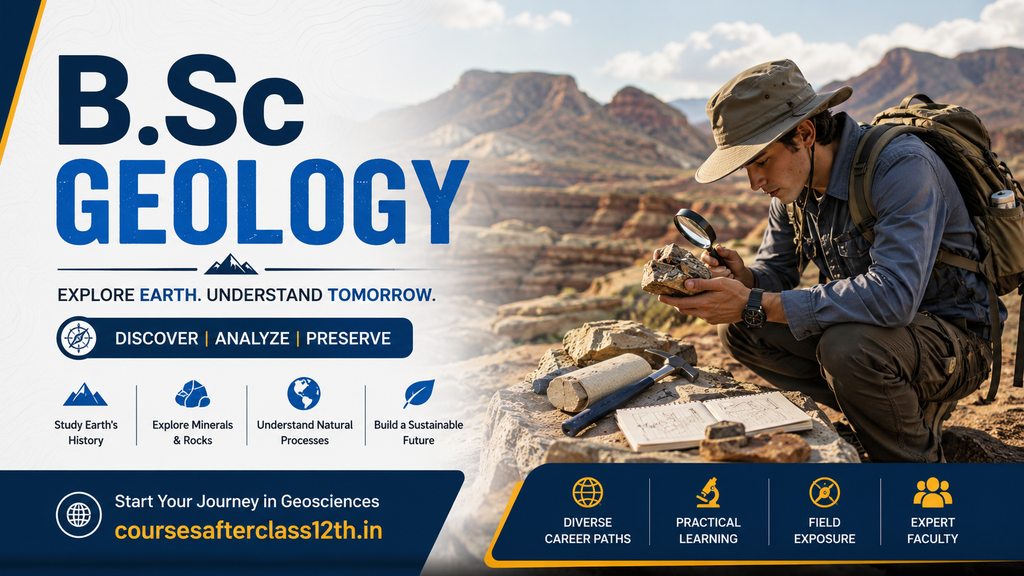
B.Sc Geology is an undergraduate science degree that focuses on the scientific study of the Earth, its materials, structure, history and the geological processes that shape the planet. The course introduces students to subjects such as minerals, rocks, fossils, plate tectonics, geomorphology, sedimentology, structural geology, geochemistry, hydrogeology and environmental geology.
For students who have completed Class 12 with Science and are interested in the Earth, natural resources, mountains, rocks, minerals, groundwater, fossils, climate and geological processes, B.Sc Geology can be an interesting undergraduate career pathway.
Geology is not limited to studying rocks. It helps explain how mountains and valleys form, how earthquakes and volcanoes occur, how groundwater moves beneath the Earth’s surface, how mineral and energy resources are formed and how geological conditions influence construction, agriculture, environmental management and natural-hazard planning.
Table of Contents
B.Sc Geology program
generally combines classroom education with laboratory practicals, geological maps, fieldwork, sample identification, mineral and rock studies, geological observation and project work. Field-based learning is particularly important because many geological concepts become easier to understand when students observe actual rock formations, landscapes and geological structures.
After graduation, students can explore career and higher-education opportunities related to geology, environmental science, mining, groundwater, geoscience, geological surveying, research and education. Students interested in advanced technical or research-oriented careers may pursue postgraduate education such as M.Sc Geology, Applied Geology, Geophysics, Hydrogeology, Environmental Geology or related disciplines.
The exact course structure, eligibility criteria, admission process, fees and career requirements vary by university and college. Students should always check the latest official information before applying.
What is B.Sc Geology?
B.Sc Geology is a Bachelor of Science degree that studies the Earth and the natural processes responsible for its formation, structure and evolution.
Geology examines the materials that make up the Earth, including minerals, rocks and sediments, as well as the processes that transform them over time. It also studies Earth’s history through fossils, rock sequences and geological structures.
The subject covers both theoretical and practical science. Students learn to identify minerals and rocks, interpret geological maps, understand geological structures and analyze Earth’s physical history.
Geology also has strong connections with several applied fields. For example, groundwater studies can support water-resource planning, engineering geology can contribute to infrastructure development, environmental geology can help understand contamination and land-related hazards, while economic geology focuses on mineral resources.
The multidisciplinary nature of geology means students may encounter concepts from chemistry, physics, biology, geography, mathematics and environmental science.
A geology student therefore develops an understanding of the Earth as a dynamic system rather than simply memorizing the names of rocks and minerals.
B.Sc Geology Course Highlights
| Particular | Details |
| Course Name | Bachelor of Science in Geology |
| Short Name | B.Sc Geology |
| Course Level | Undergraduate |
| Duration | Generally 3 years, depending on institutional structure |
| Eligibility | Class 12 or equivalent qualification |
| Common Background | Science stream |
| Relevant Subjects | Physics, Chemistry, Mathematics and/or Biology depending on institution |
| Academic Pattern | Usually semester-based |
| Major Areas | Mineralogy, petrology, geology, geomorphology and Earth science |
| Practical Training | Laboratory work, geological mapping and field studies |
| Fieldwork | Commonly an important part of geological education |
| Higher Studies | M.Sc Geology, Applied Geology and related programs |
| Career Areas | Geology, mining, groundwater, environment, research and surveying |
| Work Settings | Field sites, laboratories, offices, mines, research institutions and consulting organizations |
Why Study B.Sc Geology?
Geology provides students with an opportunity to understand one of the most fundamental scientific questions: How does the Earth work?
The field combines scientific observation, laboratory analysis, field investigation and interpretation.
1. Understand the Earth
Students learn how Earth’s rocks, minerals, oceans, mountains and landscapes are formed and changed over geological time.
2. Strong Field-Based Learning
Geology is one of the science disciplines where fieldwork can play a major role.
Students may visit geological formations, mines, river valleys, hills, sedimentary basins and other locations to observe geological features.
3. Learn About Natural Resources
Geology is closely connected with natural resources such as minerals, groundwater and certain energy resources.
Understanding geological formations can help professionals assess how natural resources are distributed and how they can be managed.
4. Explore Environmental Applications
Geological knowledge can be applied to groundwater management, soil and land studies, natural hazards, environmental assessment and resource conservation.
5. Opportunity for Specialization
After graduation, students can specialize in areas such as:
- Applied Geology
- Hydrogeology
- Geophysics
- Environmental Geology
- Mineral Exploration
- Petroleum Geology
- Engineering Geology
- Structural Geology
- Geochemistry
- Paleontology
B.Sc Geology Eligibility
Eligibility for B.Sc Geology varies between universities and colleges.
Generally, candidates must have completed Class 12 or an equivalent examination from a recognized board.
Many institutions require students to have studied Science subjects. Some may specify Physics and Chemistry along with Mathematics or Biology, while others may have different subject combinations.
Minimum marks may also differ.
General Eligibility Overview
| Requirement | Typical Requirement |
| Educational Qualification | Class 12 or equivalent |
| Stream | Usually Science |
| Relevant Subjects | Physics, Chemistry, Mathematics and/or Biology |
| Minimum Marks | Varies by institution |
| Entrance Examination | Applicable at some institutions |
| Merit Admission | Available at some institutions |
| Age Criteria | Depends on university rules |
Students should check the current prospectus or admission notification of the university before applying.
Can PCB Students Study B.Sc Geology?
PCB students may be eligible for some B.Sc Geology programs, but the eligibility requirements vary considerably among institutions.
Biology can provide useful knowledge for subjects connected with paleontology, environmental science Earth-life interactions.
However, some geology programs may require Mathematics or specific combinations of Science subjects.
Therefore, PCB students should carefully verify the subject requirements before selecting a college.
Can PCM Students Study B.Sc Geology?
PCM students can be well suited to many Geology programs because Physics, Chemistry and Mathematics can provide useful foundations for understanding geological processes.
Physics can help with concepts related to geophysics and Earth’s physical properties.
Chemistry is important for mineralogy and geochemistry.
Mathematics can be useful for measurements, calculations, statistics and quantitative geological analysis.
However, eligibility is institution-specific.
B.Sc Geology Admission Process
The admission process differs from one university to another.
Some institutions admit students based on Class 12 merit, while others may use entrance examinations or centralized admission systems.
A typical process includes:
Step 1: Check Eligibility
Confirm Class 12 subjects and minimum marks.
Step 2: Shortlist Colleges
Compare curriculum, fieldwork, laboratories, faculty, location, fees and career support.
Step 3: Submit Application
Complete the application form according to the university’s instructions.
Step 4: Entrance Examination
Appear for an entrance examination if the institution requires one.
Step 5: Selection
Selection may be based on merit, entrance performance or another approved process.
Step 6: Document Verification
Submit the required educational and identification documents.
Step 7: Admission Confirmation
Pay applicable fees and complete enrollment formalities.
Admission rules can change, so students should rely on the latest official notification.
B.Sc Geology Duration
B.Sc Geology is generally structured as a three-year undergraduate program, although the exact structure can vary according to the university and higher-education framework.
The degree is typically divided into semesters.
The early part of the program generally establishes fundamental Earth Science concepts. Students later move toward specialized subjects such as structural geology, petrology, geomorphology, stratigraphy, economic geology and hydrogeology.
Fieldwork and practical exercises may be integrated throughout the course.
B.Sc Geology Subjects
The exact syllabus varies by institution, but common subjects include:
- Physical Geology
- Historical Geology
- Mineralogy
- Crystallography
- Petrology
- Structural Geology
- Geomorphology
- Paleontology
- Stratigraphy
- Sedimentology
- Economic Geology
- Hydrogeology
- Engineering Geology
- Environmental Geology
- Geochemistry
- Geophysics
- Remote Sensing
- GIS
- Geological Mapping
- Field Geology
- Research Methodology
- Project Work
B.Sc Geology Syllabus: Year-Wise Overview
A typical B.Sc Geology program can be broadly divided into three stages.
| Year | Major Areas |
| First Year | Physical geology, Earth science, mineralogy, crystallography and introductory practical work |
| Second Year | Petrology, structural geology, geomorphology, paleontology and stratigraphy |
| Third Year | Economic geology, hydrogeology, environmental/engineering geology, geophysics, mapping and project work |
The exact semester-wise syllabus should be checked with the university.
First-Year B.Sc Geology Subjects
The first year generally introduces students to the fundamentals of Earth Science.
Physical Geology
Physical geology studies the processes responsible for shaping Earth’s surface and interior.
Students may learn about:
- Plate tectonics
- Earthquakes
- Volcanoes
- Weathering
- Erosion
- Mass movement
- Rivers
- Glaciers
- Wind action
- Coastal processes
Understanding these processes helps students explain how landscapes develop over time.
Mineralogy
Mineralogy is the scientific study of minerals.
Students learn how minerals are identified and classified based on their physical and chemical properties.
Important properties may include:
- Color
- Hardness
- Luster
- Cleavage
- Streak
- Specific gravity
- Crystal form
Laboratory practicals can help students identify mineral specimens.
Crystallography
Crystallography introduces students to the structure, symmetry and forms of crystals.
The subject provides a foundation for understanding mineral structures and mineral identification.
Earth Science
Students may study Earth’s origin, structure, atmosphere, hydrosphere, biosphere and geological evolution.
Second-Year B.Sc Geology Subjects
The second year often moves toward detailed study of rocks and geological structures.
Petrology
Petrology is the study of rocks and their origins.
The three major rock groups are:
- Igneous rocks
- Sedimentary rocks
- Metamorphic rocks
Students learn how these rocks form and how they can be identified.
Structural Geology
Structural geology examines deformation and geological structures.
Students may study:
- Folds
- Faults
- Joints
- Foliation
- Geological contacts
- Rock deformation
Structural knowledge is important for geological mapping and understanding subsurface conditions.
Geomorphology
Geomorphology examines landforms and the processes that create them.
Students may study mountains, valleys, plateaus, river systems, coastal features and erosion processes.
Paleontology
Paleontology studies fossils and ancient life.
Fossils can provide information about Earth’s biological history and the environments that existed in the geological past.
Third-Year B.Sc Geology Subjects
The third year generally focuses more on applied geology and professional applications.
Economic Geology
Economic geology examines geological resources that have economic value.
These may include:
- Metallic minerals
- Non-metallic minerals
- Industrial minerals
- Mineral deposits
Students learn how geological processes contribute to the formation and distribution of mineral resources.
Hydrogeology
Hydrogeology focuses on groundwater.
Students learn about:
- Aquifers
- Groundwater movement
- Recharge
- Water tables
- Wells
- Groundwater quality
- Groundwater management
Hydrogeology is particularly relevant in regions where groundwater is an important source of water.
Environmental Geology
Environmental geology examines the relationship between geological processes and environmental issues.
Topics may include:
- Land degradation
- Groundwater contamination
- Soil erosion
- Natural hazards
- Waste disposal
- Environmental resource management
Engineering Geology
Engineering geology applies geological knowledge to construction and infrastructure.
Geologists may study the suitability of rocks and soils for structures such as roads, tunnels, dams and buildings.
Geological Fieldwork
Fieldwork is one of the most important components of geological education.
Students may visit geological sites to observe rocks, structures, landforms and geological relationships directly.
Field training can include:
- Rock identification
- Mineral identification
- Geological mapping
- Measuring geological structures
- Field photography
- Sample collection
- Geological observations
- Field-note preparation
- Cross-section preparation
- Interpretation of geological formations
Fieldwork develops observation and interpretation skills that cannot be fully developed through classroom lectures alone.
Geological Mapping
Geological mapping involves representing geological information on maps.
Students may learn to identify and record:
- Rock types
- Geological boundaries
- Faults
- Folds
- Strike and dip
- Geological formations
- Structural features
Geological maps are useful in resource exploration, engineering projects, groundwater studies and environmental assessments.
Laboratory Work in B.Sc Geology
Laboratory education can complement fieldwork.
Students may work with:
- Rock specimens
- Mineral specimens
- Thin sections
- Microscopes
- Geological maps
- Laboratory instruments
- Soil and sediment samples
Depending on the institution, students may learn petrographic microscopy and mineral identification techniques.
Laboratory work teaches students how to record observations systematically and connect microscopic evidence with field-scale geological processes.
Skills Developed During B.Sc Geology
| Skill | Application |
| Rock Identification | Classification of geological materials |
| Mineral Identification | Identification of mineral specimens |
| Geological Mapping | Representation of geological structures |
| Field Observation | Recording geological features |
| Data Interpretation | Understanding geological information |
| Laboratory Analysis | Examination of samples |
| GIS | Spatial and geological mapping |
| Report Writing | Preparing geological reports |
| Research | Scientific investigation |
| Problem Solving | Interpreting geological conditions |
Career Scope After B.Sc Geology
The career scope after B.Sc Geology can extend across several sectors, including environmental consulting, mineral exploration, groundwater studies, geological surveying, mining-related activities, research and education.
However, career opportunities depend on the graduate’s qualifications, specialization, practical experience and the requirements of individual employers.
For many specialized professional positions, postgraduate education can improve career options.
Career as a Junior Geologist
Graduates may explore entry-level geological roles where permitted by the employer’s qualification requirements.
Responsibilities can include:
- Field observation
- Sample collection
- Geological documentation
- Mapping assistance
- Data recording
- Laboratory support
- Field surveys
Experience can help professionals progress into more specialized geological roles.
Career in Mineral Exploration
Mineral exploration involves identifying and evaluating geological areas that may contain economically useful mineral deposits.
Geology graduates may develop careers in areas such as:
- Geological mapping
- Sampling
- Exploration support
- Mineral identification
- Data interpretation
- Field surveys
Advanced positions often require postgraduate qualifications and specialized experience.
Career in Mining
Mining companies require geological knowledge to understand ore bodies, rock formations and geological conditions.
Geology professionals can contribute to exploration, resource evaluation, geological mapping and mine-related studies.
The exact responsibilities depend on the position and qualification requirements.
Career in Hydrogeology
Hydrogeology is an important applied field because groundwater is a major natural resource.
Hydrogeologists study groundwater occurrence, movement and quality.
Graduates interested in this area can pursue specialized higher education and develop skills in groundwater assessment, GIS, field surveying and hydrogeological interpretation.
Career in Environmental Geology
Environmental geology connects Earth Science with environmental management.
Professionals may contribute to studies involving:
- Groundwater
- Soil
- Land use
- Natural hazards
- Environmental contamination
- Resource management
This can provide opportunities in environmental consulting and related organizations.
Career in Engineering Geology
Engineering geology applies Earth Science to infrastructure and construction.
Geological information can help engineers understand ground conditions and geological risks.
Possible areas include:
- Roads
- Tunnels
- Dams
- Buildings
- Foundations
- Slopes
- Infrastructure projects
Specialized positions may require postgraduate qualifications in engineering geology or related fields.
Government Career Opportunities After B.Sc Geology
Government organizations can offer opportunities related to geology, mining, groundwater, environmental management, geological surveys and natural resources.
Potential areas include:
- Geological survey organizations
- Mining departments
- Groundwater departments
- State geology and mining departments
- Government research institutions
- Water-resource organizations
- Environmental agencies
However, government recruitment is position-specific.
Some roles may accept a bachelor’s degree, while others require postgraduate qualifications or specific subject combinations.
Students should always check the current recruitment notification for eligibility.
Private Sector Jobs After B.Sc Geology
Private-sector opportunities can exist in industries and organizations associated with natural resources, infrastructure, environmental services and geoscience.
| Sector | Possible Work Area |
| Mining | Exploration and geological support |
| Environmental Consulting | Geological and environmental studies |
| Infrastructure | Engineering geology support |
| Groundwater | Hydrogeological surveys |
| Mineral Exploration | Geological mapping and sampling |
| Laboratories | Geological sample analysis |
| GIS Companies | Geological mapping and spatial data |
| Research Organizations | Geoscience research |
| Education | Academic and laboratory support |
B.Sc Geology Salary
Salary after B.Sc Geology varies depending on the organization, job role, location, experience, specialization and educational qualification.
Fresh graduates generally begin in entry-level positions where they can develop practical experience.
Professionals who specialize in areas such as hydrogeology, geophysics, GIS, environmental geology, mineral exploration or engineering geology may have different career trajectories.
Postgraduate education can be important for many advanced technical, research and academic positions.
Students should evaluate career progression rather than relying only on a starting salary figure.
Higher Studies After B.Sc Geology
Higher education is an important option for students who want to specialize.
M.Sc Geology
M.Sc Geology is one of the most direct postgraduate options.
It provides deeper study of geological processes, minerals, rocks, structures, resources and applied geology.
M.Sc Applied Geology
Applied Geology focuses on using geological knowledge to solve practical problems involving resources, groundwater, engineering and environmental applications.
M.Sc Geophysics
Geophysics uses principles of physics to study Earth’s interior and physical properties.
It can be suitable for students interested in seismic studies, subsurface exploration and geophysical investigation.
Hydrogeology
Students interested in groundwater can specialize in hydrogeology or related postgraduate programs.
Environmental Geology
Environmental geology can be suitable for students interested in groundwater, land, natural hazards and environmental management.
Engineering Geology
Students interested in infrastructure and construction-related geological studies can consider engineering geology.
Remote Sensing and GIS
GIS and remote sensing provide technical skills useful for geological mapping, land analysis, natural-resource studies and environmental applications.
B.Sc Geology vs B.Sc Environmental Science
Both subjects deal with Earth and environmental systems but have different primary focuses.
| Feature | B.Sc Geology | B.Sc Environmental Science |
| Main Focus | Earth, rocks, minerals and geological processes | Environment, ecosystems and sustainability |
| Mineralogy | Strong | Limited |
| Petrology | Strong | Usually limited |
| Groundwater | Strong | Related area |
| Biodiversity | Limited | Strong |
| Pollution | Applied area | Strong |
| Geological Mapping | Strong | Limited/Related |
| Fieldwork | Strong | Common |
| Mining | Relevant | Limited |
| Sustainability | Applied | Strong |
Students interested in rocks, minerals, Earth’s structure and geological processes may prefer Geology, while students more interested in ecosystems, pollution and sustainability may prefer Environmental Science.
B.Sc Geology vs B.Sc Geography
Geology and Geography overlap in areas such as landscapes, Earth processes and mapping, but their academic focus differs.
| Feature | B.Sc Geology | B.Sc Geography |
| Rocks and Minerals | Strong | Limited |
| Earth Structure | Strong | Related |
| Human Geography | Limited | Strong |
| Physical Geography | Related | Strong |
| Geological Mapping | Strong | Related |
| GIS | Increasingly important | Strong |
| Mineral Exploration | Strong | Limited |
| Population Studies | Limited | Strong |
B.Sc Geology vs B.Sc Physics
Physics focuses on fundamental physical laws, matter, energy and forces.
Geology applies scientific concepts to Earth’s materials and processes.
Students who enjoy Earth Science, fieldwork and natural-resource studies may prefer Geology, while students interested in theoretical and experimental physics may prefer Physics.
Importance of GIS in Geology
Geographic Information Systems (GIS) have become useful tools in modern geological work.
GIS can be applied to:
- Geological mapping
- Mineral exploration
- Groundwater studies
- Landslide mapping
- Land-use analysis
- Environmental assessment
- Hazard mapping
- Resource management
Students who develop GIS skills can expand their options in geospatial and environmental fields.
Remote Sensing and Geology
Remote sensing allows information about Earth’s surface to be collected using sensors, including satellite and aerial platforms.
In geology, remote sensing can assist with:
- Geological mapping
- Structural interpretation
- Mineral exploration
- Landform analysis
- Environmental monitoring
- Hazard assessment
Combining geology with GIS and remote sensing can provide a useful technical specialization.
Geology and Natural Resources
Geologists play an important role in understanding Earth’s natural resources.
Resources may include:
- Metallic minerals
- Non-metallic minerals
- Groundwater
- Building materials
- Energy resources
Responsible resource management requires geological understanding as well as environmental and economic considerations.
Geology and Groundwater
Groundwater is stored and moves through geological formations.
The characteristics of rocks, sediments, fractures and geological structures influence groundwater availability.
Geologists can contribute to groundwater assessment by studying:
- Aquifer characteristics
- Recharge areas
- Geological formations
- Groundwater flow
- Water quality
- Well locations
This makes hydrogeology an important applied area for geology graduates.
Geology and Natural Hazards
Geological knowledge can help society understand natural hazards.
Relevant hazards include:
- Earthquakes
- Landslides
- Volcanic activity
- Coastal erosion
- Ground subsidence
- Rockfalls
Geologists can contribute to hazard assessment, geological mapping and risk-reduction planning.
Geology and Climate Change
Although climate science is a specialized field, geology provides valuable evidence about Earth’s long-term environmental history.
Sediments, fossils, rocks and other geological records can preserve information about past environmental conditions.
This historical perspective helps scientists understand how Earth’s climate and environments have changed over geological time.
Importance of Field Trips
Field trips are valuable because geological features are three-dimensional and spatial.
Students can observe how different rock types occur in natural settings and how geological structures relate to landscapes.
Field trips may help students connect theoretical concepts such as:
Rock Formation → Geological Structure → Weathering → Landscape Development
This practical understanding can strengthen geological interpretation skills.
Project Ideas for B.Sc Geology Students
Students can select academic projects according to their interests and institutional requirements.
Possible topics include:
- Geological mapping of a selected area
- Mineral identification and classification
- Petrographic study of rock samples
- Groundwater-quality assessment
- Study of local geological formations
- Analysis of geomorphological features
- GIS-based geological mapping
- Study of soil and sediment characteristics
- Landslide susceptibility assessment
- Geological study of a river basin
- Remote-sensing analysis of landforms
- Study of local mineral resources
- Groundwater potential mapping
- Environmental geology assessment
- Geological hazard awareness study
Projects should be conducted under appropriate academic supervision.
Internship Opportunities During B.Sc Geology
Internships can help students understand professional geological work.
Possible internship areas include:
- Geological laboratories
- Mining companies
- Environmental consulting firms
- Groundwater organizations
- GIS companies
- Research institutions
- Mineral exploration organizations
- Infrastructure companies
- Academic research departments
Students should prioritize supervised internships that provide meaningful technical exposure.
Skills to Develop Alongside B.Sc Geology
A degree provides the academic foundation, but additional technical skills can improve career readiness.
GIS
Learn geological mapping and spatial-data analysis.
Remote Sensing
Understand satellite imagery and Earth observation.
Data Analysis
Develop basic statistical and data interpretation skills.
Field Mapping
Practice geological observation and mapping.
Technical Writing
Learn how to prepare geological reports.
Computer Skills
Develop proficiency in relevant software used in geological and geospatial work.
Communication
Learn to present geological observations clearly to technical and non-technical audiences.
Is B.Sc Geology a Good Career Option?
B.Sc Geology can be a good option for students who are interested in Earth Science, fieldwork, natural resources and scientific investigation.
The course is particularly suitable for students who enjoy:
- Science
- Outdoor learning
- Rocks and minerals
- Geography and Earth processes
- Field surveys
- Laboratory work
- Maps and spatial analysis
- Natural resources
- Environmental studies
Students should understand that some geology careers involve outdoor work, travel, field sites and physically demanding conditions.
Those who prefer laboratory or office-based work can explore areas such as GIS, geochemistry, data analysis, research and environmental consulting.
Advantages of B.Sc Geology
Multidisciplinary Science
Geology connects chemistry, physics, biology, geography and environmental science.
Field-Based Learning
Students gain opportunities to observe real geological formations.
Natural Resource Applications
Geological knowledge has applications in mineral, groundwater and other resource-related sectors.
Specialization Opportunities
Students can pursue advanced areas such as hydrogeology, geophysics, environmental geology and GIS.
Research Opportunities
Students interested in Earth’s history, climate, natural hazards or geological processes can pursue research.
Challenges to Consider
Geology can involve fieldwork and travel, depending on the career path.
Some specialized jobs may require postgraduate qualifications.
Mining and exploration-related careers may involve remote locations and demanding field conditions.
Government positions can also be competitive.
Students should therefore choose the course based on genuine interest and long-term career planning.
How to Choose the Best B.Sc Geology College
The quality of practical education is particularly important in Geology.
Students should evaluate:
| Factor | What to Check |
| Curriculum | Core and applied geology subjects |
| Faculty | Academic qualifications and expertise |
| Laboratory | Mineral, rock and petrography facilities |
| Fieldwork | Geological field trips and mapping |
| GIS | Availability of GIS training |
| Research | Faculty and student research opportunities |
| Library | Geology books, journals and resources |
| Internships | Industry and research exposure |
| Projects | Field and laboratory project opportunities |
| Recognition | Current affiliation/recognition |
| Fees | Complete educational cost |
| Career Support | Placement and career guidance |
Students should independently verify institutional information before admission.
Documents Required for Admission
The exact documents depend on the university, but commonly requested documents may include:
- Class 10 mark sheet
- Class 12 mark sheet
- Class 12 certificate
- Transfer certificate
- Migration certificate where applicable
- Passport-size photographs
- Government-issued identification
- Category certificate where applicable
- Domicile certificate where applicable
- Entrance examination documents where applicable
Always follow the current document checklist provided by the institution.
B.Sc Geology Fees
The B.Sc Geology fees can vary considerably between institutions.
Factors that can affect the total cost include:
- Type of college
- Location
- Laboratory facilities
- Fieldwork expenses
- Hostel charges
- Examination fees
- Practical fees
- Other institutional charges
Students should compare the total cost of the program rather than tuition fees alone.
Field-based programs may have additional expenses related to educational trips and practical activities.
Scholarships for B.Sc Geology Students
Scholarship availability depends on the institution, government schemes and student eligibility.
Possible scholarship categories may include:
- Merit-based scholarships
- Need-based assistance
- Category-based scholarships
- Institutional scholarships
- State-level schemes
- National-level scholarship programs
Students should check current scholarship eligibility and deadlines through official sources.
Career Roadmap After B.Sc Geology
A possible career pathway is:
Class 12 Science → B.Sc Geology → Fieldwork/Internship → Entry-Level Geological Role or Higher Studies → Specialization → Professional Growth
For a research-oriented pathway:
B.Sc Geology → M.Sc Geology → Research → PhD → Research/Academic Career
For GIS:
B.Sc Geology → GIS/Remote Sensing Skills → Internship → Geospatial/Geological Mapping Career
For groundwater:
B.Sc Geology → M.Sc/Higher Study in Hydrogeology → Field Experience → Hydrogeology Career
For environmental work:
B.Sc Geology → Environmental Geology/Sustainability Skills → Internship → Environmental Consulting
Future Scope of Geology
The future scope of geology is connected with the continued need to understand Earth’s resources, geological hazards, groundwater and environmental conditions.
Potential areas include:
- Mineral exploration
- Groundwater management
- Environmental geology
- Engineering geology
- Geospatial technology
- Natural-hazard assessment
- Geological research
- Resource management
- Geochemistry
- Geophysics
- Climate and Earth-system research
Technology is also changing the way geologists work. GIS, remote sensing, digital mapping, geospatial databases and data analysis are increasingly relevant to modern Earth Science.
Emerging Career Area: Geospatial Geology
Geospatial technologies are increasingly important in geological studies.
Students who combine geology with GIS and remote sensing can work on spatial analysis, mapping and resource assessment.
Possible applications include:
- Geological maps
- Mineral exploration
- Groundwater mapping
- Hazard mapping
- Land-use analysis
- Environmental monitoring
Emerging Career Area: Environmental Geology
Environmental geology combines geological understanding with environmental management.
Professionals may contribute to studies involving groundwater contamination, soil conditions, geological hazards and land development.
This area can be particularly suitable for students who want to combine geology with environmental science.
Emerging Career Area: Hydrogeology
Water security makes groundwater studies an important application of geology.
Hydrogeologists analyze how water occurs and moves underground and how geological conditions affect groundwater resources.
Students interested in this field can build expertise in groundwater modelling, GIS, field surveying and hydrochemical analysis.
Emerging Career Area: Engineering Geology
Infrastructure development requires an understanding of geological conditions.
Engineering geologists may contribute to assessments involving rock strength, slope stability, foundations, tunnels, dams and other infrastructure.
Students interested in construction-related Earth Science can consider this specialization.
B.Sc Geology: Direct Answers for Students
What is B.Sc Geology?
B.Sc Geology is an undergraduate science degree that studies Earth’s materials, structure, history and geological processes.
How long is B.Sc Geology?
The course is generally three years, although the exact academic structure can vary between institutions.
What are the main B.Sc Geology subjects?
Common subjects include mineralogy, petrology, structural geology, geomorphology, paleontology, stratigraphy, economic geology, hydrogeology and environmental geology.
Can PCB students study B.Sc Geology?
PCB students may be eligible for some programs, but subject requirements differ among institutions.
Can PCM students study B.Sc Geology?
Yes, PCM students may be eligible for many Geology programs, depending on the university’s requirements.
What can I do after B.Sc Geology?
Graduates can explore geology-related entry-level roles, environmental work, geological surveying, mining-related activities, research and higher education.
What should I study after B.Sc Geology?
M.Sc Geology, Applied Geology, Geophysics, Hydrogeology, Environmental Geology, Engineering Geology and GIS-related programs are possible pathways depending on eligibility.
Frequently Asked Questions About B.Sc Geology
B.Sc Geology is an undergraduate degree focused on the scientific study of the Earth, including rocks, minerals, geological structures, fossils, Earth’s history and geological processes.
The degree is generally completed in three years, although the exact academic structure varies by institution.
Students generally need to complete Class 12 or an equivalent qualification. Science-stream requirements and subject combinations vary among universities.
PCB students may be eligible for some B.Sc Geology programs. However, students should check whether Mathematics or another subject is required by their preferred institution.
Yes. PCM students may be eligible for many geology programs, and Physics, Chemistry and Mathematics can provide useful foundations for geological study.
Subjects can include physical geology, mineralogy, crystallography, petrology, structural geology, geomorphology, paleontology, stratigraphy, economic geology, hydrogeology and environmental geology.
The course requires scientific understanding, field observation, laboratory work, map interpretation and analytical thinking. Students who enjoy Earth Science and practical learning may find it suitable.
Does B.Sc Geology include fieldwork?
Many geology programs include fieldwork because direct observation of rocks, structures and landscapes is an important part of geological education.
What are the career options after B.Sc Geology?
Possible areas include geological surveying, mining-related work, mineral exploration, groundwater studies, environmental consulting, GIS, research and further education.
Can I get a government job after B.Sc Geology?
Some government positions may be available depending on recruitment rules. Eligibility varies by position, and some posts may require postgraduate qualifications.
What is the scope of B.Sc Geology?
The scope includes mineral exploration, groundwater, environmental geology, engineering geology, GIS, geophysics, geological research and related Earth Science fields.
Can I do M.Sc Geology after B.Sc?
Yes. M.Sc Geology is one of the most direct postgraduate options after a bachelor’s degree in Geology, subject to institutional eligibility.
Is GIS useful for Geology students?
Yes. GIS can be useful for geological mapping, groundwater studies, mineral exploration, environmental assessment and natural-hazard mapping.
Is Geology useful for groundwater careers?
Yes. Hydrogeology is a specialized geological field focused on groundwater occurrence, movement, quality and management.
Can Geology graduates work in environmental fields?
Yes. Geological knowledge can be applied to groundwater, land, natural hazards and environmental assessment. Additional specialization may be useful for advanced roles.
Can I work in mining after B.Sc Geology?
Geology graduates can explore mining and mineral-exploration opportunities where their qualifications meet the employer’s requirements. Specialized positions may require higher education.
What are the higher-study options after B.Sc Geology?
Options can include M.Sc Geology, Applied Geology, Geophysics, Hydrogeology, Environmental Geology, Engineering Geology, GIS and related Earth Science programs.
Is B.Sc Geology a good option after 12th Science?
It can be a suitable option for students interested in Earth Science, rocks, minerals, natural resources, fieldwork and geological processes.
What skills should I develop during B.Sc Geology?
Students can benefit from developing geological mapping, mineral and rock identification, GIS, remote sensing, field observation, data analysis, report writing and research skills.
Does Geology involve outdoor work?
Some geology careers involve significant fieldwork, travel and outdoor activities, while others are primarily laboratory- or office-based.