
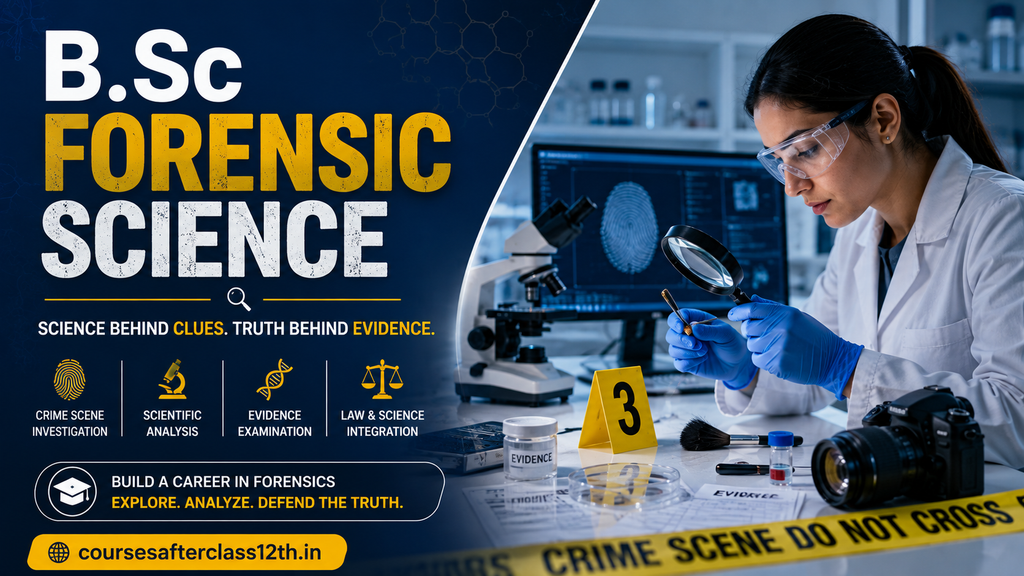
B.Sc Forensic Science is an undergraduate science degree that focuses on the scientific examination of evidence related to crime, investigations and legal proceedings. The course combines concepts from biology, chemistry, physics, criminalistics, toxicology, forensic medicine, questioned documents, fingerprints, digital evidence and other scientific disciplines to help students understand how physical and biological evidence can be collected, examined and interpreted.
For students who have completed Class 12 and are interested in science, investigation, crime analysis, laboratory work and evidence examination, B.Sc Forensic Science can provide an interesting multidisciplinary academic pathway. The program generally introduces students to the scientific principles behind forensic investigation while developing laboratory, analytical, observational and documentation skills.
Forensic Science has applications in criminal investigations, law enforcement, forensic laboratories, private laboratories, cybersecurity-related investigations, legal proceedings, research and academic institutions. Depending on the university, students may receive practical exposure through laboratory sessions, crime-scene simulation exercises, evidence-handling activities, case-study analysis, field visits and project work.
The exact curriculum, eligibility requirements, admission process, fees and career opportunities can vary from one university or college to another. Students should therefore check the latest official information from their preferred institution before applying.
Table of Contents
What is B.Sc Forensic Science?
B.Sc Forensic Science is a science-based undergraduate program that teaches students how scientific principles are applied to the examination and interpretation of evidence.
The word “forensic” generally refers to the application of knowledge and scientific techniques to matters involving the law. Forensic scientists may examine evidence associated with criminal or civil investigations and provide scientific findings that can assist investigators, legal professionals or courts.
Forensic Science is multidisciplinary because evidence can take many forms. A biological sample may require knowledge of biology and genetics, while a suspected chemical substance may require analytical chemistry. Fingerprints involve specialized identification techniques, while documents can require handwriting and ink analysis. Digital evidence requires knowledge of computers, networks and digital systems.
During a B.Sc Forensic Science program, students may therefore study subjects from multiple scientific areas. They can learn about crime-scene investigation, forensic biology, forensic chemistry, toxicology, fingerprints, questioned documents, ballistics, forensic anthropology, forensic psychology and digital forensics depending on the institution’s curriculum.
The course is generally designed to develop careful observation, logical reasoning, scientific analysis and accurate documentation. These skills are important because forensic work requires evidence to be examined systematically rather than based on assumptions.
B.Sc Forensic Science Course Highlights
| Particular | Details |
| Course Name | Bachelor of Science in Forensic Science |
| Short Name | B.Sc Forensic Science |
| Course Level | Undergraduate |
| Duration | Generally 3 years, depending on institutional structure |
| Eligibility | Class 12 or equivalent qualification |
| Common Stream | Science |
| Relevant Subjects | Physics, Chemistry, Biology and/or Mathematics depending on institution |
| Academic Pattern | Usually semester-based |
| Major Areas | Criminalistics, forensic biology, chemistry, toxicology and evidence analysis |
| Practical Training | Laboratory work, evidence examination and crime-scene exercises |
| Higher Studies | M.Sc Forensic Science and related postgraduate programs |
| Career Areas | Forensic laboratories, investigation support, research, security and related fields |
| Work Settings | Laboratories, offices, investigation environments and academic institutions |
Why Study B.Sc Forensic Science?
Forensic Science can be an attractive option for students who enjoy science but also want to understand its application to investigations and legal processes.
The degree offers a combination of theoretical learning and practical scientific analysis.
1. Application of Science to Real-World Problems
One of the most interesting aspects of Forensic Science is its practical application. Scientific methods can be used to examine evidence and help answer questions relevant to investigations.
Students learn that even small pieces of evidence may have scientific significance when properly collected, preserved and analyzed.
2. Multidisciplinary Learning
Forensic Science brings together several scientific disciplines.
A student may study chemistry, biology, physics, genetics, statistics, psychology and computer science within the broader context of forensic investigation.
This can provide students with a broad scientific foundation.
3. Laboratory-Oriented Education
Many forensic subjects involve laboratory analysis. Students may receive practical exposure to microscopy, chemical analysis, biological examination, fingerprint development and other forensic techniques, depending on institutional facilities.
4. Development of Analytical Thinking
Forensic work requires attention to detail and logical interpretation.
Students are trained to observe evidence carefully, understand scientific limitations and reach conclusions based on available information.
5. Diverse Specialization Options
After completing an undergraduate degree, students can explore specialized postgraduate programs or professional pathways related to areas such as forensic biology, toxicology, forensic chemistry, digital forensics, questioned documents and crime-scene investigation.
B.Sc Forensic Science Eligibility
The eligibility requirements for B.Sc Forensic Science vary between colleges and universities.
Generally, students need to have completed Class 12 or an equivalent examination from a recognized board. Many institutions prefer candidates from the Science stream.
Some universities may require students to have studied particular subjects such as Physics, Chemistry and Biology or Mathematics. Other institutions may have different combinations.
Minimum percentage requirements, entrance examinations and admission procedures also differ.
General Eligibility Overview
| Eligibility Factor | Typical Requirement |
| Educational Qualification | Class 12 or equivalent |
| Preferred Stream | Science |
| Relevant Subjects | Physics, Chemistry, Biology and/or Mathematics |
| Minimum Marks | Varies by institution |
| Entrance Test | Applicable at some institutions |
| Merit Admission | Available at some institutions |
| Age Criteria | Depends on institutional rules |
Important: Students should always verify the current eligibility criteria of the university or college they intend to join.
Can PCB Students Study B.Sc Forensic Science?
Yes, students from the PCB stream can be eligible for many B.Sc Forensic Science programs.
Biology and Chemistry can be particularly useful for subjects such as forensic biology, genetics, toxicology and forensic chemistry.
Students with a Biology background may find topics involving biological evidence, blood, DNA, tissues and microorganisms especially relevant.
However, the exact eligibility criteria differ among institutions. Some universities may specify particular Class 12 subjects, so PCB students should check the current admission notification before applying.
Can PCM Students Study B.Sc Forensic Science?
Students from the PCM stream may also be eligible for certain B.Sc Forensic Science programs.
Physics and Chemistry can provide useful foundations for forensic chemistry, physical evidence and analytical techniques. Mathematics may also help students develop quantitative and analytical skills.
However, whether Biology is mandatory depends on the institution.
Therefore, PCM students should check the subject-specific eligibility requirements of their preferred college before submitting an application.
Admission Process
Admission procedures vary depending on the institution.
Some colleges may offer admission based on Class 12 merit, while others may conduct entrance examinations or use centralized admission systems.
A typical process may include:
Step 1: Check Eligibility
Review the Class 12 stream, subjects and minimum marks required by the institution.
Step 2: Research Colleges
Compare curriculum, laboratories, faculty, practical facilities, internships, location and total fees.
Step 3: Submit Application
Complete the college or university application form within the specified deadline.
Step 4: Entrance Examination
If required, appear for the relevant entrance examination.
Step 5: Selection
Selection may be based on merit, entrance performance or another institutional process.
Step 6: Document Verification
Selected candidates generally need to submit academic and identification documents.
Step 7: Fee Payment
Complete the applicable fee payment and enrollment process.
Students should rely on the current admission notification of the institution rather than assuming that every university follows the same procedure.
B.Sc Forensic Science Duration
B.Sc Forensic Science is generally structured as a three-year undergraduate degree, although academic structures can vary according to the university and applicable higher-education framework.
The program is commonly divided into semesters.
Early semesters generally introduce fundamental science and forensic concepts. Later semesters may focus on specialized forensic disciplines, practical training, case studies and project work.
Some institutions may provide additional opportunities such as internships, field visits, workshops and laboratory training.
B.Sc Forensic Science Subjects
The exact syllabus differs between institutions, but common areas of study include:
- Introduction to Forensic Science
- Criminalistics
- Forensic Chemistry
- Forensic Biology
- Forensic Toxicology
- Forensic Physics
- Fingerprint Science
- Questioned Documents
- Forensic Serology
- Forensic Genetics
- DNA Analysis
- Crime-Scene Investigation
- Ballistics
- Forensic Anthropology
- Forensic Psychology
- Digital Forensics
- Cybercrime
- Forensic Medicine
- Criminology
- Environmental Forensics
- Research Methodology
- Statistics
- Practical Laboratory Training
Not every university offers all of these subjects as standalone papers. The structure depends on the institution.
B.Sc Forensic Science Syllabus: Year-Wise Overview
A typical program can be broadly understood through three stages.
| Year | Major Areas |
| First Year | Basic forensic science, chemistry, biology, physics, criminalistics and introductory practical work |
| Second Year | Forensic biology, toxicology, fingerprints, questioned documents, forensic chemistry and evidence examination |
| Third Year | Advanced forensic applications, digital forensics, crime-scene investigation, specialized subjects, research and project work |
The actual semester-wise syllabus should be checked with the respective university.
First-Year Subjects
The first year generally builds the scientific foundation required for forensic studies.
Students may learn about basic chemistry, biology and physics alongside introductory forensic concepts.
Introduction to Forensic Science
This subject introduces students to the history, scope, principles and applications of Forensic Science.
Students learn how different forensic disciplines contribute to investigations and why scientific evidence must be collected and examined systematically.
Criminalistics
Criminalistics focuses on the examination and interpretation of physical evidence.
It may cover evidence recognition, collection, preservation, documentation and laboratory examination.
Basic Forensic Chemistry
Chemistry is important in forensic analysis because many forms of evidence contain chemical substances.
Students may study analytical techniques and the examination of unknown substances, residues and materials.
Forensic Biology
Forensic biology introduces students to biological evidence relevant to investigations.
Topics may include biological materials, cells, tissues, body fluids, biological identification and basic genetics.
Second-Year Subjects
The second year generally introduces more specialized forensic disciplines.
Forensic Toxicology
Forensic toxicology deals with the scientific examination of drugs, poisons, alcohol and other potentially toxic substances in biological or other samples.
Students learn about sample collection, analytical methods and interpretation within the context of forensic investigation.
Fingerprint Science
Fingerprints have historically been an important form of identification evidence.
Students may learn about fingerprint patterns, classification, development techniques, comparison principles and documentation.
Questioned Documents
Questioned-document examination involves the scientific study of documents whose authenticity or origin is disputed.
Depending on the curriculum, students may learn about handwriting characteristics, signatures, inks, paper and alterations.
Forensic Serology
Forensic serology focuses on biological fluids and related evidence.
Students learn scientific methods used to identify and examine biological materials that may have forensic relevance.
Third-Year Subjects
The third year may include advanced forensic topics and project-based learning.
DNA and Forensic Genetics
DNA analysis has become an important area of modern forensic science.
Students may learn about genetic material, DNA profiling principles, sample handling, laboratory procedures and interpretation concepts.
Digital Forensics
Digital forensics deals with the identification, preservation, examination and interpretation of digital evidence.
It may involve computers, mobile devices, storage media, networks and other digital systems.
Crime-Scene Investigation
Crime-scene investigation involves systematic documentation, evidence identification, collection and preservation.
Students may participate in simulated crime-scene exercises to understand how evidence should be handled.
Research Methodology
Research methodology teaches students how to design scientific studies, collect data, analyze findings and prepare research reports.
Forensic Laboratory Training
Laboratory training is an important part of forensic education.
Depending on institutional infrastructure, students may work with:
- Microscopes
- Analytical instruments
- Chemical reagents
- Biological samples
- Fingerprint materials
- Document-analysis tools
- Digital-forensic software
- Evidence packaging materials
- Photography equipment
- Laboratory documentation systems
Practical training helps students understand that forensic science is based on controlled scientific procedures rather than assumptions or dramatic investigative techniques commonly portrayed in entertainment media.
Crime-Scene Investigation Training
Crime-scene investigation is one of the most recognizable areas of Forensic Science.
Students may learn how a crime scene can be documented and how evidence can be identified, photographed, collected, packaged and preserved.
Important skills may include:
- Scene observation
- Photography
- Sketching
- Evidence marking
- Documentation
- Sample collection
- Evidence packaging
- Chain-of-custody principles
- Laboratory submission procedures
The exact practical activities depend on institutional facilities and safety protocols.
Forensic Evidence and Chain of Custody
The reliability of forensic evidence depends not only on scientific analysis but also on how evidence is handled.
The chain of custody refers to the documented history of evidence from collection through storage, transfer and examination.
Students learn why accurate documentation is important.
An evidence item may need proper labeling, packaging, sealing, storage and recordkeeping so that its integrity can be maintained.
This is an important professional principle because forensic conclusions are meaningful only when the underlying evidence has been properly handled.
Types of Forensic Evidence
Forensic evidence can take many forms.
| Evidence Type | Example |
| Biological | Blood, hair, tissue and other biological material |
| Chemical | Drugs, unknown substances and chemical residues |
| Physical | Glass, fibers, paint and other materials |
| Impression | Footwear and tire impressions |
| Fingerprints | Latent or visible fingerprints |
| Documents | Handwriting, signatures and altered documents |
| Digital | Files, device data and electronic records |
| Firearms-related | Firearm and ammunition-related evidence |
| Trace Evidence | Fibers, particles and microscopic materials |
Each type of evidence requires appropriate collection, preservation and examination methods.
B.Sc Forensic Science Practical Skills
Students can develop several technical and professional skills during the degree.
| Skill | Importance |
| Observation | Identifying relevant evidence |
| Documentation | Maintaining accurate records |
| Laboratory Analysis | Examining samples scientifically |
| Evidence Handling | Protecting evidence integrity |
| Scientific Reasoning | Interpreting findings logically |
| Data Analysis | Understanding laboratory results |
| Report Writing | Communicating scientific findings |
| Photography | Documenting scenes and evidence |
| Research | Conducting scientific investigations |
| Communication | Presenting findings clearly |
Career Scope After B.Sc Forensic Science
The career scope after B.Sc Forensic Science can include opportunities in forensic laboratories, investigation support, research, private analytical laboratories, security-related fields and academic environments.
However, job eligibility varies by organization and position. Some specialized government or forensic-scientist positions may require postgraduate qualifications or specific subject combinations.
Graduates can therefore consider both entry-level employment and higher education depending on their career goals.
Forensic Laboratory Career
Forensic laboratories analyze evidence submitted by investigation agencies or other authorized bodies.
Depending on their qualifications and organizational requirements, graduates may explore entry-level laboratory roles, technical support positions, laboratory assistance or related work.
Further specialization and postgraduate education can be useful for advanced scientific roles.
Crime-Scene Investigation Career
Crime-scene work involves documenting and processing scenes and collecting evidence according to established procedures.
The role requires attention to detail, discipline and knowledge of evidence handling.
Students interested in this area should develop practical skills in documentation, photography, evidence collection and scientific observation.
Forensic Toxicology Career
Forensic toxicology is a specialized area involving the examination of potentially toxic substances.
Graduates interested in laboratory-based work can pursue further specialization in toxicology, analytical chemistry, or related areas.
Digital Forensics Career
Digital evidence has become increasingly important as computers, smartphones, cloud services, and other technologies become part of everyday life. In digital investigations, professionals may examine electronic evidence by following appropriate procedures for handling and analysis.
Postgraduate specialization may provide a stronger pathway into advanced digital-forensics roles.
Students interested in this area can strengthen their knowledge of computer systems, cybersecurity, data structures, operating systems and digital investigation techniques.
Career in Forensic Biology and DNA Analysis
Students interested in biology and genetics can explore forensic biology and DNA-related education.
Forensic genetics involves scientific analysis of DNA and genetic information for identification and investigative purposes.
Because advanced DNA analysis requires specialized laboratory training, students interested in this career path may benefit from postgraduate education and hands-on laboratory experience.
Career in Questioned Document Examination
Questioned-document examination involves analyzing documents where authenticity, authorship or alterations may be relevant.
Potential areas of examination can include handwriting, signatures, inks, paper and document modifications.
Students interested in this specialization should develop strong observation, comparison and documentation skills.
Government Career Opportunities After B.Sc Forensic Science
Government organizations may recruit professionals for forensic laboratories, investigation-related departments, scientific institutions and other public-sector functions.
Possible areas may include:
- Forensic laboratories
- Police departments
- Scientific investigation units
- Government research institutions
- Public-sector laboratories
- Crime investigation support
- Cybercrime-related units
- Regulatory and analytical organizations
However, students should not assume that every government forensic position accepts a B.Sc qualification.
Recruitment rules differ by position, and some scientific posts may require a master’s degree or specific specialization.
Candidates should always read the latest official recruitment notification.
Private Sector Career Opportunities
Private organizations can also have roles connected with scientific analysis, investigation support, security, digital forensics, laboratories and consulting.
Potential sectors include:
| Sector | Possible Work |
| Private Laboratories | Sample analysis and laboratory support |
| Cybersecurity Firms | Digital investigation support |
| Security Companies | Investigation and analytical services |
| Research Organizations | Forensic research |
| Analytical Laboratories | Chemical and biological testing |
| Legal Support Services | Evidence-related analytical assistance |
| Academic Institutions | Research and laboratory assistance |
B.Sc Forensic Science Salary
Salary after B.Sc Forensic Science depends on the organization, role, location, qualifications, experience and specialization.
Fresh graduates typically begin with entry-level responsibilities. Professionals who develop specialized expertise and relevant experience may progress into more advanced positions.
Higher qualifications can be particularly important for specialized forensic science and research roles.
Instead of evaluating the degree only on starting salary, students should consider:
- Career progression
- Specialization options
- Practical training
- Higher-study opportunities
- Government recruitment pathways
- Industry demand
- Geographic mobility
Higher Studies After B.Sc Forensic Science
Students who want advanced knowledge can pursue postgraduate education.
M.Sc Forensic Science
M.Sc Forensic Science is one of the most direct postgraduate pathways.
It can provide deeper specialization in forensic biology, chemistry, toxicology, crime-scene investigation and other forensic disciplines.
M.Sc Forensic Chemistry
Students interested in chemical evidence and laboratory analysis may consider postgraduate study in forensic chemistry or related analytical disciplines.
M.Sc Forensic Biology
Students interested in DNA, genetics and biological evidence can explore postgraduate programs focused on forensic biology or related areas.
Digital Forensics and Cybersecurity
Students interested in technology-based investigation can consider postgraduate programs in digital forensics, cybersecurity, information security or related disciplines.
Criminology
Criminology focuses on crime, criminal behavior, criminal justice systems and social dimensions of crime.
It can complement a forensic background depending on the student’s career goals.
Biotechnology and Genetics
Students interested in biological evidence may also consider postgraduate education in biotechnology, genetics or molecular biology, subject to eligibility.
B.Sc Forensic Science vs B.Sc Biotechnology
Both degrees can involve biology and laboratory science, but their primary applications are different.
| Feature | B.Sc Forensic Science | B.Sc Biotechnology |
| Main Focus | Scientific examination of evidence | Application of biological technology |
| Crime Investigation | Strong | Limited |
| Forensic Biology | Strong | Related foundation |
| DNA | Forensic applications | Broad biological applications |
| Laboratory Work | Strong | Strong |
| Biotechnology | Limited/Applied | Core area |
| Pharmaceutical Applications | Limited | Stronger |
| Criminalistics | Core area | Not usually core |
| Career Focus | Forensics and investigation | Biotechnology and life sciences |
Students should select the degree according to their interests and long-term career objectives.
B.Sc Forensic Science vs B.Sc Microbiology
B.Sc Microbiology focuses primarily on microorganisms, microbial biology, and their applications in various fields. In comparison, the B.Sc Forensic Science course focuses on the scientific examination of evidence and draws knowledge from multiple scientific disciplines.
| Feature | B.Sc Forensic Science | B.Sc Microbiology |
| Crime Investigation | Strong | Limited |
| Microbiology | Supporting area | Core area |
| Forensic Biology | Strong | Related |
| Industrial Microbiology | Limited | Strong |
| Laboratory Work | Strong | Strong |
| Toxicology | Commonly included | Usually limited |
| DNA Applications | Forensic context | Biological/research context |
B.Sc Forensic Science vs B.Sc Biology
B.Sc Biology provides a broad foundation in biological sciences and research. In contrast, the B.Sc Forensic Science course applies scientific knowledge specifically to evidence examination and forensic investigation.
Students interested in crime-scene science and forensic laboratories may prefer Forensic Science, whereas those interested in broader biological research may find B.Sc Biology more suitable.
Internships During B.Sc Forensic Science
Internships can be highly valuable because forensic science requires practical understanding.
Potential internship environments may include:
- Forensic laboratories
- Research laboratories
- Analytical laboratories
- Cybersecurity organizations
- Digital-forensics firms
- Investigation-support organizations
- Universities
- Scientific research institutions
Students should prioritize legitimate organizations that provide supervised educational exposure.
An internship can help students understand laboratory procedures, professional documentation and workplace expectations.
Project Ideas for B.Sc Forensic Science
Students can use academic projects to explore specific forensic areas.
Possible project topics include:
- Study of fingerprint patterns
- Analysis of handwriting characteristics
- Examination of questioned documents
- Study of common forensic toxicology techniques
- Review of DNA profiling methods
- Analysis of trace evidence
- Crime-scene documentation techniques
- Study of forensic photography
- Digital evidence preservation
- Cybercrime awareness study
- Forensic anthropology research
- Study of bloodstain-pattern principles
- Forensic chemistry techniques
- Evidence-handling and chain-of-custody study
- Review of forensic laboratory quality practices
Projects should be conducted under appropriate academic supervision and according to laboratory safety and ethical requirements.
Role of Technology in Forensic Science
Technology has transformed forensic investigation.
Modern forensic work can involve advanced analytical instruments, DNA technologies, imaging systems, databases, digital evidence tools and specialized software.
Areas influenced by technology include:
- DNA profiling
- Digital forensics
- Forensic imaging
- Chemical analysis
- Fingerprint databases
- Digital evidence management
- Geographic information systems
- Data analysis
- Automated laboratory systems
Students should therefore develop both scientific knowledge and basic technological literacy.
Importance of Scientific Ethics in Forensic Science
Forensic Science has a direct connection with the justice system, making scientific ethics particularly important.
A forensic professional must understand that scientific evidence should be reported objectively.
Important principles include:
- Accuracy
- Impartiality
- Confidentiality
- Proper documentation
- Scientific validity
- Evidence integrity
- Responsible interpretation
- Awareness of limitations
A forensic professional should not alter or exaggerate findings to support a particular conclusion.
This ethical foundation is an important part of professional forensic practice.
Forensic Science and the Justice System
Forensic Science can support investigations by providing scientific information about evidence.
However, forensic evidence is only one component of a broader investigation.
A forensic scientist’s role is generally to examine evidence using appropriate scientific methods and communicate the findings objectively. Decisions about guilt, innocence and legal responsibility are determined through the appropriate legal process.
Understanding this distinction is important for students considering a forensic career.
Is B.Sc Forensic Science a Good Career Option?
B.Sc Forensic Science can be a suitable career option for students who have a genuine interest in science, evidence analysis, investigation and laboratory work.
The degree is particularly suitable for students who:
- Enjoy Biology and Chemistry
- Like laboratory work
- Have strong observation skills
- Prefer evidence-based reasoning
- Are interested in criminal investigation
- Enjoy scientific problem-solving
- Are comfortable with detailed documentation
Students should also understand that forensic careers are not exactly like television or movie portrayals.
Real forensic work can involve repetitive laboratory procedures, detailed paperwork, quality control, evidence documentation and strict protocols.
Advantages of B.Sc Forensic Science
Multidisciplinary Education
Students learn from biology, chemistry, physics, genetics, psychology, computer science and other disciplines.
Practical Learning
Laboratory work and simulated crime-scene activities can provide hands-on experience.
Specialization Opportunities
Students can later specialize in forensic biology, toxicology, chemistry, digital forensics and related fields.
Scientific Career Path
The course can provide a foundation for laboratory and research-oriented careers.
Higher Education Options
Several postgraduate pathways are available after graduation.
Challenges to Consider
Students should also understand the realities of the field.
Some specialized forensic positions may require postgraduate education.
Laboratory work requires accuracy and patience. Crime-scene-related careers may involve irregular working environments or emotionally challenging cases.
Government forensic positions can also be competitive, and eligibility requirements vary by recruitment.
Therefore, students should approach the degree as a scientific career pathway rather than simply as a route into crime investigation.
How to Choose the Best B.Sc Forensic Science College
Choosing the right college can significantly affect practical learning.
Students should consider:
| Factor | What to Check |
| Curriculum | Breadth and relevance of forensic subjects |
| Faculty | Qualifications and academic expertise |
| Laboratories | Availability of forensic laboratory facilities |
| Practical Work | Frequency and quality of laboratory sessions |
| Crime-Scene Training | Availability of simulation facilities |
| Digital Forensics | Relevant software and computer facilities |
| Internships | Opportunities for supervised practical exposure |
| Research | Faculty research and student projects |
| Library | Forensic science books and journals |
| Fees | Complete cost of study |
| Recognition | Current institutional recognition and affiliation |
| Career Support | Placement and career guidance |
Students should independently verify institutional claims before taking admission.
Documents Required for B.Sc Forensic Science Admission
The exact list depends on the institution.
Commonly requested documents may include:
- Class 10 mark sheet
- Class 12 mark sheet
- Class 12 certificate
- Transfer certificate
- Migration certificate, where applicable
- Passport-size photographs
- Government-issued identity document
- Category certificate, where applicable
- Domicile certificate, where applicable
- Entrance examination documents, where applicable
Students should follow the official document checklist issued by the institution.
Career Roadmap After B.Sc Forensic Science
A possible career roadmap can look like:
Class 12 Science → B.Sc Forensic Science → Practical Training/Internship → Entry-Level Role or Higher Studies → Specialization → Professional Experience
Students interested in laboratory careers may follow:
B.Sc → M.Sc Forensic Science → Specialization → Forensic Laboratory/Research Career
Students interested in digital investigation may follow:
B.Sc → Digital Forensics/Cybersecurity Specialization → Practical Certification/Training → Digital Investigation Career
Students interested in research may follow:
B.Sc → M.Sc → Research Project → PhD → Research/Academic Career
Future Scope of Forensic Science
The future of Forensic Science is closely connected with developments in science and technology.
Modern investigations increasingly involve biological evidence, digital evidence, chemical analysis, advanced imaging and data-driven investigation.
Potential growth areas include:
- DNA analysis
- Digital forensics
- Cybercrime investigation
- Forensic toxicology
- Forensic chemistry
- Forensic biology
- Forensic anthropology
- Trace evidence
- Forensic databases
- Advanced analytical techniques
- Research and development
Students who combine a forensic degree with specialized technical skills and higher education can potentially expand their professional opportunities.
Emerging Area: Digital Forensics
The growth of smartphones, computers, cloud platforms and connected devices has created a major need for digital evidence examination.
Digital forensic professionals may work with:
- Computers
- Mobile devices
- Storage media
- Network information
- Digital files
- System logs
- Metadata
- Online activity records
Students interested in this field should build a strong foundation in computer systems and cybersecurity in addition to forensic concepts.
Emerging Area: DNA Forensics
DNA technology continues to be an important component of modern forensic science.
Forensic genetics can help establish biological relationships or support identification when scientifically appropriate samples are available.
Students interested in this area should develop strong knowledge of molecular biology, genetics, laboratory methods and statistical interpretation.
Emerging Area: Forensic Toxicology
Forensic toxicology remains important in investigations involving potentially toxic substances.
Modern analytical instruments allow laboratories to detect and identify substances at increasingly sophisticated levels.
Students interested in toxicology may benefit from postgraduate specialization in forensic toxicology, analytical chemistry or related disciplines.
Emerging Area: Forensic Chemistry
Forensic chemistry involves the examination of chemical evidence.
It can include analysis of unknown substances, residues, materials and other chemical evidence.
Students with a strong interest in Chemistry may find this specialization particularly suitable.
Important Skills for Students
Students can improve their employability by developing skills beyond the classroom curriculum.
Useful skills include:
Laboratory Skills
Learn how to follow laboratory protocols, maintain records and handle samples appropriately.
Analytical Skills
Develop the ability to interpret observations and laboratory results logically.
Computer Skills
Basic computer literacy is important, while students interested in digital forensics should develop more advanced technical knowledge.
Communication
Forensic professionals need to document and communicate scientific findings clearly.
Research Skills
Students should learn how to evaluate scientific literature, formulate research questions and interpret data.
Attention to Detail
Small errors in documentation or evidence handling can have significant consequences.
B.Sc Forensic Science Fees
The B.Sc Forensic Science fees vary significantly between colleges and universities.
Factors affecting total cost can include:
- Type of institution
- Location
- Laboratory facilities
- Hostel accommodation
- Examination fees
- Practical fees
- Equipment or material charges
- Other institutional charges
Students should compare the complete cost of education rather than looking only at tuition fees.
A college offering extensive practical training may have different fees from an institution with fewer laboratory facilities.
Scholarships for B.Sc Forensic Science Students
Scholarship availability depends on the institution, government schemes, student eligibility and other criteria.
Students may find scholarships based on:
- Academic merit
- Economic eligibility
- Category-based criteria
- Institutional schemes
- State-level programs
- National scholarship programs
Students should verify current eligibility and application deadlines through official scholarship portals or institutional offices.
B.Sc Forensic Science Preparation After Class 12
Students can prepare for the degree by strengthening basic Science concepts.
Chemistry
Focus on basic organic, inorganic and analytical chemistry.
Biology
Understand cell biology, genetics, human biology and molecular concepts.
Physics
Build fundamental understanding of mechanics, optics, electricity and measurement where relevant.
Mathematics and Statistics
Basic statistics can be useful for data interpretation and scientific analysis.
Computer Skills
Basic digital literacy is increasingly useful, particularly for students interested in digital forensics.
Who Should Choose B.Sc Forensic Science?
B.Sc Forensic Science may be suitable for students who:
- Have an interest in Science
- Enjoy laboratory work
- Like solving analytical problems
- Have good observational abilities
- Are interested in evidence examination
- Want to learn about forensic investigations
- Are comfortable following strict procedures
- Want to explore scientific career options
Students should not choose the course only because they enjoy crime-related television shows or movies. Actual forensic work is highly scientific and procedure-oriented.
Who Should Not Choose B.Sc Forensic Science?
The course may be less suitable for students who dislike laboratory work, scientific documentation or detailed analysis.
It may also be unsuitable for students who expect every forensic job to involve field investigation or police-style investigation.
Students should research actual job responsibilities before selecting the degree.
Frequently Asked Questions About B.Sc Forensic Science
1. What is B.Sc Forensic Science?
B.Sc Forensic Science is an undergraduate science program that applies scientific principles to the examination and interpretation of evidence relevant to investigations and legal processes.
2. What is the duration of B.Sc Forensic Science?
The course is generally three years, although the exact academic structure can vary by institution.
3. What is the eligibility for B.Sc Forensic Science?
Candidates generally need to complete Class 12 or an equivalent qualification. Many institutions require or prefer Science subjects, with exact requirements varying by university.
4. Can PCB students study B.Sc Forensic Science?
Yes. PCB students are eligible for many programs, particularly because Biology and Chemistry are relevant to forensic biology, genetics and toxicology.
5. Can PCM students study B.Sc Forensic Science?
PCM students may be eligible for certain programs. Students should check whether Biology is required by their chosen institution.
6. What subjects are taught in B.Sc Forensic Science?
Subjects may include forensic biology, forensic chemistry, toxicology, fingerprints, questioned documents, criminalistics, crime-scene investigation, DNA analysis, digital forensics and research methodology.
7. Is B.Sc Forensic Science difficult?
The course requires scientific understanding, laboratory work, observation, documentation and analytical thinking. Students who are comfortable with Science and practical work may find it manageable.
8. What are the career options after B.Sc Forensic Science?
Career areas can include forensic laboratories, analytical laboratories, research, investigation support, digital forensics and other related sectors, depending on qualifications and job requirements.
9. Can I get a government job after B.Sc Forensic Science?
Some government positions may be available, but eligibility varies by recruitment. Certain specialized forensic positions may require postgraduate qualifications.
10. Can I do M.Sc after B.Sc Forensic Science?
Yes. M.Sc Forensic Science is one of the most direct higher-study options.
11. Is B.Sc Forensic Science good for a career in forensic laboratories?
It can provide a foundation for laboratory-based forensic careers. Advanced scientific roles may require postgraduate education and specialized training.
12. Can I specialize in DNA forensics?
Yes. Students can pursue postgraduate education or specialized training in forensic biology, genetics, molecular biology or related fields.
13. Can I enter digital forensics after B.Sc Forensic Science?
Students can explore digital-forensics pathways, particularly by developing additional knowledge of computers, cybersecurity and digital evidence examination.
14. Does B.Sc Forensic Science include practical work?
Many programs include laboratory sessions and practical exercises. The exact level of practical exposure depends on the institution.
15. Is internship important in Forensic Science?
Yes. A relevant internship can provide practical exposure and help students understand professional laboratory and documentation procedures.
16. What skills are important for forensic students?
Observation, laboratory skills, scientific reasoning, documentation, data analysis, communication, research and attention to detail are valuable.
17. Is Forensic Science the same as Criminology?
No. Forensic Science focuses on the scientific examination of evidence, while Criminology primarily studies crime, criminal behavior and social aspects of crime.
18. Is Forensic Science the same as Biotechnology?
No. Biotechnology focuses on applications of biological systems and technologies, whereas Forensic Science applies scientific methods to evidence and investigation-related questions.
19. What are the higher-study options after B.Sc Forensic Science?
Students may consider M.Sc Forensic Science, forensic biology, forensic chemistry, toxicology, digital forensics, cybersecurity, criminology and other related programs, subject to eligibility.
20. Is Forensic Science a good career option after 12th Science?
It can be a good option for students interested in science, laboratory work, evidence analysis and investigation. Students should understand the practical nature of the profession before choosing the course.