
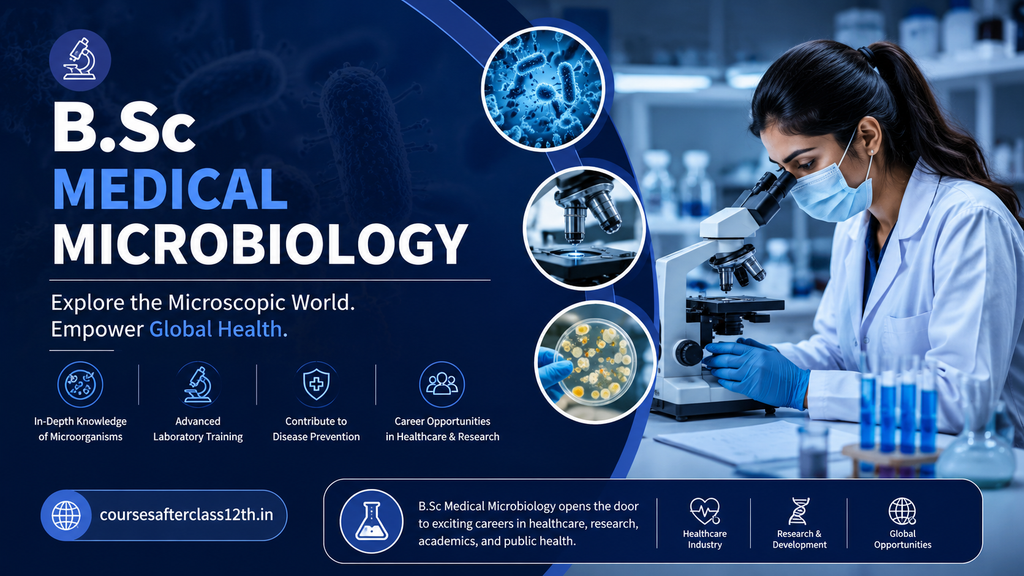
B.Sc Medical Microbiology is an undergraduate life-science and health-science programme that focuses on microorganisms associated with human health and disease. Students learn about bacteria, viruses, fungi, parasites and other microorganisms while developing an understanding of laboratory methods used to study infectious diseases and identify microorganisms.
The programme combines theoretical knowledge with practical laboratory training and introduces learners to areas related to clinical laboratories, infection, disease diagnosis and microbiological investigation.
The course introduces students to bacteria, viruses, fungi, parasites and other microorganisms, along with laboratory methods used to study infectious diseases, identify microorganisms and understand their relationship with the human body.
Table of Contents
Course Focus and Subjects
Unlike a general microbiology programme, Medical Microbiology has a stronger connection with healthcare, clinical laboratories, infection, disease diagnosis and laboratory investigation. Depending on the university, students may study subjects such as human anatomy, physiology, biochemistry, pathology, immunology, general microbiology, bacteriology, virology, mycology, parasitology, clinical microbiology and laboratory techniques.
Who Can Consider This Programme?
The programme is particularly relevant for students interested in microorganisms, laboratory science, healthcare and disease-related research. It can provide a foundation for further education and employment in laboratory and life-science environments, although eligibility for specific professional or regulated roles depends on the qualification, employer and applicable regulations.
A current B.Sc Medical Microbiology syllabus from Kerala University of Health Sciences describes the programme as a four-year course emphasizing practical training, medical subjects, clinical laboratory organization and routine and special investigative procedures related to medical microbiology.
For students planning their education after Class 12, B.Sc Medical Microbiology can be considered alongside related courses such as B.Sc Microbiology, B.Sc Biotechnology, B.Sc Biochemistry, B.Sc Biology and other allied life-science programmes.
What is B.Sc Medical Microbiology?
B.Sc Medical Microbiology is an undergraduate programme that applies microbiological knowledge to human health and clinical laboratory science.
Microorganisms are an important part of the biological world. Some are harmless or beneficial, while others can contribute to infectious diseases. Medical microbiology focuses on understanding microorganisms that are relevant to human disease, how infections are investigated and how laboratory evidence can support clinical decision-making.
Students generally learn about the characteristics of microorganisms and the methods used to culture, observe, identify and study them. The course can also introduce students to specimen handling, microscopy, staining, culture techniques, antimicrobial testing, immunological methods and other laboratory procedures.
The programme usually combines classroom teaching with laboratory practicals. This is particularly important because microbiology is an experimental science. UGC’s learning-outcomes framework highlights the relationship between theory and experiment and recognizes practical assignments, laboratory reports, project work, internships and research-facility visits as possible components of undergraduate education.
The exact syllabus, however, should always be checked with the university because UGC frameworks allow higher-education institutions flexibility in programme and syllabus development rather than prescribing one identical national syllabus for every programme.
Why Study this course?
Students interested in healthcare and biological sciences often choose Medical Microbiology because it connects microbiology with human health.
The programme can help students understand how microorganisms are studied in laboratory settings and how microbiological knowledge contributes to infection-related investigations. It can also introduce students to scientific documentation, laboratory safety, quality practices and interpretation of biological observations.
Another important feature is its interdisciplinary character. Medical microbiology can overlap with:
- Human anatomy
- Human physiology
- Biochemistry
- Pathology
- Immunology
- Genetics
- Molecular biology
- Microbiology
- Clinical laboratory science
- Epidemiology
- Biotechnology
- Public health
This interdisciplinary foundation can be useful for students who are considering postgraduate study in microbiology, medical microbiology, biotechnology, biomedical science, molecular biology, public health or related areas.
UGC’s undergraduate framework identifies scientific reasoning, information and digital literacy, problem-solving, transferable skills and preparation for further study or employment among important graduate capabilities.
Course Highlights
| Particular | Details |
| Course Name | B.Sc Medical Microbiology |
| Level | Undergraduate |
| Academic Area | Medical Microbiology / Life Sciences / Allied Health Sciences |
| Duration | Varies by university; some programmes are structured for 4 years |
| Eligibility | Usually Class 12 with required science subjects |
| Main Subjects | Microbiology, Medical Microbiology, Anatomy, Physiology, Biochemistry, Pathology and related subjects |
| Practical Training | Laboratory practicals are an important component in many programmes |
| Admission | Merit or entrance-based depending on institution |
| Career Areas | Clinical laboratories, research, biotechnology, testing laboratories and related sectors |
| Higher Studies | M.Sc Medical Microbiology, M.Sc Microbiology, Biotechnology and related programmes |
| Important Skills | Laboratory techniques, observation, documentation, scientific reasoning and data interpretation |
The table represents a general overview. Students should verify the latest information from the university or college before applying.
Eligibility
The eligibility criteria for B.Sc Medical Microbiology vary among institutions.
In general, students are expected to complete Class 12 or an equivalent examination with science subjects relevant to the programme. Biology is commonly important for health and life-science programmes, while some institutions may specify Physics, Chemistry and Biology or another combination.
Minimum percentage requirements can also differ.
General Eligibility
A student may generally need to:
- Complete Class 12 from a recognized board.
- Study the science subjects specified by the university.
- Meet the minimum marks requirement.
- Fulfil any entrance examination requirement, if applicable.
- Meet institution-specific documentation requirements.
Students should not assume that one eligibility rule applies to every B.Sc Medical Microbiology college in India.
For example, health-science programmes can have detailed subject and admission requirements, and universities publish their own regulations and curricula. The safest approach is to check the official programme information before submitting an application.
Can PCB Students Study B.Sc Medical Microbiology?
Students with a Physics, Chemistry and Biology (PCB) background may be eligible for many Medical Microbiology programmes, depending on the university.
PCB students already have exposure to biological systems, chemistry and basic scientific principles, which can provide a useful foundation for studying microbiology and medical subjects.
However, eligibility should be confirmed against the exact admission rules of the college because some universities may specify different subject combinations or minimum marks.
Admission Process
The admission process depends on the university.
Some colleges may select students based on Class 12 marks, while others may use an entrance examination, centralized admission process or institution-specific selection procedure.
A typical process may include:
- Check the eligibility criteria.
- Research suitable colleges and universities.
- Review the syllabus and course duration.
- Complete the application form.
- Submit academic and other required documents.
- Appear for an entrance examination if required.
- Check the merit list or admission result.
- Complete counselling where applicable.
- Attend document verification.
- Pay the required admission fees.
- Confirm admission.
Students should use the official admission notification of the selected institution as the final source of information.
Entrance Exam
There is no single entrance examination that universally governs admission to every B.Sc Medical Microbiology programme in India.
Depending on the university, admission may be merit-based or entrance-based.
If an entrance examination is required, students should carefully review the official syllabus. Preparation may involve senior-secondary Biology, Chemistry, Physics and general scientific aptitude, depending on the examination.
A useful preparation plan includes:
- Revising Class 11 and 12 Biology.
- Strengthening basic Chemistry concepts.
- Understanding cell biology.
- Revising genetics and basic microbiology.
- Practising objective questions.
- Reviewing previous question papers where available.
- Checking the university’s official admission syllabus.
Whats is the Duration of this course?
The duration of B.Sc Medical Microbiology depends on the university and its academic structure.
A current Kerala University of Health Sciences curriculum describes B.Sc Medical Microbiology as a four-year course with emphasis on practical training and medical subjects.
Other institutions may use different structures depending on their academic framework.
Therefore, students should not assume that every B.Sc Medical Microbiology programme has exactly the same duration.
Why Duration Can Differ
Differences can arise because institutions may structure programmes according to:
- University regulations
- Credit frameworks
- Practical training requirements
- Internship or clinical exposure
- Multiple-entry or exit structures
- Institutional academic policies
- Regulatory or professional requirements
UGC’s current undergraduate framework provides flexibility in curriculum design and supports multidisciplinary learning and multiple entry and exit options within the broader higher-education framework.
Syllabus
The syllabus is designed to build knowledge progressively, starting with foundational science and moving toward medical and clinical microbiology.
A typical curriculum may include the following areas.
Human Anatomy
Anatomy introduces students to the structure of the human body. Knowledge of organs, tissues and body systems provides context for understanding infections and disease.
Human Physiology
Physiology focuses on how body systems function. Students may learn about systems such as the respiratory, digestive, circulatory, nervous and immune systems.
Understanding normal physiological processes helps students recognize the biological context in which infections occur.
Biochemistry
Biochemistry explains chemical processes occurring within living organisms. Students may study proteins, carbohydrates, lipids, enzymes, metabolism and other biochemical concepts.
General Microbiology
General microbiology introduces the basic principles of microorganisms.
Students may study:
- Bacterial structure
- Microbial growth
- Microbial nutrition
- Classification
- Microbial metabolism
- Microbial genetics
- Sterilization
- Culture methods
- Microscopy
Bacteriology
Bacteriology focuses on bacteria and their characteristics.
Students may learn about medically important bacterial groups, their morphology, growth characteristics, laboratory identification and disease associations.
Virology
Virology introduces viruses, their structure, replication and interactions with host cells.
The course may discuss medically important viral infections and laboratory approaches used for viral investigation.
Mycology
Mycology focuses on fungi.
Students may learn about medically relevant fungi, fungal infections, identification methods and laboratory investigation.
Parasitology
Parasitology introduces parasites of medical importance and the diseases associated with them.
Topics can include protozoan and helminthic infections, life cycles, specimens and diagnostic approaches.
Immunology
Immunology examines the body’s immune response.
Students may study:
- Innate immunity
- Adaptive immunity
- Antigens
- Antibodies
- Immune cells
- Complement
- Hypersensitivity
- Immune-related disorders
Pathology
Pathology provides an introduction to disease processes and pathological changes.
The subject helps students connect microorganisms and infections with changes occurring in tissues and organs.
Medical Microbiology
Medical Microbiology integrates microbiological knowledge with human disease.
Students may study microorganisms associated with different body systems and understand how laboratory investigations can contribute to identifying infectious agents.
Clinical Microbiology
Clinical Microbiology focuses on laboratory investigation of clinically relevant microorganisms.
A programme may cover specimen processing, culture, identification, antimicrobial susceptibility testing and reporting principles.
Subjects
The exact subject list varies by university, but the following table provides a useful general picture.
| Subject Area | What Students Learn |
| Human Anatomy | Structure of the human body |
| Human Physiology | Functions of organs and body systems |
| Biochemistry | Chemical processes in living organisms |
| General Microbiology | Fundamentals of microorganisms |
| Bacteriology | Medical and laboratory study of bacteria |
| Virology | Viruses and viral diseases |
| Mycology | Medical fungi and fungal infections |
| Parasitology | Medically important parasites |
| Immunology | Immune responses and host defence |
| Pathology | Disease processes |
| Medical Microbiology | Microorganisms related to human disease |
| Clinical Microbiology | Laboratory investigation of clinical specimens |
| Molecular Biology | Molecular basis of biological processes |
| Biotechnology | Biological techniques and applications |
| Laboratory Techniques | Practical diagnostic and microbiological methods |
A current B.Sc Medical Microbiology curriculum from Kerala University of Health Sciences describes training that begins with anatomy, physiology and chemistry and progresses toward medical microbiology, clinical laboratory practice and advanced research-oriented learning.
Practical Training
Practical training is one of the most important aspects of Medical Microbiology.
Students need to understand not only what microorganisms are but also how laboratory professionals work with specimens, cultures, equipment, records and analytical procedures.
Practical classes may introduce students to:
- Microscopy
- Staining techniques
- Culture methods
- Media preparation
- Sterilization principles
- Microbial identification
- Biochemical testing
- Antimicrobial susceptibility testing
- Laboratory documentation
- Basic molecular techniques
- Quality-control principles
The exact techniques available depend on the institution’s laboratories, equipment and curriculum.
UGC’s learning framework specifically recognizes substantial laboratory-based practical work, experiments, projects, internships and research exposure as useful approaches to undergraduate education.
Laboratory Safety in Medical Microbiology
Laboratory safety is an essential part of microbiology education.
Students may work with biological materials during practical training, so they must follow institutional safety procedures and appropriate microbiological practices.
Important principles include:
- Wearing appropriate personal protective equipment.
- Following laboratory instructions.
- Correctly labelling samples.
- Maintaining clean work areas.
- Following waste-disposal procedures.
- Using equipment correctly.
- Reporting accidents or exposures.
- Following institutional biosafety protocols.
India’s National Guidelines for Infection Prevention and Control in Healthcare Facilities classify laboratories into different biosafety levels according to the risks associated with biological agents, facility design, containment, equipment and procedures. The guidelines also describe the role of biosafety cabinets in reducing aerosol hazards.
Students should therefore understand that microbiology laboratory work requires discipline and adherence to safety protocols rather than simply performing experiments mechanically.
Skills Developed in during this course
A good programme can help students develop both technical and transferable skills.
Laboratory Skills
Students learn how to work systematically with laboratory equipment, samples and procedures.
Observation Skills
Microbiology requires careful observation of cultures, microscopic findings and experimental results.
Scientific Reasoning
Students learn to interpret observations and connect evidence with microbiological principles.
UGC identifies scientific reasoning as the ability to analyse and interpret quantitative or qualitative data and critically evaluate evidence.
Documentation
Laboratory records must be clear and accurate. Students can develop habits related to recording observations, procedures and results.
Communication
Seminars, practical reports, presentations and group activities can strengthen scientific communication.
Digital Literacy
Modern life-science education increasingly involves digital information, databases and software. UGC’s graduate attributes include information and digital literacy as important capabilities.
Fees
There is no single fee applicable to all B.Sc Medical Microbiology colleges in India.
Fees depend on:
- Type of institution
- University
- Location
- Course duration
- Laboratory infrastructure
- Hostel facilities
- Practical training
- Examination charges
- Registration charges
- Other institutional services
Students should compare the total cost of education rather than only the tuition fee.
| Fee Component | What to Check |
| Tuition | Annual or semester fee |
| Laboratory | Whether practical charges are separate |
| Examination | Examination-related charges |
| Registration | One-time or recurring |
| Hostel | Accommodation and related charges |
| Library | Included or additional |
| Other Charges | Student services and institutional charges |
Always verify the current fee structure directly from the college.
Career Scope
The career scope of B.Sc Medical Microbiology is connected with laboratory science, microbiology, biotechnology, research and other life-science areas.
Graduates may explore opportunities in:
- Diagnostic laboratories
- Research laboratories
- Biotechnology companies
- Pharmaceutical-related laboratories
- Food microbiology laboratories
- Water and environmental testing
- Quality-control environments
- Academic laboratories
- Clinical research support
- Life-science organizations
However, students should distinguish between being qualified for an entry-level laboratory role and being independently responsible for regulated clinical decisions.
Some medical-laboratory and microbiology positions have specific qualification and experience requirements. For example, government clinical-laboratory standards and guidance specify qualifications and staffing requirements for certain roles, demonstrating that job eligibility cannot be inferred from the degree name alone.
Jobs After completeing this course
Possible entry-level job titles vary by employer.
| Job Area | Possible Responsibilities |
| Laboratory Assistant | Supporting routine laboratory activities |
| Microbiology Laboratory Assistant | Supporting microbiological testing |
| Laboratory Technician | Performing assigned laboratory procedures according to qualification and employer requirements |
| Research Assistant | Supporting research experiments and documentation |
| Quality Control Trainee | Supporting laboratory quality processes |
| Microbiology Trainee | Learning and assisting with microbiological procedures |
| Research Project Assistant | Supporting academic or research projects |
| Laboratory Documentation Assistant | Maintaining records and documentation |
| Food Microbiology Assistant | Supporting microbiological testing in food-related laboratories |
| Environmental Testing Assistant | Supporting microbiological testing of environmental samples |
Job titles and responsibilities vary. Students should carefully read the employer’s qualification requirements before applying.
Diagnostic Laboratories
Diagnostic laboratories are an important application area of medical microbiology.
Microbiological laboratory work can involve the investigation of clinical specimens for microorganisms. Depending on the laboratory and the student’s qualification, work may involve specimen processing, culture-related procedures, identification, antimicrobial susceptibility testing and documentation.
The exact duties assigned to a graduate depend on the employer, laboratory standards, supervision and applicable regulations.
Clinical laboratory environments also require strong quality and safety systems. Government clinical-establishment guidance addresses laboratory staffing, equipment, quality processes, biosafety and record maintenance.
This makes practical training particularly valuable for students planning laboratory-related careers.
B.Sc Medical Microbiology and Research
Research is another important direction for students interested in Medical Microbiology.
Research may investigate areas such as:
- Infectious diseases
- Antimicrobial resistance
- Microbial genetics
- Immunology
- Molecular diagnostics
- Vaccine development
- Microbial pathogenesis
- Host-microbe interactions
- Epidemiology
- Public health microbiology
Students who want research-oriented careers should develop strong laboratory skills and consider postgraduate education.
A bachelor’s degree can provide the foundation, but advanced research positions often require higher qualifications and specialized experience.
Higher Studies After completing this program
Students can explore postgraduate programmes after completing their bachelor’s degree, subject to university-specific eligibility.
Possible options include:
- M.Sc Medical Microbiology
- M.Sc Microbiology
- M.Sc Biotechnology
- M.Sc Molecular Biology
- M.Sc Biochemistry
- M.Sc Life Sciences
- M.Sc Biomedical Sciences
- M.Sc Immunology
- M.Sc Clinical Research
- M.Sc Bioinformatics
- Public Health-related postgraduate programmes
Not every university will accept every B.Sc specialization for every M.Sc programme.
Students should therefore compare the undergraduate subjects they have completed with the eligibility criteria of the postgraduate programme.
B.Sc Medical Microbiology and Molecular Biology
Medical Microbiology and Molecular Biology overlap in several areas.
Molecular biology helps explain biological processes at the level of DNA, RNA and proteins, while Medical Microbiology applies microbiological knowledge to microorganisms and human disease.
Modern microbiology increasingly uses molecular approaches for research and laboratory investigation.
Students interested in this combination can develop additional knowledge in:
- Genetics
- Molecular diagnostics
- PCR-based methods
- DNA analysis
- Microbial genomics
- Bioinformatics
- Molecular epidemiology
The specific techniques taught at undergraduate level depend on institutional facilities and curriculum.
B.Sc Medical Microbiology and Biotechnology
Biotechnology focuses on applying biological knowledge and techniques to practical purposes.
Medical Microbiology provides knowledge about microorganisms, infectious disease and laboratory science, while biotechnology can introduce students to techniques used in developing biological products, diagnostic methods and research applications.
The two areas overlap in:
- Molecular biology
- Genetic engineering
- Microbial biotechnology
- Diagnostic technologies
- Vaccine-related research
- Biotechnology laboratories
Students who enjoy both microbiology and technology may consider biotechnology as a higher-study or career direction.
B.Sc Medical Microbiology vs B.Sc Microbiology
These two programmes can appear similar, but their emphasis may differ.
| Feature | B.Sc Medical Microbiology | B.Sc Microbiology |
| Main Focus | Microorganisms related to human health and disease | Broad study of microorganisms |
| Medical Subjects | Usually stronger emphasis | May be limited depending on programme |
| Clinical Microbiology | Often a major area | May be included |
| Anatomy & Physiology | May be included | Not always central |
| Bacteriology | Important | Important |
| Virology | Important | Commonly included |
| Industrial Microbiology | May be less prominent | Can receive greater emphasis |
| Career Orientation | Healthcare/laboratory-related | Broader microbiology applications |
The exact distinction depends on the curriculum of the university.
B.Sc Medical Microbiology vs B.Sc Biotechnology
| Feature | Medical Microbiology | Biotechnology |
| Primary Focus | Microorganisms and human health | Application of biological systems and technologies |
| Medical Orientation | Stronger | Varies |
| Microbiology | Central | One component |
| Molecular Biology | Common | Common |
| Clinical Topics | More prominent | Usually less central |
| Industrial Applications | Possible | Often more prominent |
| Research | Strong potential | Strong potential |
| Higher Study | Medical Microbiology, Microbiology, Life Sciences | Biotechnology, Molecular Biology, Life Sciences |
Students should compare actual syllabi rather than choosing solely based on course names.
The Internship
Internships can help students understand how microbiology is applied in professional environments.
Possible internship settings include:
- University laboratories
- Research institutes
- Diagnostic laboratories
- Biotechnology companies
- Pharmaceutical laboratories
- Food testing laboratories
- Environmental testing laboratories
Students should confirm whether internships are approved or recognized by their institution.
An internship may help students develop:
- Laboratory discipline
- Professional communication
- Documentation skills
- Equipment familiarity
- Quality awareness
- Workplace behaviour
- Scientific reporting
UGC’s undergraduate framework recognizes internships in industry and research establishments as one possible component of active and practical learning.
Project Work
Project work can give students an opportunity to apply classroom knowledge to a structured scientific question.
A project may involve:
- Selecting a research topic.
- Reviewing relevant scientific literature.
- Defining an objective.
- Planning an appropriate methodology.
- Collecting observations or data.
- Analysing the findings.
- Discussing limitations.
- Preparing a written report.
- Presenting the findings.
Projects should be conducted under appropriate academic supervision and within the safety requirements of the institution.
Career Skills That Can Improve Employability
A B.Sc degree provides academic knowledge, but students can improve their professional readiness by developing complementary skills.
Laboratory Documentation
Accurate record keeping is important in laboratory environments.
Computer Skills
Basic spreadsheet, documentation and data-handling skills can be useful.
Scientific Communication
Students should learn to explain laboratory observations clearly.
Data Interpretation
Understanding basic statistics and interpreting experimental findings can support research work.
Quality Awareness
Students should understand why standardized procedures, controls, documentation and quality systems matter.
Biosafety Awareness
Safe laboratory practices are essential in microbiological environments.
Is B.Sc Medical Microbiology a Good Course?
B.Sc Medical Microbiology can be a suitable choice for students who have a genuine interest in microbiology, healthcare and laboratory science.
The course may be particularly appropriate for students who enjoy:
- Biology
- Microorganisms
- Laboratory experiments
- Human health
- Disease-related science
- Scientific investigation
- Research
- Clinical laboratory environments
However, students should not select the programme solely because they expect an immediate high-paying job.
Career outcomes depend on factors such as:
- Institution
- Academic performance
- Practical skills
- Internship experience
- Location
- Employer requirements
- Higher qualifications
- Specialization
Students planning long-term research or specialized scientific careers may benefit from postgraduate study.
Advantages of this course
Healthcare Connection
The course connects microbiology with human health and infectious diseases.
Practical Learning
Laboratory training can help students develop hands-on scientific skills.
Interdisciplinary Education
Students may study microbiology alongside anatomy, physiology, pathology, biochemistry and immunology.
Research Foundation
The course can provide a foundation for postgraduate research.
Multiple Higher-Study Options
Graduates can explore several life-science and microbiology-related postgraduate programmes depending on eligibility.
Scientific Skill Development
Students can develop observation, documentation, analytical and laboratory skills.
Challenges of this course
Medical Microbiology also requires commitment.
Students may need to learn large amounts of scientific terminology and detailed biological information.
Laboratory work requires patience, accuracy and consistent adherence to procedures.
Students may also need to continue their education if they want to move into specialized research or higher-level scientific roles.
Another important consideration is that not every job advertised in the medical laboratory sector will accept every B.Sc specialization. Qualification requirements can differ between employers and regulated settings.
Therefore, students should check career requirements before selecting a specialization.
Salary
There is no single salary applicable to every B.Sc Medical Microbiology graduate.
Salary can depend on:
- Job title
- Employer
- Location
- Experience
- Laboratory type
- Technical skills
- Additional qualifications
- Industry sector
An entry-level laboratory role may have a different salary from a research position, quality-control role or specialized technical position.
Students should avoid websites or advertisements that promise a fixed salary for every graduate.
A more reliable approach is to review current job advertisements for specific positions and compare the qualifications employers are requesting.
Scope in India
Medical microbiology has relevance across healthcare, research, biotechnology, diagnostics, pharmaceutical science, food testing and public-health-related laboratory activities.
The field is also connected with growing scientific interest in infectious diseases, antimicrobial resistance, molecular diagnostics and microbiological research.
However, the scope of a degree should be understood realistically.
A B.Sc can provide an academic and practical foundation, but advanced roles may require M.Sc-level qualifications, specialized training, professional registration or relevant experience depending on the position.
Government laboratory standards also demonstrate that different laboratory positions can have specific qualification and experience requirements.
Top Employment Areas After B.Sc Medical Microbiology
Graduates may explore employment environments such as:
| Sector | Possible Work Area |
| Diagnostic Laboratories | Microbiological testing support |
| Research Institutes | Research project assistance |
| Biotechnology | Laboratory and research support |
| Pharmaceutical Sector | Quality and laboratory-related roles |
| Food Industry | Food microbiology and quality testing |
| Environmental Testing | Microbiological testing |
| Academic Institutions | Laboratory support |
| Clinical Research | Research support |
| Healthcare Laboratories | Laboratory-related work subject to qualification |
| Life-Science Companies | Technical or laboratory support |
The availability of specific positions varies by location and employer.
How to Choose a B.Sc Medical Microbiology College
Students should compare colleges using more than just rankings or advertisements.
Check the Curriculum
Look for subjects such as Medical Microbiology, Clinical Microbiology, Bacteriology, Virology, Immunology and practical laboratory training.
Check Laboratory Facilities
A laboratory-oriented programme should provide suitable facilities for practical education.
Check Faculty
Review the academic qualifications and experience of teaching staff where information is available.
Check University Affiliation
Verify the institution’s official affiliation or recognition information.
Check Practical Exposure
Find out how much laboratory training students actually receive.
Check Internship Opportunities
Ask whether internships, projects or research exposure are available.
Check Fees
Compare the complete programme cost rather than only tuition.
Check Career Support
Look at whether the institution provides career guidance, internships or placement assistance.
B.Sc Medical Microbiology Admission Checklist
Before applying, students should verify:
- Course duration
- Eligibility
- Required Class 12 subjects
- Minimum marks
- Entrance requirements
- Application dates
- Admission process
- Fee structure
- Laboratory facilities
- Internship requirements
- University affiliation
- Examination structure
- Hostel availability
- Postgraduate pathways
The official university notification should always take priority over third-party information.
Who Should Choose B.Sc Medical Microbiology?
This course may be suitable for students who:
- Enjoy Biology.
- Are interested in microorganisms.
- Want to understand infectious diseases.
- Like laboratory-based learning.
- Are interested in healthcare science.
- Want to study microbiology in a medical context.
- Enjoy scientific experiments.
- Are considering research.
- May want to pursue postgraduate study.
Students who strongly dislike laboratory work may find the programme less suitable because practical training can form a significant part of Medical Microbiology education.
What After B.Sc Medical Microbiology?
Students have several possible pathways after graduation.
Pathway 1: Employment
Graduates can explore suitable entry-level positions in laboratories, biotechnology, research support, quality-related environments and other life-science sectors.
Pathway 2: M.Sc
Students can pursue postgraduate study in Medical Microbiology, Microbiology, Biotechnology, Molecular Biology, Life Sciences or related subjects, depending on eligibility.
Pathway 3: Research
Students interested in research can build toward postgraduate and doctoral-level education.
Pathway 4: Specialized Skills
Additional training in molecular biology, bioinformatics, clinical research, data analysis or quality systems can help students develop a more focused profile.
B.Sc Medical Microbiology and AI-Driven Life Sciences
Modern life-science research increasingly involves digital tools and large biological datasets.
Students who combine microbiology with computational skills may explore areas such as:
- Bioinformatics
- Genomic data
- Microbial genomics
- Sequence analysis
- Biological databases
- Data visualization
- Computational microbiology
This does not mean that every Medical Microbiology graduate needs advanced programming skills. However, basic digital literacy and data interpretation can be valuable.
UGC’s graduate learning framework explicitly recognizes information and digital literacy as important capabilities, including the ability to access, evaluate and use relevant information sources and appropriate software for data analysis.
B.Sc Medical Microbiology and Antimicrobial Resistance
Antimicrobial resistance is an important area within modern microbiology.
Microbiology education can help students understand how microorganisms respond to antimicrobial agents and why laboratory testing, infection-control practices and responsible antimicrobial use are important.
Students may encounter topics related to antimicrobial susceptibility testing and resistance mechanisms during advanced microbiology study.
The subject is particularly relevant to healthcare microbiology because laboratory evidence can contribute to understanding microbial susceptibility patterns.
Students should remember that microbiology graduates do not independently prescribe or select treatment simply because they have studied antimicrobial resistance. Clinical decisions belong to appropriately qualified healthcare professionals.
B.Sc Medical Microbiology and Infection Control
Medical microbiology is closely connected with infection prevention and control.
Laboratory knowledge can help students understand microorganisms, transmission routes, specimen handling and microbiological investigation.
India’s National Guidelines for Infection Prevention and Control in Healthcare Facilities include laboratory biosafety levels, safety equipment and procedures designed to reduce exposure and infection risks.
Students can therefore benefit from developing a strong understanding of laboratory safety and infection-control principles throughout their undergraduate education.
B.Sc Medical Microbiology: Learning Outcomes
By the end of an appropriately structured programme, students may be expected to develop:
- Foundational knowledge of microbiology.
- Understanding of medically relevant microorganisms.
- Knowledge of basic human anatomy and physiology.
- Familiarity with laboratory procedures.
- Ability to document laboratory observations.
- Scientific reasoning skills.
- Basic data interpretation abilities.
- Awareness of laboratory safety.
- Understanding of infection-related microbiology.
- Preparation for higher study or suitable entry-level employment.
UGC’s learning-outcomes approach emphasizes knowledge, understanding, skills, attitudes and values and is designed to help graduates prepare for further education, employment and responsible participation in society.
Frequently Asked Questions About B.Sc Medical Microbiology
1. What is B.Sc Medical Microbiology?
B.Sc Medical Microbiology is an undergraduate programme focused on microorganisms associated with human health and disease. It combines microbiology with medical and laboratory-related subjects.
2. What does B.Sc Medical Microbiology cover?
The programme may cover General Microbiology, Medical Microbiology, Bacteriology, Virology, Mycology, Parasitology, Immunology, Anatomy, Physiology, Biochemistry, Pathology and laboratory techniques.
3. Is B.Sc Medical Microbiology a 4-year course?
The duration varies by institution. Kerala University of Health Sciences currently lists a four-year B.Sc Medical Microbiology programme, but students should check the duration specified by their chosen university.
4. What is the eligibility for B.Sc Medical Microbiology?
Eligibility varies by university. Generally, students need to pass Class 12 with the science subjects specified by the institution, often including Biology.
5. Can PCB students study B.Sc Medical Microbiology?
PCB students may be eligible for many programmes, but the exact subject and marks requirements must be checked with the university.
6. Does B.Sc Medical Microbiology include practicals?
Yes. Practical laboratory training is an important component of many Medical Microbiology programmes.
7. What subjects are taught in B.Sc Medical Microbiology?
Common subjects include Anatomy, Physiology, Biochemistry, General Microbiology, Bacteriology, Virology, Mycology, Parasitology, Immunology, Pathology and Medical or Clinical Microbiology.
8. What can I do after B.Sc Medical Microbiology?
Graduates can explore suitable laboratory, research-support, biotechnology, quality-related and other life-science opportunities or pursue higher education.
9. Can I pursue M.Sc after B.Sc Medical Microbiology?
Yes, graduates may be eligible for relevant M.Sc. programs, depending on the admission requirements of the university.
10. Can B.Sc Medical Microbiology graduates work in diagnostic laboratories?
Graduates may be eligible for certain laboratory roles depending on their qualification, employer requirements and applicable regulations. Not every clinical laboratory position has the same eligibility criteria.
11. Is Medical Microbiology the same as microbiology?
No. They overlap substantially, but Medical Microbiology generally places greater emphasis on microorganisms related to human health, disease and clinical laboratory science.
12. Is B.Sc Medical Microbiology good for research?
It can provide a useful foundation for research-oriented study. Students planning advanced research careers may need postgraduate qualifications and specialized research training.
13. Is B.Sc Medical Microbiology good for students interested in biotechnology?
Yes. Microbiology and biotechnology overlap in areas such as microbial biotechnology, molecular biology, genetic techniques and laboratory research.
14. What laboratory skills are taught?
Depending on the institution, practical training may introduce students to microscopy, staining, culture methods, biochemical tests, microbial identification, antimicrobial testing and other laboratory procedures.
15. Is B.Sc Medical Microbiology difficult?
The programme can be demanding because students study detailed biological concepts and laboratory procedures. Consistent study and practical participation can help students manage the coursework.
16. What is the scope of Medical Microbiology in India?
The field has applications in diagnostic laboratories, research, biotechnology, pharmaceutical-related laboratories, food testing, environmental testing and other life-science sectors.
17. What salary can I expect after B.Sc Medical Microbiology?
Salary varies by employer, job role, location, experience and qualification. There is no single salary applicable to every graduate.
18. Can I do PhD after B.Sc Medical Microbiology?
Students generally need to follow the postgraduate qualifications and admission requirements specified for the doctoral programme they wish to enter.
19. Can I study Molecular Biology after B.Sc Medical Microbiology?
Some postgraduate Molecular Biology programmes may accept Medical Microbiology or other life-science graduates, but eligibility varies by university.
20. What should I check before choosing a B.Sc Medical Microbiology college?
Check the official eligibility criteria, duration, syllabus, laboratory facilities, faculty, fees, affiliation, practical training, internship opportunities and postgraduate options.