
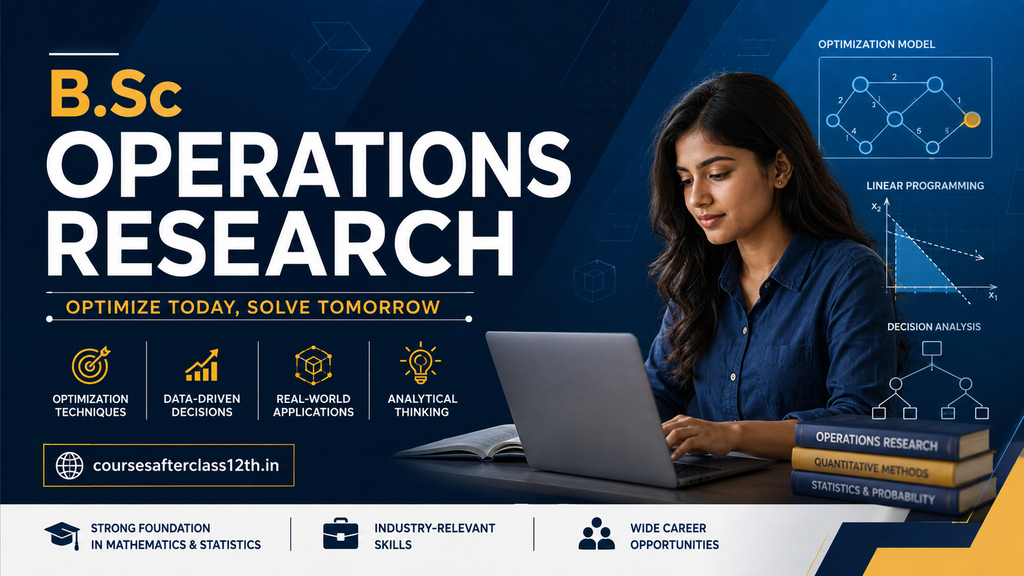
B.Sc Operations Research is an interdisciplinary undergraduate programme that focuses on using mathematics, statistics, analytical techniques and computing to solve complex decision-making and resource-allocation problems. The field is commonly abbreviated as OR, and the term Operational Research is also widely used.
The central idea behind Operations Research is simple: when an organisation has limited resources, multiple choices and competing objectives, mathematical and analytical methods can help identify better decisions.
For example, a company may need to decide how much of different products to manufacture, how many employees should be scheduled for different shifts, which delivery routes should be selected, how much inventory should be maintained, or how limited resources should be allocated among competing activities.
Operations Research converts these practical questions into mathematical or computational models. Students learn how to formulate such models, analyse alternatives, use optimisation techniques and interpret the resulting solutions.
The subject draws knowledge from several disciplines. Mathematics provides modelling and optimisation techniques, statistics helps deal with uncertainty and data, computer science provides computational tools, and economics, engineering and management provide practical application areas. The University of Delhi’s B.Sc. (Hons.) Operational Research programme explicitly describes OR as drawing on mathematics, statistics, information technology, economics and engineering.
This makes the course particularly relevant for students who enjoy mathematics, logical reasoning, computers, problem-solving and analytical decision-making.
Table of Contents
What is B.Sc Operations Research?
B.Sc Operations Research is a bachelor’s-level programme that teaches students how to use quantitative and analytical methods for solving real-world problems.
The discipline is concerned with questions such as:
- How can resources be allocated efficiently?
- What is the best production plan?
- How can transportation costs be reduced?
- How should employees or machines be scheduled?
- What is the optimum inventory level?
- How can waiting time be reduced?
- Which project activities should receive priority?
- How can a business make better decisions under uncertainty?
- Which combination of alternatives produces the best possible result?
Instead of relying only on intuition, Operations Research attempts to build a systematic decision-making process.
A typical OR problem can be represented as:
Real-world problem → Data collection → Mathematical model → Analysis → Optimisation → Solution → Decision
The solution is then interpreted in the context of the original problem.
This is an important distinction. Operations Research is not simply about solving mathematical equations. The objective is to use quantitative techniques to support practical decisions.
Why Study B.Sc Operations Research?
Operations Research can be an attractive choice for students who enjoy mathematics but also want to understand how quantitative methods are applied to business, industry, logistics, technology and management.
1. Develops Analytical Thinking
The course encourages students to break complicated problems into smaller components and analyse them systematically.
2. Strong Mathematical Foundation
Students may study mathematical concepts that support optimisation, probability, statistics and modelling.
3. Practical Problem-Solving
OR techniques can be applied to production, transportation, scheduling, inventory, finance, project management and supply chains.
4. Combines Mathematics and Computing
Modern OR increasingly relies on computational tools. Students may learn programming, databases, numerical techniques and specialised optimisation software.
5. Useful for Data-Driven Decisions
Organisations increasingly use data to support planning and decision-making. OR provides a structured quantitative approach to such problems.
6. Multiple Career Directions
Depending on their skills and further education, graduates can explore areas such as analytics, operations, logistics, supply chain, business analysis, project management and research.
The published B.Sc. (Hons.) Operational Research curriculum at Shaheed Sukhdev College of Business Studies includes practical OR laboratory work, object-oriented programming, database management, business data analysis, logistics and supply chain management, project management and industrial training.
Research Course Highlights
| Particular | Details |
| Course Name | Bachelor of Science in Operations Research |
| Alternative Name | Operational Research |
| Short Form | OR |
| Level | Undergraduate |
| Stream | Science / Quantitative and Analytical Sciences |
| Main Focus | Mathematical modelling, optimisation and decision-making |
| Important Areas | Mathematics, Statistics, Programming, Optimisation and Analytics |
| Eligibility | Usually Class 12 with prescribed subjects |
| Mathematics | Generally important |
| Duration | Commonly 3 or 4 years depending on university structure |
| Learning Methods | Theory, tutorials, practicals, computer labs and projects |
| Career Areas | Analytics, operations, logistics, supply chain, research and business analysis |
| Higher Studies | M.Sc, MCA/MBA or related quantitative programmes subject to eligibility |
| Suitable For | Students interested in mathematics, computers and analytical problem-solving |
Important: There is no single curriculum applicable to every institution. Students should verify the latest eligibility requirements, duration, subjects, credits and admission process of the university they intend to join.
B.Sc Operations Research Eligibility
Eligibility varies from one university to another.
Because Operations Research is strongly quantitative, Mathematics is often an important prerequisite.
Common eligibility requirements may include:
- Completion of Class 12 or equivalent.
- Science or another accepted academic stream.
- Mathematics as a required or preferred subject.
- Minimum marks specified by the university.
- Additional entrance requirements, where applicable.
Some programmes may have specific subject combinations. Students should therefore check the official prospectus rather than assuming that all colleges follow the same rules.
Can Science Students Apply?
Yes. Students with Mathematics in Class 12 are generally well positioned for quantitative undergraduate programmes such as Operations Research.
A strong foundation in algebra, calculus, statistics and logical reasoning can make the transition into the course easier.
Can Commerce Students Study Operations Research?
This depends on the institution’s eligibility rules.
Commerce students with Mathematics may find certain programmes accessible, but the university’s subject requirements should be checked carefully.
Can Arts Students Study Operations Research?
Eligibility varies. Some universities may accept students from broader backgrounds if they have the required Mathematics qualification, while others may restrict admission to specific science or mathematics combinations.
Mathematics in B.Sc Operations Research
Mathematics is one of the central components of Operations Research.
Students may encounter:
- Calculus
- Algebra
- Linear algebra
- Matrices
- Differential equations
- Numerical methods
- Mathematical modelling
- Optimisation
- Probability
- Statistics
The mathematics is not studied only as abstract theory. Many concepts are used to construct models and determine optimal solutions.
For example, linear algebra can support mathematical modelling, while calculus can be useful in optimisation and statistics can help analyse uncertainty.
A student who is uncomfortable with mathematics should therefore consider this aspect seriously before selecting the course.
Admission Process
The admission procedure depends on the institution.
Some universities may use academic merit, while others may use entrance examinations or other selection procedures.
A general process may include:
| Stage | Admission Activity |
| 1 | Check eligibility |
| 2 | Research universities and colleges |
| 3 | Review course curriculum |
| 4 | Register for admission |
| 5 | Complete application |
| 6 | Upload required documents |
| 7 | Take entrance examination if applicable |
| 8 | Check merit/selection list |
| 9 | Participate in counselling where required |
| 10 | Complete document verification |
| 11 | Pay admission fee |
| 12 | Begin classes |
Students should use the official admission notification for current dates and requirements.
B.Sc Operations Research Duration
The duration depends on the university and academic framework.
Traditional undergraduate structures may be three years, while newer undergraduate models can extend to four years with additional credits, research components or other academic pathways.
The University of Delhi’s published B.Sc. (Hons.) Operational Research structure is organised across six semesters, while newer university frameworks may follow different structures.
Before admission, students should verify:
- Number of semesters
- Total credits
- Internship requirements
- Project requirements
- Honours/research structure
- Exit provisions, where applicable
- Maximum programme duration
B.Sc. Operations Research Syllabus
The syllabus generally combines mathematics, statistics, optimisation and computer-based analytical methods.
A representative curriculum may contain the following areas.
Introduction to Operations Research
Students learn the basic concepts, objectives, methodology and applications of OR.
Topics can include:
- Meaning of Operations Research
- Development of OR
- OR methodology
- Mathematical modelling
- Model formulation
- Decision-making
- Applications of OR
- Advantages and limitations of modelling
Linear Programming
Linear Programming is one of the foundational techniques of Operations Research.
Students learn how to formulate problems where an objective needs to be maximised or minimised subject to constraints.
For example:
A manufacturer has limited labour, raw materials and machine hours. Different products generate different profits. The problem is to determine the production quantities that maximise profit without exceeding available resources.
This can be represented mathematically using:
- Decision variables
- Objective function
- Constraints
- Non-negativity conditions
Students may learn graphical methods, simplex techniques and related approaches.
The University of Delhi’s Operational Research curriculum begins with Introduction to Operational Research and Linear Programming and later includes Advanced Linear Programming.
Advanced Linear Programming
As students progress, they may study more advanced concepts such as:
- Simplex method
- Duality
- Dual simplex
- Sensitivity analysis
- Artificial variables
- Big-M method
- Special cases of linear programming
- Post-optimal analysis
These techniques help students understand not only how to obtain a solution but also how changes in constraints or parameters can influence that solution.
Optimisation
Optimisation is central to Operations Research.
The goal is to identify the best feasible solution according to a defined objective.
Depending on the programme, students may study:
- Linear optimisation
- Non-linear optimisation
- Constrained optimisation
- Unconstrained optimisation
- Integer programming
- Network optimisation
- Multi-objective optimisation
The term “best” depends on the objective.
For example:
- Minimise cost.
- Maximise profit.
- Minimise travel time.
- Maximise production.
- Minimise waiting time.
- Maximise resource utilisation.
Transportation Problems
Transportation models deal with moving goods or resources from multiple sources to multiple destinations.
For example, a company may have several warehouses and several retail locations. Each warehouse has limited supply, each destination has demand, and transportation costs differ between routes.
An OR model can help determine how much should be transported along each route.
Students may learn techniques such as:
- North-West Corner Rule
- Least Cost Method
- Vogel’s Approximation Method
- MODI Method
Transportation problems are useful for understanding how mathematical optimisation can address practical logistics decisions.
Assignment Problems
Assignment models are used when tasks need to be allocated to resources.
For example:
- Employees to jobs
- Machines to tasks
- Drivers to routes
- Teams to projects
The objective may be to minimise cost or time.
Students may study the Hungarian Method and related assignment techniques.
Inventory Management
Inventory is an important business problem.
Too much inventory can increase storage and holding costs. Too little inventory can result in shortages, delays and lost sales.
Operations Research provides models for determining appropriate inventory decisions.
Topics may include:
- Inventory costs
- Economic Order Quantity
- Reorder levels
- Safety stock
- Quantity discounts
- Shortage models
- Deterministic inventory models
- Probabilistic inventory models
Inventory management is especially relevant to manufacturing, retail, logistics and supply-chain operations.
Queueing Theory
Queueing theory studies waiting lines and service systems.
Examples include:
- Customers waiting at service counters.
- Vehicles waiting at toll plazas.
- Calls waiting in customer-service systems.
- Patients waiting for services.
- Jobs waiting for processing.
Students may study:
- Arrival processes
- Service processes
- Waiting time
- Queue length
- Service utilisation
- Queue models
The purpose is to balance service capacity and waiting costs.
The University of Delhi’s B.Sc. (Hons.) Operational Research curriculum includes Queueing and Reliability Theory.
Game Theory
Game Theory deals with decision-making in situations where the outcome depends partly on the actions of other participants.
Applications can include:
- Competitive business decisions
- Pricing
- Market strategies
- Negotiation
- Resource competition
Students may study:
- Two-person games
- Zero-sum games
- Pure strategies
- Mixed strategies
- Saddle points
- Dominance
- Payoff matrices
This introduces students to strategic decision-making rather than optimisation in isolation.
Network Analysis
Network models represent relationships between connected activities, locations or systems.
Applications can include:
- Transportation networks
- Communication systems
- Project activities
- Supply chains
- Road networks
Students may encounter:
- Shortest path problems
- Minimum spanning trees
- Network flows
- Project networks
Network analysis demonstrates how OR can be used to solve structured connectivity problems.
PERT and CPM
PERT and CPM are widely associated with project planning and scheduling.
CPM, or Critical Path Method, helps identify activities that influence the total project duration.
PERT, or Programme Evaluation and Review Technique, incorporates uncertainty in activity times.
Students may learn about:
- Project networks
- Activities
- Events
- Critical paths
- Slack
- Float
- Project scheduling
- Activity times
These techniques are relevant to construction, engineering, software development, manufacturing and other project-based environments.
Scheduling Techniques
Scheduling involves deciding when activities, jobs or resources should be used.
Students may study scheduling problems involving:
- Machines
- Employees
- Jobs
- Projects
- Production systems
The objective may be to minimise completion time, waiting time or operational cost.
The B.Sc. (Hons.) Operational Research programme at Shaheed Sukhdev College of Business Studies includes Scheduling Techniques as a core subject.
Reliability Theory
Reliability deals with the probability that a system or component performs its intended function under specified conditions.
It can be relevant to:
- Manufacturing
- Engineering
- Electronics
- Maintenance
- Infrastructure
- Industrial systems
Students may learn basic reliability models and methods for analysing system performance.
Statistics in B.Sc Operations Research
Statistics is another major component.
Students may study:
- Probability
- Probability distributions
- Sampling
- Estimation
- Hypothesis testing
- Regression
- Correlation
- Time-series analysis
- Statistical modelling
Statistics helps students deal with uncertainty and variability.
Operations Research often uses both deterministic and probabilistic models. A deterministic model assumes known parameters, while probabilistic models account for uncertainty.
Programming in Operations Research
Modern Operations Research is closely connected with computing.
Students may learn programming languages such as:
- Python
- R
- C
- C++
- Java
The exact language depends on the university.
Programming can be used to:
- Implement mathematical models.
- Automate calculations.
- Analyse datasets.
- Run simulations.
- Build optimisation models.
- Visualise results.
- Process large datasets.
The published University of Delhi Operational Research curriculum includes Object-Oriented Programming and practical OR laboratory work.
Database Management in Operations Research
Data is the foundation of many analytical models.
Students may therefore study database concepts such as:
- Data storage
- Relational databases
- SQL
- Data retrieval
- Database design
- Data management
Database skills can become useful when OR graduates work with business, logistics, production or operational datasets.
Simulation in Operations Research
Simulation allows analysts to model how a system behaves under different conditions.
For example, a simulation can be used to examine:
- Customer queues
- Manufacturing processes
- Traffic systems
- Inventory behaviour
- Service systems
Instead of changing a real system immediately, an organisation can test possible scenarios through a model.
Students may learn simulation concepts, random-number generation and model analysis.
Business Analytics and Operations Research
Operations Research and business analytics are closely related but not identical.
Business analytics focuses strongly on extracting insights from data, while OR places greater emphasis on using mathematical models to determine decisions or optimal actions.
The two areas can complement each other.
For example:
Analytics: What happened?
Predictive analysis: What might happen?
Operations Research: What should we do?
This distinction can help students understand why OR remains valuable even when organisations already use data analytics.
B.Sc Operations Research Practical Training
Practical education is important because OR techniques are often applied through software and computational models.
Students may practise:
- Linear programming
- Transportation models
- Assignment models
- Network models
- Scheduling
- Inventory models
- Statistical analysis
- Simulation
- Optimisation
- Data analysis
Depending on the university, students may use specialised software or programming environments.
A published B.Sc. Operational Research curriculum includes practical OR laboratory components and skill-enhancement subjects such as Data Analysis and Operational Research Applications.
B.Sc. Operations Research Project
A project provides an opportunity to apply OR techniques to a practical problem.
Possible project topics include:
- Optimisation of delivery routes
- Inventory optimisation
- Employee scheduling
- Production planning
- Hospital resource allocation
- Traffic management
- Queue optimisation
- Supply-chain optimisation
- Project scheduling
- Transportation cost minimisation
- Retail demand analysis
- Warehouse optimisation
A strong project should clearly explain:
- The real-world problem.
- The available data.
- The assumptions.
- The mathematical model.
- The optimisation method.
- The results.
- The limitations.
- The practical recommendation.
The University of Delhi programme specifically mentions an industrial project intended to address an operational issue faced by a company.
Internship Opportunities After B.Sc Operations Research
Internships can help students understand how quantitative methods are used in organisations.
Potential internship environments include:
- Logistics companies
- Supply-chain organisations
- Manufacturing companies
- Consulting firms
- E-commerce companies
- Banks and financial organisations
- Analytics firms
- Transportation companies
- Retail organisations
- Research institutions
- Project-management organisations
Internship responsibilities may include:
- Data collection
- Data cleaning
- Spreadsheet analysis
- Process analysis
- Inventory analysis
- Scheduling
- Reporting
- Dashboard preparation
- Mathematical modelling
- Business analysis
Students should prioritise internships that provide actual analytical exposure rather than selecting opportunities only for certificates.
B.Sc Operations Research Fees
The fee structure varies considerably between institutions.
Factors affecting cost can include:
- Government or private institution
- University
- Location
- Course duration
- Laboratory/computer facilities
- Hostel
- Examination charges
- Additional academic services
| Expense | What Students Should Check |
| Tuition | Annual/semester fee |
| Examination | University examination charges |
| Computer/Lab | Practical facility charges |
| Library | Library and digital resources |
| Hostel | Accommodation |
| Food | Hostel mess expenses |
| Transport | Daily commuting |
| Project | Project-related expenses |
| Internship | Travel and accommodation |
| Other Charges | Institutional fees |
Students should calculate the total cost of completing the degree rather than comparing tuition fees alone.
Career Scope After B.Sc Operations Research
Operations Research can provide a foundation for careers involving quantitative decision-making and operational analysis.
Potential career areas include:
- Business analytics
- Operations analytics
- Supply-chain management
- Logistics
- Inventory management
- Production planning
- Project management
- Data analysis
- Consulting
- Financial analytics
- Research
- Process improvement
Career outcomes depend on the graduate’s skills, employer requirements, location, experience and further education.
The course should therefore be viewed as a quantitative foundation, not as a guarantee of a particular job title.
Jobs After B.Sc Operations Research
Possible entry-level roles can include:
| Career Area | Possible Roles |
| Analytics | Junior Data/Business Analyst |
| Operations | Operations Analyst |
| Supply Chain | Supply Chain Analyst |
| Logistics | Logistics Analyst |
| Planning | Planning Executive/Analyst |
| Inventory | Inventory Analyst |
| Business | Business Analyst |
| Research | Research Assistant |
| Project Management | Project Coordinator |
| Consulting | Junior Consulting/Analytical Roles |
| Data | Junior Data Analyst |
| Process Improvement | Process/Operations Support |
Exact eligibility varies by employer.
Some employers may prefer candidates with postgraduate qualifications, specialised certifications, programming skills or previous experience.
Operations Analyst Career
An Operations Analyst studies how an organisation’s processes perform and identifies opportunities for improvement.
Typical activities may include:
- Analysing operational data.
- Identifying inefficiencies.
- Preparing reports.
- Studying resource utilisation.
- Monitoring performance.
- Supporting planning.
- Recommending process improvements.
Knowledge of OR can be useful because the role often involves quantitative reasoning and structured decision-making.
Supply Chain Career
Supply chains involve the movement of materials, products, information and resources.
OR techniques can support:
- Demand planning
- Inventory management
- Transportation
- Warehouse planning
- Route optimisation
- Supplier decisions
- Distribution planning
Students interested in this sector can strengthen their profile with supply-chain concepts, Excel, SQL, Python, data visualisation and business communication.
Logistics Career
Logistics involves coordinating the movement and storage of goods.
Operations Research can be applied to:
- Vehicle routing
- Delivery scheduling
- Warehouse allocation
- Transportation planning
- Fleet utilisation
- Distribution networks
Students with OR knowledge can therefore explore logistics-related analytical roles.
Production Planning Career
Manufacturing organisations must decide:
- What to produce.
- How much to produce.
- When to produce.
- Which machines should be used.
- How labour should be allocated.
These are classic Operations Research problems.
Graduates can build relevant skills in production systems, inventory, optimisation and data analysis.
Business Analyst Career
Business analysts help organisations understand processes, requirements and performance.
An OR graduate can bring quantitative skills to such roles.
Useful additional skills include:
- Excel
- SQL
- Data visualisation
- Business communication
- Requirement analysis
- Process mapping
- Basic project management
Data Analyst and Operations Research
A graduate with OR training can potentially move toward data analysis by developing additional technical skills.
Recommended areas include:
- Excel
- SQL
- Python
- R
- Statistics
- Power BI
- Tableau
- Data visualisation
Operations Research provides a strong quantitative foundation, but students should understand that becoming a competitive data analyst requires practical data skills in addition to the degree.
B.Sc Operations Research and Data Science
Operations Research and Data Science overlap in several areas.
Both can involve:
- Mathematics
- Statistics
- Programming
- Data analysis
- Modelling
- Decision-making
The main difference is emphasis.
| Operations Research | Data Science |
| Optimisation | Data analysis and prediction |
| Decision models | Statistical and machine-learning models |
| Resource allocation | Pattern discovery |
| Scheduling | Prediction |
| Linear programming | Machine learning |
| Network optimisation | Data engineering/analytics |
| Operations | Broader data applications |
Students interested in both areas can develop a hybrid skill set.
B.Sc Operations Research vs B.Sc Mathematics
Both programmes are quantitative, but their emphasis differs.
| Operations Research | Mathematics |
| Applied decision-making | Broader mathematical theory |
| Optimisation | Pure and applied mathematics |
| Modelling | Mathematical structures |
| Statistics | Mathematics and analysis |
| Operations | Theoretical and applied pathways |
| Business/industry applications | Wider mathematical applications |
Students who enjoy mathematical theory may prefer Mathematics.
Those who want to apply mathematics to optimisation and decision-making may find Operations Research more suitable.
B.Sc Operations Research vs B.Sc Statistics
Statistics focuses primarily on collecting, analysing and interpreting data.
Operations Research focuses strongly on optimisation, modelling and decision-making.
| Operations Research | Statistics |
| Optimisation | Statistical inference |
| Mathematical modelling | Data analysis |
| Scheduling | Probability |
| Resource allocation | Sampling |
| Network models | Regression |
| Decision models | Statistical modelling |
There is considerable overlap, particularly in probability, statistics and data analysis.
B.Sc Operations Research vs B.Sc Computer Science
Computer Science focuses more broadly on computing, software, algorithms and computer systems.
Operations Research uses computing as a tool for mathematical modelling and optimisation.
| Operations Research | Computer Science |
| Mathematical optimisation | Software development |
| Decision models | Algorithms and systems |
| Statistics | Programming |
| Scheduling | Databases |
| Resource allocation | Networks |
| Modelling | Computer architecture |
Students whose primary interest is software engineering may prefer Computer Science.
Those who enjoy mathematics and analytical decision-making may prefer OR.
Higher Studies After B.Sc Operations Research
Graduates can consider several postgraduate directions depending on eligibility.
Possible options include:
- M.Sc Operations Research
- M.Sc Mathematics
- M.Sc Statistics
- M.Sc Data Science
- M.Sc Business Analytics
- M.Sc Applied Mathematics
- MBA
- MBA Operations
- MBA Supply Chain Management
- MBA Business Analytics
- Postgraduate programmes in Financial Analytics
- Related quantitative disciplines
Eligibility varies considerably, so students should check the requirements of each programme.
M.Sc. Operations Research
An M.Sc in Operations Research can provide deeper exposure to mathematical modelling and optimisation.
Students may study:
- Advanced optimisation
- Stochastic processes
- Advanced statistics
- Simulation
- Mathematical programming
- Integer programming
- Non-linear programming
- Decision theory
- Advanced algorithms
This can be particularly useful for students interested in research, consulting, analytics or specialised quantitative roles.
MBA After B.Sc Operations Research
An MBA can be considered by students who want to move towards managerial roles.
Relevant specialisations may include:
- Operations Management
- Supply Chain Management
- Business Analytics
- Finance
- Marketing Analytics
- Project Management
The combination of quantitative OR knowledge and management education can be useful for careers involving business decision-making.
Research Career After B.Sc Operations Research
Students interested in research can pursue postgraduate study and eventually doctoral research.
Possible research areas include:
- Optimisation
- Supply-chain modelling
- Transportation systems
- Healthcare optimisation
- Financial modelling
- Scheduling
- Artificial intelligence
- Machine learning
- Energy systems
- Sustainable logistics
- Network optimisation
- Stochastic modelling
Advanced research often requires postgraduate-level mathematical and computational knowledge.
Artificial Intelligence and Operations Research
AI and OR are increasingly connected.
Machine learning can help predict outcomes, while Operations Research can help determine what action should be taken based on those predictions.
For example:
Machine Learning: Predict future demand.
Operations Research: Determine how much inventory should be ordered.
This combination can be powerful in supply chains, manufacturing, transportation and business planning.
Students interested in this intersection can study:
- Python
- Machine learning
- Statistics
- Optimisation
- Algorithms
- Data science
Modern undergraduate OR programmes are also beginning to connect OR with data science and computational methods. For example, an international B.S. Operations Research curriculum at Rice University includes specialisation options in Data Science, Financial Engineering and Supply Chain Management alongside optimisation, stochastic models and computational thinking.
Operations Research in Supply Chain Management
Supply-chain management is one of the major practical application areas of OR.
Companies must continuously make decisions involving:
- Suppliers
- Inventory
- Warehouses
- Transportation
- Production
- Demand
- Distribution
OR models can help evaluate different scenarios and identify efficient solutions.
This is particularly important when organisations need to balance cost, speed, service quality and resource constraints.
Operations Research in Healthcare
Healthcare systems also involve complex resource-allocation decisions.
Potential applications include:
- Hospital scheduling
- Bed allocation
- Staff scheduling
- Ambulance routing
- Appointment scheduling
- Operating-room planning
- Waiting-line management
The objective is not merely to reduce costs. Models can be designed around service levels, capacity, waiting time and other relevant objectives.
Students interested in this field may consider postgraduate specialisation in healthcare analytics or related areas.
Operations Research in Banking and Finance
Quantitative methods can be applied to:
- Portfolio optimisation
- Risk analysis
- Resource allocation
- Financial modelling
- Scheduling
- Forecasting
Students interested in finance can strengthen their background with statistics, financial mathematics, programming and financial analytics.
Advanced finance roles may require postgraduate qualifications and specialised knowledge.
Operations Research in Transportation
Transportation systems generate numerous optimisation problems.
Examples include:
- Vehicle routing
- Route selection
- Fleet scheduling
- Traffic management
- Public transportation planning
- Delivery optimisation
OR methods can help compare alternative routes and schedules under defined constraints.
Operations Research in E-Commerce
E-commerce companies manage complex systems involving:
- Inventory
- Warehouses
- Delivery
- Demand
- Pricing
- Workforce
- Customer service
Operations Research can support optimisation across these functions.
This makes e-commerce another potential application area for graduates with analytical and quantitative skills.
Operations Research in Manufacturing
Manufacturing has traditionally been an important application area.
OR can support:
- Production planning
- Machine scheduling
- Inventory control
- Quality management
- Maintenance planning
- Resource allocation
A student interested in manufacturing can combine OR with knowledge of industrial engineering and supply-chain systems.
Important Skills for B.Sc Operations Research Students
A successful OR student should develop more than theoretical knowledge.
Mathematical Skills
Build confidence in algebra, calculus, matrices and optimisation.
Statistical Skills
Understand probability, distributions, regression and statistical inference.
Programming
Learn at least one practical programming language.
Excel
Advanced spreadsheet skills can be useful in business and operational environments.
SQL
Database knowledge is valuable for data-oriented roles.
Data Visualisation
Learn how to present analytical results clearly.
Communication
An excellent model has limited value if decision-makers cannot understand the recommendation.
Business Understanding
Learn how organisations actually operate.
Software and Tools for Operations Research
Depending on the programme and career direction, students may encounter:
- Microsoft Excel
- Python
- R
- MATLAB
- SQL
- Power BI
- Tableau
- Optimisation packages
- Statistical software
Some universities may use specialised OR software.
The exact tools vary, so students should focus on understanding the underlying concepts rather than becoming dependent on one software package.
B.Sc Operations Research Project Ideas
Students looking for practical project topics can consider:
| Project Area | Example Topic |
| Inventory | Optimising inventory levels |
| Logistics | Delivery route optimisation |
| Transportation | Minimising transportation cost |
| Scheduling | Employee shift scheduling |
| Manufacturing | Production planning model |
| Healthcare | Hospital appointment scheduling |
| Retail | Stock allocation |
| Supply Chain | Warehouse allocation |
| Finance | Portfolio optimisation |
| Project Management | CPM-based project analysis |
| Queues | Customer waiting-time analysis |
| Data Analytics | Operational performance analysis |
A project should be based on a clearly defined problem and appropriate data.
How to Choose the Best B.Sc Operations Research College
Before choosing a college, students should investigate more than the course name.
Curriculum
Check whether the syllabus includes:
- Mathematics
- Statistics
- Programming
- Optimisation
- Data analysis
- OR applications
Practical Facilities
Ask whether students receive hands-on computational training.
Faculty
Review the academic and research background of faculty members.
Projects
Find out whether students complete research or industry-oriented projects.
Internship
Check whether internships are encouraged or integrated into the programme.
Industry Exposure
Look for seminars, workshops, industrial projects and collaborations.
Placement Information
Review actual placement information where reliably available.
Higher Studies
Check whether graduates progress into relevant postgraduate programmes.
Admission Checklist for Students
Before applying, verify:
- Class 12 subject requirements
- Minimum marks
- Mathematics requirement
- Entrance examination
- Admission dates
- Programme duration
- Semester structure
- Curriculum
- Practical components
- Internship
- Project
- Fees
- Hostel
- Scholarships
- Placement information
- Postgraduate options
This helps prevent decisions based on incomplete or outdated information.
Is B.Sc Operations Research Difficult?
Operations Research can be challenging because it combines mathematics, statistics, logical reasoning and computing.
Students may find topics such as linear programming, optimisation, probability and mathematical modelling demanding initially.
However, the difficulty becomes manageable with regular practice.
Students should focus on:
- Understanding concepts.
- Solving numerical problems.
- Practising models.
- Learning software gradually.
- Connecting mathematics with real examples.
Memorising formulas without understanding their purpose is usually less effective than learning how and when to apply a method.
Who Should Choose B.Sc Operations Research?
This programme can be suitable for students who:
- Enjoy Mathematics.
- Like solving analytical problems.
- Are interested in computers.
- Enjoy logical reasoning.
- Like statistics.
- Want to understand business operations.
- Are interested in optimisation.
- Enjoy working with data.
- May want a career in analytics or operations.
Students who strongly dislike mathematics may want to consider other undergraduate options.
Advantages of B.Sc Operations Research
| Advantage | Explanation |
| Quantitative foundation | Develops mathematical decision-making skills |
| Analytical thinking | Strengthens structured problem-solving |
| Interdisciplinary | Combines mathematics, statistics and computing |
| Industry applications | Useful across many sectors |
| Optimisation skills | Teaches resource-allocation methods |
| Data orientation | Supports analytical careers |
| Higher-study options | Connects with multiple quantitative disciplines |
| Research potential | Suitable foundation for advanced modelling |
Challenges of B.Sc Operations Research
The course also has some challenges.
First, mathematics can be demanding. Students need consistent practice.
Second, the programme may require programming and software skills. Students who have never coded may need additional practice.
Third, some specialised OR positions may require postgraduate education.
Finally, employers often look for practical problem-solving ability rather than only theoretical knowledge.
For this reason, students should develop a portfolio of projects and analytical work during the degree.
B.Sc Operations Research Salary
There is no single salary applicable to all graduates.
Income depends on:
- Job role
- Employer
- Location
- Technical skills
- Experience
- Industry
- Postgraduate qualifications
- Programming ability
- Analytical skills
A graduate entering a junior operations role will have a different compensation profile from someone with advanced analytics skills or a postgraduate qualification.
Students should therefore focus on building career value through skills and experience rather than relying on a fixed salary expectation.
Future Scope of Operations Research
The future of Operations Research is increasingly connected with data analytics, artificial intelligence and optimisation.
Important areas include:
Supply Chain Analytics
Companies need better planning and resource allocation.
Logistics Optimisation
E-commerce and global supply chains require efficient transportation and distribution.
AI and Optimisation
Machine learning can predict outcomes while OR models can optimise decisions.
Financial Analytics
Quantitative methods support portfolio and risk-related analysis.
Healthcare Analytics
Hospitals can use analytical models for scheduling and capacity management.
Energy Systems
Optimisation can support energy planning and resource allocation.
Smart Transportation
Routing and scheduling can become increasingly data-driven.
Sustainable Operations
OR can help organisations balance cost, efficiency and environmental objectives.
B.Sc Operations Research and Sustainability
Modern organisations increasingly need to consider environmental objectives alongside economic performance.
Operations Research can help model problems involving:
- Energy consumption
- Transportation emissions
- Waste reduction
- Resource allocation
- Sustainable supply chains
- Renewable energy planning
This creates opportunities for interdisciplinary work involving OR, environmental science and engineering.
B.Sc Operations Research and Machine Learning
Machine learning and OR solve different parts of many decision problems.
Machine learning may estimate:
- Demand
- Risk
- Customer behaviour
- Equipment failure
- Traffic patterns
Operations Research can then determine:
- Production quantities
- Resource allocation
- Routes
- Schedules
- Inventory levels
This combination is sometimes described as predictive analytics + prescriptive analytics.
Students who learn both areas can potentially build a strong analytical profile.
E-E-A-T Approach for an Operations Research Course Page
An educational webpage should provide useful information without making unrealistic promises.
For example, it is better to write:
“Graduates may explore entry-level analytical and operational roles depending on their skills and employer requirements.”
rather than:
“Every graduate will get a high-paying analyst job.”
Similarly, course duration, fees and eligibility should not be presented as universal when universities differ.
Authoritative university curricula demonstrate that OR programmes can include mathematics, statistics, programming, optimisation, databases, logistics, project management and industrial training.
This distinction helps make course information more transparent and trustworthy.
Frequently Asked Questions About B.Sc Operations Research
1. What is B.Sc Operations Research?
B.Sc Operations Research is an undergraduate degree focused on mathematical modelling, optimisation, statistics and computational methods for solving decision-making and resource-allocation problems.
2. What is Operations Research also called?
Operations Research is commonly abbreviated as OR and is also referred to as Operational Research in many academic and professional contexts.
3. Is B.Sc Operations Research a good course after 12th?
It can be a good option for students who enjoy mathematics, statistics, logical reasoning, computers and analytical problem-solving.
4. Is Mathematics compulsory for B.Sc Operations Research?
Mathematics is an important part of the subject and is commonly required for admission, but exact eligibility varies by university.
5. What are the main subjects in B.Sc Operations Research?
Subjects can include Mathematics, Statistics, Linear Programming, Optimisation, Programming, Inventory Management, Transportation, Assignment Problems, Queueing Theory, Game Theory, Network Analysis and Scheduling.
6. Can PCB students do B.Sc Operations Research?
This depends on the institution. Because Mathematics is usually important for OR, PCB students should carefully check the university’s Class 12 subject requirements.
7. Can Commerce students study operations research?
Some universities may accept Commerce students with Mathematics, while others may specify a particular stream. Eligibility should be checked with the institution.
8. Does B.Sc Operations Research include programming?
Many programmes include programming or computational components. For example, the University of Delhi’s B.Sc. (Hons.) Operational Research curriculum includes Object-Oriented Programming and database management.
9. Is B.Sc Operations Research difficult?
It can be challenging because it combines mathematics, statistics, modelling and computing. Regular practice can help students develop confidence.
10. What jobs can I get after B.Sc Operations Research?
Depending on skills and employer requirements, graduates may explore operations analyst, business analyst, supply-chain analyst, logistics, planning, research and data-related entry-level roles.
11. Can I become a Data Analyst after B.Sc Operations Research?
Yes, students can move towards data analytics by developing additional skills such as Excel, SQL, Python, stata B.Sc. in operations research?istics and data visualisation.
12. Can I do MBA after B.Sc Operations Research?
Yes. Graduates can consider MBA programmes subject to admission requirements. Operations, supply chain and business analytics can be relevant areas.
13. Can I do M.Sc after B.Sc Operations Research?
Yes. Depending on eligibility, students may consider M.Sc programmes in Operations Research, Mathematics, Statistics, Data Science, Business Analytics and related fields.
14. Is Operations Research related to Data Science?
Yes. Both fields use mathematics, statistics and computing. OR focuses strongly on optimisation and decision-making, while Data Science has a broader emphasis on extracting insights and building predictive models.
15. Is Operations Research useful in supply chain?
Yes. OR techniques can support inventory, transportation, warehouse, production and distribution decisions.
16. Can Operations Research be used in healthcare?
Yes. OR can support scheduling, resource allocation, capacity planning, waiting-time analysis and other healthcare-system decisions.
17. Can I study Artificial Intelligence after B.Sc Operations Research?
Students can develop AI and machine-learning skills after graduation. A strong background in mathematics, statistics and optimisation can be useful, although additional programming and machine-learning training is recommended.
18. Is B.Sc Operations Research good for research?
Yes. The programme can provide a foundation for postgraduate research in optimisation, mathematical modelling, supply chains, networks, scheduling, stochastic systems and related areas.
19. Does Operations Research have a future?
Operations Research remains relevant wherever organisations need to make decisions involving constraints, uncertainty and limited resources. Its applications increasingly overlap with analytics, AI, supply chains and optimisation.
20. Which is better: B.Sc Mathematics or B.Sc Operations Research?
Neither is universally better. Mathematics offers broader mathematical study, while Operations Research focuses more strongly on applied modelling, optimisation and decision-making