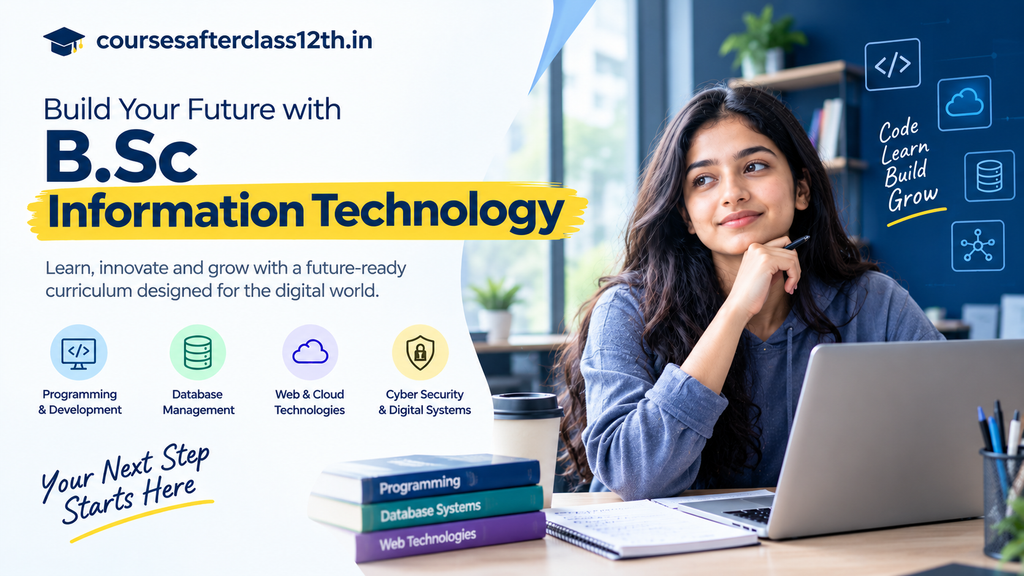
B.Sc Information Technology (B.Sc IT) is an undergraduate degree programme designed for students who want to develop knowledge and practical skills in information technology, computer systems, software applications, databases, networking, web technologies and digital infrastructure. The course combines fundamental computing concepts with practical applications of technology in business, education, communication, healthcare, finance and other sectors.
For students completing Class 12, B.Sc IT can be an alternative to engineering-oriented computer programmes. It is particularly relevant for learners who are interested in understanding how technology is developed, implemented, managed and used to solve real-world problems.
The curriculum varies between universities and colleges. Depending on the institution, students may study programming, database management systems, operating systems, computer networks, web development, software engineering, information security, cloud computing, data analytics, mobile technologies and other emerging areas.
Practical learning is an important part of technology education. Laboratory work, assignments, presentations, internships and projects can help students apply classroom concepts to practical situations. Students can also build additional skills independently through coding practice, certifications, technical projects and industry-oriented learning.
After graduation, career opportunities may be available in software development, web development, technical support, database administration, networking, IT operations, testing, data-related roles and other technology functions. Graduates can also pursue higher education such as MCA, M.Sc IT, M.Sc Computer Science, MBA in IT or specialised programmes in cybersecurity, data science, cloud computing and related fields.
Table of Contents
What is B.Sc Information Technology?
B.Sc Information Technology is a science-based undergraduate programme focused on the use, management and implementation of computer and information systems.
While computer science often places significant emphasis on computational theory, algorithms and the underlying principles of computing, information technology generally focuses more strongly on the practical use of technology, software systems, networks, databases and digital infrastructure.
However, the distinction is not identical across all institutions. Many B.Sc IT programmes include programming, algorithms, databases, operating systems and networking, while some computer science programmes also include extensive application-oriented subjects.
The actual syllabus should therefore be checked before admission.
A typical IT degree can help students understand how software applications communicate with databases, how computers connect through networks, how information is stored and how organisations use digital systems to support their operations.
B.Sc Information Technology After 12th
Students who have completed Class 12 can consider B.Sc IT as an undergraduate career option.
Eligibility differs from one university to another. Many institutions accept students who have completed 10+2 with Science subjects, while some may have specific requirements concerning Mathematics, Computer Science or another relevant subject.
Students should check the current admission rules of every institution before submitting an application.
Important factors to verify include:
- Class 12 eligibility
- Required subjects
- Minimum qualifying marks
- Mathematics requirement
- Entrance examination requirements
- Admission procedure
- Course duration
- Fees
- University recognition
- Curriculum
- Laboratory facilities
- Internship opportunities
- Placement support
The name of the programme alone should not determine the decision. A comparison of the actual curriculum and practical opportunities can provide a better understanding of the value of the programme.
Why Choose this course?
B.Sc IT can be suitable for students who want to build a career around technology without necessarily following a four-year engineering programme.
1. Technology-Focused Education
Students are introduced to computer systems, software, networks, databases and information technologies.
2. Programming Knowledge
Programming is generally an important part of the curriculum. Students may learn languages such as C, C++, Java, Python or other languages depending on the university.
3. Practical Learning
Laboratory sessions and academic projects allow students to apply technical concepts.
4. Multiple Career Options
Graduates can explore software, web, data, networking, support, database and IT operations roles.
5. Higher Education Opportunities
After graduation, students can pursue MCA, M.Sc IT, M.Sc Computer Science and several specialised postgraduate programmes.
6. Relevance Across Industries
IT systems are used in almost every modern industry. Technology professionals therefore work across sectors rather than being restricted to technology companies alone.
Course Highlights
| Particular | Details |
| Course Name | Bachelor of Science in Information Technology |
| Common Name | B.Sc IT |
| Level | Undergraduate |
| Duration | Usually 3 years |
| Study Pattern | Semester-based in many institutions |
| Eligibility | Class 12 or equivalent qualification |
| Mathematics | Required by some institutions |
| Core Areas | Programming, DBMS, Networking, OS, Web Technologies |
| Practical Learning | Computer Labs, Assignments, Projects |
| Admission | Merit or entrance-based, depending on institution |
| Career Areas | Software, Web, IT Support, Networking, Data and more |
| Higher Studies | MCA, M.Sc IT, M.Sc CS, MBA IT and specialised programmes |
B.Sc IT Eligibility
Eligibility requirements are not identical across India.
A common requirement is successful completion of Class 12 from a recognised board. Some universities may specify Science subjects, while others may require Mathematics or Computer Science.
Minimum marks can also differ.
Before applying, students should check the latest official admission notification of the selected university.
Common Eligibility Requirements
A student may need:
- Class 12 or equivalent qualification
- Required subjects according to the institution
- Minimum aggregate marks where applicable
- Mathematics or Computer Science where specified
- Valid entrance examination score where applicable
The admission authority’s current notification should always take priority over general information available online.
Can Science Students Pursue B.Sc IT?
Yes, Science students are commonly eligible for B.Sc IT programmes, subject to the specific rules of the institution.
Students with Mathematics and Computer Science may find some technical subjects easier to approach initially, although prior programming experience is not necessarily required by every college.
A Science background can provide useful preparation for mathematics, logical reasoning and computer-related subjects.
Can Commerce Students Pursue B.Sc IT?
Eligibility for Commerce students varies.
Some institutions may allow Commerce students to apply if they meet the required subject and marks criteria. Others may require Mathematics, Science or Computer Science at Class 12 level.
Commerce students interested in IT should therefore compare the eligibility requirements of individual colleges.
They should not assume that all B.Sc IT programmes follow the same admission policy.
Can Arts Students Pursue B.Sc IT?
This also depends on the university.
Certain institutions may accept students from different academic streams, while others may specify Science or Mathematics requirements.
Arts students should check the exact eligibility criteria before applying.
Students who enter an IT programme without previous programming exposure may need additional practice during the early stages of the course.
B.Sc IT Admission Process
The admission process depends on the institution.
Some colleges admit students based on Class 12 performance, while others may conduct entrance examinations or follow a combination of merit and institutional selection criteria.
A typical admission process may include:
| Stage | What Happens |
| 1 | Research colleges and universities |
| 2 | Check eligibility |
| 3 | Compare syllabus and fees |
| 4 | Complete application |
| 5 | Submit documents |
| 6 | Take entrance examination if required |
| 7 | Check merit or selection result |
| 8 | Complete counselling where applicable |
| 9 | Pay admission fees |
| 10 | Complete enrolment |
Students should keep track of application deadlines because admission schedules differ between institutions.
Course Duration
B.Sc IT is commonly offered as a three-year undergraduate programme divided into six semesters.
However, programme structures can differ according to university regulations.
The number of credits, practical courses, electives, internships and project requirements may vary.
Students should check the current academic structure of the institution they intend to join.
Syllabus
There is no single syllabus followed by every university.
However, common areas can include:
- Computer Fundamentals
- Programming
- Mathematics
- Database Management Systems
- Data Structures
- Computer Networks
- Operating Systems
- Web Development
- Software Engineering
- Computer Organisation
- Information Security
- Cloud Computing
- Data Analytics
- Mobile Technologies
- Project Work
A representative structure may look like this:
| Academic Stage | Common Areas |
| Early Stage | Computer Fundamentals, Programming, Mathematics |
| Early Stage | Digital Logic, Communication, Basic Computing |
| Middle Stage | Data Structures, DBMS, OOP |
| Middle Stage | Operating Systems, Computer Organisation |
| Advanced Stage | Networking, Web Development, Software Engineering |
| Final Stage | Security, Cloud/Data Electives, Project Work |
The exact semester-wise arrangement varies by university.
Computer Fundamentals
The programme generally begins by establishing an understanding of computers and information systems.
Students may learn about:
- Computer components
- Input and output devices
- Memory
- Storage
- Software
- Operating systems
- Computer applications
- Digital information
- Basic troubleshooting
These concepts create a foundation for more advanced subjects.
Programming in B.Sc IT
Programming is one of the core skills for IT students.
Students may begin with basic programming concepts such as:
- Variables
- Data types
- Operators
- Conditions
- Loops
- Functions
- Arrays
- Strings
- File handling
- Basic object-oriented concepts
The language used depends on the curriculum.
C, C++, Java and Python are examples of languages commonly used in academic computing education.
The main objective should be understanding programming logic rather than memorising syntax.
Object-Oriented Programming
Object-oriented programming provides a way to organise software around objects and their behaviour.
Students may study:
- Classes
- Objects
- Encapsulation
- Inheritance
- Polymorphism
- Abstraction
Understanding these principles can help students work with larger software applications.
Data Structures
Data structures provide methods for storing and organising information.
Common concepts include:
- Arrays
- Linked lists
- Stacks
- Queues
- Trees
- Graphs
- Hashing
Students also learn how different structures can affect the efficiency of operations.
This subject is particularly useful for software development and technical interview preparation.
Database Management Systems
Information technology depends heavily on the ability to store and retrieve data efficiently.
Database Management Systems introduce students to the principles of organising information in databases.
Students may learn:
- Relational databases
- Tables
- Primary keys
- Foreign keys
- SQL
- Relationships
- Normalisation
- Transactions
- Database security
- Query optimisation
Practical assignments can involve creating databases and connecting them to software applications.
SQL
SQL is an important skill for students interested in databases and data-related work.
Students can learn how to:
- Create tables
- Insert records
- Retrieve information
- Filter results
- Update data
- Delete records
- Join tables
- Aggregate information
SQL can be useful in software development, database administration and data analysis.
Operating Systems
Operating systems act as an interface between applications and computer hardware.
Students may study:
- Processes
- Threads
- Memory management
- File systems
- Scheduling
- Deadlocks
- Resource allocation
- System security
This subject helps learners understand what happens behind the graphical interface of a computer.
Computer Networks
Computer networking explains how computers and devices communicate.
Topics may include:
- LAN and WAN
- Network topologies
- Communication protocols
- IP addressing
- Routing
- Network layers
- Internet architecture
- Network security
Networking knowledge can be useful for IT support, system administration, cloud computing and cybersecurity.
Web Technologies
Web technologies are commonly included in IT-oriented programmes.
Students may learn:
Front-End Technologies
- HTML
- CSS
- JavaScript
- Responsive design
- Basic user interface principles
Back-End Concepts
- Server-side programming
- APIs
- Databases
- Authentication
- Application logic
Practical projects can help students understand how websites communicate with servers and databases.
Software Engineering
Software engineering focuses on systematic methods for developing software.
Students may learn:
- Requirements gathering
- Software design
- Development models
- Testing
- Documentation
- Maintenance
- Version control
- Project management
The subject helps learners understand professional software-development practices.
Information Security
Digital information needs to be protected from unauthorised access, modification and misuse.
An IT curriculum may introduce concepts such as:
- Authentication
- Authorisation
- Encryption
- Access control
- Security policies
- Network security
- Malware
- Secure software practices
Students interested in cybersecurity can pursue additional specialised training after developing these fundamentals.
Cloud Computing
Cloud computing has become an important component of modern IT infrastructure.
Students may learn about:
- Cloud services
- Virtualisation
- Cloud storage
- Computing resources
- Deployment models
- Scalability
- Cloud security
A university course may provide introductory knowledge, while professional cloud engineering roles generally require deeper hands-on experience.
Data Analytics
Data analytics focuses on examining information to identify patterns and support decision-making.
Students may develop skills in:
- Data collection
- Data cleaning
- SQL
- Statistics
- Data visualisation
- Spreadsheet analysis
- Python-based analysis
Students who want to specialise in analytics can pursue further study in data science or related disciplines.
Mobile Application Development
Some programmes include mobile application development as an elective or specialised subject.
Students may learn how applications are designed for mobile platforms, how interfaces work and how applications interact with databases or APIs.
Academic projects can be used to develop simple applications such as:
- Expense trackers
- Student applications
- Reminder systems
- Attendance applications
- Information portals
Practical Learning in B.Sc IT
Practical work is essential because technology careers require the ability to apply concepts.
Laboratory sessions may involve programming, database design, networking exercises and software development.
Students should also work on independent projects.
Examples include:
- Student management systems
- Library management systems
- E-commerce prototypes
- Portfolio websites
- Inventory applications
- Attendance systems
- Data dashboards
- Expense management applications
Projects help demonstrate that a student can apply knowledge rather than simply pass examinations.
B.Sc IT Projects
A good project should solve a defined problem.
For example, students can create a simple inventory system for a small organisation.
The project can include:
- Requirement analysis
- Database design
- User interface
- Programming
- Testing
- Documentation
- Deployment
Such projects can combine several subjects into one practical solution.
Project Ideas
| Project | Skills Involved |
| Student Management System | Programming + DBMS |
| Online Library | Web + Database |
| Expense Tracker | Programming + Data |
| Inventory Management | DBMS + Software Development |
| Portfolio Website | HTML + CSS + JavaScript |
| Attendance System | Web + Database |
| Data Dashboard | SQL + Analytics |
| Help Desk System | Web + Database + IT Support |
| Online Quiz System | Programming + DBMS |
| Basic E-commerce Website | Web + Database |
Students should select projects according to their knowledge and institutional requirements.
Internship Opportunities After or During B.Sc IT
Internships can help students understand professional work environments.
Possible internship areas include:
- Web development
- Software development
- IT support
- Quality assurance
- Database management
- Data analysis
- Networking
- Cloud computing
- Cybersecurity
- Technical operations
Students should focus on learning outcomes.
A valuable internship can provide exposure to:
- Team collaboration
- Version control
- Documentation
- Client requirements
- Testing
- Project management
- Professional communication
Skills Developed During this course
A graduate can develop both technical and professional skills.
Technical Skills
- Programming
- Database management
- SQL
- Web development
- Networking
- Operating systems
- Software testing
- Information security
- Data analysis
- Cloud fundamentals
Soft Skills
- Communication
- Teamwork
- Presentation
- Analytical thinking
- Problem-solving
- Time management
- Documentation
Technology employers often assess practical competence in addition to educational qualifications.
Career Scope After B.Sc IT
B.Sc IT graduates can explore a range of entry-level technology roles.
Potential career areas include:
- Software Development
- Web Development
- IT Support
- Software Testing
- Database Management
- Networking
- Data Analysis
- IT Operations
- Cloud Support
- Cybersecurity
- Technical Consulting
The actual job title and eligibility depend on the employer.
Jobs After B.Sc Information Technology
IT Support Executive
IT support professionals help users resolve technology-related issues.
They may troubleshoot software, operating systems, networks and basic hardware problems.
Communication skills are particularly important because the role involves assisting users.
Software Developer
Software developers create and maintain applications.
Students interested in development should strengthen programming, data structures, databases and software engineering.
Practical projects can improve their ability to demonstrate technical skills.
Web Developer
Web developers create and maintain websites and web applications.
Depending on the position, professionals may specialise in front-end development, back-end development or full-stack development.
Software Tester
Software testers evaluate applications to identify defects and functional issues.
Students can learn manual testing first and later explore test automation.
Database Administrator
Database professionals manage data systems and help maintain database availability, security and performance.
SQL and database fundamentals are important for this career path.
Network Administrator
Network professionals maintain and troubleshoot network infrastructure.
Knowledge of networking concepts, operating systems and security can provide a useful foundation.
Data Analyst
Data analysts work with structured information to identify trends and provide insights.
Students interested in this career can strengthen SQL, statistics, spreadsheets, Python and visualisation skills.
Cybersecurity Analyst
Cybersecurity roles involve monitoring and protecting systems against security threats.
A B.Sc IT degree can provide foundational knowledge, but dedicated cybersecurity roles may require specialised education, certifications and practical experience.
Cloud Support Associate
Cloud-related support roles can involve monitoring cloud services, troubleshooting deployments and assisting with infrastructure operations.
Students can strengthen their profile through cloud labs and recognised cloud training.
B.Sc IT Salary
There is no single salary applicable to every B.Sc IT graduate.
Earnings depend on:
- Job role
- Technical skills
- Employer
- City
- Experience
- Industry
- Internship background
- Certifications
- Interview performance
Fresh graduates generally enter at entry-level positions. With experience and stronger technical skills, professionals can move into specialised and senior roles.
Students should therefore evaluate a career using long-term growth rather than relying only on advertised starting salaries.
Higher Studies After B.Sc IT
Graduates can pursue higher education according to their career interests.
| Higher Study | Possible Direction |
| MCA | Advanced computer applications |
| M.Sc IT | Information technology specialisation |
| M.Sc Computer Science | Advanced computing |
| M.Sc Data Science | Analytics and machine learning |
| Cybersecurity Programme | Information security |
| Cloud Computing Programme | Cloud technologies |
| MBA IT | Technology and management |
| Research Programme | Academic/research pathway |
Eligibility differs by university.
MCA After B.Sc IT
MCA is one possible postgraduate route for graduates interested in advanced computer applications and software development.
Depending on the curriculum, an MCA may include advanced programming, databases, software engineering, cloud computing, networking, data science and other areas.
Students should verify the eligibility conditions of the university before applying.
B.Sc IT vs B.Sc Computer Science
The two degrees have considerable overlap.
| Factor | B.Sc IT | B.Sc Computer Science |
| Main Orientation | Practical use and management of technology | Computing principles and applications |
| Programming | Commonly included | Commonly included |
| DBMS | Important | Important |
| Networking | Often prominent | Usually included |
| Algorithms | Included in many programmes | Often strongly emphasised |
| Career Options | IT and technology roles | Computing and technology roles |
| Higher Studies | MCA, M.Sc IT and others | MCA, M.Sc CS and others |
The distinction depends heavily on the university curriculum.
B.Sc IT vs BCA
Both programmes can lead towards IT careers.
| Factor | B.Sc IT | BCA |
| Degree Type | Science | Computer Applications |
| Orientation | IT systems and technology | Computer applications |
| Programming | Important | Important |
| Networking | Common | Varies |
| Database | Common | Common |
| Higher Study | M.Sc IT, MCA and others | MCA, M.Sc and others |
| Career | IT, Software, Data and Support | Software, Web, IT and related roles |
Students should compare the actual syllabus rather than relying only on the programme name.
B.Sc IT vs B.Tech CSE
B.Sc IT and B.Tech Computer Science Engineering are different degree pathways.
| Factor | B.Sc IT | B.Tech CSE |
| Degree | Bachelor of Science | Bachelor of Technology |
| Typical Duration | 3 years | 4 years |
| Orientation | Information technology | Engineering and computer technology |
| Engineering Curriculum | Limited | More extensive |
| Programming | Important | Important |
| Practical Work | Labs and projects | Labs and engineering projects |
| Higher Studies | MCA, M.Sc and others | M.Tech, MS, MBA and others |
Neither is automatically the right choice for every student.
B.Sc IT and Software Development
Students targeting software development should build skills beyond the academic syllabus.
A useful pathway is:
Programming → OOP → Data Structures → Algorithms → SQL → Git → Development Framework → Projects → Internship → Job
Students should learn at least one programming language properly and understand how software is designed and tested.
B.Sc IT and Web Development
Students interested in web development can begin with HTML, CSS and JavaScript.
They can then explore:
- Front-end frameworks
- Backend programming
- APIs
- Databases
- Authentication
- Deployment
Creating functional websites can provide practical evidence of skills during job applications.
B.Sc IT and Data Analytics
Data analytics can be a useful specialisation for students who enjoy working with information.
A suitable learning sequence may include:
Excel/Spreadsheets → SQL → Statistics → Python → Data Visualisation → Projects
Students can then explore more advanced areas such as machine learning.
B.Sc IT and Cybersecurity
Cybersecurity requires an understanding of how systems and networks work.
Students can build a foundation through:
Networking → Operating Systems → Programming → Security Fundamentals → Security Labs → Specialisation
Additional certifications and hands-on experience may be useful for professional cybersecurity roles.
B.Sc IT and Cloud Computing
Cloud computing provides infrastructure and services for modern applications.
Students interested in cloud careers should understand:
- Networking
- Operating systems
- Virtualisation
- Storage
- Databases
- Security
- Cloud architecture
Practical cloud projects can strengthen their profile.
B.Sc IT and Artificial Intelligence
AI is increasingly being integrated into software and business systems.
B.Sc IT students interested in AI can build additional knowledge in:
- Python
- Statistics
- Mathematics
- Data handling
- Machine learning
- AI fundamentals
- Generative AI
A strong understanding of programming and data is useful before progressing to advanced AI concepts.
B.Sc IT and Generative AI
Generative AI tools can assist with programming, documentation, research and productivity.
Students can use these tools as learning assistants, but they should verify generated information and understand the underlying concepts.
Blindly copying AI-generated code can create problems because generated solutions may contain logical, security or compatibility issues.
A strong IT professional should be able to review, test and improve AI-assisted output.
Importance of Git and Version Control
Git is widely used for tracking changes in software projects.
Learning version control can help students:
- Maintain project history
- Collaborate with teammates
- Manage different versions
- Recover previous work
- Demonstrate project experience
A well-organised project repository can also contribute to a student’s professional portfolio.
Building a Portfolio During B.Sc IT
Students should begin building a portfolio before graduation.
A portfolio can contain:
- Personal website
- Git repositories
- Academic projects
- Personal projects
- Internship experience
- Technical skills
- Certifications
- Project documentation
Each project should clearly explain what problem it solves and what technologies were used.
Certifications for B.Sc IT Students
Certifications can complement academic learning.
Students may explore certification-oriented learning in:
- Cloud computing
- Networking
- Cybersecurity
- Databases
- Data analytics
- Programming
- IT service management
The best certification depends on the student’s intended career.
A certificate without practical understanding is unlikely to provide the same value as genuine hands-on experience.
Government Career Opportunities After B.Sc IT
Graduates may also explore government recruitment where the relevant notification accepts their qualification.
Eligibility varies according to the position.
Students should carefully examine:
- Degree requirement
- Subject requirement
- Age limit
- Experience
- Percentage
- Examination pattern
- Technical qualifications
A B.Sc IT degree should not be assumed to qualify for every technical government post.
The official recruitment notification remains the final authority.
Freelancing After B.Sc IT
IT graduates can explore freelance work after developing marketable skills.
Potential areas include:
- Website development
- WordPress work
- Website maintenance
- Data-related services
- Technical support
- Basic automation
- Database services
- Software development
Freelancing also requires client communication, pricing, project planning, documentation and deadline management.
Entrepreneurship After B.Sc IT
Students with business interests can combine technology skills with entrepreneurship.
Potential technology businesses may include:
- SaaS products
- Website development agencies
- IT support services
- Automation solutions
- Mobile applications
- Educational technology products
- Data services
Successful technology entrepreneurship requires understanding customer problems, business models and product-market fit in addition to technical skills.
Importance of Communication Skills
Technical knowledge alone may not be sufficient for long-term career growth.
IT professionals often communicate with:
- Customers
- Managers
- Developers
- Designers
- Analysts
- Vendors
- Business teams
Students should therefore practise:
- Professional email writing
- Presentations
- Technical explanations
- Team communication
- Documentation
- Interview communication
Strong communication can help technical professionals collaborate more effectively.
How to Prepare for Placements
Students should begin placement preparation before the final semester.
Technical Preparation
Focus on:
- Programming
- Data structures
- SQL
- Computer networks
- Operating systems
- OOP
- Web fundamentals
Interview Preparation
Practise:
- Technical questions
- Coding problems
- Project explanations
- HR questions
- Communication
Portfolio Preparation
Keep ready:
- Resume
- GitHub profile
- Project links
- Internship details
- Certifications
- Academic achievements
Career Roadmap After B.Sc IT
A practical roadmap can be:
Class 12 → B.Sc IT → Programming → DBMS + Networking → Projects → Internship → Specialisation → Job/Higher Studies
For software development:
Programming → OOP → Data Structures → SQL → Git → Projects → Internship → Developer Role
For data:
SQL → Statistics → Python → Data Analysis → Visualisation → Machine Learning → Data Role
For cybersecurity:
Networking → OS → Security Fundamentals → Practical Labs → Specialisation → Security Role
For cloud:
Networking → Linux/OS → Virtualisation → Cloud Platform → Projects → Cloud Role
How to Choose the Right B.Sc IT College
Selecting the right institution requires more than comparing advertisements.
Students should evaluate:
| Factor | What to Examine |
| Curriculum | Core and elective subjects |
| Faculty | Qualifications and experience |
| Labs | Computers, software and infrastructure |
| Projects | Practical learning |
| Internships | Industry exposure |
| Placements | Relevant roles and recruiters |
| Fees | Total cost |
| Location | Travel/hostel requirements |
| Recognition | Applicable accreditation/recognition |
| Alumni | Career outcomes |
| Higher Studies | Academic progression |
Students should ask whether placement statistics are specifically for B.Sc IT students or represent the entire institution.
B.Sc IT Fees
Fees vary widely depending on the institution.
Factors affecting total cost include:
- Type of institution
- Location
- University charges
- Laboratory facilities
- Course structure
- Hostel
- Transportation
- Examination fees
- Books
- Technology requirements
Therefore, students should obtain the latest official fee structure before admission.
The overall cost of education should include both academic and living expenses.
Scholarships for B.Sc IT Students
Students may be eligible for scholarships based on academic performance, income, category, state-level schemes or institutional policies.
Possible sources include:
- Government scholarship schemes
- State scholarship portals
- University scholarships
- Merit awards
- Financial assistance programmes
Eligibility and deadlines vary, so students should verify the current requirements before applying.
Is B.Sc IT Difficult?
The difficulty level depends on the student’s interests and preparation.
Programming, databases, networking and mathematics may initially seem challenging.
Regular practice can make these concepts easier.
Students do not necessarily need previous professional programming experience, but they should be willing to learn continuously.
Is B.Sc IT Good for Students Who Do Not Know Coding?
Yes, students can learn programming during the programme if the institution accepts them without prior coding experience.
However, they should start practising early.
A good approach is to learn one language, understand basic programming logic and gradually solve increasingly complex problems.
Is B.Sc IT a Good Career Option?
B.Sc IT can be a suitable option for students interested in technology, software systems, networking, databases and digital services.
The degree provides a foundation, but career outcomes depend heavily on practical skills, experience, specialisation and the quality of the student’s learning.
Students who build projects, complete internships and develop relevant technical skills can improve their employability.
Advantages of B.Sc Information Technology
Technology-Oriented Education
The programme focuses on practical applications of computing and information systems.
Multiple Career Paths
Graduates can explore software, web, data, networking, support and other IT-related fields.
Higher Education
MCA, M.Sc IT and other postgraduate pathways are available subject to eligibility.
Practical Learning
Laboratory work and projects provide opportunities to apply technical concepts.
Cross-Industry Opportunities
IT systems are used across healthcare, banking, education, retail, manufacturing, government and many other sectors.
Challenges of B.Sc Information Technology
Students should also understand the challenges.
Technology changes rapidly, so graduates need to continue learning after completing the degree.
Competition for software jobs can be strong. A basic degree without practical skills may not be enough for highly technical roles.
Students should therefore build a portfolio and develop relevant skills throughout college.
Future Scope of Information Technology
The IT sector continues to evolve around several technology areas.
Important fields include:
- Artificial intelligence
- Machine learning
- Cloud computing
- Cybersecurity
- Data analytics
- Internet of Things
- Automation
- Software engineering
- Mobile technologies
- DevOps
- Enterprise applications
- Digital transformation
Students should develop strong fundamentals before specialising in emerging technologies.
B.Sc IT and the Future of Work
Modern organisations increasingly depend on software, cloud infrastructure, data and digital communication.
This creates opportunities for professionals who understand technology and can apply it to business problems.
Future IT professionals may need a combination of:
Technical Skills + Analytical Thinking + Communication + Business Understanding + Continuous Learning
The ability to adapt can become particularly important as technology and workplace requirements change.
Common Mistakes to Avoid
1. Learning Only for Examinations
Passing university examinations does not automatically create job-ready technical skills.
2. Ignoring Projects
Projects demonstrate practical application.
3. Learning Too Many Technologies at Once
It is generally better to understand a smaller number of technologies properly.
4. Waiting Until Final Year
Career preparation should begin early.
5. Relying Completely on AI
AI can support learning but should not replace independent understanding.
6. Ignoring Communication
Technical professionals often work with teams and clients.
B.Sc IT First-Year Preparation
During the first year, students should concentrate on fundamentals.
Recommended areas include:
- Computer basics
- One programming language
- Mathematics
- Logical reasoning
- Basic database concepts
- Communication skills
Students can also begin using Git and creating small projects.
B.Sc IT Second-Year Preparation
The second year can be used to develop intermediate technical skills.
Focus on:
- Data structures
- SQL
- Networking
- Operating systems
- Web development
- Object-oriented programming
- Software engineering
Students can begin internships and larger projects during this stage.
B.Sc IT Final-Year Preparation
The final year should focus on career direction.
Students should:
- Select a specialisation
- Complete a meaningful project
- Build a portfolio
- Prepare a resume
- Apply for internships
- Practise interviews
- Learn relevant tools
- Explore postgraduate programmes
This can create a smoother transition after graduation.
Who Should Choose B.Sc Information Technology?
The programme may be suitable for students who:
- Enjoy technology
- Want to learn computer applications
- Are interested in software and IT systems
- Like problem-solving
- Want to learn programming
- Are interested in networking or databases
- Want to work in the technology sector
- Are willing to continuously update their skills
Who Should Think Carefully Before Choosing B.Sc IT?
Students should carefully consider the programme if they strongly dislike:
- Computers
- Programming
- Logical reasoning
- Technical subjects
- Continuous learning
Technology careers often require professionals to learn new tools throughout their working lives.
Frequently Asked Questions About B.Sc Information Technology
1. What is B.Sc Information Technology?
B.Sc Information Technology is an undergraduate programme focused on information systems, programming, databases, networking, software applications and other areas of IT.
2. Is B.Sc IT a good course after 12th?
It can be a suitable choice for students interested in computers, software, information systems and technology careers. Students should compare college eligibility, curriculum, fees and practical opportunities before admission.
3. What is the duration of B.Sc IT?
B.Sc IT is commonly offered as a three-year undergraduate programme, although the academic structure can vary by institution.
4. Is Mathematics compulsory for B.Sc IT?
Mathematics requirements differ among universities. Some institutions require or prefer Mathematics at Class 12 level, while others may have different criteria.
5. Can Commerce students pursue B.Sc IT?
Some universities may accept Commerce students, while others require specific Science or Mathematics subjects. Eligibility should be checked with the selected institution.
6. Can Arts students do B.Sc IT?
This depends on the university. Students should check whether their Class 12 subjects meet the institution’s eligibility requirements.
7. What subjects are taught in B.Sc IT?
Common areas include programming, databases, data structures, operating systems, computer networks, web technologies, software engineering and information security. Advanced subjects vary by institution.
8. What are the career options after B.Sc IT?
Career areas can include software development, web development, IT support, software testing, database management, networking, data analysis, cloud support and cybersecurity.
9. Can I do MCA after B.Sc IT?
MCA can be a relevant higher-study option after B.Sc IT, subject to the eligibility criteria of the university or institution.
10. Is B.Sc IT better than BCA?
Neither is universally better. B.Sc IT generally focuses on information technology and systems, while BCA focuses on computer applications. The best choice depends on the student’s interests and the specific curriculum.
11. Is B.Sc IT better than B.Tech CSE?
They are different degree pathways. B.Sc IT is a science-based IT programme, while B.Tech CSE is an engineering degree. Students should choose based on career goals, academic preferences and eligibility.
12. Can B.Sc IT graduates become software developers?
Yes, graduates can apply for relevant software development roles if they meet the employer’s requirements and have suitable programming, project and problem-solving skills.
13. Can I enter cybersecurity after B.Sc IT?
Yes, B.Sc IT can provide foundational knowledge for cybersecurity. Specialised training, certifications and hands-on experience can help students move towards dedicated security roles.
14. Can B.Sc IT students enter data science?
Yes. Students can build additional skills in statistics, SQL, Python, data analysis and machine learning to move towards data-related careers.
15. Is coding compulsory in B.Sc IT?
Programming is commonly included in B.Sc IT curricula. Students should expect to study and practise coding as part of their degree.
16. What skills should I learn with B.Sc IT?
Students should consider programming, SQL, databases, networking, Git, web development, problem-solving, communication and at least one specialised technology area.