
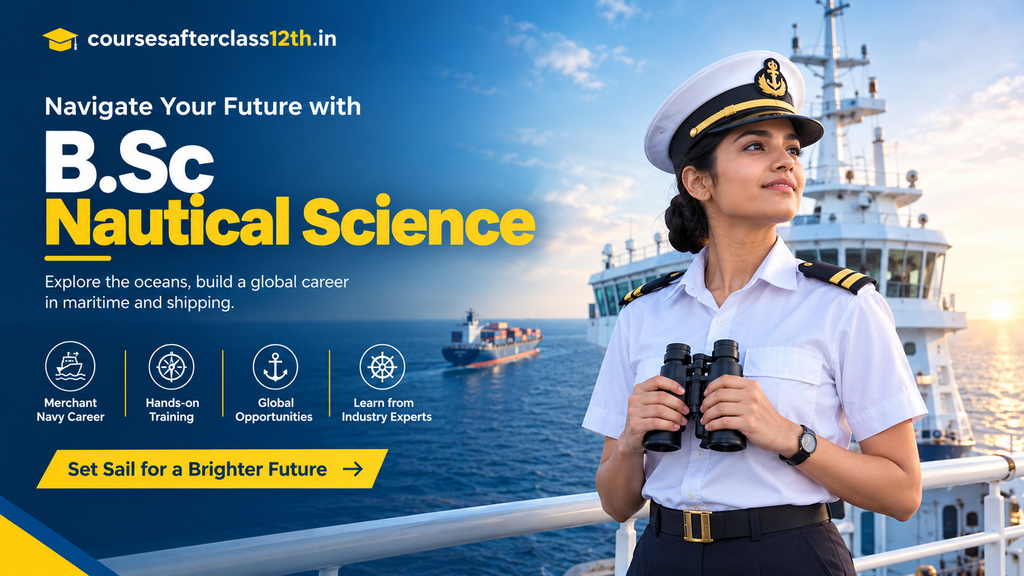
B.Sc Nautical Science is an undergraduate programme designed for students who want to build a professional career in the maritime and merchant navy sector. The course combines academic education with nautical knowledge and can introduce students to navigation, seamanship, ship operations, maritime safety, marine communication, cargo operations, meteorology and other subjects associated with working on commercial ships.
For students who have completed Class 12 and are fascinated by ships, oceans, navigation and international transportation, B.Sc Nautical Science can be an interesting career pathway. The programme is different from conventional B.Sc courses because maritime education is closely connected with professional training, practical experience, medical fitness requirements and applicable maritime regulations.
The merchant shipping industry plays an important role in international trade. Commercial ships transport large quantities of goods between countries, including raw materials, energy products, manufactured goods and other cargo. Behind these operations are trained maritime professionals who manage navigation, ship operations, cargo, safety and daily activities onboard.
B.Sc Nautical Science primarily relates to the deck side of ship operations. Students are introduced to the knowledge and skills required for navigation and shipboard responsibilities. With appropriate training, sea service and required certifications, a graduate can progress through the professional ranks of the deck department.
However, students should understand an important distinction: completing an academic degree alone does not automatically make someone a licensed deck officer or guarantee a Merchant Navy job. Professional maritime careers involve additional training, examinations, medical standards, practical sea service and certification requirements.
Therefore, students considering B.Sc Nautical Science should evaluate the complete pathway rather than looking at the degree name alone.
What is B.Sc Nautical Science?
B.Sc Nautical Science is an undergraduate programme focused on the academic and practical foundations of nautical operations and merchant shipping.
The course can cover subjects such as navigation, ship construction, seamanship, cargo handling, maritime safety, marine meteorology, maritime communication, ship stability and maritime regulations.
Students may also learn how ships are navigated, how cargo is handled safely, how bridge operations are conducted and how crew members respond to emergencies.
The programme can provide a foundation for students who want to pursue a professional career in the deck department of merchant ships.
A nautical science student may eventually work toward professional responsibilities associated with navigating and operating commercial vessels. Career progression can involve moving through different ranks after obtaining the necessary training, sea service and certification.
The exact course structure varies by institution. Therefore, students should carefully check whether a particular college is approved or recognized for the intended maritime training pathway and whether its programme meets applicable regulatory requirements.
B.Sc Nautical Science Course Highlights
| Particular | Details |
| Course Name | B.Sc Nautical Science |
| Level | Undergraduate |
| Duration | Commonly around 3 years academically, depending on programme structure |
| Eligibility | Class 12/equivalent subject to institution and maritime requirements |
| Common Subjects | Navigation, seamanship, cargo, safety, meteorology and maritime studies |
| Career Area | Merchant shipping and maritime sector |
| Main Department | Deck department |
| Practical Training | May include shipboard training, workshops, simulations and related training |
| Work Environment | Ships, ports, shipping companies and maritime organizations |
| Higher Study | Maritime management and related postgraduate programmes |
| Key Skills | Navigation, discipline, communication, teamwork and safety awareness |
The exact duration, eligibility and professional pathway can vary by institution and applicable maritime regulations.
Why Choose B.Sc Nautical Science After 12th?
Students often search for professional courses after Class 12 that can lead to specialized careers. B.Sc Nautical Science is one option for students who are interested in the maritime sector and are comfortable with the distinctive lifestyle associated with working at sea.
One of the main attractions of nautical science is its professional orientation. Students are not simply studying theoretical subjects; they are learning about an industry in which navigation, safety, cargo and shipboard operations are central responsibilities.
Another attraction is the international nature of merchant shipping. Commercial vessels can operate across international routes and connect ports in different countries. As a result, maritime professionals can gain exposure to multicultural crews, international trade and global shipping operations.
The profession can also provide a clearly structured career hierarchy. With appropriate qualifications, certification and sea experience, deck professionals can progress from junior positions toward senior officer and management-level responsibilities.
However, this career path is not suitable for everyone.
Working onboard a ship can mean spending extended periods away from family. Shipboard routines can be demanding, and employees need to adapt to strict safety procedures, teamwork and professional discipline.
Therefore, students should choose B.Sc Nautical Science because they are genuinely interested in maritime life and navigation rather than simply because they have heard that Merchant Navy jobs can provide attractive earnings.
Who Should Study B.Sc Nautical Science?
B.Sc Nautical Science may be suitable for students who have a strong interest in ships, navigation, geography, science and maritime transportation.
The course can be considered by students who:
- Have completed Class 12 with the required subjects.
- Have an interest in ships and oceans.
- Enjoy Physics and Mathematics.
- Have good numerical and analytical abilities.
- Are comfortable working in teams.
- Can follow safety procedures carefully.
- Have good communication skills.
- Can adapt to multicultural environments.
- Are physically and medically fit according to applicable requirements.
- Are prepared for extended periods at sea.
- Want a professional career in merchant shipping.
- Can handle responsibility and disciplined working environments.
A strong sense of responsibility is particularly important because shipboard operations involve safety-critical activities.
B.Sc Nautical Science Eligibility
Eligibility requirements for B.Sc Nautical Science can involve both academic qualifications and maritime-specific requirements.
Students generally need to complete Class 12 or an equivalent qualification. Depending on the institution and applicable regulations, Physics, Chemistry and Mathematics may be important subjects.
Minimum marks, English-language requirements, age criteria, medical fitness and eyesight standards can also apply.
Because these requirements can change and may differ between institutions and maritime pathways, students should always verify the latest official requirements before applying.
| Eligibility Area | General Consideration |
| Qualification | Class 12 or equivalent |
| Academic Subjects | Often includes Physics, Chemistry and Mathematics |
| English | May have specified requirements |
| Minimum Marks | Institution/regulation specific |
| Age | May be subject to applicable rules |
| Medical Fitness | Maritime medical standards may apply |
| Eyesight | Specific standards may apply |
| Admission Test | May apply depending on institution |
| Training Approval | Important to verify for the intended career pathway |
Important: Do not publish a single universal percentage, age limit or eyesight standard unless it has been checked against the current official requirements applicable to your target audience.
B.Sc Nautical Science Admission Process
The admission process can vary between colleges, universities and maritime training institutions.
Students may need to complete an application, satisfy academic eligibility, participate in an entrance or selection process where applicable and undergo medical assessment.
A typical process may involve the following stages.
Step 1: Check Academic Eligibility
Confirm Class 12 subjects, marks and other educational requirements.
Step 2: Research Maritime Institutions
Check the institution’s recognition, programme approval, training facilities, faculty, placement support and maritime-industry connections.
Step 3: Complete the Application
Submit the required application form and supporting information.
Step 4: Entrance Examination
Some institutions may conduct an entrance examination or use a centralized admission process.
Step 5: Selection
Candidates may be selected based on examination performance, academic merit or institution-specific criteria.
Step 6: Medical Examination
Medical fitness is particularly important for careers involving sea service. Students should complete medical assessment through an appropriately authorized medical process where required.
Step 7: Document Verification
Academic certificates and other required documents may need to be verified.
Step 8: Enrollment
After selection and verification, students complete enrollment and fee formalities.
Students should verify the exact process from the institution’s latest admission information.
B.Sc Nautical Science Duration
B.Sc Nautical Science is commonly structured as a three-year academic programme, although the overall professional pathway can extend beyond classroom study because maritime careers involve practical training and sea service.
This is an important point for students and parents.
The academic duration of the degree should not be confused with the complete process of becoming a professionally certified deck officer.
After academic education, students may need to complete additional approved training, onboard sea service and examinations or certification requirements depending on the applicable maritime framework.
Therefore, when evaluating a programme, students should ask the institution to explain the complete journey from admission to professional certification.
B.Sc Nautical Science Syllabus
The syllabus can vary by university and training institution, but students may study a combination of nautical theory, science and practical subjects.
| Subject Area | Possible Topics |
| Navigation | Terrestrial and electronic navigation concepts |
| Seamanship | Shipboard operations and seamanship |
| Cargo | Cargo handling and stowage |
| Ship Stability | Stability and trim |
| Meteorology | Weather and ocean-related conditions |
| Maritime Safety | Emergency and safety procedures |
| Marine Communication | Maritime communication systems |
| Ship Construction | Basic ship structure and design |
| Maritime Regulations | International and national maritime rules |
| Navigation Instruments | Nautical instruments and bridge equipment |
| Maritime Management | Shipboard organization |
| Practical Training | Simulations, workshops and sea training |
The actual subjects and semester structure should be checked against the specific university’s curriculum.
Navigation in B.Sc Nautical Science
Navigation is one of the most important areas of nautical science. It involves determining a vessel’s position, planning routes, monitoring movement, and ensuring that the ship reaches its destination safely.
Students may be introduced to traditional and modern navigation concepts.
These can include:
- Charts
- Position fixing
- Compass navigation
- Electronic navigation
- Route planning
- Navigation equipment
- Bridge procedures
- Electronic chart systems
- Navigation safety
Modern ships use sophisticated electronic systems, but maritime professionals still need a strong understanding of fundamental navigation principles.
Technology can support decision-making, but professional officers must understand the underlying concepts and be able to respond appropriately when systems fail or conditions change.
Seamanship
Seamanship refers broadly to the knowledge and practical skills involved in handling and operating a vessel.
Students may learn about:
- Shipboard routines
- Knots and ropes
- Mooring operations
- Anchoring
- Deck equipment
- Maintenance
- Watchkeeping
- Ship handling
- Safety practices
Seamanship combines practical knowledge with discipline and teamwork.
Ship Stability
Ship stability is a crucial area because a vessel must remain stable under different loading and operational conditions.
Students may study concepts such as:
- Centre of gravity
- Centre of buoyancy
- Stability
- Trim
- List
- Displacement
- Loading conditions
Understanding stability helps maritime professionals appreciate how cargo distribution and other factors can influence vessel behaviour.
Cargo Operations
Commercial ships transport different types of cargo, and cargo must be loaded, secured and transported safely.
Students may learn about:
- Cargo handling
- Cargo documentation
- Stowage
- Securing
- Loading plans
- Cargo safety
- Shipboard cargo operations
Different cargo types have different characteristics and handling requirements.
Therefore, cargo knowledge can be an important part of a deck officer’s professional education.
Marine Meteorology
Weather conditions can have a significant influence on maritime operations.
Students may study:
- Wind
- Pressure
- Waves
- Storm systems
- Visibility
- Weather forecasting
- Ocean conditions
- Weather charts
Understanding weather helps maritime professionals make informed operational decisions.
Maritime Safety
Safety is at the heart of shipboard operations.
Students can learn about emergency preparedness, fire safety, lifesaving equipment, accident prevention and safe working practices.
Potential areas include:
- Fire prevention
- Firefighting
- Lifesaving equipment
- Emergency drills
- Abandon-ship procedures
- Personal safety
- Risk awareness
- Emergency communication
Safety training is not simply an academic subject. It is an essential component of professional maritime life.
Maritime Communication
Communication plays a critical role in navigation and ship operations.
Students may learn about marine communication procedures and systems used for communication between ships, shore authorities and other maritime organizations.
Clear communication is particularly important during emergencies.
A nautical professional must be able to communicate instructions accurately and understand information received from other parties.
Ship Construction
Students may receive an introduction to the construction and structure of commercial ships.
Topics may include:
- Hull
- Decks
- Bulkheads
- Machinery spaces
- Superstructure
- Structural components
- Ship dimensions
Understanding basic ship construction helps students understand how vessels are organized and how different areas contribute to ship operations.
Maritime Laws and Regulations
The maritime industry operates within an extensive regulatory framework.
Students may be introduced to international conventions, national maritime legislation, safety requirements and other rules applicable to ships and seafarers.
The exact regulatory framework depends on the country, vessel type and professional role.
This is why students should use current official sources when checking licensing and certification requirements.
Practical Training in B.Sc Nautical Science
Practical training is one of the most important aspects of nautical education.
Classroom learning can explain navigation and ship operations, but professional competence requires practical experience.
Depending on the programme, practical education may include:
- Navigation simulators
- Bridge simulations
- Seamanship exercises
- Safety drills
- Workshops
- Laboratory sessions
- Ship visits
- Practical demonstrations
- Shipboard training
The quality of practical training should be an important factor when comparing colleges.
Students should ask whether the institution provides access to modern simulation equipment and whether practical training is conducted by appropriately qualified instructors.
Sea Training and Shipboard Experience
A distinctive feature of nautical careers is the importance of onboard experience.
Students pursuing professional deck careers generally need practical sea experience as part of their overall professional development and certification pathway.
Shipboard training allows students to experience:
- Watchkeeping
- Bridge operations
- Safety drills
- Cargo operations
- Deck maintenance
- Ship routines
- Communication
- Teamwork
Sea training can help students understand the difference between classroom theory and real operational conditions.
Life of a B.Sc Nautical Science Student
Students often want to know what daily life is like.
A nautical science programme can involve a structured routine.
Students may attend classroom lectures, practical sessions, simulations, workshops and physical or safety-related training.
Discipline can be an important part of maritime education.
Students may also need to develop professional habits such as:
- Punctuality
- Proper documentation
- Teamwork
- Personal responsibility
- Safety awareness
- Professional communication
The educational environment may feel different from a conventional college because the programme is preparing students for a specialized professional environment.
Life at Sea After B.Sc Nautical Science
Working at sea is different from working in a conventional office.
A seafarer may spend an extended period onboard a vessel while performing assigned duties according to a structured schedule.
The experience can provide international exposure and professional independence, but it also involves challenges.
Possible realities include:
- Long periods away from home
- Shift-based work
- Limited personal space
- Strict safety procedures
- Multicultural crews
- Operational pressure
- Changing weather conditions
- Physical and mental demands
Students should understand these realities before choosing a maritime career.
B.Sc Nautical Science Career Options
B.Sc Nautical Science primarily provides a foundation for careers associated with the deck department of merchant vessels.
Depending on professional certification and experience, career progression can include positions such as:
- Deck Cadet
- Junior Deck Officer
- Third Officer
- Second Officer
- Chief Officer
- Master/Ship Captain
Exact titles, certification requirements and progression depend on the applicable maritime regulations, vessel type and employer.
A degree should therefore be considered the beginning of the professional pathway rather than the final qualification.
Deck Cadet
A Deck Cadet is generally an entry-level trainee position in the deck department.
Cadets gain practical experience and learn about navigation, safety, cargo operations, shipboard routines and other responsibilities under supervision.
This stage can be an important bridge between academic education and professional certification.
Third Officer
A qualified junior deck officer may take on responsibilities associated with navigation watchkeeping, safety equipment or other assigned duties.
The exact responsibilities depend on the vessel and company.
Progression into such a position requires appropriate professional certification and sea service.
Second Officer
The Second Officer often has significant navigation-related responsibilities onboard.
Depending on the vessel and company structure, duties can include navigation planning, chart management, bridge watchkeeping and other responsibilities.
The position requires professional competence and appropriate certification.
Chief Officer
The Chief Officer is a senior deck officer and can have extensive responsibility for cargo operations, deck activities, safety and crew management.
This role requires significant sea experience and professional certification.
Master or Captain
The Master is the senior authority onboard a commercial vessel.
The role involves overall responsibility for the ship, crew, cargo, safety and operational compliance.
Becoming a Master requires substantial sea experience, professional certification and demonstrated competence.
It is therefore a long-term career goal rather than an immediate outcome after completing the degree.
B.Sc Nautical Science Salary
Salary in the maritime industry can vary significantly.
Compensation may depend on:
- Rank
- Vessel type
- Shipping company
- Flag state
- Contract
- Sea experience
- Professional certification
- Route
- Employer
- Additional responsibilities
Entry-level trainees and experienced senior officers can have very different compensation structures.
Therefore, websites should avoid presenting a single guaranteed salary figure for every B.Sc Nautical Science graduate.
A more accurate approach is to explain that earnings generally change substantially as a professional progresses from trainee positions toward certified officer and senior ranks.
Career Progression After B.Sc Nautical Science
A simplified career pathway can be represented as:
Class 12 → B.Sc Nautical Science → Practical/Approved Training → Sea Service → Required Examinations & Certification → Deck Officer → Senior Officer → Chief Officer → Master
This is a simplified educational explanation and should not be interpreted as a guarantee of certification or employment.
Each stage can involve specific eligibility, training, sea service and examination requirements.
Merchant Navy and B.Sc Nautical Science
The Merchant Navy refers broadly to the commercial shipping sector rather than the military navy.
Commercial vessels transport cargo and passengers and support international trade.
B.Sc Nautical Science is particularly relevant to students interested in the deck side of commercial shipping.
The Merchant Navy can include different types of vessels, such as:
- Container ships
- Bulk carriers
- Tankers
- General cargo vessels
- Ro-Ro vessels
- Passenger ships
- Specialized vessels
The requirements and work environment can differ depending on the vessel type.
B.Sc Nautical Science vs Marine Engineering
Students sometimes confuse nautical science with marine engineering.
They are different professional pathways.
| Feature | B.Sc Nautical Science | Marine Engineering |
| Main Area | Deck and navigation | Engine and machinery |
| Key Focus | Navigation and ship operations | Marine engines and technical systems |
| Department | Deck | Engine |
| Subjects | Navigation, seamanship, cargo | Thermodynamics, engines, machinery |
| Career Path | Deck officer to Master | Marine engineer to senior engineering ranks |
| Work | Bridge, deck and cargo operations | Engine room and technical systems |
Students who enjoy navigation, geography and ship operations may prefer nautical science.
Students who are more interested in engines, machinery and mechanical systems may consider marine engineering.
B.Sc Nautical Science vs B.Sc Aviation
These courses serve different industries.
| Feature | B.Sc Nautical Science | B.Sc Aviation |
| Industry | Maritime/shipping | Aviation |
| Main Environment | Ships and maritime sector | Airports, airlines and aviation organizations |
| Technical Focus | Navigation and ship operations | Aviation operations/technology depending on programme |
| Career | Deck officer pathway | Aviation-related careers |
| Practical Training | Maritime/shipboard | Aviation-related |
| Lifestyle | May involve extended sea periods | Usually land-based, depending on role |
Students should choose according to their preferred industry and lifestyle.
B.Sc Nautical Science vs B.Tech Naval Architecture
Naval architecture is more closely associated with the design, construction and engineering of ships.
B.Sc Nautical Science focuses primarily on the operation and navigation of vessels.
| Course | Main Focus |
| B.Sc Nautical Science | Ship navigation and deck operations |
| Marine Engineering | Ship engines and machinery |
| Naval Architecture | Ship design and construction |
| Maritime Management | Shipping business and management |
Understanding this difference can help students choose a course aligned with their career objective.
Skills Required for B.Sc Nautical Science
A successful maritime professional needs a combination of technical, physical and interpersonal abilities.
Navigation Skills
Understanding navigation concepts is central to deck careers.
Mathematical Ability
Mathematics can be useful for navigation, calculations and technical subjects.
Communication
Clear communication is essential onboard.
Teamwork
Ships depend on coordinated teamwork.
Discipline
Shipboard life requires adherence to schedules and procedures.
Decision-Making
Officers may need to make decisions under time-sensitive conditions.
Safety Awareness
Safety procedures must be followed consistently.
Leadership
Leadership becomes increasingly important as a professional progresses toward senior ranks.
Adaptability
Seafarers need to adapt to changing conditions and multicultural working environments.
Importance of Medical Fitness
Medical fitness is particularly important for students planning maritime careers.
Seafarers may need to satisfy medical standards established under applicable maritime regulations.
Requirements can involve areas such as:
- General physical fitness
- Vision
- Hearing
- Medical history
- Physical capability
- Other occupational health criteria
Students should complete the appropriate medical examination through the required authorized process before committing substantial resources to a maritime career.
This is one of the most important practical considerations for anyone planning to study B.Sc Nautical Science.
Eyesight Requirements
Eyesight can be particularly relevant for deck-related careers because navigation and watchkeeping involve visual observation and interpretation.
However, eyesight standards can depend on the applicable regulations, certification and professional role.
Students should not rely on generic internet claims about eyesight requirements.
Instead, they should obtain current requirements from the relevant maritime authority or approved medical examiner.
B.Sc Nautical Science Fees
Course fees vary between universities and maritime institutions.
Students should consider the complete cost rather than tuition alone.
| Expense | Possible Cost Component |
| Tuition | Academic programme fees |
| Hostel | Accommodation |
| Training | Practical/specialized training |
| Uniform | Maritime uniform |
| Books | Nautical study materials |
| Medical | Required medical examination |
| Safety Training | Applicable safety courses |
| Examination | Academic/professional examinations |
| Travel | Training or joining-related travel |
| Other | Institution-specific charges |
Before admission, students should request a detailed fee structure and identify which costs are included.
How to Choose the Best B.Sc Nautical Science College
Selecting a maritime institution requires careful research.
Verify Recognition and Approval
This should be one of the first checks.
Students should verify whether the institution and programme are appropriately approved or recognized for the professional pathway they intend to follow.
Check Training Facilities
Look for:
- Navigation simulators
- Bridge simulators
- Safety-training facilities
- Seamanship equipment
- Laboratories
- Workshops
Check Sea Training Arrangements
Ask how students obtain practical sea experience and whether the institution has established arrangements with shipping companies or approved training organizations.
Check Faculty
Experienced maritime faculty can improve practical learning.
Examine Placement Information
Students should distinguish between verified placement information and general promotional claims.
Understand Total Fees
Calculate tuition, hostel, training, uniform, medical and other expenses.
B.Sc Nautical Science College Selection Checklist
| Factor | What to Verify |
| Recognition | Is the institution appropriately recognized? |
| Programme | Is the course suitable for the intended professional pathway? |
| Medical | What medical standards apply? |
| Curriculum | Are core nautical subjects included? |
| Simulator | Are modern navigation facilities available? |
| Practical Training | What hands-on training is provided? |
| Sea Training | How is onboard training arranged? |
| Faculty | Are instructors appropriately qualified? |
| Placement | What verified employment support is provided? |
| Fees | What is the complete programme cost? |
| Accommodation | Is suitable hostel accommodation available? |
Internship and Practical Exposure
In conventional undergraduate programmes, internships are often optional or short-term.
In nautical education, practical exposure can be much more closely connected to professional development.
Students can benefit from experiencing actual shipboard environments and understanding how theoretical concepts are applied.
Practical exposure can help develop:
- Navigation awareness
- Watchkeeping habits
- Safety discipline
- Cargo knowledge
- Teamwork
- Communication
- Shipboard responsibility
The exact structure depends on the programme and professional certification pathway.
Technology in Modern Nautical Science
The maritime industry has changed significantly with the development of digital navigation, satellite communication, automation and data systems.
Modern vessels can use advanced systems for:
- Navigation
- Positioning
- Communication
- Weather information
- Cargo monitoring
- Engine monitoring
- Operational management
This means modern maritime professionals need both traditional nautical knowledge and digital competence.
Students should therefore become comfortable with technology rather than assuming that nautical careers are based only on traditional navigation.
Electronic Navigation
Electronic navigation systems have become important in modern shipping.
Students may learn about electronic charts, positioning systems, radar and other navigation technologies.
However, technology does not eliminate the need for fundamental navigation knowledge.
Professional officers must understand how systems work and remain prepared to respond if equipment fails or information becomes unreliable.
Radar and Navigation Systems
Radar can help maritime professionals identify objects, assess movement and support safe navigation.
Students may learn basic principles related to radar interpretation and collision-avoidance awareness.
The ability to combine information from multiple sources is an important professional skill.
Maritime Communication Technology
Modern vessels rely on satellite and digital communication systems to maintain contact with shore organizations and other vessels.
Technology supports:
- Emergency communication
- Operational communication
- Weather information
- Vessel tracking
- Administrative coordination
Students should understand both communication technology and proper maritime communication procedures.
Artificial Intelligence and Shipping
Artificial intelligence and data technologies are increasingly relevant to transportation and shipping.
Potential applications can include:
- Route optimization
- Predictive maintenance
- Weather analysis
- Cargo optimization
- Operational analytics
- Autonomous shipping research
Students entering the maritime industry may benefit from basic data and digital literacy.
However, technology is not a replacement for professional maritime certification and human decision-making responsibilities.
Sustainable Shipping and Future Scope
Environmental sustainability is becoming increasingly important in shipping.
The maritime industry is exploring technologies and operational approaches intended to reduce emissions and improve fuel efficiency.
Future-oriented areas can include:
- Alternative marine fuels
- Energy-efficient ship design
- Emission reduction
- Digital route optimization
- Efficient cargo operations
- Green shipping technologies
Students interested in the future of maritime careers can benefit from understanding sustainability developments alongside traditional nautical knowledge.
B.Sc Nautical Science and International Exposure
One of the distinctive features of merchant shipping is its international character.
A commercial vessel can visit multiple ports and interact with people from different countries.
This can provide professional exposure to:
- International trade
- Different cultures
- Global shipping practices
- Port operations
- International maritime regulations
Students should nevertheless remember that international exposure comes with the reality of spending extended periods away from home.
Advantages of B.Sc Nautical Science
Specialized Career
The programme prepares students for a specialized maritime field.
International Industry
Shipping is connected to international trade and transportation.
Structured Career Progression
Deck careers can have defined professional ranks.
Practical Learning
The pathway includes substantial practical and professional training.
Technical Knowledge
Students develop navigation and ship-operation knowledge.
Leadership Development
Career progression can involve increasing responsibility and leadership.
Challenges of B.Sc Nautical Science
A realistic career guide should also explain the challenges.
Long Periods Away From Home
Seafarers can spend extended periods onboard.
Shift Work
Ship operations can continue around the clock.
Strict Discipline
Safety and operational procedures must be followed carefully.
Physical and Mental Demands
Life onboard can be demanding.
Medical Requirements
Medical fitness is an important part of the profession.
Professional Certification
Students need more than an academic degree for many professional roles.
Career Competition
Obtaining suitable sea placements and progressing professionally can be competitive.
Is B.Sc Nautical Science Difficult?
B.Sc Nautical Science can be academically and professionally demanding.
Students may study Mathematics, Physics, navigation, maritime regulations, cargo operations and safety.
The practical side can also require discipline and attention to detail.
Students who enjoy technical subjects and structured environments may find the course engaging.
The most important factor is consistent learning.
Students should avoid treating nautical science as a course that can be completed through memorization alone. Professional maritime work requires understanding and practical competence.
Is B.Sc Nautical Science a Good Career?
B.Sc Nautical Science can be a good career option for students who genuinely want to work in the merchant shipping industry and are comfortable with life at sea.
The programme may be especially suitable for students who are interested in navigation, ships, international transportation and maritime operations.
However, it is not ideal for students who strongly prefer a conventional land-based nine-to-five career.
Before selecting the course, students should consider the lifestyle, medical requirements, training pathway and professional certification process.
Can Girls Pursue B.Sc Nautical Science?
Yes. Women can pursue maritime education and careers subject to the same applicable academic, medical, training and professional requirements.
The maritime industry includes women working in various professional positions.
Students should focus on selecting an appropriate institution, completing the required training and developing professional competence.
Can I Join Merchant Navy After B.Sc Nautical Science?
B.Sc Nautical Science can be an important academic component of a deck-officer career pathway.
However, completing the degree alone does not automatically guarantee employment or professional officer certification.
Students generally need to complete the applicable training, sea service, examinations and certification requirements.
The exact pathway should be verified with the relevant maritime authority and approved training institution.
Can I Become a Captain After B.Sc Nautical Science?
A graduate does not become a ship captain immediately after completing B.Sc Nautical Science.
A simplified progression may be:
B.Sc Nautical Science → Cadet/Training → Sea Service → Certification → Junior Officer → Second Officer → Chief Officer → Master
The timeline depends on sea service, examinations, certification, performance and applicable regulations.
Becoming a Master is therefore a long-term professional goal.
Can I Work on Cruise Ships?
Cruise ships are part of the maritime industry and employ professionals across deck, engineering, hospitality and other departments.
A B.Sc Nautical Science graduate pursuing a deck career may explore cruise-ship opportunities if they satisfy the relevant professional qualifications and employer requirements.
Cruise operations can have different working environments from cargo shipping, so students should research the specific career path.
Can I Work on Cargo Ships?
Yes, qualified deck professionals can work on commercial cargo vessels depending on their certification, sea experience and employer requirements.
Cargo ships can include container vessels, bulk carriers and specialized cargo vessels.
Each vessel type can provide different operational experiences.
Can I Work in Ports After B.Sc Nautical Science?
Maritime experience can also be relevant to certain shore-based roles.
Depending on qualifications and experience, graduates may eventually explore areas such as:
- Port operations
- Shipping administration
- Marine logistics
- Cargo operations
- Maritime compliance
- Ship management
- Marine consultancy
- Maritime education
However, shore-based roles can have their own qualification and experience requirements.
Shore-Based Careers After Maritime Experience
Not every maritime professional remains at sea throughout their entire career.
Experienced professionals may transition into shore-based positions.
Possible areas include:
| Area | Possible Work |
| Ship Management | Vessel operations and coordination |
| Port Operations | Port and cargo activities |
| Maritime Logistics | Shipping and logistics |
| Marine Safety | Safety and compliance |
| Marine Surveying | Inspection-related work |
| Maritime Training | Education and training |
| Chartering | Commercial shipping activities |
| Marine Operations | Shore-based vessel support |
Additional education and experience may be beneficial for management-oriented positions.
Higher Studies After B.Sc Nautical Science
Students can consider higher education after gaining a bachelor’s degree and professional experience.
Potential areas include:
- Maritime Management
- Shipping Management
- Port Management
- Logistics and Supply Chain Management
- International Business
- Maritime Law
- Business Administration
- Transport Management
An MBA can be useful for students who eventually want to transition toward management or shore-based commercial roles.
B.Sc Nautical Science and Maritime Management
Maritime management focuses more on the business and operational side of shipping.
Students who want to move from shipboard responsibilities toward shore-based management may consider postgraduate education in areas such as shipping or maritime management.
Such education can complement practical maritime experience.
B.Sc Nautical Science and Logistics
Shipping is an important component of global logistics.
Nautical science students who later move into logistics can benefit from their understanding of vessels, ports, cargo and maritime transportation.
Additional education in logistics and supply-chain management can strengthen this transition.
B.Sc Nautical Science and Maritime Safety
Safety is a major area of maritime employment.
Professionals with appropriate experience and qualifications may explore safety-related roles.
Potential areas include:
- Safety management
- Risk assessment
- Compliance
- Emergency preparedness
- Training
- Auditing
The requirements vary by position.
Career Growth After B.Sc Nautical Science
Career development in merchant shipping is generally based on a combination of:
- Education
- Certification
- Sea service
- Professional competence
- Examinations
- Performance
- Leadership
- Employer opportunities
A graduate should therefore think beyond the first job.
Long-term planning can involve deciding whether to pursue:
- A deck officer career.
- Senior shipboard ranks.
- Shore-based management.
- Maritime logistics.
- Maritime education.
- Maritime safety or compliance.
- Further academic specialization.
How to Prepare for B.Sc Nautical Science
Students can begin preparation during Class 12.
Strengthen Mathematics
Navigation and technical calculations can require mathematical understanding.
Study Physics
Physics provides useful foundations for understanding motion, forces and other scientific concepts.
Improve English
Professional maritime communication requires clear English communication in many international contexts.
Develop Fitness
Students should maintain a healthy lifestyle and understand the applicable medical requirements.
Improve General Awareness
Knowledge of geography, oceans, weather and international transportation can be useful.
Develop Discipline
Maritime careers require punctuality and adherence to procedures.
B.Sc Nautical Science Admission Preparation
Students preparing for entrance examinations or selection processes can focus on:
- Mathematics
- Physics
- Chemistry
- English
- Logical reasoning
- General awareness
The actual entrance syllabus depends on the institution or admission authority.
Students should always use the latest official examination pattern rather than relying on outdated preparation material.
Important Documents for Admission
Institutions can request different documents, but applicants may generally need academic records and identity-related documentation.
A typical checklist may include:
| Document | Purpose |
| Class 10 Certificate | Date of birth/academic verification |
| Class 12 Certificate | Educational eligibility |
| Mark Sheets | Academic assessment |
| Identity Proof | Verification |
| Passport-size Photos | Application |
| Medical Certificate | Maritime fitness where required |
| Entrance Score | Where applicable |
| Other Certificates | Institution-specific requirements |
Students should verify the exact list before submitting an application.
B.Sc Nautical Science Career Roadmap
A simplified career roadmap is:
Stage 1 – Class 12
Complete the required subjects and academic qualification.
Stage 2 – B.Sc Nautical Science
Study navigation, seamanship, cargo, safety and maritime subjects.
Stage 3 – Practical Training
Complete required practical and safety training.
Stage 4 – Sea Service
Gain supervised onboard experience according to the applicable professional pathway.
Stage 5 – Certification
Complete required examinations and certification processes.
Stage 6 – Deck Officer
Progress into qualified officer responsibilities.
Stage 7 – Senior Rank
With additional sea service and certification, progress toward senior deck positions.
Stage 8 – Master or Shore-Based Management
Experienced professionals can pursue senior shipboard positions or transition into suitable shore-based roles.
How to Choose the Right Maritime Institution
Before paying fees, students should investigate the institution thoroughly.
Verify Approval
Check official approval or recognition.
Verify Training
Ask about practical training and simulation facilities.
Verify Sea-Time Support
Understand how onboard training and sea service are arranged.
Verify Placement
Ask for evidence of actual employment support rather than relying on generic claims.
Verify Medical Requirements
Understand the medical standards before admission.
Verify Fees
Request the complete cost structure.
Verify Career Path
Ask how the academic programme connects to professional certification.
B.Sc Nautical Science: Mistakes Students Should Avoid
Choosing Only Based on Salary
High salary claims should never be the sole reason for selecting maritime education.
Ignoring Medical Requirements
Students should understand medical and eyesight requirements early.
Assuming the Degree Guarantees a Job
Employment depends on qualifications, certification, training, sea placements and market conditions.
Ignoring Lifestyle
Students should understand the realities of spending extended periods at sea.
Selecting an Unverified Institution
Always verify institutional and programme status.
Assuming All Maritime Courses Are the Same
Nautical science, marine engineering and naval architecture have different career pathways.
Future Scope of B.Sc Nautical Science
The future scope of nautical science is closely connected with the global shipping industry and technological developments in maritime transportation.
The sector continues to evolve through:
- Digital navigation
- Automation
- Maritime analytics
- Advanced communication
- Sustainable shipping
- Alternative fuels
- Smart ports
- Autonomous vessel research
Future maritime professionals may therefore need both traditional nautical competence and digital awareness.
Smart Shipping
Modern shipping is increasingly data-driven.
Ships and shipping companies can use digital technologies to monitor operations, optimize routes and improve efficiency.
This creates opportunities for professionals who understand both maritime operations and technology.
Autonomous Ships
Autonomous and remotely supported vessels are an emerging area of maritime technology.
Although such technologies may change certain operational responsibilities, human expertise, regulation, safety management and oversight remain important.
Students should see technological development as an opportunity to expand their skills rather than assuming automation will eliminate maritime careers.
Green Shipping
Environmental regulations and sustainability goals are influencing the development of new shipping technologies.
Future maritime professionals may encounter vessels using new propulsion systems, alternative fuels and improved energy-management technologies.
Knowledge of sustainability can therefore become an increasingly useful professional skill.
Digital Maritime Careers
Data and digital systems are becoming increasingly important in shipping.
Professionals can benefit from understanding:
- Data interpretation
- Digital navigation
- Maritime software
- Electronic documentation
- Cybersecurity awareness
- Communication technology
Digital competence can complement traditional nautical education.
Cybersecurity in Maritime Operations
As vessels become increasingly connected, cybersecurity is also becoming relevant to maritime operations.
Students may benefit from basic awareness of:
- Digital security
- Access control
- Data protection
- Safe use of onboard systems
- Cyber risk
Maritime professionals do not necessarily need to become cybersecurity specialists, but awareness of digital risks can be increasingly important.
Is B.Sc Nautical Science Worth It?
For the right student, B.Sc Nautical Science can be a valuable professional education pathway.
It is particularly relevant for students who:
- Want a career at sea.
- Are interested in navigation.
- Enjoy working with ships.
- Can handle disciplined environments.
- Are comfortable spending time away from home.
- Want an internationally connected career.
- Are prepared to complete additional professional training.
However, students who strongly prefer a land-based career may want to explore other courses.
The best decision depends on career objectives, personal preferences, medical eligibility and willingness to follow the complete maritime certification pathway.
B.Sc Nautical Science – Key Takeaways
B.Sc Nautical Science is an undergraduate programme focused on navigation, seamanship, cargo operations, maritime safety and shipboard operations.
It can provide an academic foundation for students interested in the deck side of merchant shipping.
The course is generally relevant to students from Class 12 science backgrounds who satisfy the institution’s requirements.
However, students should understand that the degree is only one part of the professional pathway. Sea training, practical experience, examinations, medical fitness and professional certification can be required before taking on qualified officer responsibilities.
Career progression can potentially move from cadet-level training through junior and senior deck officer positions toward Chief Officer and Master, subject to applicable requirements.
Students can also consider shore-based careers in maritime management, logistics, port operations, safety and ship management after gaining relevant qualifications and experience.
Frequently Asked Questions About B.Sc Nautical Science
1. What is B.Sc Nautical Science?
B.Sc Nautical Science is an undergraduate programme focused on navigation, seamanship, ship operations, cargo handling, maritime safety, marine communication, meteorology and related nautical subjects.
2. Can I pursue B.Sc Nautical Science after Class 12?
Yes. Students who meet the academic and other requirements of the selected institution can apply. Science subjects such as Physics, Chemistry and Mathematics may be required depending on the programme.
3. How long is B.Sc Nautical Science?
The academic programme is commonly structured over approximately three years, although the complete professional pathway can take longer because additional training, sea service and certification may be required.
4. What subjects are taught in B.Sc Nautical Science?
Subjects can include navigation, seamanship, ship stability, cargo operations, marine meteorology, maritime safety, communication, ship construction and maritime regulations.
5. Can B.Sc Nautical Science lead to a Merchant Navy career?
Yes, it can form part of the professional pathway toward a deck career in merchant shipping. However, additional training, sea service, examinations and certification requirements may apply.
6. Can I become a captain after B.Sc Nautical Science?
Not immediately. Graduates must progress through the professional deck-officer pathway, gaining required sea experience, certification and higher qualifications before becoming eligible for senior ranks such as Master.
7. What is a Deck Cadet?
A Deck Cadet is generally a trainee position in the deck department. The cadet gains practical shipboard experience under supervision as part of professional development.
8. What jobs can I get after B.Sc Nautical Science?
Depending on professional certification and experience, career progression can include deck cadet and qualified deck officer positions, potentially leading to senior ranks such as Chief Officer and Master.
9. Is B.Sc Nautical Science difficult?
The course can be demanding because it combines academic subjects, navigation, practical training, safety procedures and professional discipline. Students with good mathematical ability and an interest in ships may find it more manageable.
10. Is B.Sc Nautical Science a good career?
It can be a good career for students who genuinely want to work in merchant shipping and are comfortable with the lifestyle of working onboard ships.
11. Is medical fitness required for B.Sc Nautical Science?
Medical fitness can be an important requirement for professional maritime careers. Students should verify the applicable medical standards before committing to the course.
12. Are eyesight requirements important?
Yes. Deck-related maritime careers can have specific eyesight standards. Students should verify the current requirements through the relevant official maritime authority or authorized medical examiner.
13. Can girls study B.Sc Nautical Science?
Yes. Women can pursue maritime education and careers provided they meet the applicable academic, medical, training and professional requirements.
14. Can I work on a cruise ship after B.Sc Nautical Science?
Qualified maritime professionals may explore cruise-ship deck careers depending on their certification, sea experience and employer requirements.
15. Can I work on cargo ships?
Yes. Qualified deck professionals can work on suitable commercial cargo vessels depending on their certification and employer requirements.
16. Can I work onshore after B.Sc Nautical Science?
With relevant professional experience and additional qualifications, maritime professionals can explore shore-based areas such as shipping management, port operations, logistics, marine safety and ship management.
17. What is the salary after B.Sc Nautical Science?
Salary varies significantly by rank, shipping company, vessel type, experience, certification, contract and other factors. There is no single salary applicable to every graduate.
18. Is B.Sc Nautical Science better than Marine Engineering?
Neither course is universally better. B.Sc Nautical Science focuses mainly on the deck, navigation and ship-operation pathway, while marine engineering focuses on engines and machinery.
19. Can I pursue an MBA after B.Sc Nautical Science?
Depending on admission requirements, graduates can consider MBA programmes in areas such as shipping, logistics, maritime management, operations or general management.
20. What skills are important for nautical science students?
Important skills include navigation, mathematics, communication, teamwork, discipline, leadership, decision-making, safety awareness and adaptability.
21. Does B.Sc Nautical Science involve practical training?
Yes, nautical education can include practical training, simulations, workshops, safety training and shipboard experience depending on the programme and professional pathway.
22. Is B.Sc Nautical Science suitable for students who do not want to travel?
Students should carefully consider this before choosing the course. Professional deck careers can involve extended periods at sea and international travel.
23. What is the difference between B.Sc Nautical Science and B.Sc Aviation?
B.Sc Nautical Science focuses on ships, navigation and maritime operations, while B.Sc Aviation relates to the aviation industry. The two courses lead toward different professional environments.
24. What is the future scope of B.Sc Nautical Science?
Future opportunities can be influenced by developments in global shipping, digital navigation, smart ports, sustainable shipping, maritime technology and the continued need for qualified maritime professionals.
25. How do I choose the best B.Sc Nautical Science college?
Check institutional recognition, programme approval, training facilities, navigation simulators, practical training, sea-training arrangements, faculty, placement support, fees and medical requirements before applying.