
Table of Contents
Introduction to B.Sc Forestry
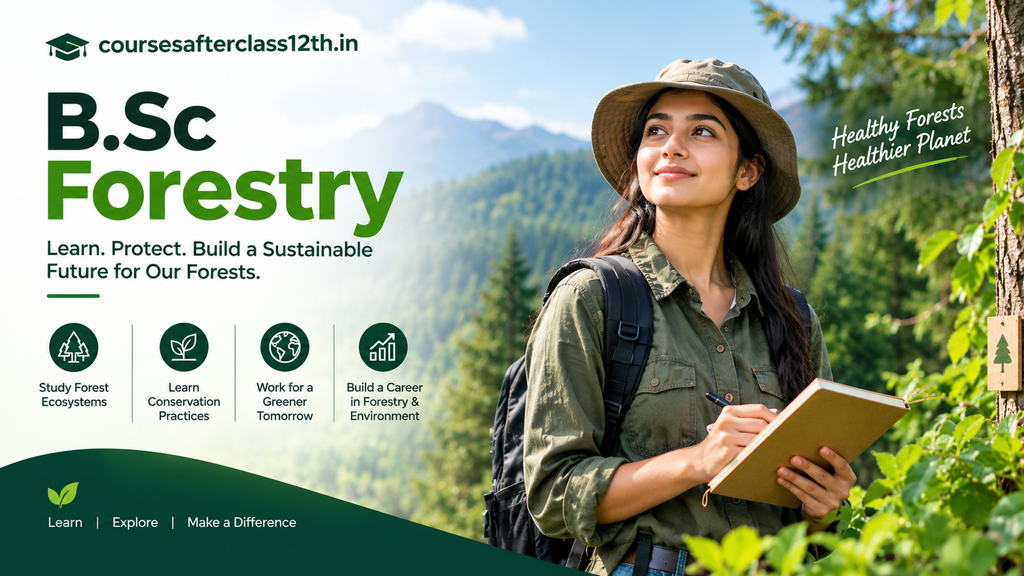
B.Sc Forestry is an undergraduate degree programme that focuses on the scientific management, conservation, protection and sustainable utilization of forests and natural resources. The course combines biological sciences, environmental studies, forest management, wildlife conservation, soil science, ecology, tree improvement, forest economics and related areas.
Forests are much more than sources of timber. They support biodiversity, influence water cycles, protect soil, provide livelihoods and contribute to climate regulation and ecological stability. As a result, forestry has developed into a multidisciplinary field requiring scientific knowledge as well as practical understanding of ecosystems and natural-resource management.
A B.Sc Forestry programme can introduce students to the structure and functioning of forests, tree identification, forest ecology, silviculture, forest mensuration, wildlife management, forest protection and forest economics. Students may also learn about forest products, watershed management, social forestry, agroforestry and environmental conservation.
For students who have completed Class 12 and are interested in forests, wildlife, environmental conservation, plants, ecology, natural resources and outdoor fieldwork, B.Sc Forestry can provide a specialized pathway into the environmental and natural-resource sector.
What is B.Sc Forestry?
B.Sc Forestry is an undergraduate degree that focuses on the science and management of forests, trees, wildlife habitats and associated natural resources.
The programme combines classroom education with laboratory and field-based learning. Students may study how forests develop, how trees are cultivated and managed, how forest resources are measured, how biodiversity can be protected and how forests can be managed sustainably.
Forestry also involves understanding the relationship between people and natural resources. Communities may depend on forests for livelihoods, fuel, food, non-timber forest products and other resources. Therefore, modern forestry includes social and economic considerations alongside ecological science.
The field can also overlap with climate change, watershed management, biodiversity conservation, environmental monitoring and sustainable development.
Consequently, a forestry graduate may explore careers in government forest departments, wildlife and conservation organizations, research institutions, environmental consultancies, plantations, NGOs, forest-based industries and related sectors.
B.Sc Forestry Course Highlights
| Particular | Details |
| Course Name | B.Sc Forestry / B.Sc. (Hons.) Forestry |
| Level | Undergraduate |
| Course Duration | Commonly 4 years, depending on university |
| Eligibility | Class 12 or equivalent with subjects specified by the institution |
| Academic Focus | Forestry, ecology, silviculture, wildlife, conservation and natural-resource management |
| Learning Method | Classroom, laboratory, nursery, forest and field-based learning |
| Admission | Merit and/or entrance examination depending on institution |
| Suitable For | Students interested in forests, wildlife, ecology and environmental conservation |
| Major Areas | Silviculture, forest ecology, wildlife, forest management, soil and water conservation |
| Higher Studies | M.Sc./M.Sc. Forestry and related postgraduate programmes |
| Career Sectors | Government, research, conservation, forestry, plantations, NGOs and environmental organizations |
| Entrepreneurship | Nursery, agroforestry, plantation and environmental service opportunities |
The exact degree title, duration, eligibility and curriculum should be verified from the current university prospectus.
Why Study B.Sc Forestry After 12th?
Choosing forestry after Class 12 can be appropriate for students who want a career connected with nature and environmental management.
Forestry is not limited to working in forests. The discipline includes science, technology, resource management, conservation, economics and community development.
1. Study of Forest Ecosystems
Students learn how forests function as ecosystems and how plants, animals, soil, water and climate interact.
2. Practical Field Exposure
Forestry education can involve field surveys, tree identification, forest measurements, nursery activities and outdoor practical training.
3. Wildlife and Biodiversity
Students interested in wildlife conservation can develop a foundation in habitat management, biodiversity and wildlife science.
4. Environmental Conservation
Forestry graduates can contribute to conservation and natural-resource management initiatives.
5. Government Career Opportunities
The degree can be relevant to various forest and environment-related recruitment opportunities, subject to specific eligibility requirements.
6. Higher Education
Graduates can pursue postgraduate education in forestry, wildlife, environmental science and related disciplines.
7. Research Opportunities
Forestry provides research possibilities in ecology, forest genetics, climate, conservation, silviculture and natural-resource management.
B.Sc Forestry Eligibility
Eligibility varies among universities.
Generally, students must have completed Class 12 or an equivalent examination from a recognized board.
Depending on the institution, students may be required to have studied subjects such as:
- Physics
- Chemistry
- Biology
- Mathematics
- Agriculture
Some universities may specify particular subject combinations or minimum marks.
General Eligibility Table
| Eligibility Factor | Typical Requirement |
| Educational Qualification | Class 12 / equivalent |
| Stream | Science or other eligible stream according to university |
| Relevant Subjects | Physics, Chemistry, Biology, Mathematics and/or Agriculture |
| Minimum Marks | Institution-specific |
| Entrance Exam | May be required |
| Age Requirement | May vary |
| Other Conditions | University-specific |
Important: Students should check the official admission notification because eligibility rules can change between universities and admission years.
B.Sc Forestry Admission Process
The admission process depends on the university.
Some colleges may offer admission based on Class 12 merit, whereas others may use entrance examinations or centralized counselling.
Step 1: Check Eligibility
Read the university’s current eligibility requirements carefully.
Step 2: Research Colleges
Compare:
- Curriculum
- Faculty
- Field facilities
- Laboratories
- Forest nurseries
- Practical training
- Fees
- Hostel facilities
- Placement support
Step 3: Apply
Complete the university or centralized admission application.
Step 4: Entrance Examination
If applicable, appear for the relevant entrance examination.
Step 5: Merit List/Counselling
Qualified students may participate in counselling or seat allocation.
Step 6: Document Verification
Submit the required academic and identity documents according to institutional requirements.
Step 7: Admission Confirmation
Pay the applicable fees and complete registration.
B.Sc Forestry Course Duration
B.Sc Forestry is commonly structured as a four-year undergraduate degree programme, although the exact duration and curriculum depend on the institution.
Forestry education generally progresses from basic sciences and introductory forestry concepts toward specialized areas such as silviculture, forest management, wildlife management, forest economics, conservation and field training.
Students should always confirm the current course structure directly from their selected university.
B.Sc Forestry Subjects
The syllabus varies between universities, but students can commonly encounter subjects such as:
- Fundamentals of forestry
- Forest ecology
- Silviculture
- Forest botany
- Dendrology
- Forest mensuration
- Forest management
- Forest economics
- Forest protection
- Wildlife management
- Soil science
- Watershed management
- Agroforestry
- Social forestry
- Forest genetics
- Tree improvement
- Forest pathology
- Forest entomology
- Forest products
- Environmental science
- Biodiversity conservation
- Remote sensing and GIS
- Forest policy and legislation
- Extension education
- Statistics
- Research methodology
B.Sc Forestry Semester-Wise Subjects
The following is a general representation. Individual universities may arrange subjects differently.
| Academic Stage | Major Learning Areas |
| Early Stage | Basic sciences, forestry fundamentals, botany, ecology |
| Intermediate Stage | Silviculture, dendrology, soil science, forest measurements |
| Advanced Stage | Forest management, wildlife, forest economics, conservation |
| Specialized Stage | Agroforestry, forest products, GIS, watershed management |
| Practical Stage | Field surveys, nursery work, forest visits and measurements |
| Final Stage | Advanced forestry, project work, experiential learning and specialized training |
Major Subjects in B.Sc Forestry
1. Silviculture
Silviculture is one of the central subjects in forestry.
It focuses on the establishment, growth, composition and management of forest stands.
Students can learn about:
- Forest regeneration
- Tree growth
- Plantation establishment
- Stand management
- Natural regeneration
- Artificial regeneration
- Silvicultural systems
Understanding silviculture helps forestry students learn how forests can be managed according to ecological and production objectives.
2. Forest Ecology
Forest ecology studies relationships among organisms and their environment within forest ecosystems.
Students may learn about:
- Ecosystems
- Food chains
- Biodiversity
- Energy flow
- Nutrient cycles
- Forest succession
- Species interactions
- Ecological communities
Ecology is important because sustainable forest management requires an understanding of how interventions can influence ecosystems.
3. Dendrology
Dendrology involves the identification and study of trees and woody plants.
Students learn to recognize tree species using characteristics such as:
- Leaves
- Bark
- Flowers
- Fruits
- Seeds
- Growth patterns
- Branching characteristics
Field identification is an important practical skill for forestry professionals.
4. Forest Mensuration
Forest mensuration deals with the measurement of trees and forest resources.
Students may learn how to estimate:
- Tree height
- Diameter
- Basal area
- Volume
- Growth
- Forest yield
Measurements are useful for forest inventories and management planning.
5. Forest Management
Forest management involves planning and implementing practices designed to achieve particular forest objectives.
These objectives can include:
- Conservation
- Timber production
- Biodiversity protection
- Recreation
- Watershed protection
- Community needs
- Sustainable resource use
Modern forest management attempts to balance ecological, economic and social considerations.
6. Wildlife Management
Wildlife management focuses on the conservation and management of wild animals and their habitats.
Students may learn about:
- Wildlife ecology
- Habitat management
- Biodiversity
- Protected areas
- Human-wildlife interactions
- Wildlife monitoring
- Conservation principles
Students interested in wildlife careers can develop additional specialization through postgraduate study.
7. Forest Soil Science
Soil provides physical support and nutrients for vegetation.
Forestry students can learn about:
- Soil properties
- Soil fertility
- Soil classification
- Nutrient cycles
- Soil conservation
- Erosion
- Forest-soil relationships
Healthy soil is fundamental to forest regeneration and ecosystem productivity.
8. Forest Protection
Forest protection deals with threats to forests.
These can include:
- Forest fires
- Insect pests
- Plant diseases
- Invasive species
- Illegal activities
- Environmental degradation
Students learn preventive and management approaches relevant to forest protection.
9. Agroforestry
Agroforestry combines trees with agricultural crops and/or livestock systems.
Students may study how trees can be integrated into agricultural landscapes.
Potential benefits can include:
- Diversification
- Soil protection
- Additional products
- Biodiversity benefits
- Microclimate effects
Agroforestry is particularly relevant to sustainable land-use planning.
10. Social Forestry
Social forestry focuses on tree and forest-related activities that address community and social needs.
It can include tree planting and management outside traditional forest areas, depending on the programme and context.
Students may explore:
- Community participation
- Rural development
- Extension
- Farm forestry
- Community forestry
- Social benefits of trees
11. Forest Economics
Forests also have economic dimensions.
Forest economics introduces students to:
- Resource valuation
- Production
- Costs
- Benefits
- Forest products
- Markets
- Resource allocation
This helps students understand the relationship between conservation and economic decision-making.
12. Forest Products
Forests provide a variety of products.
Students can learn about:
- Timber
- Bamboo
- Resin
- Fibres
- Gums
- Oils
- Medicinal products
- Non-timber forest products
The subject can introduce students to the processing, properties and utilization of forest resources.
Practical Training in B.Sc Forestry
Forestry is an applied discipline, so practical learning is particularly important.
Students may participate in:
- Forest visits
- Tree identification
- Forest surveys
- Nursery management
- Plantation activities
- Soil studies
- Wildlife observation
- Forest measurements
- Field mapping
- GIS exercises
- Biodiversity surveys
Practical training can help students develop confidence in outdoor work.
For example, a forestry student may learn to identify tree species in the field rather than relying solely on textbook images.
Similarly, forest mensuration exercises can demonstrate how theoretical formulas are applied to actual trees.
Skills Developed During B.Sc Forestry
A strong forestry graduate can develop several categories of skills.
Technical Skills
- Tree identification
- Forest inventory
- Nursery management
- Plantation management
- Forest measurement
- Wildlife observation
- Soil assessment
- Conservation planning
Field Skills
- Surveying
- Sampling
- Mapping
- Field documentation
- Species identification
- Outdoor observation
Analytical Skills
- Data collection
- Statistical analysis
- Ecological interpretation
- Resource assessment
- Research methodology
Digital Skills
Students can benefit from learning:
- GIS
- Remote sensing
- GPS
- Spreadsheet analysis
- Mapping software
- Environmental data tools
Communication Skills
Forestry professionals may interact with:
- Communities
- Government agencies
- Researchers
- NGOs
- Private organizations
- Forest-dependent stakeholders
Therefore, communication is an important professional skill.
Career Options After B.Sc Forestry
B.Sc Forestry can open opportunities across government, private, research and conservation sectors.
| Career Area | Possible Roles |
| Forest Department | Forest-related field positions subject to recruitment rules |
| Wildlife | Wildlife/Conservation-related roles |
| Research | Research Assistant/Technical positions |
| Forestry | Forestry Executive/Field Officer |
| Plantations | Plantation Management roles |
| Conservation | Conservation Project positions |
| NGOs | Programme/Field Coordinator |
| Environment | Environmental field roles |
| GIS | GIS/Mapping-related roles |
| Nursery | Forest/Tree Nursery Manager |
| Agroforestry | Agroforestry Project roles |
| Forest Products | Technical/production roles |
| Academia | Teaching/support roles subject to qualification |
| Entrepreneurship | Nursery, plantation and environmental services |
A specific job title should never be treated as automatically available to every B.Sc Forestry graduate. Recruitment requirements differ between employers.
Government Jobs After B.Sc Forestry
Government service is an important career consideration for forestry graduates.
Depending on the recruitment rules of the relevant organization, graduates may explore opportunities connected with:
- State Forest Departments
- Forest management
- Wildlife conservation
- Environmental departments
- Rural development
- Research institutions
- Agricultural and forestry universities
- Government conservation programmes
Some government positions require specific degrees, examinations, physical standards, age criteria or other conditions.
Therefore, students should always consult the latest official recruitment notification.
Forest Ranger and Forestry Careers
Students often search for “B.Sc Forestry jobs” because they are interested in forest-related government careers.
However, the eligibility for positions such as forest officer, ranger or other forest-service posts varies according to the recruiting authority.
Some positions may have degree-specific requirements, while others may specify particular science subjects.
Selection can also include:
- Written examinations
- Physical tests
- Medical requirements
- Interviews
- Document verification
Students should check the official recruitment authority rather than relying on coaching websites or social-media claims.
B.Sc Forestry and Wildlife Conservation
Students interested in wildlife can use forestry as a foundation for conservation-related careers.
Forests provide habitats for numerous plant and animal species.
A forestry graduate can develop knowledge of:
- Habitat management
- Biodiversity
- Wildlife ecology
- Protected areas
- Conservation planning
- Human-wildlife interactions
Students who want highly specialized wildlife careers may consider postgraduate education in wildlife science, ecology, conservation biology or related disciplines.
B.Sc Forestry and Environmental Conservation
Forestry overlaps with environmental science because forests are closely connected to soil, water, biodiversity and climate.
Graduates may work on projects involving:
- Biodiversity conservation
- Watershed management
- Restoration
- Ecological monitoring
- Environmental education
- Community conservation
- Natural-resource management
Additional environmental qualifications can broaden career opportunities.
B.Sc Forestry and GIS
Geographic Information Systems (GIS) are increasingly useful for environmental and forestry applications.
GIS can be used for:
- Forest mapping
- Land-use analysis
- Habitat mapping
- Resource inventories
- Monitoring
- Spatial planning
Remote sensing can provide additional information through satellite or aerial imagery.
Students interested in this area can strengthen their profile by learning GIS software, remote sensing fundamentals and spatial data analysis.
B.Sc Forestry and Climate Change
Forests are closely connected with climate systems.
Forestry students may learn about:
- Carbon storage
- Forest ecosystems
- Climate impacts
- Forest restoration
- Drought
- Fire
- Biodiversity
- Climate-resilient management
Climate-related research and environmental policy are therefore potential areas for postgraduate specialization.
B.Sc Forestry and Forest Conservation
Forest conservation aims to protect forest ecosystems while considering sustainable resource use and human needs.
Students can learn about:
- Conservation planning
- Protected areas
- Forest restoration
- Biodiversity management
- Community participation
- Sustainable forestry
Modern conservation increasingly requires collaboration between scientists, government agencies, local communities and other stakeholders.
B.Sc Forestry and Agroforestry
Agroforestry can provide an important link between forestry and agriculture.
Trees can be integrated with crops or livestock in different land-use systems.
Graduates may find opportunities in:
- Agroforestry projects
- Rural development
- Sustainable agriculture
- Plantation management
- Research
- Community programmes
B.Sc Forestry and Entrepreneurship
Forestry graduates can also explore entrepreneurship.
Potential areas include:
- Tree nurseries
- Plantation services
- Landscaping
- Agroforestry consultancy
- Environmental education
- Forest-based products
- Bamboo-related enterprises
- Ecotourism-related services
- GIS and environmental mapping services
Entrepreneurship requires business planning, market research, financial management and knowledge of applicable laws and regulations.
Higher Studies After B.Sc Forestry
Students can pursue postgraduate programmes to specialize.
| Higher Study | Possible Focus |
| M.Sc Forestry | Advanced forestry |
| M.Sc Wildlife Science | Wildlife and conservation |
| M.Sc Environmental Science | Environment and sustainability |
| M.Sc Ecology | Ecosystem science |
| M.Sc Botany | Plant sciences |
| M.Sc Natural Resource Management | Natural resources |
| M.Sc Forest Management | Forest planning and management |
| MBA | Management and business |
| Environmental Management | Sustainability and environmental planning |
| GIS/Remote Sensing | Spatial and environmental applications |
Postgraduate qualifications can be especially valuable for research, teaching and specialized technical careers.
B.Sc Forestry Salary in India
Salary after B.Sc Forestry varies according to the employer and career path.
Important factors include:
- Job role
- Government or private sector
- Location
- Experience
- Specialization
- Additional qualifications
- Technical skills
- Employer
- Recruitment level
General Career Progression
| Career Stage | Factors Influencing Salary |
| Entry Level | Qualification, employer and role |
| Early Career | Experience and technical skills |
| Mid Career | Specialization and responsibility |
| Senior Career | Management and leadership |
| Research | Qualification and institution |
| Government | Applicable pay structure |
| Entrepreneurship | Business performance and scale |
Avoid publishing a single guaranteed salary figure for B.Sc Forestry because actual compensation can differ substantially.
B.Sc Forestry Fees
Fees vary considerably depending on the university.
The total cost may include:
- Tuition
- Examination fees
- Laboratory charges
- Fieldwork charges
- Hostel
- Food
- Transportation
- Books
- Equipment
- Other university charges
| Expense | What Students Should Consider |
| Tuition Fee | Annual academic fee |
| Hostel | Accommodation |
| Food | Mess/food expenses |
| Fieldwork | Travel and field training costs |
| Laboratory | Practical charges |
| Books | Study material |
| Equipment | Field equipment where applicable |
Government universities may have different fee structures from private institutions.
Students should always obtain the latest official fee schedule.
B.Sc Forestry Scope
The scope of forestry is broader than traditional timber production.
The modern forestry ecosystem includes:
Forest Management → Conservation → Wildlife → Research → Natural Resources → Climate → Communities → Forest Products → Technology
This creates opportunities in multiple sectors.
Forestry graduates can develop careers in:
- Forest management
- Wildlife conservation
- Environmental monitoring
- Plantation management
- Research
- GIS
- Natural-resource management
- Agroforestry
- Forest products
- Government services
- NGOs
- Environmental organizations
Future Scope of B.Sc Forestry
The future scope of forestry is influenced by environmental conservation, biodiversity protection, climate change, technology and sustainable resource management.
1. GIS and Remote Sensing
Spatial technologies can support forest mapping and monitoring.
2. Biodiversity Conservation
Conservation of ecosystems and species remains an important area.
3. Climate Research
Forest ecosystems are increasingly relevant to climate-related research.
4. Forest Restoration
Restoration of degraded landscapes can require ecological and forestry expertise.
5. Sustainable Resource Management
Forests need management approaches that consider ecological and socioeconomic factors.
6. Community Forestry
Local communities can play important roles in forest conservation and management.
7. Environmental Consulting
Environmental organizations may require professionals with knowledge of ecosystems and natural resources.
B.Sc Forestry and Sustainable Development
Forestry is strongly connected with sustainable development.
Sustainable forestry aims to balance different requirements, including:
- Ecological conservation
- Resource use
- Community needs
- Economic considerations
- Biodiversity protection
- Long-term forest health
Students can learn why short-term resource extraction and long-term ecosystem health need to be considered together.
B.Sc Forestry and Biodiversity
Forests can contain complex biological communities.
Biodiversity studies help students understand:
- Species diversity
- Genetic diversity
- Ecosystem diversity
- Habitat relationships
- Conservation priorities
This knowledge is relevant to protected-area management and ecological restoration.
B.Sc Forestry and Forest Fire Management
Forest fires can have ecological, economic and social consequences.
Forestry education can introduce students to:
- Fire ecology
- Fire prevention
- Fire detection
- Risk assessment
- Forest-fire management
- Restoration after fire
Technology such as satellite imagery and remote sensing can also support forest-fire monitoring.
B.Sc Forestry and Watershed Management
Forests and watersheds are closely connected.
Students can study:
- Soil erosion
- Water conservation
- Catchment management
- Watershed planning
- Vegetation and water relationships
Watershed management is particularly relevant to sustainable natural-resource planning.
B.Sc Forestry and Forest Products
Forests provide various products beyond timber.
These may include:
- Bamboo
- Gums
- Resins
- Fibres
- Medicinal products
- Oils
- Fruits
- Seeds
- Other non-timber forest products
Understanding these resources can help students explore sustainable utilization and value chains.
Is B.Sc Forestry a Good Career Option?
B.Sc Forestry can be a good career option for students who are genuinely interested in forests, wildlife, environmental conservation, ecology and outdoor fieldwork.
The degree can provide a broad foundation in natural-resource management.
However, students should understand that forestry careers can involve fieldwork, remote locations and outdoor conditions depending on the job.
Government jobs may also be competitive and may require additional examinations.
Students who develop complementary skills such as GIS, remote sensing, data analysis, communication and environmental assessment can potentially expand their career options.
B.Sc Forestry vs B.Sc Agriculture
| Factor | B.Sc Forestry | B.Sc Agriculture |
| Main Focus | Forests and natural resources | Agricultural production and allied sciences |
| Forest Ecology | Major focus | Limited/related |
| Wildlife | Stronger focus | Usually limited |
| Silviculture | Major subject | Not central |
| Crop Production | Limited | Major focus |
| Soil Science | Relevant | Major component |
| Agroforestry | Important | Relevant |
| Forest Management | Major focus | Not central |
| Farm Management | Limited | Important |
| Conservation | Strong focus | Related |
| Career Direction | Forestry, wildlife, conservation | Agriculture, agribusiness, farming |
Which course should you choose?
Choose B.Sc Forestry if you are particularly interested in forests, wildlife, biodiversity, conservation and natural resources.
Choose B.Sc Agriculture if you are more interested in crop production, farming, agribusiness and agricultural sciences.
B.Sc Forestry vs Environmental Science
| Factor | B.Sc Forestry | Environmental Science |
| Forest Management | Strong | Related |
| Wildlife | Strong | Related |
| Ecology | Strong | Strong |
| Pollution Studies | Limited | Stronger |
| Natural Resources | Strong | Strong |
| Silviculture | Major | Usually not central |
| Forest Products | Relevant | Limited |
| Environmental Policy | Related | Stronger |
| Fieldwork | High | Varies |
Both degrees can lead toward environmental careers, but their academic focus is different.
Who Should Choose B.Sc Forestry?
B.Sc Forestry may suit students who:
- Love nature
- Are interested in forests
- Enjoy biology
- Like outdoor fieldwork
- Are interested in wildlife
- Want to study ecosystems
- Are interested in conservation
- Want to work with natural resources
- Are interested in climate and environment
- Want to explore forest-related government careers
- Enjoy field surveys and ecological observation
Who May Not Prefer B.Sc Forestry?
The programme may not be ideal for students who strongly dislike:
- Outdoor fieldwork
- Forest environments
- Biology
- Plant science
- Ecological subjects
- Field surveys
Students who want a completely office-based career may need to examine individual forestry job profiles carefully.
How to Choose the Best B.Sc Forestry College?
Students should compare institutions on objective factors rather than relying only on advertisements.
1. University Status
Verify the institution’s recognition and current programme information.
2. Curriculum
Review the full syllabus and specialization options.
3. Forest and Field Facilities
Check whether the institution has access to:
- Forest areas
- Experimental forests
- Nurseries
- Plantations
- Laboratories
- GIS facilities
4. Faculty
Consider faculty qualifications and research activity.
5. Practical Training
Find out how much fieldwork students receive.
6. Research Opportunities
Look for research projects and field studies.
7. Internship
Check whether students receive structured internship opportunities.
8. Placement
Review actual placement information.
9. Fees
Compare the complete cost of education.
10. Location
Consider the surrounding ecological environment and field-learning opportunities.
Career Roadmap After B.Sc Forestry
Government Career
B.Sc Forestry → Competitive Examination → Selection → Forest/Environment-related Government Career
Research Career
B.Sc Forestry → M.Sc Forestry/Related Field → Research Experience → Specialized Research Career
Conservation Career
B.Sc Forestry → Internship → Conservation Project → Field/Programme Role → Specialist
GIS Career
B.Sc Forestry → GIS & Remote Sensing Skills → Internship → GIS/Environmental Role
Entrepreneurship
B.Sc Forestry → Practical Experience → Business Planning → Nursery/Agroforestry/Environmental Enterprise
Advantages of B.Sc Forestry
- Specialized forestry education
- Strong fieldwork exposure
- Forest ecology knowledge
- Wildlife and biodiversity exposure
- Conservation-oriented career options
- Natural-resource management knowledge
- Government-sector opportunities
- Research possibilities
- GIS and remote-sensing opportunities
- Agroforestry exposure
- Environmental career pathways
- Entrepreneurship possibilities
Challenges of B.Sc Forestry
Forestry also has certain challenges.
Some jobs can require extensive outdoor work.
Field positions may involve travel and work in remote locations.
Government positions can be competitive.
Research careers may require postgraduate qualifications.
Private-sector opportunities can vary depending on region and specialization.
Therefore, students should select forestry based on genuine interest rather than assuming that the degree guarantees a particular job.
Frequently Asked Questions About B.Sc Forestry
What is B.Sc Forestry?
B.Sc Forestry is an undergraduate programme focused on forest ecosystems, tree science, silviculture, forest management, wildlife, conservation, natural resources and related subjects.
Is B.Sc Forestry a 4-year course?
B.Sc Forestry is commonly offered as a four-year undergraduate programme, but students should confirm the exact duration with their selected university.
Can I pursue B.Sc Forestry after 12th?
Yes. Students who satisfy the subject and marks requirements of the university can apply after Class 12.
Is Biology compulsory for B.Sc Forestry?
Biology may be required by some universities, while other institutions may accept different science-subject combinations. Students should check the specific admission notification.
What are the subjects in B.Sc Forestry?
Common subjects include silviculture, forest ecology, dendrology, forest mensuration, forest management, wildlife management, forest economics, soil science, agroforestry and forest protection.
What can I do after B.Sc Forestry?
Graduates can explore forestry, wildlife conservation, environmental organizations, research, plantations, GIS, agroforestry, forest products, government opportunities and entrepreneurship.
Can B.Sc Forestry graduates get government jobs?
Yes, graduates may be eligible for certain government positions, depending on the specific recruitment rules.
Can I become a Forest Officer after B.Sc Forestry?
Eligibility for forest-officer positions depends on the particular recruiting authority and post. Candidates should check the latest official recruitment notification.
What is the salary after B.Sc Forestry?
Salary varies according to employer, position, location, experience, specialization and sector. Government and private-sector compensation structures can differ significantly.
Can I do M.Sc after B.Sc Forestry?
Yes. Students can pursue postgraduate programmes in forestry, wildlife, environmental science, ecology, natural-resource management and related fields.
Can I do an MBA after B.Sc Forestry?
Yes. Graduates can consider MBA programmes if they satisfy the institution’s admission requirements.
Is B.Sc Forestry good for wildlife careers?
It can provide a useful foundation because forestry includes forest ecology, biodiversity and habitat-related subjects. Students seeking specialized wildlife careers may consider postgraduate education in wildlife science or conservation.
Is B.Sc Forestry better than B.Sc Agriculture?
Neither course is universally better. Forestry focuses more strongly on forests, wildlife, conservation and natural resources, while agriculture covers crop production and agricultural sciences more broadly.
Is B.Sc Forestry difficult?
The programme includes biological sciences, fieldwork, ecological concepts, measurements and practical training. Students who are interested in the subject and participate consistently can manage the course effectively.
Can B.Sc Forestry graduates work in environmental companies?
Yes. Graduates may explore suitable roles in environmental consulting, conservation projects, ecological monitoring and natural-resource management, depending on the employer’s requirements.
Is B.Sc Forestry good for entrepreneurship?
It can support businesses related to nurseries, plantations, agroforestry, landscaping, environmental services and other permitted forest-related activities.