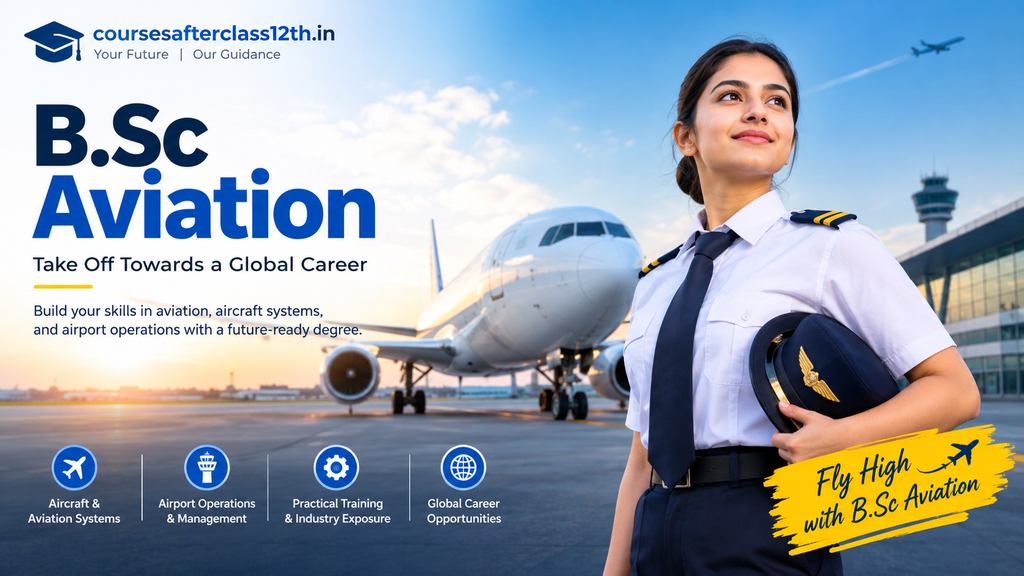
The B.Sc Aviation course is an undergraduate degree designed for students who want to build a professional career in the aviation and airline industry. Aviation is a multidisciplinary field that combines airport operations, airline management, aviation safety, passenger services, aviation regulations, aircraft-related knowledge, logistics and business administration. As air travel continues to connect cities, countries and businesses, the aviation sector offers career opportunities across airlines, airports, aviation service companies, cargo operations, ground handling organizations and related businesses.
For students who have completed Class 12 and are interested in aviation, airport management or airline operations, a B.Sc Aviation degree can provide an organized academic pathway into this rapidly developing industry. The course can help students understand how airports and airlines operate, how passengers and aircraft movements are coordinated, how safety procedures are implemented and how different departments work together to maintain efficient aviation operations.
Unlike the common perception that aviation careers are limited to pilots and cabin crew, the industry includes numerous professional roles behind every flight. Airport operations executives, ground operations staff, airline customer service professionals, cargo coordinators, aviation safety personnel, airport administration executives and operations managers all contribute to the functioning of the aviation ecosystem.
Therefore, students considering B.Sc Aviation after 12th should look beyond individual job titles and understand the complete aviation value chain. The right educational institution, practical exposure, communication skills, industry knowledge and professional attitude can play an important role in determining career development.
Table of Contents
What is B.Sc Aviation?
B.Sc Aviation is a bachelor’s degree programme focused on the academic and practical aspects of aviation operations and management. Depending on the university or institution, the curriculum may cover aviation management, airport operations, airline operations, aviation safety, aviation security, aviation regulations, passenger handling, cargo operations, aviation meteorology, aircraft fundamentals and related subjects.
The exact syllabus and course structure can vary significantly between universities. Some institutions may emphasize airport and airline management, while others may include more technical aviation subjects. Consequently, students should carefully examine the curriculum, practical training opportunities, recognition or affiliation, internship arrangements and institutional facilities before selecting a college.
A B.Sc Aviation programme generally aims to develop both academic understanding and workplace-oriented skills. Students may learn how various aviation departments coordinate with one another and how operational decisions affect passengers, aircraft movement, airport efficiency and airline performance.
The programme can be particularly suitable for students who enjoy organized working environments, customer interaction, transportation systems, management activities and aviation-related operations.
B.Sc Aviation Course Highlights
| Particular | Details |
| Course Name | B.Sc Aviation |
| Course Level | Undergraduate |
| Duration | Generally 3 years |
| Eligibility | Class 12 or equivalent, subject to university requirements |
| Stream | Requirements vary by institution |
| Admission | Merit-based, entrance-based or institution-specific |
| Study Areas | Aviation, airport operations, airline operations and management |
| Practical Exposure | May include internships, industrial visits and practical training |
| Career Areas | Airlines, airports, ground handling, cargo and aviation services |
| Course Mode | Generally full-time |
| Higher Studies | M.Sc, MBA, PG Diploma and specialised aviation programmes |
| Key Skills | Communication, coordination, safety awareness, customer service and operations management |
The information above should be treated as a general guide because eligibility, duration, admission procedures and curriculum can differ between universities and colleges.
Why Choose B.Sc Aviation After 12th?
Choosing a degree after Class 12 is an important decision because it can influence a student’s initial professional direction. B.Sc Aviation may be attractive to students who have a strong interest in airports, airlines, transportation, customer-facing operations and the broader aviation industry.
One of the major advantages of studying aviation is the opportunity to understand a highly coordinated industry. A commercial flight involves numerous teams working together, including airport authorities, airline employees, ground handlers, security personnel, customer service teams, maintenance professionals, cargo staff and air traffic-related organizations. Understanding this ecosystem can provide students with a broader perspective of aviation operations.
Another reason students consider B.Sc Aviation is the diversity of career functions available within the sector. Aviation graduates are not restricted to a single job role. Depending on their qualifications and skills, they may explore airport operations, airline administration, passenger services, ground operations, cargo logistics, customer relations and aviation management.
The course can also help students develop transferable skills. Communication, teamwork, time management, problem-solving, documentation, coordination and professional conduct are valuable not only in aviation but also in logistics, transportation, hospitality and other service industries.
However, students should not select the programme solely because aviation appears glamorous. Aviation is a highly regulated and operationally demanding industry. Employees may need to work shifts, weekends and holidays depending on their department and employer. Therefore, students should evaluate their interests, working preferences and long-term career goals before choosing the programme.
Who Should Study B.Sc Aviation?
B.Sc Aviation can be considered by students who are interested in the aviation industry and want to understand airline or airport operations from an academic and management perspective.
The course may be suitable for students who:
- Have completed Class 12 from a recognised board.
- Have an interest in airports and airlines.
- Enjoy communication and customer interaction.
- Are comfortable working as part of a team.
- Can manage responsibilities in structured environments.
- Have good organisational and coordination skills.
- Are interested in transportation and logistics.
- Want to explore airport or airline operations.
- Are willing to work in a dynamic industry.
- Want to develop a long-term career in aviation management or related areas.
Good communication skills can be particularly valuable because aviation professionals frequently interact with passengers, colleagues, supervisors, airport authorities and service providers.
B.Sc Aviation Eligibility
Eligibility requirements for B.Sc Aviation vary from one institution to another. Generally, applicants need to have successfully completed Class 12 or an equivalent qualification from a recognised education board.
Some universities may specify particular subjects or minimum marks. Certain institutions may also have additional admission conditions. Therefore, students should verify the official eligibility requirements of the institution where they intend to apply.
A general eligibility structure may look like this:
| Requirement | General Guideline |
| Educational Qualification | 10+2/Class 12 or equivalent |
| Board | Recognised education board |
| Minimum Marks | Varies by institution |
| Subject Requirements | May vary by university |
| Entrance Examination | May be applicable at selected institutions |
| Age Requirement | Institution-specific |
| English Requirement | May apply depending on programme |
Students should not assume that one eligibility rule applies to every B.Sc Aviation college. The official university prospectus should always be considered the final source for admission requirements.
B.Sc Aviation Admission Process
The admission process for B.Sc Aviation can differ depending on the college or university. Some institutions admit students on the basis of Class 12 marks, whereas others may conduct entrance examinations, interviews or additional selection stages.
A typical admission process may involve the following steps:
Step 1: Check Eligibility
Students should first confirm that they satisfy the academic and subject requirements of the selected institution.
Step 2: Research Colleges
Compare universities based on curriculum, faculty, practical exposure, facilities, internships, industry connections, location and overall academic reputation.
Step 3: Complete the Application
Eligible candidates generally need to complete an online or offline application form and provide the required academic information.
Step 4: Entrance Test or Selection
If the university conducts an entrance examination, candidates may need to appear for it. Some institutions may use merit-based selection.
Step 5: Counselling or Interview
Selected institutions may conduct counselling or interviews before confirming admission.
Step 6: Document Verification
Candidates may be required to submit academic certificates, identification documents, photographs and other required paperwork.
Step 7: Fee Payment and Enrollment
After selection and verification, students generally complete the admission process by paying the applicable course fees.
Because procedures change between institutions, applicants should check the current admission notification of their chosen university.
B.Sc Aviation Duration
B.Sc Aviation is generally structured as a three-year undergraduate programme divided into semesters. However, the academic structure may vary according to the university.
During the programme, students typically progress from foundational concepts to more specialized aviation and operational subjects. Early semesters may focus on basic aviation knowledge, management and communication. Later semesters can introduce advanced operational, safety, management or industry-oriented subjects.
Some programmes may also include internships, industrial visits, practical sessions, projects or other forms of experiential learning.
B.Sc Aviation Syllabus
The B.Sc Aviation syllabus varies between institutions, so students should treat the following subjects as representative rather than universal.
Possible B.Sc Aviation Subjects
| Area | Possible Subjects |
| Aviation Fundamentals | Introduction to Aviation |
| Airport Management | Airport Operations and Management |
| Airline Management | Airline Operations |
| Safety | Aviation Safety Management |
| Security | Aviation Security |
| Customer Services | Passenger Handling |
| Cargo | Air Cargo Management |
| Regulations | Aviation Laws and Regulations |
| Weather | Aviation Meteorology |
| Aircraft | Aircraft Fundamentals |
| Management | Aviation Management |
| Communication | Professional Communication |
| Operations | Ground Operations |
| Business | Aviation Economics |
| Practical Learning | Internship/Project Work |
Aviation Fundamentals
Students may be introduced to the history, development and structure of the aviation industry. This can include an overview of airlines, airports, aircraft operators, regulatory organizations and supporting aviation businesses.
Airport Operations
Airport operations are an important component of aviation education. Students may learn about terminal operations, passenger movement, ground services, airport coordination and the various departments required to keep airport activities running efficiently.
Airline Operations
Airline operations involve coordination between multiple departments. Students can develop an understanding of flight operations, passenger services, scheduling concepts, ground coordination and operational planning.
Aviation Safety
Safety is fundamental to aviation. Students may study basic safety management concepts, operational procedures, risk awareness and the importance of compliance.
Aviation Security
Security procedures are essential for protecting passengers, staff, aircraft and airport infrastructure. Students may learn about security awareness, access control concepts, screening procedures and regulatory requirements.
Passenger Handling
Passenger handling involves activities from check-in through boarding and other airport service processes. Communication, patience and problem-solving are important skills for professionals working in this area.
Air Cargo Management
Air cargo is an important component of the aviation ecosystem. Students may learn about cargo handling, documentation, logistics coordination and the movement of goods by air.
Aviation Meteorology
Weather can influence flight operations significantly. Aviation-related programmes may introduce students to weather concepts relevant to aviation operations.
Aviation Regulations
Aviation is governed by extensive rules and standards. Students may therefore receive an introduction to aviation laws, regulatory structures and compliance requirements.
B.Sc Aviation Practical Training
Academic knowledge becomes more useful when students understand how aviation operations work in real environments. Practical exposure may therefore be an important part of an aviation degree.
Depending on the institution, practical learning can include internships, airport visits, industry interactions, projects, simulations, workshops and other activities.
An internship can provide students with an opportunity to understand workplace procedures, professional communication, operational coordination and organizational culture.
Students should therefore compare colleges not only on classroom curriculum but also on the quality and relevance of their practical exposure.
Skills Developed During B.Sc Aviation
Aviation employers often look for more than academic qualifications. Professional skills can significantly influence employability.
Communication Skills
Clear communication is essential in aviation. Professionals must communicate with customers, colleagues, supervisors and service providers accurately and professionally.
Customer Service
Airport and airline employees frequently interact with passengers. The ability to remain calm, polite and solution-oriented can be valuable.
Teamwork
Aviation is highly collaborative. Employees need to coordinate with different departments and teams.
Time Management
Flights and airport operations work according to strict schedules. Employees must understand the importance of punctuality and operational efficiency.
Problem-Solving
Unexpected situations can occur in aviation operations. Professionals need to identify problems, follow established procedures and communicate effectively.
Professionalism
Employees in aviation generally work in environments where professional appearance, conduct, punctuality and communication are important.
Safety Awareness
Aviation professionals need to understand that safety and compliance are fundamental operational priorities.
B.Sc Aviation Fees
The total cost of studying B.Sc Aviation varies considerably according to the institution, location, facilities and programme structure.
| Expense | Typical Variation |
| Tuition Fee | Depends on institution |
| Examination Fee | Institution-specific |
| Practical/Training Charges | May apply |
| Hostel | Depends on campus and location |
| Transportation | Depends on student requirements |
| Study Material | Varies |
| Uniform/Professional Training | May apply |
Students should always request a complete fee structure from the university before taking admission. Instead of comparing tuition fees alone, students should consider the overall value of the programme, including academic facilities, practical exposure, internships and career support.
B.Sc Aviation Career Options
One of the key attractions of aviation education is the variety of career areas available after graduation.
A B.Sc Aviation graduate may explore opportunities in:
- Airport operations
- Airline operations
- Ground handling
- Passenger services
- Customer service
- Airport administration
- Cargo operations
- Aviation logistics
- Airline support services
- Aviation management
- Travel and transportation services
- Aviation-related private organizations
The exact job title and responsibilities depend on the employer, candidate’s skills, additional certifications and experience.
Airport Operations Executive
Airport operations professionals help coordinate activities that contribute to smooth airport functioning. Responsibilities can vary according to the airport and department.
Potential tasks may include coordination, documentation, passenger assistance, operational support and communication with different teams.
Airline Operations Executive
Airline operations roles can involve coordination between airline departments and airport-based teams. Professionals may support passenger services, ground operations and other operational processes.
Ground Staff
Ground staff work in airport environments and may handle passenger assistance, check-in support, boarding coordination, baggage-related processes or other airport services depending on the department.
Airport Customer Service Executive
Customer service professionals interact directly with passengers. They may assist with enquiries, documentation, airport procedures and service-related concerns.
Cargo Operations Executive
Cargo operations professionals support the movement and handling of goods transported through air cargo networks.
This area can be suitable for graduates who are interested in logistics and transportation.
Aviation Administration
Administrative roles involve documentation, coordination, scheduling support and other organizational functions.
Graduates with strong organizational skills may find these positions relevant.
Aviation Safety and Compliance
Safety-related careers can require additional specialization or training. Graduates interested in this area should understand the specific qualifications required for individual positions.
B.Sc Aviation Salary
Salary after B.Sc Aviation is not fixed because compensation depends on several factors.
These may include:
- Employer
- Job role
- Location
- Academic background
- Internship experience
- Communication skills
- Technical knowledge
- Additional certifications
- Professional experience
- Organization size
Fresh graduates generally begin in entry-level roles and can progress as they gain experience and develop specialized skills.
Rather than selecting a course only based on an advertised salary figure, students should consider the long-term career pathway. Experience, specialization and managerial responsibilities can influence earning potential over time.
Factors That Influence Aviation Career Growth
Career progression in aviation can depend on a combination of education, experience and professional skills.
Educational Qualification
A bachelor’s degree can provide a foundation, but certain specialized roles may require additional qualifications.
Experience
Industry experience can help employees understand real-world aviation procedures and operational responsibilities.
Communication
Strong English and professional communication can be valuable in many aviation positions.
Technology Skills
Modern aviation relies heavily on digital systems. Basic computer literacy and familiarity with workplace technology can improve professional effectiveness.
Customer Handling
Employees who interact with passengers should be able to manage questions and concerns professionally.
Leadership
As professionals progress into supervisory and managerial positions, leadership and team-management skills become increasingly important.
B.Sc Aviation vs Other Aviation Courses
Students often compare B.Sc Aviation with other aviation programmes. The correct choice depends on career objectives.
| Course | General Focus |
| B.Sc Aviation | Aviation operations, management and industry knowledge |
| Airport Management | Airport administration and operations |
| Airline Management | Airline business and operational management |
| Aviation Hospitality | Passenger service and hospitality |
| Commercial Pilot Training | Professional pilot training |
| Aircraft Maintenance Engineering | Aircraft maintenance and technical specialization |
These courses are not interchangeable. A student interested in flying aircraft, for example, needs to investigate professional pilot-training requirements rather than assuming a general aviation degree provides a pilot licence.
Similarly, students interested in aircraft maintenance should investigate programmes and regulatory requirements specifically related to aircraft maintenance.
B.Sc Aviation and Pilot Careers
One common misconception is that completing B.Sc Aviation automatically qualifies a student to become a commercial pilot.
A general B.Sc Aviation degree and professional pilot training are different educational pathways. Students who want to become commercial pilots should research the licensing requirements and approved flight-training pathways applicable to their country and intended licence.
B.Sc Aviation can still provide valuable knowledge of the broader aviation ecosystem, but it should not be presented as a substitute for required pilot training and licensing.
B.Sc Aviation and Airport Jobs
Airport employment includes a wide range of departments. Graduates can explore positions in operations, customer service, ground handling, cargo, administration and other support functions.
Airport jobs can be demanding because airports often operate for extended hours. Some roles involve shift work, weekends and public holidays.
Students who are comfortable with dynamic environments and customer-facing responsibilities may find airport operations particularly interesting.
B.Sc Aviation and Airline Jobs
Airlines require professionals across operations, customer services, administration, sales, logistics and other business functions.
Aviation graduates can explore airline-related positions depending on their educational background and the requirements of individual employers.
Building industry knowledge during college through internships, projects and professional networking can help students understand which airline functions best match their interests.
Higher Education After B.Sc Aviation
Graduation does not necessarily mark the end of an aviation student’s education. Students can consider postgraduate study depending on their career goals.
Potential options may include:
- M.Sc Aviation
- MBA in Aviation Management
- MBA in Airport Management
- MBA in Logistics
- MBA in Operations Management
- PG Diploma in Aviation Management
- Specialized aviation certifications
- Logistics and supply-chain programmes
An MBA can be particularly relevant for students who want to move towards business administration, operations management or leadership positions.
B.Sc Aviation Abroad
Aviation is an international industry, and students may consider higher education or employment opportunities outside India after gaining relevant qualifications and experience.
However, international employment depends on immigration rules, employer requirements, professional qualifications and local regulations.
Students planning an international career should therefore research country-specific licensing, visa, employment and qualification-recognition requirements instead of assuming that an Indian degree automatically provides employment eligibility abroad.
Importance of English in Aviation
English is widely used in international aviation communication. Therefore, students pursuing aviation-related careers can benefit significantly from developing strong English communication skills.
Important areas include:
- Speaking
- Listening
- Reading
- Professional writing
- Customer communication
- Workplace vocabulary
- Presentation skills
Students can improve these abilities through presentations, group discussions, internships and regular communication practice.
B.Sc Aviation and Technology
Technology has become increasingly important across the aviation industry. Airports and airlines use digital systems for reservations, passenger processing, baggage handling, operational management, communication, documentation and data management.
Consequently, aviation graduates should not ignore digital skills.
Basic knowledge of:
- MS Office
- Data handling
- Digital communication
- Airline and airport software concepts
- Documentation
- Online customer-service systems
can be useful in professional environments.
Students who combine aviation knowledge with technology and analytical skills can potentially develop broader career capabilities.
Future Scope of B.Sc Aviation
The future scope of aviation education is closely connected with the development of air transportation, airport infrastructure, airline networks, cargo movement and aviation-support services.
For students, the long-term opportunity is not limited to obtaining an entry-level airport position. With experience and additional qualifications, professionals can move into supervisory, administrative and managerial responsibilities.
The aviation industry also overlaps with other sectors, including logistics, tourism, transportation, hospitality and international business.
This creates opportunities for professionals who develop transferable skills along with aviation knowledge.
Advantages of B.Sc Aviation
Industry-Oriented Education
The course focuses on a specialized industry and can help students understand aviation operations.
Multiple Career Areas
Graduates can explore different functions rather than being restricted to one specific occupation.
Practical Exposure
Where internships and practical training are available, students can gain exposure to workplace environments.
Transferable Skills
Communication, teamwork, coordination and customer service skills can be useful across multiple industries.
Higher Study Opportunities
Graduates can pursue management or specialized postgraduate programmes.
Challenges of Working in Aviation
Students should also understand the challenges before choosing this career path.
Aviation can involve:
- Shift-based working
- Weekend and holiday duties
- Customer-facing pressure
- Strict operational procedures
- High responsibility
- Time-sensitive work
- Security and compliance requirements
- Competitive recruitment
Therefore, students should choose aviation because they genuinely enjoy the industry rather than simply because airports appear attractive or prestigious.
How to Choose the Best B.Sc Aviation College
Selecting the right institution is one of the most important decisions students make.
Check Accreditation and Recognition
Students should verify the institution’s recognition, affiliation and programme status through official sources.
Review the Curriculum
Compare the syllabus of different colleges. A good programme should cover relevant aviation concepts rather than relying solely on generic management subjects.
Investigate Practical Training
Ask whether students receive internships, industrial visits, practical sessions or other forms of industry exposure.
Examine Faculty
Experienced and qualified faculty can contribute significantly to academic learning.
Check Infrastructure
Look at classrooms, libraries, computer facilities, aviation laboratories or simulation facilities where applicable.
Understand Placement Claims
Students should examine placement information carefully and distinguish between verified institutional data and promotional claims.
Compare Total Costs
Consider tuition, accommodation, transportation, training charges and other expenses.
B.Sc Aviation Admission Checklist
Before applying, students can use the following checklist:
| Checklist | What to Verify |
| Eligibility | Class 12 requirements |
| Subjects | Required subjects, if any |
| Marks | Minimum percentage |
| Admission | Merit or entrance |
| Duration | Programme duration |
| Fees | Complete fee structure |
| Curriculum | Subjects and specialization |
| Internship | Practical training availability |
| Recognition | University/institution recognition |
| Placement | Verified career support |
| Location | Airport and industry ecosystem |
| Accommodation | Hostel availability if required |
B.Sc Aviation Career Roadmap
A student can think about an aviation career in stages.
Class 12 → B.Sc Aviation → Internship → Entry-Level Aviation Role → Skill Development → Specialization → Supervisory Role → Management Career
This is only a general career pathway. Individual career progression can differ depending on the student’s specialization, employer, experience and additional qualifications.
How to Improve Employability During B.Sc Aviation
Students should start preparing for employment before graduation.
First, develop strong communication skills. Aviation involves continuous interaction with people, and professional communication can make a meaningful difference.
Second, gain practical experience wherever possible. An internship can help students understand workplace expectations.
Third, learn digital tools. Aviation operations are increasingly technology-driven.
Fourth, develop professional discipline. Punctuality, presentation, teamwork and responsibility matter in aviation environments.
Fifth, build a professional CV. Highlight internships, projects, certifications, communication skills and relevant practical experience.
Finally, stay informed about the aviation industry. Understanding airline operations, airport development, passenger trends, cargo logistics and industry changes can help candidates perform better during interviews.
Is B.Sc. Aviation a Good Course?
B.Sc Aviation can be a good course for students who are genuinely interested in aviation, airport operations, airline services and aviation management. The value of the programme depends heavily on the institution, curriculum, practical exposure and the student’s ability to develop industry-relevant skills.
Students should not select B.Sc Aviation solely because they want to work at an airport. They should understand that aviation includes operational responsibilities, shift work, customer service and strict procedures.
For students who enjoy aviation environments and want a structured undergraduate education related to the industry, the programme can provide a useful foundation.
Is B.Sc Aviation Good for Girls?
B.Sc Aviation can be considered by students of any gender who meet the institution’s eligibility requirements and are interested in aviation careers.
Women work across many areas of aviation, including airline operations, airport services, customer relations, administration, cargo, management and other professional functions.
The suitability of a particular job depends more on the individual’s qualifications, skills, interests and the employer’s requirements than on gender.
Is B.Sc Aviation Difficult?
The difficulty level depends on the student’s academic background and interests.
Students may need to study a combination of aviation concepts, management principles, safety procedures, communication and operational subjects.
The course may be easier for students who actively participate in practical learning, develop good study habits and understand the relationship between different aviation departments.
Strong communication and organizational skills can also make many aspects of the programme more manageable.
What Can You Do After B.Sc Aviation?
After graduation, students can consider entry-level positions in aviation and related industries. Depending on qualifications and employer requirements, career areas can include airport operations, airline services, ground handling, cargo, customer service and aviation administration.
Students can also pursue postgraduate education to move towards specialized or management-oriented careers.
The most appropriate route depends on whether the student’s priority is immediate employment, specialization or further education.
B.Sc Aviation: Key Takeaways
B.Sc Aviation is an undergraduate programme designed to introduce students to aviation operations, airline and airport management, safety, customer services, cargo and related areas.
The course is generally suitable for students who have completed Class 12 and are interested in the aviation industry. However, eligibility and admission requirements vary by university.
The programme can lead to career opportunities in airports, airlines, ground handling, cargo operations, customer services and aviation-related organizations.
Students should remember that aviation careers require more than a degree. Communication, professionalism, teamwork, technology skills, operational awareness and practical experience can significantly strengthen employability.
For students planning a long-term career, postgraduate education and specialized training can provide additional opportunities for professional development.
Frequently Asked Questions About B.Sc Aviation
1. What is B.Sc Aviation?
B.Sc Aviation is an undergraduate degree programme that covers various aspects of the aviation industry, including airport operations, airline operations, aviation management, safety, passenger services, cargo and related subjects.
2. How long is B.Sc Aviation?
B.Sc Aviation is generally a three-year undergraduate programme, although the exact structure can vary by university.
3. Can I pursue B.Sc Aviation after Class 12?
Yes. Students who have completed Class 12 or an equivalent qualification can generally apply, subject to the eligibility criteria of the selected university.
4. What are the subjects in B.Sc Aviation?
Subjects vary by institution but may include aviation fundamentals, airport operations, airline management, aviation safety, aviation security, passenger handling, air cargo management, aviation meteorology and aviation regulations.
5. Is B.Sc Aviation a good career option?
B.Sc Aviation can be a suitable career-oriented programme for students interested in airport operations, airline services, aviation management and related fields. Career outcomes depend on skills, institution, experience and employer requirements.
6. What jobs can I get after B.Sc Aviation?
Graduates can explore roles such as airport operations executive, airline operations executive, ground operations staff, customer service executive, cargo operations executive and aviation administration professional, depending on qualifications and employer requirements.
7. Can B.Sc Aviation make me a pilot?
No. A general B.Sc Aviation degree should not be considered a substitute for professional pilot training and the required pilot licensing pathway.
8. Can I do an MBA after B.Sc Aviation?
Yes. Depending on eligibility requirements, graduates can consider MBA programmes such as Aviation Management, Airport Management, Operations Management, Logistics or general management.
9. What skills are important for aviation careers?
Communication, customer service, teamwork, time management, problem-solving, professionalism, digital literacy and safety awareness can be valuable for aviation careers.
10. Is aviation a good career after 12th?
Aviation can be a good career field for students who are genuinely interested in airports, airlines, transportation and service operations. Students should research individual career pathways before selecting a course.
11. Does B.Sc Aviation include practical training?
Some institutions include internships, practical sessions, industry visits, projects or other forms of experiential learning. Students should confirm the exact practical-training structure with their chosen college.
12. What is the salary after B.Sc Aviation?
Salary varies according to job role, employer, location, experience, skills and additional qualifications. Graduates commonly begin with entry-level responsibilities and can progress with experience.
13. Can I work at an airport after B.Sc Aviation?
Yes, graduates may be eligible to apply for suitable airport roles depending on the employer’s qualification and experience requirements.
14. Can I work for an airline after B.Sc Aviation?
Graduates can explore suitable airline positions in operations, customer service, administration and other departments, subject to employer-specific requirements.
15. Is B.Sc Aviation suitable for students from all streams?
This depends on the university’s eligibility criteria. Students should check whether their Class 12 stream and subjects satisfy the requirements of the selected institution.
16. What is the future scope of B.Sc Aviation?
The degree can provide a foundation for careers in airport operations, airline services, ground handling, cargo, aviation administration and related industries. Higher education can further expand specialization and management opportunities.