
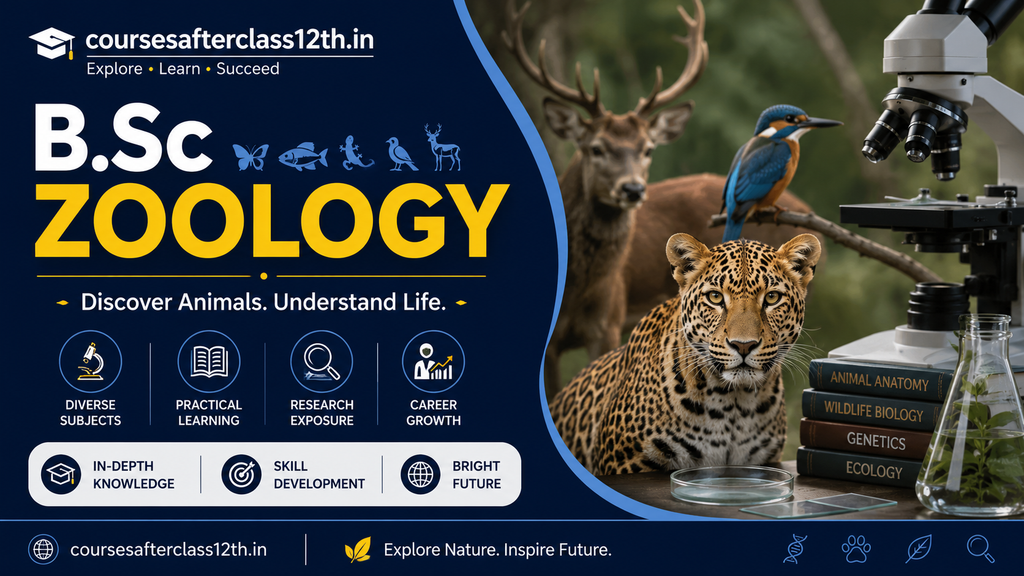
B.Sc Zoology is an undergraduate science degree focused on the scientific study of animals, their structure, physiology, behaviour, genetics, evolution, ecology, reproduction and interactions with their environment. It is a suitable undergraduate option for students who have an interest in animals, wildlife, biological sciences, laboratory research and the natural world.
Zoology is a broad field that connects animal biology with several areas of modern science. During a B.Sc Zoology course, students may study animal diversity, cell biology, genetics, developmental biology, physiology, ecology, evolution, biochemistry, molecular biology, microbiology and animal behaviour.
The importance of zoological sciences extends beyond the study of animals. Zoological knowledge contributes to wildlife conservation, biodiversity management, environmental research, veterinary-related scientific research, pharmaceutical research, biotechnology, fisheries, education and ecological studies.
For students completing Class 12 with Biology and other relevant Science subjects, B.Sc Zoology can provide a strong foundation for higher studies and careers in animal science and related life-science disciplines. Students interested in research can pursue M.Sc Zoology and subsequently consider doctoral research, while students interested in interdisciplinary fields can explore biotechnology, ecology, conservation biology, bioinformatics and environmental science.
The exact B.Sc Zoology curriculum varies from one university to another. Some programmes focus strongly on animal physiology and taxonomy, while others include molecular biology, genetics, biotechnology, environmental science and research methodology.
This comprehensive guide explains the eligibility, admission process, duration, subjects, syllabus, practical training, fees, career options, salary, higher studies, internships, skills and future scope after 12th.
Table of Contents
What is B.Sc Zoology?
B.Sc Zoology stands for Bachelor of Science in Zoology. It is an undergraduate programme dedicated primarily to the scientific study of animals and animal-related biological processes.
The subject covers animals at multiple levels of organisation, including cells, tissues, organs, organ systems, organisms, populations and ecosystems.
Students may learn about:
- Animal diversity
- Animal classification
- Cell biology
- Genetics
- Animal physiology
- Evolution
- Ecology
- Developmental biology
- Reproductive biology
- Animal behaviour
- Biochemistry
- Molecular biology
- Wildlife biology
- Environmental biology
- Parasitology
- Immunology
The course normally combines theoretical education with practical laboratory work. Depending on the institution, students may also participate in field visits, specimen studies, ecological surveys and project work.
B.Sc Zoology Course Highlights
| Particular | Details |
| Course Name | Bachelor of Science in Zoology |
| Common Name | B.Sc Zoology |
| Course Level | Undergraduate |
| Duration | Commonly 3 years |
| Academic Structure | Usually semester-based |
| Eligibility | Class 12 with relevant Science subjects |
| Important Subject | Biology |
| Core Area | Animal Science |
| Major Topics | Zoology, Genetics, Physiology, Ecology, Evolution |
| Practical Work | Laboratory and field-based learning |
| Career Areas | Research, wildlife, environment, laboratories, education |
| Higher Studies | M.Sc Zoology and related disciplines |
| Admission | Merit and/or entrance-based |
| Suitable For | Students interested in animals and life sciences |
Why Study B.Sc Zoology?
Animals are an important part of ecosystems and biodiversity. Understanding animal biology helps scientists study health, behaviour, evolution, conservation and environmental changes.
This programme gives students a structured introduction to these areas and can serve as a foundation for specialised study.
Major Reasons to Choose B.Sc Zoology
1. Strong Foundation in Animal Science
Students develop systematic knowledge of animal structure, physiology, diversity, reproduction, genetics and evolution.
2. Wildlife and Conservation Opportunities
Students interested in wildlife can build a foundation for careers and higher studies in conservation biology, ecology and wildlife science.
3. Research Potential
Zoology provides a pathway toward research in animal physiology, genetics, molecular biology, ecology, behaviour and conservation.
4. Multiple Higher-Study Options
After completing this course, students can consider M.Sc programmes in Zoology and related disciplines depending on university eligibility.
5. Environmental Relevance
Animals are important indicators of ecosystem health. Zoological knowledge can contribute to biodiversity assessment and environmental research.
6. Laboratory Exposure
Students generally receive practical training in areas such as microscopy, specimen study, anatomy and biological experimentation.
7. Interdisciplinary Career Paths
Zoology can be combined with biotechnology, bioinformatics, environmental science, genetics and data analysis.
B.Sc Zoology Eligibility
Eligibility requirements vary between colleges and universities.
Generally, students need to complete Class 12 or an equivalent qualification from a recognised board with relevant Science subjects.
Many institutions require or prefer Biology as one of the Class 12 subjects.
General Eligibility Criteria
| Requirement | Typical Criteria |
| Educational Qualification | Class 12 or equivalent |
| Stream | Science |
| Relevant Subject | Biology |
| Other Subjects | As specified by institution |
| Minimum Marks | Varies by college |
| Entrance Test | Required by some institutions |
| Age Requirement | As per institutional rules |
| Board | Recognised education board |
Students should always check the current admission notification of the university because subject combinations and minimum marks can differ.
Can PCB Students Pursue B.Sc Zoology?
Yes. Students who have completed Class 12 with Physics, Chemistry and Biology (PCB) can generally consider this course, subject to the eligibility requirements of the selected institution.
A Biology background can be particularly useful because the undergraduate curriculum builds on concepts introduced in senior secondary biology.
Students should verify the specific subject combination and minimum percentage required by their preferred college before applying.
B.Sc Zoology Admission Process
The admission process depends on the institution.
Some colleges provide admission based on Class 12 merit, while others may use entrance examinations or centralised admission systems.
Typical Admission Process
| Step | Process |
| 1 | Check eligibility |
| 2 | Research colleges |
| 3 | Complete application |
| 4 | Appear for entrance test if required |
| 5 | Check merit/selection list |
| 6 | Complete document verification |
| 7 | Pay admission fees |
| 8 | Complete enrolment |
Students should apply before the stated deadline and keep copies of submitted documents.
B.Sc Zoology Duration
This program is commonly structured as a three-year undergraduate programme.
A conventional programme may contain six semesters.
However, academic structures can differ depending on the university. Some institutions may follow updated undergraduate frameworks with different credit structures, pathways or exit options.
Students should check the official programme details of the institution they plan to join.
B.Sc Zoology Subjects
The subjects offered in this course vary between universities.
Common areas include:
- Animal Diversity
- Animal Classification
- Cell Biology
- Genetics
- Animal Physiology
- Evolution
- Ecology
- Developmental Biology
- Reproductive Biology
- Animal Behaviour
- Biochemistry
- Molecular Biology
- Immunology
- Microbiology
- Parasitology
- Wildlife Biology
- Environmental Biology
- Biostatistics
- Biotechnology
Not every institution includes all of these subjects.
B.Sc Zoology Syllabus
The syllabus usually develops from fundamental animal biology to advanced concepts and applications.
First-Year Syllabus
The first year generally introduces students to the fundamentals of zoology.
| Subject Area | Major Topics |
| Animal Diversity | Major animal groups and characteristics |
| Taxonomy | Classification and identification |
| Cell Biology | Cell structure and functions |
| Genetics | Basic heredity and variation |
| Animal Anatomy | Structure of animal bodies |
| Practical Zoology | Specimen study and microscopy |
Students develop basic knowledge of animal diversity and biological organisation.
Second-Year Syllabus
The second year may introduce physiological and ecological concepts.
| Subject Area | Major Topics |
| Animal Physiology | Functions of organ systems |
| Ecology | Animals and their environment |
| Evolution | Adaptation and evolutionary processes |
| Developmental Biology | Growth and development |
| Biochemistry | Biomolecules and metabolism |
| Reproductive Biology | Reproduction and development |
| Practical Work | Laboratory and field studies |
This stage helps students understand how animals function and interact with their environment.
Third-Year Syllabus
The final year may include advanced and application-oriented subjects.
| Subject Area | Major Topics |
| Molecular Biology | DNA, RNA and gene expression |
| Immunology | Immune system |
| Biotechnology | Applications of biological science |
| Wildlife Biology | Wildlife and conservation |
| Animal Behaviour | Behavioural patterns |
| Environmental Biology | Animals and environmental change |
| Research Project | Independent study or investigation |
The exact third-year syllabus depends on the university.
Major Areas
Animal Diversity
Animal diversity is a fundamental part of Zoology.
Students study major animal groups, their characteristics, classification, evolutionary relationships and biological significance.
This area helps students understand the enormous diversity of animal life and how different organisms have adapted to different environments.
Animal Taxonomy
Taxonomy involves identifying, classifying and naming organisms.
Zoology students learn classification systems and may study morphological, anatomical and evolutionary characteristics used to identify animals.
Taxonomic knowledge can be useful in wildlife research, biodiversity studies and conservation.
Animal Anatomy
Animal anatomy focuses on the physical structure of animals.
Students may study:
- Tissues
- Organs
- Organ systems
- Body organisation
- Comparative anatomy
Understanding anatomy provides a foundation for physiology and advanced biological study.
Animal Physiology
Animal physiology examines how animal bodies function.
Students may study:
- Nervous system
- Digestive system
- Respiratory system
- Circulatory system
- Excretory system
- Endocrine system
- Reproductive system
Physiology is important for understanding how animals maintain internal balance and respond to environmental conditions.
Cell Biology
Cell biology explores the basic structural and functional unit of life.
Students may study:
- Cell membranes
- Organelles
- Cell division
- Cellular communication
- Chromosomes
- Cellular metabolism
Cell biology provides a foundation for genetics, molecular biology and biotechnology.
Genetics
Genetics studies heredity and biological variation.
The students may learn about:
- Genes
- Chromosomes
- DNA
- Genetic inheritance
- Mutations
- Genetic variation
- Gene expression
Genetics is important in modern animal biology, evolutionary research and biotechnology.
Evolution
Evolution is a central concept in zoology.
Students study how animal populations change over generations and how biodiversity develops through evolutionary processes.
Topics can include:
- Natural selection
- Adaptation
- Speciation
- Evolutionary relationships
- Population variation
Ecology
Animal ecology examines relationships between animals and their environment.
Students may study:
- Ecosystems
- Food webs
- Populations
- Communities
- Biodiversity
- Ecological interactions
- Environmental changes
Ecology provides a foundation for wildlife and conservation careers.
Animal Behaviour
Animal behaviour examines how animals respond to internal and external factors.
Students may study:
- Feeding behaviour
- Reproductive behaviour
- Social behaviour
- Communication
- Territoriality
- Migration
- Learning
Behavioural biology is useful for wildlife research and ecological studies.
Developmental Biology
Developmental biology studies how organisms grow and develop.
Students may learn about:
- Fertilisation
- Embryonic development
- Cell differentiation
- Organ formation
- Developmental regulation
This field connects zoology with cell biology, genetics and molecular biology.
Reproductive Biology
Reproductive biology explores mechanisms through which animals reproduce and pass genetic information to the next generation.
Topics can include:
- Gametogenesis
- Fertilisation
- Reproductive organs
- Hormonal regulation
- Embryonic development
Wildlife Biology
Wildlife biology focuses on wild animals and their natural environments.
Students may explore:
- Wildlife diversity
- Animal populations
- Habitat
- Behaviour
- Conservation
- Human-wildlife interactions
Students interested in wildlife careers may pursue specialised postgraduate education in wildlife science or conservation biology.
Animal Conservation
Conservation biology seeks to understand and protect biological diversity.
Zoology graduates can build knowledge related to:
- Endangered species
- Habitat conservation
- Population monitoring
- Wildlife management
- Biodiversity
- Ecological restoration
Field experience is especially valuable for students interested in conservation careers.
B.Sc Zoology Practical Training
Practical learning is a major component of many Zoology programmes.
Students may receive exposure to:
- Microscopy
- Specimen identification
- Animal anatomy
- Histological observation
- Biological experiments
- Laboratory safety
- Field observation
- Ecological surveys
- Data recording
- Scientific reporting
Practical classes allow students to connect classroom concepts with real biological observations.
B.Sc. Zoology Laboratory Skills
Students can develop several practical skills during the degree.
| Skill | Application |
| Microscopy | Study of cells and tissues |
| Specimen Identification | Animal classification |
| Slide Preparation | Microscopic observation |
| Laboratory Safety | Safe experimental work |
| Data Recording | Research documentation |
| Basic Statistics | Biological data analysis |
| Field Observation | Ecology and wildlife studies |
| Scientific Writing | Reports and projects |
| Experimental Design | Research methodology |
B.Sc Zoology Career Scope
The career scope after B.Sc Zoology includes several life-science, environmental, research and education pathways.
Graduates may explore:
- Research assistance
- Laboratory work
- Wildlife conservation
- Environmental organisations
- Zoological institutions
- Fisheries-related sectors
- Biotechnology
- Pharmaceutical research support
- Scientific communication
- Education
- Government recruitment
- Higher studies
Specialised scientific and research careers often require postgraduate qualifications.
Career Options After B.Sc Zoology
1. Zoologist
A zoologist studies animals and may work in research, education, conservation or other animal-science environments.
Advanced positions generally require postgraduate education.
2. Research Assistant
Zoology graduates can explore research-support positions in universities, laboratories and research organisations.
Possible responsibilities include:
- Literature review
- Sample collection
- Experimental assistance
- Data recording
- Research documentation
- Fieldwork
3. Wildlife Conservation Professional
Students interested in wildlife can explore opportunities in conservation projects and biodiversity programmes.
Potential activities include:
- Wildlife surveys
- Habitat monitoring
- Species documentation
- Conservation education
- Data collection
Specialised roles may require M.Sc or other relevant qualifications.
4. Environmental Professional
Zoology provides a foundation for understanding animal-environment interactions.
Graduates can explore environmental projects involving:
- Biodiversity
- Ecosystem monitoring
- Environmental education
- Conservation
- Ecological surveys
5. Laboratory Assistant
Graduates may qualify for selected laboratory support positions depending on employer requirements.
Responsibilities can include sample handling, documentation and routine laboratory procedures.
6. Biotechnology Professional
Students who develop additional biotechnology skills can explore opportunities in life-science organisations.
Potential areas include:
- Molecular biology
- Research support
- Laboratory operations
- Biological testing
- Biotechnology projects
Specialised positions may require postgraduate qualifications.
7. Fisheries-Related Careers
Zoological knowledge can be useful in aquatic biology and fisheries-related education.
Students interested in this field can pursue specialised study in fisheries science, aquatic biology or related disciplines.
8. Scientific Content Writer
Students with good communication skills can build careers in science communication.
Potential areas include:
- Biology content
- Educational content
- Scientific articles
- Research summaries
- E-learning material
9. Biology Tutor
Graduates with strong subject knowledge can explore tutoring and academic support opportunities.
Formal teaching positions may require additional qualifications depending on the institution.
10. Animal Behaviour Research
Students interested in behavioural science can pursue specialised study and research in animal behaviour.
Career opportunities can involve wildlife research, behavioural studies and ecological projects.
Government Career Opportunities After B.Sc Zoology
B.Sc Zoology graduates can explore government opportunities where their educational qualification matches the recruitment requirements.
Possible areas include:
- Research institutions
- Government laboratories
- Wildlife-related organisations
- Forest and environmental departments
- Fisheries organisations
- Biodiversity programmes
- Public-sector organisations
- Graduate-level competitive examinations
Eligibility differs from one recruitment notification to another, so students should always check the official requirements.
Higher Studies After B.Sc Zoology
Higher education is a common pathway for students who want specialised careers.
Popular postgraduate options include:
| Programme | Possible Specialisation |
| M.Sc Zoology | Advanced animal science |
| M.Sc Wildlife Science | Wildlife and conservation |
| M.Sc Ecology | Ecosystem studies |
| M.Sc Environmental Science | Environmental systems |
| M.Sc Biotechnology | Applied biological science |
| M.Sc Microbiology | Microbial sciences |
| M.Sc Genetics | Genetics and molecular biology |
| M.Sc Biochemistry | Biological chemistry |
| M.Sc Bioinformatics | Biology and computing |
| M.Sc Molecular Biology | Molecular research |
| M.Sc Marine Biology | Aquatic and marine organisms |
Admission requirements vary among universities.
M.Sc Zoology After B.Sc Zoology
M.Sc Zoology is one of the most direct higher-study options after B.Sc Zoology.
Postgraduate education can provide deeper knowledge in areas such as:
- Animal physiology
- Genetics
- Molecular biology
- Ecology
- Evolution
- Wildlife biology
- Animal behaviour
- Developmental biology
- Research methodology
Students interested in scientific research can use postgraduate study to develop specialised research skills.
B.Sc Zoology and Wildlife Science
Students interested in animals and nature can consider wildlife science as a specialised pathway.
Wildlife careers can involve:
- Wildlife research
- Conservation
- Population studies
- Habitat management
- Biodiversity assessment
- Environmental education
Students should develop fieldwork skills and consider postgraduate specialisation for advanced positions.
B.Sc Zoology and Biotechnology
Zoology and biotechnology overlap in areas such as molecular biology, genetics, cell biology and laboratory research.
| Zoology | Biotechnology |
| Primarily animal-focused | Application-oriented biology |
| Animal diversity | Biological technologies |
| Animal physiology | Molecular applications |
| Ecology and behaviour | Laboratory and industrial applications |
| Wildlife | Biotechnology research |
Students interested in biotechnology can build additional laboratory and molecular biology skills.
B.Sc Zoology and Environmental Science
Zoology studies animals, while Environmental Science examines environmental systems more broadly.
| B.Sc Zoology | Environmental Science |
| Animal-focused | Environment-focused |
| Animal physiology | Environmental processes |
| Animal diversity | Ecosystems |
| Animal behaviour | Pollution and environmental management |
| Wildlife | Sustainability and conservation |
The better option depends on the student’s preferred academic focus.
B.Sc Zoology and Biology
This program generally provides broader exposure to life sciences, whereas Zoology focuses more deeply on animals.
| B.Sc Biology | B.Sc Zoology |
| Broad life sciences | Animal-focused |
| Plants, animals and microorganisms | Primarily animals |
| Broad academic foundation | Deeper animal science |
| Flexible life-science pathways | Strong animal and wildlife foundation |
BSc Zoology and Microbiology
Microbiology focuses primarily on microorganisms, while Zoology focuses on animals.
Students interested in bacteria, fungi and microbial systems may prefer Microbiology.
Students interested in animals, wildlife and animal physiology may prefer Zoology.
B.Sc Zoology Research Opportunities
Research is an important long-term career pathway.
Students can gain early research exposure through:
- Undergraduate projects
- Research internships
- Field studies
- Faculty-led research
- Laboratory projects
- Wildlife surveys
- Biodiversity studies
- Scientific literature reviews
Research experience can help students prepare for postgraduate and doctoral study.
B.Sc Zoology Project Ideas
Students can select projects according to their interests and available facilities.
| Project Area | Example |
| Ecology | Local animal biodiversity survey |
| Behaviour | Observation of selected animal behaviour |
| Wildlife | Documentation of local species |
| Entomology | Study of local insect diversity |
| Parasitology | Literature-based parasite study |
| Environmental Biology | Relationship between habitat and species |
| Genetics | Literature-based genetic analysis |
| Aquatic Biology | Study of local aquatic organisms |
| Conservation | Endangered species documentation |
| Data Analysis | Statistical analysis of ecological data |
Research projects should be conducted under appropriate academic supervision.
B.Sc Zoology Internship Opportunities
Internships can provide students with exposure to practical applications of Zoology.
Possible internship areas include:
- Wildlife organisations
- Research laboratories
- Zoological institutions
- Environmental organisations
- Biodiversity projects
- Fisheries organisations
- Universities
- Biotechnology laboratories
- Scientific publishing
Students should focus on internships that offer genuine practical learning and supervision.
Skills Required for B.Sc Zoology Students
A successful Zoology career requires both scientific knowledge and practical abilities.
Important skills include:
Animal identification: Ability to recognise and classify animal species.
Laboratory skills: Microscopy, specimen handling and biological observation.
Fieldwork: Recording ecological and wildlife observations.
Data analysis: Understanding basic statistics and biological datasets.
Research methodology: Designing and documenting scientific studies.
Scientific writing: Preparing reports and academic documents.
Communication: Explaining scientific concepts effectively.
Digital skills: Using spreadsheets, presentations and relevant software.
B.Sc Zoology and Bioinformatics
Modern biological research increasingly combines animal science with computational analysis.
Students interested in this interdisciplinary field can learn:
- Programming
- Statistics
- Biological databases
- Data analysis
- Sequence analysis
- Data visualisation
These skills can support postgraduate study or careers in computational biology and bioinformatics.
B.Sc Zoology and Data Science
Animal research can generate significant amounts of data, particularly in ecology, genetics and population studies.
Zoology students can benefit from learning:
- Excel
- Statistics
- Python
- R
- Data visualisation
- Basic machine learning
Combining zoological knowledge with data skills can support emerging interdisciplinary fields.
B.Sc Zoology in Wildlife Conservation
Wildlife conservation requires scientific understanding of species, populations and habitats.
Zoology graduates can develop knowledge relevant to:
- Species monitoring
- Wildlife surveys
- Habitat studies
- Population ecology
- Conservation planning
- Human-wildlife interactions
Students interested in professional conservation roles should consider specialised postgraduate education and field experience.
B.Sc Zoology in Environmental Research
Animals are closely connected to ecosystem health.
Zoology graduates can contribute to research involving:
- Biodiversity
- Ecosystem monitoring
- Species distribution
- Environmental changes
- Habitat loss
- Conservation
This makes Zoology relevant to broader environmental research.
B.Sc Zoology in Pharmaceutical Research
Animal biology contributes to several areas of biomedical and pharmaceutical research.
Students may encounter subjects such as physiology, biochemistry, genetics, immunology and molecular biology.
Graduates may explore eligible support roles in life-science organisations, while specialised research positions generally require advanced qualifications.
B.Sc Zoology and Fisheries
Aquatic animals and ecosystems form an important area of biological science.
Students interested in aquatic organisms can consider further education in:
- Fisheries science
- Aquatic biology
- Marine biology
- Aquaculture
- Ecology
Specific professional fisheries positions may require specialised qualifications.
B.Sc Zoology and Animal Behaviour
Animal behaviour is an interdisciplinary field involving biology, ecology and psychology-related concepts.
Students can explore:
- Communication
- Social organisation
- Feeding
- Reproduction
- Migration
- Territorial behaviour
- Learning
Advanced research generally requires postgraduate study.
B.Sc Zoology Salary
The salary after B.Sc Zoology depends on several factors, including job role, employer, experience, location, skills and additional qualifications.
Fresh graduates may start in entry-level positions, while specialised careers often require postgraduate education.
Factors Affecting Salary
| Factor | Effect |
| Education | Advanced qualifications may open specialised roles |
| Experience | Practical experience can improve employability |
| Technical Skills | Laboratory and data skills broaden opportunities |
| Industry | Different industries offer different salary levels |
| Location | Compensation varies by region |
| Specialisation | Niche expertise can improve career prospects |
| Employer | Organisations have different pay structures |
Students should consider career progression and professional development rather than only initial salary.
Is B.Sc Zoology a Good Career Option?
Yes, B.Sc Zoology can be a good career option for students who are interested in animals, wildlife, ecology, research and biological science.
The course is particularly suitable for students who enjoy understanding animal diversity, physiology, behaviour and environmental relationships.
However, students should understand that many specialised research, academic and wildlife positions require postgraduate education.
A strong career strategy can include B.Sc Zoology followed by M.Sc Zoology or another relevant specialisation, combined with internships, projects and field experience.
Who Should Choose B.Sc Zoology?
B.Sc Zoology may be suitable for students who:
- Enjoy studying animals
- Are interested in wildlife
- Like biology
- Enjoy laboratory work
- Are interested in ecology
- Want to explore conservation
- Enjoy scientific observation
- Want to pursue research
- Are interested in animal behaviour
- Want to study life sciences at an advanced level
Students who are primarily interested in plants may prefer Botany, while those interested in microorganisms may prefer Microbiology.
B.Sc Zoology Career Roadmap
A typical career roadmap can be:
Class 12 Science → B.Sc Zoology → Internship/Project → Skill Development → Entry-Level Opportunity or M.Sc → Specialisation → Career Growth
For research:
Class 12 → B.Sc Zoology → Research Internship → M.Sc Zoology → Research Project → PhD → Research/Academic Career
For wildlife:
Class 12 → B.Sc Zoology → Field Experience → M.Sc Wildlife/Conservation → Wildlife Career
For computational biology:
Class 12 → B.Sc Zoology → Programming + Statistics → Bioinformatics Training → Specialisation → Computational Biology
B.Sc Zoology and PhD
Students interested in advanced research can pursue a PhD after meeting the required postgraduate and institutional eligibility criteria.
Possible research areas include:
- Animal physiology
- Genetics
- Evolution
- Ecology
- Wildlife biology
- Animal behaviour
- Molecular biology
- Developmental biology
- Conservation biology
- Parasitology
A doctoral degree can support careers in academic research, universities, scientific institutions and specialised R&D environments.
B.Sc Zoology for Teaching Career
Zoology graduates can explore tutoring, educational content and teaching-related opportunities.
Formal school teaching generally depends on additional teacher-qualification requirements.
Students interested in higher-education teaching usually need postgraduate education and must satisfy applicable eligibility requirements.
B.Sc Zoology and Wildlife Career
Wildlife careers can be highly field-oriented.
Students interested in this pathway should develop:
- Species identification
- Field observation
- Data collection
- Geographic and ecological awareness
- Scientific documentation
- Conservation knowledge
Additional qualifications in wildlife science, ecology or conservation biology may improve opportunities.
B.Sc Zoology Fees
The cost of B.Sc Zoology varies according to the college, university, location and facilities.
Government institutions and private colleges may have significantly different fee structures.
Students should consider the complete cost of education.
| Expense | Consideration |
| Tuition Fee | Main academic cost |
| Laboratory Fee | May apply |
| Examination Fee | Institution dependent |
| Books | Study materials |
| Fieldwork | Programme dependent |
| Hostel | If required |
| Transportation | Location dependent |
| Project Expenses | Depends on project |
Always verify the latest fee structure with the institution before admission.
Scholarships for B.Sc Zoology Students
Students may be eligible for scholarships based on academic performance, financial circumstances, category, state schemes or university policies.
Potential sources include:
- Government scholarships
- State-level schemes
- University scholarships
- Merit-based scholarships
- Need-based financial aid
- Institution-specific assistance
Students should verify current eligibility criteria, documentation and deadlines from official scholarship sources.
How to Choose the Best B.Sc Zoology College
Choosing a college should involve more than comparing rankings.
Check the following:
Curriculum: Does the programme cover your preferred areas?
Laboratory facilities: Are practical facilities adequate?
Faculty: Do teachers have relevant academic and research experience?
Fieldwork: Does the college provide field-based learning?
Research: Are there research projects or laboratory opportunities?
Internships: Can students access relevant internships?
Fees: What is the total cost?
Location: Is the college accessible and affordable?
Higher Studies: Does the academic environment support postgraduate preparation?
Documents Required for B.Sc Zoology Admission
Common documents may include:
- Class 10 marksheet
- Class 12 marksheet
- Transfer certificate
- Migration certificate, where applicable
- Identity proof
- Passport-size photographs
- Category certificate, if applicable
- Domicile certificate if required
- Entrance examination scorecard if applicable
The exact requirements depend on the institution.
How to Prepare for B.Sc Zoology
Students can prepare by strengthening their Class 11 and 12 Biology concepts.
Important topics include:
- Cell biology
- Animal physiology
- Genetics
- Evolution
- Ecology
- Human biology
- Animal diversity
- Reproduction
Basic Chemistry knowledge is also useful because biochemistry is commonly connected with biological science.
Is B.Sc Zoology Difficult?
B.Sc Zoology can be challenging because it combines theoretical knowledge, scientific terminology, practical work and biological observation.
Students may find subjects such as genetics, physiology, biochemistry and molecular biology demanding.
However, students who study consistently, understand concepts and participate actively in practical sessions can manage the course effectively.
B.Sc Zoology Study Tips
Understand concepts
Try to understand biological mechanisms rather than memorising isolated facts.
Use diagrams
Diagrams can simplify anatomy, physiology and developmental concepts.
Practise classification
Regular revision helps with animal taxonomy and diversity.
Maintain practical records
Keep laboratory observations and diagrams organised.
Develop data skills
Basic statistics can help with research and ecology.
Read scientific material
Scientific articles and credible educational resources can improve subject understanding.
Future Scope of B.Sc Zoology
The future of Zoology is connected with several areas of science and environmental research.
Wildlife Conservation
Biodiversity conservation continues to require scientific understanding of species and ecosystems.
Molecular Zoology
Molecular approaches are expanding research in genetics, evolution and animal biology.
Biotechnology
Zoological knowledge can contribute to biotechnology and biological research.
Ecology
Environmental changes increase the importance of ecological research.
Bioinformatics
Computational methods are becoming increasingly important in biological research.
Animal Behaviour
Behavioural studies contribute to wildlife research and ecological understanding.
Climate Research
Understanding how animals respond to changing environmental conditions is increasingly important.
Emerging Skills for Zoology Graduates
Students can increase their career flexibility by developing interdisciplinary skills.
Useful skills include:
- Bioinformatics
- Statistics
- Programming
- GIS basics
- Data analysis
- Molecular biology
- Scientific writing
- Research methodology
- Wildlife survey methods
- Environmental monitoring
Combining Zoology with modern analytical and digital skills can create broader opportunities.
Frequently Asked Questions About B.Sc Zoology
What is B.Sc Zoology?
B.Sc Zoology is an undergraduate science degree focused on animals, including animal diversity, anatomy, physiology, genetics, ecology, evolution, behaviour and related biological sciences.
What is the duration of B.Sc Zoology?
B.Sc Zoology is commonly a three-year undergraduate programme, although academic structures can vary between universities.
What is the eligibility for B.Sc Zoology?
Students generally need Class 12 with relevant Science subjects, particularly Biology, subject to the eligibility requirements of the selected institution.
Can PCB students pursue B.Sc Zoology?
Yes. Students with Physics, Chemistry and Biology can generally consider B.Sc Zoology if they meet the institution’s eligibility requirements.
What are the main subjects in B.Sc Zoology?
Common subjects include animal diversity, taxonomy, cell biology, genetics, physiology, ecology, evolution, developmental biology, reproductive biology, animal behaviour and molecular biology.
Is B.Sc Zoology a good course after 12th?
Yes. It can be a suitable course for students interested in animals, wildlife, ecology, conservation, research and life sciences.
What can I do after B.Sc Zoology?
Graduates can explore research support, laboratory work, wildlife conservation, environmental projects, biotechnology, education and higher studies.
Can I do M.Sc Zoology after B.Sc Zoology?
Yes. M.Sc Zoology is one of the most direct postgraduate options, subject to university eligibility requirements.
Can I pursue wildlife science after B.Sc Zoology?
Yes. Students can consider postgraduate programmes and specialised training in wildlife science, ecology or conservation biology.
Can B.Sc Zoology students pursue biotechnology?
Yes. Zoology graduates can pursue biotechnology-related higher education or training when they meet the relevant eligibility criteria.
Can I do M.Sc Biotechnology after B.Sc Zoology?
Eligibility varies among universities. Some institutions may accept Zoology graduates, while others may require particular undergraduate subjects or credits.
Is B.Sc Zoology a medical degree?
No. B.Sc Zoology is an animal-science and life-science degree and is not a professional medical qualification.
Can B.Sc Zoology students work in research?
Yes. Graduates may qualify for suitable research-support roles, while advanced research careers generally require postgraduate education.
Can I become a wildlife researcher after B.Sc Zoology?
B.Sc Zoology provides a foundation for wildlife research. For specialised research positions, postgraduate education and field experience are generally beneficial.
What is the salary after B.Sc Zoology?
Salary depends on job role, organisation, experience, location, skills and additional qualifications.
Is B.Sc Zoology difficult?
The course can be challenging because it includes scientific terminology, animal classification, physiology, laboratory work and biological data. Consistent study can make it manageable.
Does B.Sc Zoology include practical classes?
Yes. Many programmes include laboratory practicals, specimen studies, microscopy, fieldwork and project work.
Can I do PhD after B.Sc Zoology?
Students generally complete the required postgraduate education before entering a PhD programme, although eligibility pathways vary.
Can B.Sc Zoology students become teachers?
Graduates can explore teaching and tutoring pathways. Formal school teaching generally depends on additional teacher-qualification requirements.
What skills should I learn with B.Sc Zoology?
Useful skills include laboratory techniques, animal identification, field observation, statistics, research methodology, scientific writing, data analysis and potentially programming or bioinformatics.
Is B.Sc Zoology better than B.Sc Biology?
Neither is universally better. Biology is generally broader, while Zoology provides more specialised study of animals.
Is B.Sc Zoology better than Botany?
The choice depends on interest. Zoology focuses on animals, while Botany focuses on plants.
Can B.Sc Zoology students work in environmental science?
Yes. Zoology graduates can explore environmental and conservation opportunities, particularly after developing ecology and fieldwork skills.