
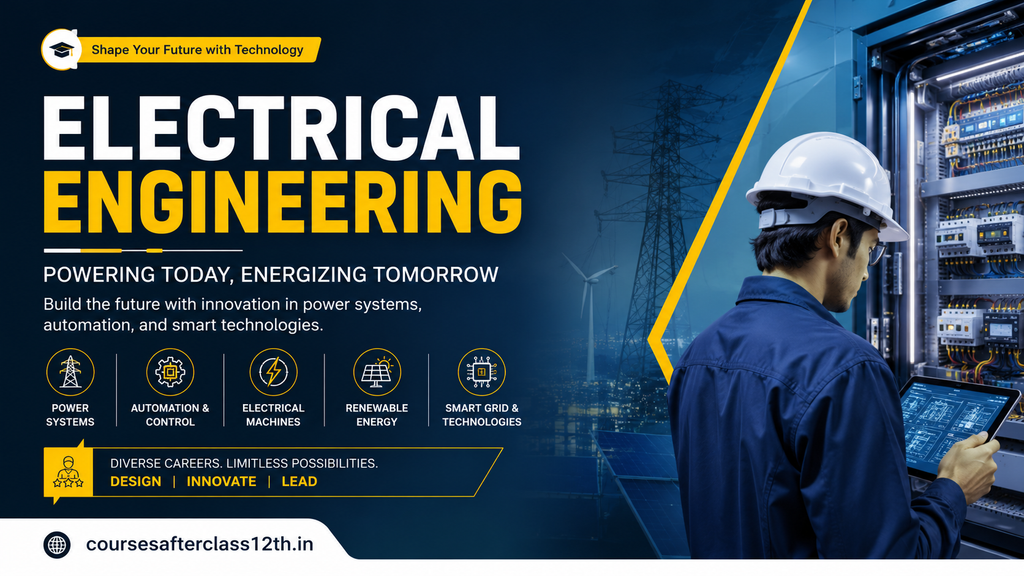
Electrical Engineering is a major branch of engineering that focuses on electricity, electrical systems, power generation, transmission, distribution, control systems, electrical machines, electronics-related applications, automation, and modern energy technologies. It plays an important role in powering homes, industries, transportation systems, communication infrastructure, commercial buildings, and public facilities. Therefore, Electrical Engineering is one of the important engineering courses after 12th for students interested in electricity, power systems, electrical machines, and control technologies.
For students who have completed Class 12 with Physics, Chemistry, and Mathematics (PCM), Electrical Engineering can be a suitable undergraduate option for those interested in electricity, electrical machines, power systems, electronics, automation, control systems, renewable energy, and industrial technology.
In India, students can pursue Electrical Engineering through undergraduate programmes such as Bachelor of Engineering (BE) in Electrical Engineering or Bachelor of Technology (BTech) in Electrical Engineering. The exact programme name, eligibility requirements, admission process, entrance examination, fee structure, curriculum, and counselling procedure can vary according to the university, state, institution, and admission route.
This guide explains Electrical Engineering after Class 12, including eligibility, entrance exams, admission process, course duration, subjects, specialisations, fees, practical learning, skills, internships, projects, career options, salary factors, government and private-sector opportunities, higher studies, emerging technologies, and future scope
Table of Contents
What Is Electrical Engineering?
Electrical Engineering is the branch of engineering concerned with the generation, transmission, distribution, control, conversion, and application of electrical energy and electrical systems.
The field covers a wide range of technologies. These include electrical machines, power systems, transformers, motors, generators, control systems, electrical circuits, instrumentation, industrial automation, power electronics, renewable energy systems, and smart-grid technologies.
Electrical engineers may work on systems that generate electricity, equipment that distributes electrical power, machines that convert electrical energy into mechanical energy, control systems used in factories, renewable-energy installations, electrical infrastructure in buildings, and many other applications.
In simple terms, Electrical Engineering is about understanding electricity and designing, operating, controlling, and maintaining systems that use electrical energy.
Electrical Engineering in Simple Words
Electricity is part of almost every modern infrastructure system. Homes need electrical distribution systems, factories require motors and automation, transportation systems increasingly use electric technologies, data centres need reliable power, and renewable-energy installations require electrical conversion and control systems.
Therefore, Electrical Engineering connects scientific principles with practical applications across several industries.
| Area | Electrical Engineering Application |
| Power generation | Generation of electrical energy |
| Transmission | Movement of electricity over transmission networks |
| Distribution | Delivery of electricity to consumers |
| Electrical machines | Motors, generators and transformers |
| Industrial automation | Control of industrial equipment and processes |
| Renewable energy | Solar, wind and other energy systems |
| Power electronics | Conversion and control of electrical power |
| Buildings | Electrical systems and power distribution |
| Transportation | Electric vehicles, rail and traction systems |
| Control systems | Monitoring and automated control |
| Smart grids | Digital monitoring and intelligent power networks |
Why Choose Electrical Eng. after 12th?
Students should choose an engineering branch according to their interests, academic strengths, career goals, and preferred work environment.
Electrical Engineering can be suitable for students who enjoy Physics, Mathematics, electricity, circuits, machines, technology, automation, energy systems, and problem-solving.
One major advantage of Electrical Engineering is its broad application. Electrical engineers can work in power generation and distribution, manufacturing, industrial automation, renewable energy, electrical equipment, transportation, consulting, infrastructure, research, and several technology-oriented industries.
Moreover, Electrical Engineering is closely connected with emerging areas such as electric mobility, renewable energy, battery systems, smart grids, energy storage, industrial automation, power electronics, and intelligent control.
However, students should not select the branch only because it appears to have broad career opportunities. A successful engineering career also depends on technical knowledge, practical exposure, internships, software skills, communication ability, project experience, and continuous learning.
Course After 12th
After completing Class 12 with the required subjects, students can apply for undergraduate Electrical Engineering programmes.
The two common degree formats are:
- BE Electrical Engineering
- BTech Electrical Engineering
The names may vary according to the institution. The curriculum and academic structure can also differ between universities and colleges.
A typical undergraduate programme begins with foundational subjects such as Mathematics, Physics, Chemistry, engineering sciences, and basic electrical concepts. Later, students progress to specialised topics such as electrical machines, power systems, control systems, power electronics, electrical measurements, and other advanced areas.
Laboratory work, projects, internships, seminars, technical activities, and practical assignments can help students connect classroom concepts with real-world applications.
Electrical Engineering Course Overview
| Parameter | Typical Information |
| Course | BE/BTech Electrical Engineering |
| Level | Undergraduate |
| Duration | Usually 4 years |
| Eligibility | Class 12 with required subjects |
| Common subjects | Physics and Mathematics with applicable additional subjects |
| Core areas | Power, machines, control, electronics, automation and electrical systems |
| Admission | Entrance examination, counselling or institution-specific process |
| Practical learning | Laboratories, projects and field exposure |
| Internship | Commonly encouraged or included |
| Higher studies | ME/MTech, MBA and specialised programmes |
| Career sectors | Power, manufacturing, automation, energy, infrastructure and technology |
What are the eligibility criteria after 12th
Eligibility requirements vary among institutions and admission routes. However, undergraduate Electrical Engineering programmes generally require students to complete Class 12 or an equivalent qualification with subjects relevant to engineering.
Physics and Mathematics are commonly important requirements. Depending on the admission route, Chemistry or another approved subject may also form part of the required subject combination.
Students should check the latest eligibility conditions of the relevant university, entrance examination, counselling authority, or institution before applying.
General Eligibility
| Requirement | General Expectation |
| Educational qualification | Class 12 or equivalent |
| Mathematics | Generally important for engineering admission |
| Physics | Generally required |
| Chemistry/approved subject | May be required depending on admission route |
| Minimum marks | Varies by institution |
| Entrance examination | Depends on admission pathway |
| Age requirements | May vary |
| Domicile | May apply for certain admission routes |
Eligibility should not be treated as universal because individual institutions and admission authorities can establish different requirements.
What is the admission process?
The admission process depends on the route through which students apply.
For example, students may enter Electrical Engineering through a national-level entrance examination, state-level examination, counselling system, university entrance test, or another approved institutional route.
A typical admission process may include:
- Check the eligibility requirements.
- Identify suitable Electrical Engineering colleges.
- Register for the applicable entrance examination if required.
- Appear for the examination.
- Check the result, rank, or merit status.
- Participate in counselling where applicable.
- Select preferred institutions and branches.
- Receive seat allocation or admission confirmation.
- Complete document verification.
- Pay applicable fees.
- Complete institutional registration.
- Begin the academic programme.
Documents Commonly Required
The exact requirements differ by institution, but students may need:
- Class 10 certificate
- Class 12 marksheet
- Entrance examination scorecard
- Admit card where applicable
- Identity proof
- Passport-size photographs
- Transfer certificate
- Migration certificate where applicable
- Category certificate where applicable
- Domicile certificate where applicable
- Other supporting documents specified by the institution
Students should carefully read the official admission instructions before submitting documents.
What is the Entrance Exams?
Admission to Electrical Engineering may take place through national-level, state-level, university-level, or institution-specific examinations.
Depending on the institution and admission pathway, students may encounter examinations such as:
- JEE Main
- JEE Advanced for applicable institutions
- State-level engineering entrance examinations
- University-specific entrance examinations
- Other approved admission routes
The examination required depends on the college and admission category. Therefore, students should check the specific admission requirements of each institution.
Entrance examinations for engineering commonly assess subjects such as Physics, Chemistry, and Mathematics, although the exact examination pattern varies.
How long is the course duration?
A regular undergraduate BE or BTech Electrical Engineering programme generally takes four years.
The course is usually divided into semesters. Students begin with fundamental engineering concepts and gradually move towards advanced Electrical Engineering subjects.
Typical Learning Progression
| Academic Stage | Major Focus |
| Early semesters | Mathematics, Physics, Chemistry and engineering fundamentals |
| Middle semesters | Electrical circuits, measurements, machines and electronics |
| Advanced semesters | Power systems, control, power electronics and specialised subjects |
| Final stage | Electives, projects, internships, seminars and career preparation |
The exact semester-wise curriculum depends on the institution.
Electrical Eng. Subjects
Electrical Engineering includes both theoretical and practical subjects.
Common subjects may include:
- Engineering Mathematics
- Engineering Physics
- Engineering Chemistry
- Engineering Mechanics
- Basic Electrical Engineering
- Electrical Circuit Theory
- Electrical Measurements
- Electrical Machines
- Electromagnetic Theory
- Power Systems
- Power System Protection
- Power Electronics
- Control Systems
- Digital Electronics
- Analog Electronics
- Microprocessors
- Instrumentation
- Signals and Systems
- Renewable Energy Systems
- High Voltage Engineering
- Industrial Automation
- Electrical Drives
- Switchgear and Protection
- Utilisation of Electrical Energy
- Power System Analysis
The actual subjects and semester structure vary according to the university.
Areas of Electrical Engineering
Electrical Engineering is a broad discipline. Students can develop expertise in several technical areas.
1. Power Systems
Power Systems is one of the traditional areas of Electrical Engineering.
It deals with the generation, transmission, distribution, protection, and management of electrical power.
Engineers in this field may work with:
- Power plants
- Transmission networks
- Distribution systems
- Substations
- Protection systems
- Grid infrastructure
- Power-quality systems
Power-system engineers need to understand electrical networks, system stability, protection, fault analysis, power flow, and equipment operation.
2. Electrical Machines
Electrical Machines focuses on equipment that converts electrical energy into mechanical energy or vice versa.
Major machines include:
- Transformers
- DC motors
- DC generators
- Induction motors
- Synchronous motors
- Synchronous generators
Electrical machines are widely used in industrial facilities, power plants, manufacturing systems, transportation, and commercial infrastructure.
Moreover, knowledge of electrical machines can help students understand how electrical energy interacts with mechanical systems.
3. Power Electronics
Power Electronics focuses on the conversion and control of electrical power using electronic devices.
It has applications in:
- Electric vehicles
- Solar power systems
- Battery systems
- Industrial drives
- Uninterruptible power supplies
- Renewable-energy systems
- Charging infrastructure
Power electronics is increasingly important because modern electrical systems often need efficient and controlled power conversion.
4. Control Systems
Control Engineering focuses on monitoring and regulating systems to ensure that they operate according to desired conditions.
These systems are commonly used in:
- Industrial automation
- Power systems
- Manufacturing processes
- Robotics
- Electrical machines
- Transportation systems
Students in this area learn about feedback, system modelling, controllers, stability, sensors, and automated control.
5. Industrial Automation
Industrial Automation combines electrical engineering, control systems, instrumentation, software, and industrial technologies.
Automation can improve consistency, productivity, monitoring, and process control.
Electrical engineers may work with:
- PLCs
- Sensors
- Control panels
- Motors
- Drives
- Industrial networks
- SCADA systems
- Automated production systems
Students interested in manufacturing and industrial technology may find this area particularly useful.
6. Renewable Energy
Renewable-energy systems are becoming an important area of modern Electrical Engineering.
Engineers may work with:
- Solar photovoltaic systems
- Wind-energy systems
- Energy storage
- Grid integration
- Power converters
- Energy management
- Battery technologies
The integration of renewable energy into electrical networks requires knowledge of power systems, electronics, control systems, and energy management.
7. Electrical Instrumentation
Instrumentation involves the measurement, monitoring, and control of physical quantities.
Electrical engineers may work with sensors and measurement systems used to monitor:
- Temperature
- Pressure
- Voltage
- Current
- Flow
- Speed
- Position
Instrumentation has applications in manufacturing, energy, process industries, laboratories, and automated systems.
Electrical Engineering Practical Learning
Electrical Engineering is not limited to classroom theory.
Laboratory work allows students to understand how electrical systems behave in practical conditions.
Students may perform experiments involving:
- Electrical circuits
- Motors
- Generators
- Transformers
- Power electronics
- Measurements
- Control systems
- Digital electronics
- Protection systems
- Electrical drives
Practical learning helps students understand concepts that may be difficult to fully appreciate through textbooks alone.
For example, studying an induction motor theoretically provides important knowledge, while conducting a laboratory experiment can help students understand its operation, measurements, performance characteristics, and practical limitations.
Skills:-
A strong Electrical Engineering graduate needs more than a degree. Technical and professional skills can improve employability and career development.
Technical Skills
Important technical skills may include:
- Circuit analysis
- Electrical machines
- Power-system fundamentals
- Control systems
- Power electronics
- Electrical measurements
- Electrical safety
- Industrial automation
- Renewable-energy concepts
- Technical documentation
Software and Digital Skills
Depending on the career path, students can learn tools related to:
- Circuit simulation
- Electrical system design
- MATLAB/Simulink
- AutoCAD Electrical
- PLC programming
- SCADA
- Power-system analysis
- Data analysis
- Embedded systems
Students should prioritise practical knowledge rather than simply collecting certificates.
Professional Skills
Electrical engineers also benefit from:
- Communication
- Teamwork
- Problem-solving
- Technical writing
- Project management
- Time management
- Presentation
- Analytical thinking
- Safety awareness
Internship
An internship can help students understand how electrical engineering knowledge applies in professional environments.
Electrical Engineering students may seek internships with:
- Power companies
- Manufacturing companies
- Automation firms
- Electrical equipment manufacturers
- Renewable-energy companies
- Engineering consultancies
- Infrastructure companies
- Industrial plants
- Research organisations
Internship activities may include exposure to:
- Electrical maintenance
- Control panels
- Power distribution
- Testing
- Electrical design
- Automation
- Equipment inspection
- Solar installations
- Project documentation
In addition, internships can help students understand workplace communication, safety procedures, technical documentation, and project coordination.
Students should evaluate an internship based on the quality of practical learning rather than only the reputation of the organisation.
Electrical Engineering Projects
Projects allow students to apply technical knowledge to practical problems.
A good Electrical Engineering project should define a clear problem, explain the methodology, present results, and discuss practical applications.
Electrical Engineering Project Ideas
| Area | Example Project |
| Renewable energy | Solar energy monitoring system |
| Automation | PLC-based industrial control system |
| Power electronics | DC-DC converter design |
| Electrical machines | Motor performance analysis |
| Power systems | Load-flow analysis |
| Energy | Energy consumption monitoring |
| Control | Automatic temperature control |
| Smart systems | Smart energy meter concept |
| Electric vehicles | Battery monitoring system |
| Protection | Electrical fault detection concept |
Students should select projects according to their academic level and available laboratory resources.
What is the electrical engineering course fees in India?
Electrical Engineering fees vary among colleges and universities.
The total cost can depend on institution type, location, facilities, admission category, hostel arrangements, laboratory resources, and other academic expenses.
Government institutions, private colleges, and private universities can have different fee structures.
Additional expenses may include:
- Hostel fees
- Examination charges
- Laboratory expenses
- Books
- Transportation
- Equipment
- Student activities
- Other institutional charges
Factors Affecting Course Cost
| Factor | Possible Effect |
| Institution type | Influences tuition fees |
| Location | Can affect living expenses |
| Hostel | Adds accommodation cost |
| Laboratory facilities | May influence institutional charges |
| Admission category | Fee structure may differ |
| Scholarships | Can reduce eligible students’ expenses |
| Transportation | Relevant for commuting students |
| Study materials | Additional academic expense |
Students should always verify the latest fee structure directly with the institution before admission.
Career Options
Electrical Engineering graduates can explore a broad range of careers.
Possible roles include:
- Electrical Engineer
- Power System Engineer
- Electrical Design Engineer
- Maintenance Engineer
- Electrical Testing Engineer
- Control Systems Engineer
- Automation Engineer
- Power Electronics Engineer
- Electrical Project Engineer
- Renewable Energy Engineer
- Electrical Site Engineer
- Protection Engineer
- Instrumentation Engineer
- Energy Engineer
- Commissioning Engineer
- Electrical Planning Engineer
The availability of these roles depends on qualifications, technical skills, industry demand, experience, and employer requirements.
Electrical Engineer Job Responsibilities
Responsibilities vary according to the role.
An electrical design engineer may prepare electrical layouts, technical calculations, drawings, specifications, and documentation.
A maintenance engineer may inspect electrical equipment, troubleshoot faults, schedule maintenance, and coordinate repairs.
A power-system engineer may work with generation, transmission, distribution, protection, and system analysis.
An automation engineer may work with PLCs, sensors, control panels, industrial networks, and automated processes.
A renewable-energy engineer may work on solar or other renewable-energy systems, power conversion, monitoring, installation, or maintenance.
Therefore, the term Electrical Engineer can describe many different professional roles.
Electrical Engineering Salary in India
Electrical Engineering salaries vary according to experience, technical skills, employer, location, industry, job role, qualifications, and project exposure.
Fresh graduates generally begin in entry-level positions, while professionals with specialised expertise and relevant experience may progress to more senior roles.
It is not advisable to present one fixed salary figure as applicable to every Electrical Engineering graduate.
Factors Affecting Salary
| Factor | Influence |
| Experience | Usually increases earning potential |
| Specialisation | Certain areas may have stronger demand |
| Employer | Compensation varies between organisations |
| Location | Local demand can influence salaries |
| Technical skills | Relevant skills can strengthen opportunities |
| Software knowledge | Can support specialised roles |
| Industry | Power, automation, manufacturing and energy may differ |
| Project experience | Practical exposure can add professional value |
| Management ability | Supports progression to senior roles |
Therefore, students should compare salary information from reliable sources and distinguish between starting, average, median, and maximum reported salaries.
Government Jobs After Electrical Engineering
Electrical Engineering graduates can explore government-sector opportunities according to the eligibility requirements of individual organisations and recruitment examinations.
Potential areas include:
- Power sector organisations
- Public infrastructure
- Railways
- Defence-related organisations
- Government engineering departments
- Energy organisations
- Public-sector companies
- Electricity utilities
- Research organisations
Recruitment may take place through competitive examinations, organisation-specific recruitment, or other approved selection processes.
In addition, students interested in government careers should monitor official recruitment notifications because eligibility, age limits, examination patterns, vacancies, and selection procedures can change over time.
Students should rely on official recruitment notifications instead of outdated online information.
Private Jobs After Electrical Engineering
The private sector offers opportunities across several industries.
Potential employers include:
- Electrical equipment manufacturers
- Power companies
- Renewable-energy firms
- Manufacturing companies
- Automation companies
- Infrastructure organisations
- Engineering consultancies
- Industrial plants
- Construction companies
- Electric mobility companies
- Technology companies
Private-sector career progression can depend on technical performance, project experience, communication, leadership, location, and willingness to learn new technologies.
Higher Studies After Electrical Engineering
After completing BE or BTech Electrical Engineering, students can pursue postgraduate education.
Potential options include:
- ME Electrical Engineering
- MTech Electrical Engineering
- Power Systems
- Power Electronics
- Control Systems
- Electrical Machines
- Renewable Energy
- Instrumentation
- Industrial Automation
- Energy Systems
- Smart Grid Technologies
- Electric Mobility
- MBA
- Project Management
- Other interdisciplinary programmes
A postgraduate degree can be useful for students who want deeper technical expertise, research opportunities, academic careers, or specialised engineering roles.
Electrical Engineering Specialisations
Students can develop expertise in different areas depending on their career objectives.
| Specialisation | Main Focus |
| Power Systems | Generation, transmission and distribution |
| Power Electronics | Electrical power conversion and control |
| Control Systems | Automated monitoring and control |
| Electrical Machines | Motors, generators and transformers |
| Renewable Energy | Solar, wind and energy systems |
| Industrial Automation | PLCs, SCADA and automated processes |
| Instrumentation | Measurement and process control |
| High Voltage Engineering | High-voltage systems and insulation |
| Smart Grid | Digital and intelligent electrical networks |
| Electric Mobility | Electric vehicles and charging systems |
The availability of these specialisations depends on the institution and postgraduate programme.
Electrical Engineering and Digital Technology
Modern Electrical Engineering is increasingly connected to digital technology.
Moreover, engineers now work with software, sensors, data, automation, simulation tools, digital monitoring, and intelligent control systems.
Digital technologies can support:
- Electrical design
- System simulation
- Predictive maintenance
- Energy monitoring
- Industrial automation
- Power-system analysis
- Equipment diagnostics
- Smart-grid management
- Renewable-energy optimisation
Students who combine electrical fundamentals with digital skills can broaden their career options.
Electrical Engineering and Artificial Intelligence
Artificial Intelligence is creating new possibilities for electrical systems.
AI-based approaches can support areas such as:
- Predictive maintenance
- Energy forecasting
- Fault detection
- Load forecasting
- Smart-grid management
- Equipment monitoring
- Industrial automation
- Energy optimisation
However, AI should support engineering judgement rather than replace fundamental engineering knowledge and safety requirements.
Therefore, students should first develop strong fundamentals in electrical systems and then learn how data and AI can contribute to modern engineering applications.
Electric Vehicles and Electrical Engineering
The growth of electric mobility has increased the importance of several Electrical Engineering technologies.
Electric vehicles involve systems such as:
- Electric motors
- Power electronics
- Batteries
- Battery-management systems
- Charging systems
- Energy conversion
- Vehicle control systems
Electrical engineers can contribute to the development, testing, maintenance, charging infrastructure, and energy systems associated with electric mobility.
Students interested in this area can develop knowledge of electrical machines, power electronics, batteries, control systems, embedded technologies, and energy management.
Renewable Energy and Electrical Engineering
Renewable energy is another important area for Electrical Engineering.
Solar and wind systems need electrical equipment to convert, control, monitor, and integrate generated power.
Electrical engineers can work on:
- Solar installations
- Inverters
- Grid connection
- Energy storage
- Monitoring systems
- Power conversion
- Electrical protection
- Energy management
As renewable energy systems become more connected to electrical networks, engineers need knowledge of both traditional power systems and modern digital technologies.
Smart Grid Technology
A smart grid combines electrical infrastructure with communication, monitoring, automation, and data technologies.
Traditional power networks primarily focus on generation, transmission, and distribution. Smart-grid technologies add digital monitoring and control capabilities.
Applications can include:
- Smart meters
- Automated distribution
- Demand management
- Fault detection
- Renewable-energy integration
- Energy monitoring
- Grid optimisation
Electrical Engineering students interested in future energy systems can explore smart-grid concepts through projects, internships, and postgraduate programmes.
Industrial Automation and Electrical Engineering
Industrial automation is an important career area for Electrical Engineering graduates.
Modern factories use automated systems to control machines, production processes, sensors, motors, and industrial equipment.
Electrical engineers involved in automation may work with:
- PLCs
- SCADA
- HMIs
- Sensors
- Motors
- Drives
- Control panels
- Industrial communication systems
For example, an automation engineer may design or maintain a control system that monitors industrial equipment and automatically responds to changes in operating conditions.
Electrical Safety
Electrical safety plays an essential role in professional engineering practice.
Proper design, installation, operation, and maintenance are important because electrical systems can pose significant risks when handled incorrectly.
Students should understand concepts such as:
- Electrical protection
- Earthing
- Insulation
- Circuit protection
- Safe operating procedures
- Equipment testing
- Workplace safety
Professional electrical work must follow applicable standards, codes, regulations, and organisational safety procedures.
Electrical Engineering Practical Exposure
Practical exposure can make engineering education more meaningful.
Students can gain practical knowledge through:
- Laboratory experiments
- Industrial visits
- Internships
- Technical workshops
- Projects
- Competitions
- Simulation exercises
- Field exposure
A student who understands both theory and practical applications may be better prepared to discuss technical problems during interviews.
Electrical Engineering Project and Research
Students interested in research can explore areas such as:
- Renewable energy
- Smart grids
- Energy storage
- Power electronics
- Electric vehicles
- Advanced control systems
- Industrial automation
- Power-system protection
- Electrical machines
- Energy efficiency
- Artificial intelligence applications
Research-oriented students should learn how to read technical literature, formulate research questions, collect and analyse data, conduct experiments, and present findings.
Electrical Engineering and Entrepreneurship
Electrical Engineering can also provide a foundation for entrepreneurship.
With appropriate professional experience and regulatory knowledge, graduates may explore businesses related to:
- Electrical contracting
- Solar installation
- Electrical consultancy
- Automation services
- Electrical maintenance
- Energy auditing
- Equipment supply
- Electrical design
- Industrial services
- Technical training
Entrepreneurship may require appropriate registrations, licences, qualified personnel, financial planning, safety compliance, and knowledge of applicable regulations.
Is Electrical Engineering a Good Career?
Electrical Engineering can be a suitable career for students who enjoy Physics, Mathematics, electricity, electrical machines, technology, automation, energy systems, and technical problem-solving.
The profession offers diverse career paths. However, students should understand that some roles can involve industrial environments, fieldwork, maintenance responsibilities, project locations, or shift-based operations.
Other roles can be primarily office-based, design-oriented, research-focused, or software-supported.
Therefore, students should investigate the actual responsibilities of their preferred career role before choosing a specialisation.
Advantages of Electrical Engineering
Broad Applications
Electrical Engineering knowledge is relevant to power, manufacturing, automation, energy, transportation, infrastructure, and technology.
Multiple Specialisations
Students can explore power systems, machines, power electronics, control systems, renewable energy, automation, instrumentation, and other areas.
Growing Technology Integration
Electrical Engineering is increasingly connected with digital technologies, automation, AI, smart grids, energy storage, and electric mobility.
Government and Private Opportunities
Graduates can explore both government and private-sector career paths depending on eligibility and skills.
Scope for Higher Studies
The degree can provide a foundation for postgraduate technical education, research, management studies, and specialised programmes.
Challenges in Electrical Engineering
Electrical Engineering also has challenges that students should understand before choosing the field.
Some roles may require:
- Fieldwork
- Equipment inspection
- Industrial environments
- Maintenance activities
- Safety responsibilities
- Travel
- Shift work
- Project deadlines
The experience depends strongly on the job role and industry.
A design engineer may spend much of the time in an office, while a maintenance or commissioning engineer may spend more time at industrial sites.
Electrical Engineering vs Other Engineering Branches
Electrical Engineering differs from other branches according to its core focus.
| Engineering Branch | Main Focus |
| Electrical Engineering | Electricity, power systems, machines, control and electrical technologies |
| Civil Engineering | Infrastructure, construction and built environment |
| Mechanical Engineering | Machines, manufacturing and mechanical systems |
| Computer Science Engineering | Computing, software and digital systems |
| Electronics and Communication Engineering | Electronics, communication and related systems |
| Chemical Engineering | Chemical processes and industrial systems |
Students should compare branches according to their interests rather than choosing only according to salary trends.
How to Build a Strong Electrical Engineering Career
A degree provides foundational knowledge, but professional development requires continuous learning.
Step 1: Build Strong Fundamentals
Develop a strong understanding of mathematics, circuits, machines, power systems, electronics, control systems, and electrical measurements.
Step 2: Choose a Career Direction
Explore power, automation, renewable energy, electrical design, power electronics, control systems, electric mobility, or another area.
Step 3: Learn Relevant Software
Develop practical skills in simulation, design, programming, automation, or electrical-analysis tools according to your career objective.
Step 4: Complete Internships
Seek internships that provide genuine technical exposure.
Step 5: Build Projects
Develop practical projects that demonstrate your ability to apply engineering concepts.
Step 6: Improve Communication
Learn to explain technical concepts, prepare reports, create presentations, and communicate professionally.
Step 7: Keep Learning
Electrical technologies continue to change. Therefore, professionals need to update their knowledge throughout their careers.
Electrical Engineering Career Roadmap
| Stage | Recommended Focus |
| Class 11–12 | Physics and Mathematics fundamentals |
| First year | Engineering mathematics and basic engineering |
| Second year | Circuits, machines and electrical fundamentals |
| Third year | Power, control, electronics and specialisation |
| Final year | Project, internship and placement preparation |
| 0–2 years | Entry-level technical role |
| 2–5 years | Specialisation and professional growth |
| 5+ years | Senior technical or management responsibilities |
| Long term | Leadership, consultancy, research or entrepreneurship |
This is a general roadmap rather than a guaranteed career progression.
Electrical Engineering Placement Preparation
Students preparing for placements should combine technical and professional preparation.
Technical Areas
Revise:
- Circuit Theory
- Electrical Machines
- Power Systems
- Control Systems
- Power Electronics
- Electrical Measurements
- Basic Electronics
- Renewable Energy
- Electrical Protection
Practical Skills
Learn relevant software and understand practical electrical systems.
Interview Preparation
Be prepared to explain:
- Academic projects
- Internship experience
- Technical concepts
- Software skills
- Problem-solving examples
- Teamwork experiences
Students should be able to explain what they actually did in a project instead of simply listing project titles.
Electrical Engineering Resume Skills
A resume may include relevant skills such as:
- Circuit Analysis
- Electrical Machines
- Power Systems
- Power Electronics
- Control Systems
- PLC
- SCADA
- MATLAB/Simulink
- AutoCAD Electrical
- Electrical Design
- Renewable Energy
- Electrical Testing
- Maintenance
- Technical Documentation
- Project Management
Students should list only skills they can genuinely explain or demonstrate.
Electrical Engineering Scope in India
The scope of Electrical Engineering is connected to the continuing need for electricity, energy infrastructure, manufacturing, automation, transportation, renewable energy, industrial systems, and electrical equipment.
The profession is also changing as energy systems become more digital and decentralised.
Areas such as:
- Renewable energy
- Energy storage
- Electric vehicles
- Smart grids
- Industrial automation
- Power electronics
- Digital monitoring
- Energy efficiency
are creating additional areas for engineering application.
Moreover, electrical engineers increasingly need to combine traditional engineering fundamentals with digital and analytical skills.
Future Scope of Electrical Engineering
The future of Electrical Engineering is influenced by technological changes and the evolving energy landscape.
Several areas may remain important for future engineers:
Renewable Energy
The integration of renewable-energy sources requires electrical expertise in power conversion, grid integration, control, and energy management.
Electric Mobility
Electric vehicles require expertise in motors, power electronics, batteries, charging infrastructure, and control systems.
Energy Storage
Battery systems and other energy-storage technologies can support renewable-energy integration and electrical reliability.
Smart Grids
Digital technologies can make electricity networks more intelligent, measurable, and controllable.
Industrial Automation
Factories increasingly use automated control systems, sensors, robotics, and digital monitoring.
AI and Data
Data-driven tools can support predictive maintenance, energy forecasting, fault detection, and system optimisation.
Therefore, future Electrical Engineering professionals may benefit from combining core electrical knowledge with digital, analytical, and interdisciplinary skills.
Civil Engineering and Electrical Engineering Comparison
Students sometimes compare Electrical Engineering with Civil Engineering before selecting an engineering branch.
| Feature | Electrical Engineering | Civil Engineering |
| Core focus | Electricity and electrical systems | Infrastructure and construction |
| Main subjects | Circuits, machines, power, control | Structures, materials, soil, transportation |
| Common industries | Power, manufacturing, automation, energy | Construction, infrastructure, transportation |
| Fieldwork | Depends on role | Often relevant to site-based roles |
| Digital skills | Simulation, automation and control | CAD, BIM and GIS |
| Emerging areas | EVs, smart grids, renewable energy | Smart infrastructure, BIM, sustainable construction |
| Higher studies | Power, control, electronics, energy | Structures, transportation, geotechnical, environment |
Students should choose according to their interests and preferred type of work.
Electrical Engineering for Students Interested in Technology
Electrical Engineering can be a good foundation for students who want to work at the intersection of physical systems and technology.
Unlike disciplines focused primarily on software, Electrical Engineering involves physical electrical systems and equipment.
However, modern electrical work increasingly involves software, data, automation, simulation, and digital monitoring.
As a result, students who develop both electrical fundamentals and digital skills can potentially explore a wider range of professional roles.
Electrical Engineering and Research
Research can be an attractive pathway for students who enjoy experimentation and technical problem-solving.
Possible research areas include:
- Advanced batteries
- Renewable energy
- Smart grids
- Power electronics
- Electric vehicles
- Energy efficiency
- Control systems
- Industrial automation
- Electrical machines
- Power-system protection
- AI applications
- Energy storage
Students interested in research should build strong analytical skills and learn how to interpret technical papers, design experiments, analyse data, and communicate research findings.
Electrical Engineering and Higher Education
Postgraduate study can help students specialise in a technical field.
For example, a graduate interested in electricity networks may pursue power systems. Another student interested in automation may choose control systems or industrial automation.
Similarly, students interested in energy may explore renewable energy, energy systems, or power electronics.
Those interested in management can consider an MBA or a related management programme.
The appropriate choice depends on career objectives.
Electrical Engineering Career in the Power Sector
The power sector is one of the traditional employment areas for Electrical Engineers.
Professionals may work in:
- Generation
- Transmission
- Distribution
- Substations
- Protection
- Maintenance
- Testing
- Grid operations
- Energy management
Power-sector roles can involve both technical and operational responsibilities.
Students interested in this career path should develop strong knowledge of electrical networks, machines, protection, power systems, safety, and relevant analysis tools.
Electrical Engineering in Manufacturing
Manufacturing industries depend heavily on electrical systems.
Factories use motors, drives, control panels, sensors, automation systems, electrical distribution equipment, and monitoring systems.
Electrical engineers may contribute to:
- Equipment maintenance
- Automation
- Electrical design
- Production support
- Energy management
- Testing
- Troubleshooting
- Commissioning
Manufacturing can therefore provide opportunities for graduates who enjoy practical engineering and industrial environments.
Electrical Engineering in Construction and Infrastructure
Electrical engineers also contribute to buildings and infrastructure.
They may work on:
- Electrical distribution
- Lighting
- Power systems
- Backup power
- Equipment
- Electrical safety
- Building services
- Project coordination
Large infrastructure projects can require coordination among civil, mechanical, electrical, electronics, and other engineering professionals.
Electrical Engineering and Sustainable Development
Electrical Engineering can contribute to sustainability through efficient energy use, renewable energy, energy storage, smart-grid technologies, and electric transportation.
Engineers can help improve energy efficiency and reduce unnecessary energy consumption through appropriate system design and monitoring.
Sustainable engineering requires professionals to consider technical performance, cost, reliability, environmental impact, and long-term operation.
Frequently Asked Questions About Electrical Engineering
1. What is Electrical Engineering?
Electrical Engineering is the branch of engineering that focuses on electricity, electrical systems, power generation, transmission, distribution, electrical machines, control systems, power electronics, and related technologies.
2. Can I study Electrical Engineering after Class 12?
Yes. Students who meet the applicable eligibility requirements can pursue BE or BTech Electrical Engineering after Class 12. Physics and Mathematics are generally important subjects for engineering admission.
3. How long is an Electrical Engineering degree?
A regular undergraduate BE or BTech Electrical Engineering programme generally takes four years.
4. What subjects are studied in Electrical Engineering?
Common subjects include electrical circuits, electrical machines, power systems, control systems, power electronics, electrical measurements, electromagnetics, electronics, instrumentation, and renewable energy.
5. Is Electrical Engineering difficult?
Electrical Engineering requires mathematics, physics, analytical thinking, circuit understanding, and technical problem-solving. Its difficulty depends on the student’s preparation, interest, and consistency.
6. What jobs can I get after Electrical Engineering?
Graduates can explore roles such as Electrical Engineer, Power System Engineer, Electrical Design Engineer, maintenance engineer, Automation Engineer, Control Systems Engineer, Power Electronics Engineer, Renewable Energy Engineer, and Project Engineer.
7. Can Electrical Engineers get government jobs?
Yes. Electrical Engineering graduates may be eligible for various government-sector engineering positions depending on the organisation, recruitment examination, eligibility requirements, and available vacancies.
8. Can Electrical Engineers work in private companies?
Yes. Private-sector opportunities are available in power, manufacturing, automation, renewable energy, infrastructure, electrical equipment, electric mobility, engineering consultancy, and other industries.
9. What software should Electrical Engineering students learn?
Depending on the career path, students can explore circuit simulation, MATLAB/Simulink, electrical design software, PLC programming, SCADA, power-system analysis tools, and other relevant engineering applications.
10. Is Electrical Engineering suitable for students interested in renewable energy?
Yes. Renewable-energy systems require electrical knowledge related to power conversion, grid integration, monitoring, control, electrical protection, and energy management.
11. Is Electrical Engineering useful for electric vehicle careers?
Yes. Electric vehicles involve electric motors, power electronics, batteries, battery-management systems, charging systems, and control technologies, all of which connect with Electrical Engineering.
12. What are the major Electrical Engineering specialisations?
Major areas include power systems, power electronics, control systems, electrical machines, renewable energy, industrial automation, instrumentation, smart grids, and electric mobility.
13. Is an internship important for Electrical Engineering students?
An internship can provide practical exposure and help students understand how electrical engineering concepts apply in professional environments. It can also improve awareness of industrial processes and workplace expectations.
14. Can I pursue higher studies after Electrical Engineering?
Yes. Graduates can pursue ME, MTech, MBA, specialised postgraduate programmes, and research-oriented education depending on their career goals.
15. What is the future scope of Electrical Engineering?
Electrical Engineering remains relevant to power systems, renewable energy, electric vehicles, energy storage, industrial automation, smart grids, power electronics, infrastructure, and other technology-driven applications.
16. Is Electrical Engineering a good career?
Electrical Engineering can be a suitable career for students interested in electricity, technology, machines, energy, automation, control systems, and technical problem-solving. Career outcomes depend on skills, experience, specialisation, employer, location, and professional development.
17. What skills should Electrical Engineering students develop?
Students should build strong fundamentals in electrical engineering and develop practical skills in circuit analysis, machines, power systems, control, power electronics, software tools, automation, communication, and project work.