
Table of Contents
An Overview
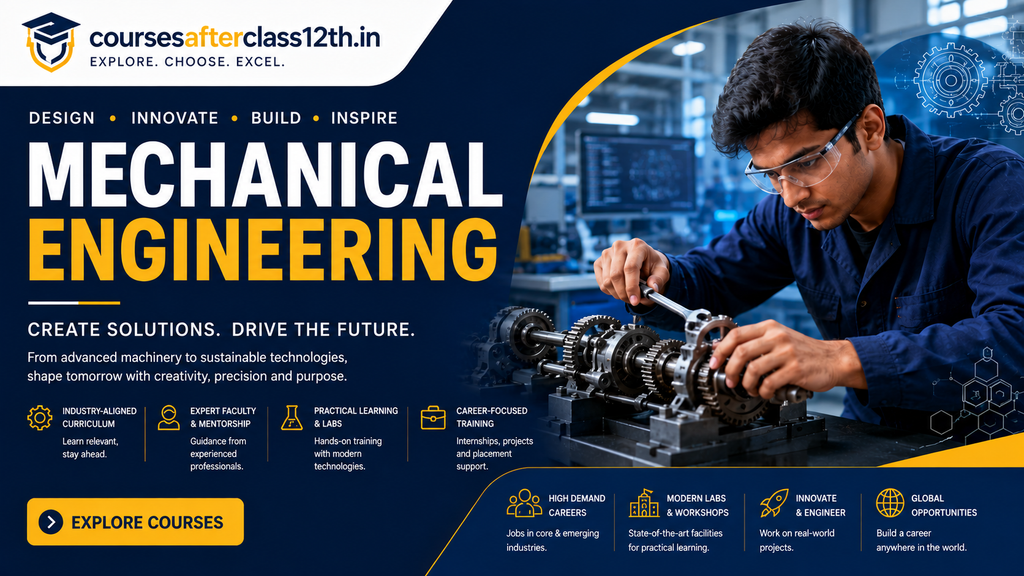
Mechanical Engineering is a major engineering discipline that focuses on the design, development, manufacturing and maintenance of machines, mechanical systems and industrial equipment. Students in this field learn concepts such as thermodynamics, fluid mechanics, engineering mechanics, manufacturing and machine design while developing practical knowledge and problem-solving skills for diverse career opportunities.
This engineering discipline has applications across automobiles, manufacturing, aerospace, robotics, energy, construction, industrial production, transportation and many other sectors. Because of its wide range of applications, students pursuing this field can explore diverse technical and industrial career paths after completing their education.
A Mechanical Engineering programme generally introduces students to engineering mathematics, engineering mechanics, thermodynamics, fluid mechanics, manufacturing processes, machine design, heat transfer, materials, industrial engineering and related subjects. Depending on the institution and specialisation, students may also study areas such as robotics, automation, computer-aided design, renewable energy and mechatronics.
For students considering this field, M.E can provide a strong foundation in engineering principles and practical problem-solving. However, career opportunities depend on factors such as academic performance, technical skills, practical exposure, internships, projects, communication abilities and the specific industry a student chooses.
What Is Mechanical Engineering?
M.Eng is an engineering discipline focused on the design, analysis, manufacturing and operation of machines, mechanical equipment and technical systems.
Professionals in this field work with systems involving motion, force, energy, materials and mechanical components. Their responsibilities can range from designing individual machine parts to developing automobile systems, improving manufacturing processes and maintaining industrial equipment.
For instance, when a company develops a new vehicle, mechanical engineers may contribute to areas such as engine systems, transmission, thermal management, vehicle components, material selection, manufacturing and testing.
Likewise, manufacturing industries depend on these professionals to design equipment, optimise production processes, maintain machinery and develop efficient industrial systems.
Therefore, this engineering field combines theoretical concepts with practical applications to solve real-world industrial and technical challenges.
Why Study Mechanical Engineering?
Mechanical Engineering can be a suitable option for students who are interested in machines, automobiles, manufacturing, design, mechanics, technology and industrial systems.
One of its major advantages is its broad application across industries. M.E. principles are used in automotive manufacturing, aerospace, energy, heavy engineering, consumer products, industrial machinery and many other sectors.
Another important aspect is the opportunity to specialise. A student may begin with fundamental M.Eng subjects and later develop expertise in areas such as automobile engineering, robotics, manufacturing, thermal engineering, design engineering or automation.
Mechanical Engineering also provides a foundation that can be combined with newer technologies. Modern mechanical engineers increasingly work with CAD software, simulation tools, automation systems, sensors, robotics, additive manufacturing and data-driven engineering processes.
Students should nevertheless understand that the field can be technically demanding. Mathematics, physics, mechanics and engineering concepts form an important part of the curriculum, and practical learning is essential for developing professional competence.
Mechanical Engineering
M.Eng can be studied at diploma, undergraduate, postgraduate and specialised certification levels.
| Course Level | Examples | Main Focus |
|---|---|---|
| Diploma | Diploma in Mechanical Engineering | Engineering fundamentals and practical technical skills |
| Undergraduate | BE Mechanical Engineering, BTech Mechanical Engineering | Core mechanical engineering theory and applications |
| Postgraduate | ME Mechanical Engineering, MTech Mechanical Engineering | Advanced study and specialisation |
| Certification | CAD, CNC, robotics, manufacturing and related certifications | Specific technical skills |
| Short-Term Training | CAD/CAM, 3D modelling, automation and manufacturing tools | Practical and specialised learning |
The exact course structure, duration, admission process and eligibility requirements vary between institutions.
Mechanical Engineering Eligibility
Eligibility for M.E depends on the level of study and the institution.
For undergraduate engineering programmes, students generally need to complete their higher secondary education with the subjects required by the relevant institution or admission system. Mathematics and Physics are commonly important for engineering programmes, while additional subject requirements may vary.
Diploma programmes can have different eligibility criteria depending on the institution and state or education board.
For postgraduate programmes, students generally require an appropriate undergraduate engineering degree.
Students should always check the current eligibility requirements of the specific college, university or admission authority before applying because admission rules can change.
Course and Duration
The duration of Mechanical Engineering depends on the programme.
A full-time undergraduate engineering degree commonly takes four years. Diploma programmes are generally shorter, while postgraduate engineering programmes usually require additional study after graduation.
| Programme | Typical Duration |
|---|---|
| Diploma in Mechanical Engineering | Commonly 3 years |
| BTech/BE Mechanical Engineering | Commonly 4 years |
| MTech/ME Mechanical Engineering | Commonly 2 years |
| Certification Courses | Varies by programme |
The exact duration should be confirmed with the institution offering the programme.
Subjects
Mechanical Engineering includes several subjects that build a student’s understanding of mechanical systems, materials, energy, manufacturing and design.
Engineering Mathematics
Engineering mathematics provides the mathematical foundation required for engineering analysis.
Students may study calculus, differential equations, linear algebra, numerical methods and other mathematical concepts. These tools are used in areas such as mechanics, thermodynamics, fluid analysis and engineering design.
Engineering Mechanics
Engineering mechanics introduces concepts related to forces, motion and equilibrium.
Students learn how forces act on bodies and how mechanical systems respond to those forces. These principles become important for later subjects such as machine design and structural analysis.
Strength of Materials
Strength of Materials focuses on how engineering materials behave when subjected to different types of forces and loads.
Students may study stress, strain, bending, torsion, shear forces and material failure. The subject helps engineers understand whether a component can safely withstand the conditions under which it will operate.
Thermodynamics
Thermodynamics deals with heat, energy and work.
Students learn concepts related to energy transfer, thermodynamic systems, cycles and efficiency. The subject has applications in engines, power plants, refrigeration systems, air-conditioning systems and energy technologies.
Fluid Mechanics
Fluid mechanics examines the behaviour of liquids and gases.
Mechanical engineers use fluid mechanics in applications involving pumps, turbines, pipelines, hydraulic systems, aerodynamics and fluid-based machinery.
Heat Transfer
Heat transfer focuses on the movement of thermal energy through conduction, convection and radiation.
The subject is relevant to engines, heat exchangers, refrigeration, thermal systems, electronics cooling and energy equipment.
Manufacturing Processes
Manufacturing processes introduce students to methods used to produce mechanical components and products.
Depending on the programme, students may study casting, welding, machining, forming, cutting and other production methods.
Understanding manufacturing helps mechanical engineers design components that can be produced efficiently and economically.
Machine Design
Machine design involves designing mechanical components and systems that can perform specific functions safely and reliably.
Students may study components such as shafts, gears, bearings, springs, fasteners and other machine elements.
Engineering Materials
Mechanical engineers need to understand how different materials behave under mechanical, thermal and environmental conditions.
Students may learn about metals, polymers, ceramics, composites and other engineering materials, including their properties and applications.
Computer-Aided Design
Computer-Aided Design, commonly known as CAD, is widely used for creating and modifying engineering drawings and three-dimensional models.
Students may learn software used for 2D drafting, 3D modelling, assemblies and engineering documentation.
CAD skills can be valuable for students interested in design engineering, product development and manufacturing.
Industrial Engineering
Industrial engineering focuses on improving processes, productivity, quality and resource utilisation.
Mechanical engineering students may learn about production planning, quality control, operations and process optimisation.
Control Systems
Control systems are used to regulate and automate machines and processes.
Students may learn about feedback, sensors, controllers and system response. These concepts become increasingly relevant in automation, robotics and modern manufacturing.
Mechanical Engineering Skills
A successful mechanical engineer requires both technical and professional skills.
| Skill Category | Examples |
|---|---|
| Engineering Fundamentals | Mechanics, thermodynamics and materials |
| Design | CAD, 3D modelling and machine design |
| Manufacturing | CNC, machining, production processes |
| Analysis | Engineering calculations and simulation |
| Automation | Robotics, sensors and control systems |
| Software | CAD/CAM and engineering simulation tools |
| Problem Solving | Identifying and resolving engineering issues |
| Communication | Technical reports and presentations |
| Teamwork | Collaboration with engineering and production teams |
| Project Management | Planning, documentation and execution |
Students should focus on building a strong foundation before trying to learn a large number of software tools.
Practical Learning in Mechanical Engineering
Practical experience is extremely important in Mechanical Engineering because many concepts are connected to physical systems and industrial processes.
Laboratory sessions allow students to observe engineering principles in practice. Workshops can introduce students to machining, manufacturing, measurement and mechanical components.
Projects provide another opportunity to apply theoretical knowledge. A student may design a mechanical component, develop a prototype, create a CAD model or work on an automation project.
Internships can further expose students to professional engineering environments. They may learn how design, manufacturing, quality control, maintenance and production processes operate in actual organisations.
Mechanical Engineering Projects for Students
Projects can help students demonstrate technical understanding and practical problem-solving.
| Project Area | Example Project |
|---|---|
| Design | Mechanical component design using CAD |
| Automobile | Vehicle braking or suspension model |
| Manufacturing | CNC-based manufacturing project |
| Automation | Automated material handling system |
| Robotics | Robotic arm prototype |
| Thermal | Heat exchanger analysis |
| Renewable Energy | Solar-powered mechanical system |
| Energy | Energy-efficiency improvement project |
| Product Design | 3D-printed mechanical prototype |
| IoT | Sensor-based machine monitoring system |
Students should choose projects that match their intended career direction.
CAD-Based Design Project
A CAD project can involve designing a machine component, assembly or product.
The project can demonstrate skills in engineering drawing, dimensions, modelling, assembly and design documentation.
Robotic Arm Project
A robotic arm project can combine mechanical design with motors, sensors and control systems.
Students can learn about mechanical movement, actuation, control and automation through such a project.
Automated Manufacturing System
An automated manufacturing project can demonstrate how mechanical components, sensors and control systems work together to improve production processes.
Renewable Energy Project
Students interested in energy can explore mechanical systems connected to solar, wind or other renewable technologies.
The project can focus on energy conversion, mechanical design, efficiency or system optimisation.
Mechanical Engineering and CAD
CAD is an important technology in modern mechanical engineering.
Traditional engineering drawings have increasingly been complemented by digital design and three-dimensional modelling. CAD software allows engineers to create detailed models, modify designs and prepare technical documentation.
Students interested in design engineering should develop strong CAD fundamentals and understand engineering drawing principles rather than focusing only on software commands.
Advanced CAD learning may also involve assemblies, simulations, rendering and design optimisation.
Mechanical Engineering and Manufacturing
Manufacturing is one of the traditional career areas for mechanical engineers.
Mechanical engineers can work on production processes, machine selection, process planning, quality improvement, tooling, maintenance and manufacturing optimisation.
Modern manufacturing increasingly combines traditional mechanical systems with automation, robotics, sensors and digital monitoring.
This means students interested in manufacturing can benefit from learning both core mechanical concepts and modern industrial technologies.
Mechanical Engineering and Automobile Industry
The automobile industry is a major application area for mechanical engineering.
Mechanical engineers may contribute to vehicle components, powertrain systems, thermal management, manufacturing, testing, quality control and product development.
The automotive industry is also evolving through electric vehicles, advanced materials, automation and connected technologies. Students interested in automobiles should therefore consider learning about both traditional mechanical systems and emerging automotive technologies.
Mechanical Engineering and Robotics
Robotics combines mechanical engineering with electronics, programming, control systems and sensors.
Mechanical engineers can contribute to robot structure, mechanisms, movement, component design and manufacturing.
Students interested in robotics can strengthen their profile by learning CAD, mechanical design, basic programming, sensors and control systems.
Mechanical Engineering and Automation
Industrial automation uses technology to reduce manual intervention and improve production processes.
Mechanical engineers can work with automated machinery, production systems, robotics and mechanical components used in industrial environments.
Knowledge of control systems, sensors, PLC concepts and manufacturing processes can complement traditional mechanical engineering education.
Mechanical Engineering and Mechatronics
Mechatronics combines mechanical engineering with electronics, control systems and software.
A modern automated machine may include mechanical components, sensors, motors, controllers and software working together.
Students interested in multidisciplinary engineering can explore mechatronics because it provides exposure to several interconnected technologies.
Mechanical Engineering and Renewable Energy
Mechanical engineers play a role in energy systems and equipment.
Areas such as turbines, pumps, heat exchangers, thermal systems and energy conversion involve mechanical engineering principles.
Renewable energy has also created opportunities for engineers working with wind systems, solar-related mechanical systems, energy efficiency and other technologies.
Students interested in sustainable engineering can combine mechanical fundamentals with knowledge of energy systems and environmental considerations.
Mechanical Design Engineer
A mechanical design engineer develops components, assemblies and complete mechanical systems for different engineering applications. In this role, professionals use CAD software to create detailed models and technical drawings. They also apply engineering calculations and simulation methods to evaluate the performance of a design. As a result, the final product can be developed with greater attention to functionality, reliability and manufacturing requirements.
Manufacturing Engineer
Manufacturing engineers focus on production processes and methods.
They may work on process improvement, tooling, production planning, quality and manufacturing efficiency.
Production Engineer
Production engineers help manage and improve manufacturing operations.
Their responsibilities may include production planning, process monitoring, quality improvement and coordination with other teams.
Quality Engineer
Quality engineers work to ensure that products and manufacturing processes meet required specifications.
They may be involved in inspection, testing, documentation, root-cause analysis and process improvement.
Maintenance Engineer
Maintenance engineers help keep machinery and industrial equipment operating reliably.
They may work on preventive maintenance, troubleshooting, equipment inspection and maintenance planning.
Automobile Engineer
Automobile-related engineering roles can involve vehicle components, manufacturing, testing, design and related technical systems.
CAD Engineer
CAD engineers create and modify engineering drawings and 3D models.
Strong knowledge of CAD software and engineering drawing is particularly useful in this career path.
Robotics Engineer
Robotics professionals work with robotic systems, mechanisms, sensors, motors and control technologies.
Mechanical engineers can enter this area by developing additional knowledge of electronics, programming and control systems.
Thermal Engineer
Thermal engineers work with systems involving heat and energy.
Applications can include engines, refrigeration, air conditioning, power systems and thermal management.
Project Engineer
Project engineers coordinate technical projects and may work with engineering teams, suppliers, production teams and management.
Communication, planning and technical knowledge are important for this role.
Mechanical Engineering Career Growth
Career progression in Mechanical Engineering can vary according to industry, technical specialisation and professional experience.
An engineer may begin in an entry-level technical position and gradually move into senior engineering, specialist, project management or leadership roles.
Some professionals become specialists in design, manufacturing, quality, automation, thermal engineering or other areas. Others move toward project management, operations or engineering management.
Continuous learning can improve long-term career development. Engineers may need to update their knowledge of design software, manufacturing technologies, automation, simulation and industry-specific systems.
Importance of Internships in Mechanical Engineering
Internships can help students connect classroom concepts with industrial practices.
A student interested in design can seek a CAD or product-development internship. Someone interested in manufacturing can explore production or quality roles. Students interested in automobiles can seek opportunities related to vehicle manufacturing, testing or components.
The value of an internship depends largely on the work performed. Students should look for opportunities that provide exposure to relevant tools, processes and engineering responsibilities.
Mechanical Engineering Certifications
Certifications can complement a Mechanical Engineering degree.
Potential certification areas include:
- CAD and 3D modelling
- CAD/CAM
- CNC programming
- Robotics
- Automation
- Project management
- Quality management
- Industrial safety
- Simulation and analysis
- Manufacturing technologies
Students should select certifications based on their career goals.
For example, a student targeting design engineering can prioritise CAD and simulation skills, while someone interested in manufacturing may benefit from CNC, production and quality-related training.
Mechanical Engineering Software and Tools
Modern mechanical engineers use various digital tools.
| Area | Examples |
|---|---|
| CAD | AutoCAD, SolidWorks and similar CAD platforms |
| 3D Modelling | Solid modelling and assembly tools |
| Simulation | Engineering analysis and simulation software |
| Manufacturing | CAM and CNC-related tools |
| Data | Excel and engineering data tools |
| Project Management | Planning and documentation tools |
| Automation | PLC, robotics and control platforms |
The availability and relevance of specific tools depend on the job and industry.
Students should learn engineering concepts alongside software. Knowing how to operate software without understanding engineering principles may not be sufficient for professional work.
Mechanical Engineering and Artificial Intelligence
Artificial Intelligence is increasingly influencing engineering workflows.
AI can support areas such as predictive maintenance, manufacturing optimisation, design exploration, quality inspection and data analysis.
Mechanical engineers do not necessarily need to become AI specialists, but understanding how data and AI can support engineering processes can be valuable.
Students interested in this intersection can explore programming, data analysis, sensors, machine learning fundamentals and engineering applications.
Mechanical Engineering and Industry 4.0
Industry 4.0 refers to the increasing integration of digital technologies into manufacturing and industrial processes.
Technologies associated with modern industrial environments can include automation, robotics, sensors, connected systems, data analytics, digital twins and cloud-based technologies.
Mechanical engineers working in modern manufacturing can benefit from understanding these technologies alongside traditional engineering knowledge.
This makes multidisciplinary learning increasingly valuable.
Mechanical Engineering and Electric Vehicles
The growth of electric vehicles has introduced new engineering requirements while retaining the importance of mechanical engineering.
Mechanical engineers can contribute to areas such as vehicle structure, thermal management, battery enclosures, manufacturing, cooling systems, materials and mechanical components.
Students interested in automotive careers can therefore consider developing knowledge of electric vehicle systems alongside conventional automobile engineering.
Mechanical Engineering Salary and Career Expectations
Mechanical engineering salaries vary significantly based on factors such as location, employer, industry, job role, experience, education and technical specialisation.
Fresh graduates should avoid choosing a career only on the basis of salary expectations. Building practical skills and gaining relevant experience can be more useful for long-term career development.
Professionals with specialised skills in areas such as automation, advanced manufacturing, design, simulation, robotics or other emerging technologies may have different career opportunities from those working in traditional roles.
Salary figures should always be checked using current, reliable sources because compensation can change over time.
Higher Studies After Mechanical Engineering
Mechanical Engineering graduates can pursue postgraduate education or specialised training.
Possible areas include:
- Thermal engineering
- Manufacturing engineering
- Machine design
- Industrial engineering
- Automotive engineering
- Robotics
- Mechatronics
- Energy engineering
- Aerospace-related engineering
- Engineering management
The appropriate option depends on the student’s interests, academic background and career goals.
Mechanical Engineering vs Civil Engineering
Both major engineering disciplines, but their applications are different.
The course Mechanical Engineering focuses primarily on machines, mechanical systems, manufacturing, energy and moving components.
And, Civil Engineering focuses more on infrastructure such as buildings, roads, bridges, water systems and other construction-related structures.
| Factor | Mechanical Engineering | Civil Engineering |
|---|---|---|
| Main Focus | Machines and mechanical systems | Infrastructure and construction |
| Common Subjects | Thermodynamics, mechanics, manufacturing | Structural engineering, surveying, construction |
| Industries | Manufacturing, automotive, energy | Construction, infrastructure, consulting |
| Design Tools | CAD and simulation tools | CAD and structural design tools |
| Practical Work | Machines, production and mechanical systems | Structures, sites and infrastructure |
Students should select the branch according to their interests rather than assuming one is universally better.
Mechanical Engineering vs Electrical Engineering
Mechanical Engineering focuses on mechanical systems, while Electrical Engineering focuses primarily on electrical and electronic systems.
However, modern industries often require professionals who understand multiple disciplines.
| Factor | Mechanical Engineering | Electrical Engineering |
|---|---|---|
| Main Focus | Mechanical systems | Electrical and electronic systems |
| Core Areas | Mechanics, thermodynamics, manufacturing | Circuits, power systems, electronics |
| Applications | Machines, vehicles, manufacturing | Power, electronics, automation |
| Emerging Overlap | Robotics, mechatronics | Automation, robotics, control |
Students interested in robotics, automation or mechatronics may eventually encounter concepts from both disciplines.
How to Build a Mechanical Engineering Career
Students can take a structured approach to career development.
First, build strong fundamentals in mathematics, mechanics, materials and engineering principles. Next, develop practical skills using CAD, manufacturing tools or other software relevant to the chosen career.
Projects should then be used to demonstrate those skills. Internships can provide industrial exposure, while certifications can add specialised knowledge.
A practical career-development roadmap can look like this:
| Stage | Goal |
|---|---|
| Stage 1 | Build engineering fundamentals |
| Stage 2 | Learn CAD and relevant engineering software |
| Stage 3 | Select a specialisation |
| Stage 4 | Complete practical projects |
| Stage 5 | Gain internship or industrial exposure |
| Stage 6 | Develop a technical portfolio |
| Stage 7 | Add relevant certifications |
| Stage 8 | Apply for suitable entry-level roles |
| Stage 9 | Continue developing specialised skills |
Mechanical Engineering Resume Preparation
A Mechanical Engineering resume should focus on evidence of technical ability.
Students can include academic qualifications, CAD skills, manufacturing knowledge, projects, internships, certifications and relevant technical coursework.
Projects should describe the student’s actual contribution. For example, instead of simply writing “Designed a machine component,” the resume can explain the component designed, software used, design considerations and outcome.
Technical skills should also be grouped clearly so recruiters can quickly understand the candidate’s capabilities.
Mechanical Engineering Portfolio
A portfolio can be particularly useful for students interested in design and product development.
It can include:
- CAD models
- Engineering drawings
- Product designs
- Simulation results
- Manufacturing projects
- Prototypes
- Robotics projects
- Technical reports
- Academic projects
Students should ensure that portfolio content is their own work and can be explained clearly during interviews.
Is Mechanical Engineering a Good Career Choice?
Mechanical Engineering can be a strong option for students interested in machines, engineering design, manufacturing, automobiles, energy and industrial technology.
Its broad foundation allows graduates to explore different sectors and specialisations. At the same time, students should be prepared for technical coursework and continuous professional development.
The strongest career outcomes generally come from combining academic education with practical skills, internships, projects and relevant software knowledge.
Advantages of Mechanical Engineering
| Advantage | Explanation |
|---|---|
| Broad Engineering Foundation | Covers mechanics, materials, energy, design and manufacturing |
| Multiple Industries | Applicable to automotive, manufacturing, energy, aerospace and other sectors |
| Design Opportunities | CAD and product development provide creative technical work |
| Emerging Technologies | Can connect with robotics, automation and Industry 4.0 |
| Specialisation | Multiple technical pathways are available |
| Practical Learning | Workshops, laboratories and projects provide hands-on exposure |
Challenges in Mechanical Engineering
Mechanical Engineering can be academically demanding because it involves mathematics, physics, mechanics and technical analysis.
Students may also need to spend significant time developing practical skills. Software such as CAD or simulation platforms can take time to learn properly.
Another challenge is adapting to technological changes. Manufacturing, automation, electric vehicles and digital engineering are changing traditional engineering workflows.
Students who continue learning and combine mechanical fundamentals with modern technologies can better prepare themselves for changing industry requirements.
Frequently Asked Questions About Mechanical Engineering
What is Mechanical Engineering?
Mechanical Engineering is an engineering discipline focused on the design, analysis, manufacturing, operation and maintenance of machines, mechanical systems and equipment.
What subjects are taught in Mechanical Engineering?
Common subjects include engineering mathematics, engineering mechanics, strength of materials, thermodynamics, fluid mechanics, heat transfer, manufacturing processes, machine design, engineering materials, CAD and industrial engineering.
Is Mechanical Engineering difficult?
Mechanical Engineering can be academically challenging because it includes mathematics, physics, mechanics and technical analysis. Consistent practice and practical learning can help students understand these concepts.
What are the career options after Mechanical Engineering?
Career options can include mechanical design engineer, manufacturing engineer, production engineer, quality engineer, maintenance engineer, CAD engineer, automobile engineer, robotics engineer and project engineer.
Is CAD important for Mechanical Engineering?
Yes. CAD is widely used in mechanical design and engineering documentation. Students interested in design-related roles can benefit from developing strong CAD skills.
Can Mechanical Engineers work in robotics?
Yes. Mechanical engineers can contribute to robotic mechanisms, structures and component design. Additional knowledge of electronics, sensors, programming and control systems can help them move into multidisciplinary robotics roles.
Can Mechanical Engineers work in the automobile industry?
Yes. Mechanical Engineering has applications in vehicle design, manufacturing, testing, thermal systems, components and production.
Can Mechanical Engineers work in electric vehicles?
Yes. Mechanical engineers can contribute to areas such as vehicle structures, thermal management, battery enclosures, manufacturing and mechanical components.
Are internships important for Mechanical Engineering students?
Yes. Internships can help students understand industrial processes and gain practical exposure related to design, manufacturing, quality, maintenance or other engineering areas.
Which software should Mechanical Engineering students learn?
The right software depends on the career path. CAD tools are useful for design, while CAM, simulation, analysis and automation tools may be useful for specialised roles.
Can Mechanical Engineering students pursue higher studies?
Yes. Graduates can pursue postgraduate education or specialisations in areas such as machine design, manufacturing, thermal engineering, automotive engineering, robotics, mechatronics and energy.
Is Mechanical Engineering still relevant?
Yes. Mechanical Engineering remains relevant across manufacturing, automotive, energy, industrial systems and other sectors. The field is also increasingly connected with automation, robotics, digital engineering and other emerging technologies.