
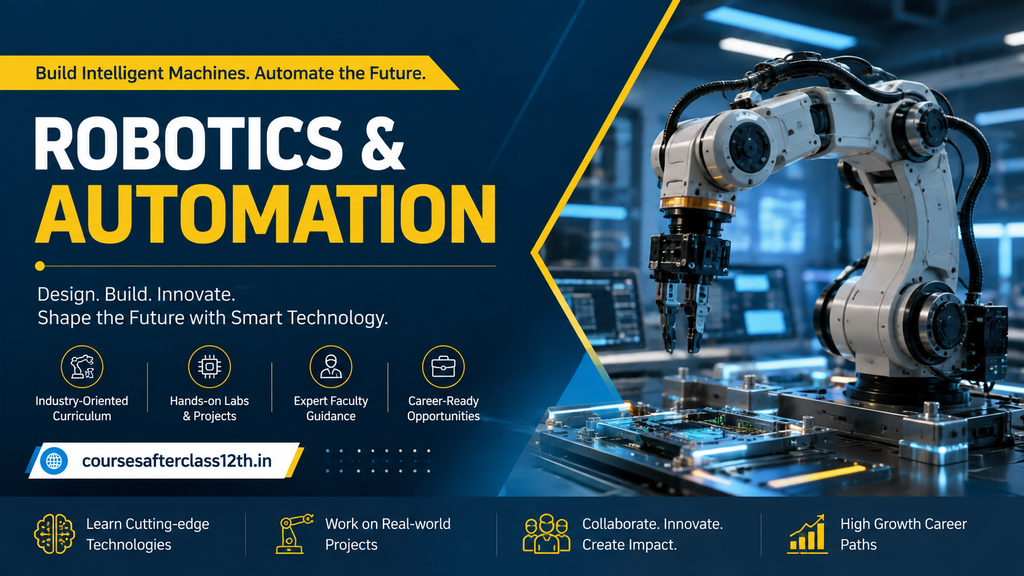
Robotics & Automation is an interdisciplinary engineering field that combines mechanical engineering, electrical engineering, electronics, computer programming, control systems, sensors, artificial intelligence, and industrial technology. It focuses on designing, developing, programming, operating, and maintaining machines and systems that can perform tasks with limited or controlled human intervention.
For students who have completed Class 12 with Physics, Chemistry, and Mathematics (PCM), Robotics & Automation after 12th can be an attractive option for those interested in robots, intelligent machines, automation, programming, electronics, manufacturing, artificial intelligence, and emerging technologies.
The field has applications across manufacturing, automotive production, healthcare, logistics, agriculture, defence, aerospace, warehousing, electronics, energy, and other technology-driven industries. Therefore, students who enjoy both engineering concepts and practical technology can consider this area as a potential career direction.
In India, students may encounter undergraduate programmes with names such as BTech in Robotics and Automation, BE in Robotics and Automation, BTech in Robotics Engineering, BTech in Automation and Robotics, or related programmes such as Mechatronics Engineering. However, programme names, eligibility conditions, admission routes, curriculum, and specialisations can vary between institutions.
This guide explains Robotics & Automation after 12th, including eligibility, entrance examinations, admission process, course duration, subjects, specialisations, fees, practical training, skills, projects, internships, career opportunities, salary factors, government and private-sector opportunities, higher education, emerging technologies, and future scope.
Table of Contents
What is Robotics & Automation?
Robotics & Automation focuses on creating systems that can sense their surroundings, process information, make decisions according to programmed rules, and perform physical or digital tasks.
A robot typically combines several engineering components. These may include mechanical structures, motors, actuators, sensors, controllers, embedded processors, communication systems, and software. Automation adds another important layer by controlling processes so that repetitive or complex operations can take place consistently.
For example, an automated production line may use sensors to detect an object, a controller to process the sensor signal, and a robotic arm to move or assemble the object. Similarly, an autonomous mobile robot can combine cameras, sensors, software, motors, and navigation algorithms to move through an environment.
Consequently, Robotics & Automation is not limited to building humanoid robots. It also covers industrial robots, robotic arms, automated machines, autonomous vehicles, warehouse systems, inspection robots, drones, medical robots, collaborative robots, and intelligent manufacturing systems.
Robotics & Automation as an Engineering Course After 12th
Students searching for engineering courses after 12th can consider Robotics & Automation if their interests match the interdisciplinary nature of the field.
Unlike a highly specialised engineering discipline, robotics combines concepts from several areas. Students may study mechanics, electrical circuits, electronics, programming, control engineering, sensors, automation, artificial intelligence, computer vision, and industrial systems.
As a result, the course can provide exposure to multiple technologies rather than focusing on only one engineering area.
However, students should compare the curriculum carefully before choosing a programme. Two institutions may use similar course names while offering different combinations of robotics, automation, mechanical engineering, electronics, programming, AI, or mechatronics subjects.
Robotics & Automation Eligibility After 12th
Eligibility requirements vary among universities, colleges, states, and admission routes. Generally, undergraduate engineering programmes require completion of Class 12 or an equivalent qualification with subjects relevant to engineering.
Physics and Mathematics are commonly important subjects for engineering admission. Depending on the institution and admission route, Chemistry, Computer Science, or another approved subject may also be considered.
Students should always check the latest eligibility rules published by the institution or relevant admission authority before applying because requirements can change.
General Eligibility Overview
| Requirement | General Information |
| Qualification | Class 12 or equivalent |
| Important subjects | Physics and Mathematics |
| Other subjects | Chemistry or another approved subject may apply |
| Stream | Science stream is generally relevant |
| Entrance examination | Depends on admission route |
| Minimum marks | Varies by institution and category |
| Age requirement | Depends on the applicable admission rules |
| Admission route | National, state, university or institutional |
The table above provides a general overview rather than a universal admission rule. Students should verify the exact requirements for their selected college.
Robotics & Automation Entrance Exams
Admission to engineering programmes can take place through different examination and counselling systems.
For example, JEE Main is used for admission to various undergraduate engineering programmes and is conducted by the National Testing Agency. The official JEE Main website currently provides information for Paper 1 covering B.E./B.Tech admissions and publishes examination notices, information bulletins, results, and related documents.
Depending on the college or state, students may also need to participate in state-level entrance examinations, university-level tests, or other approved admission processes.
Common Admission Routes
| Admission Route | Description |
| National-level examination | Used by participating institutions through national admission systems |
| State-level examination | Used for eligible colleges within a state |
| University entrance test | Conducted by individual universities where applicable |
| Counselling | Seats are allocated according to eligibility, rank, choices and availability |
| Direct institutional admission | Available at institutions where permitted under applicable rules |
Students should not assume that one entrance examination applies to every Robotics & Automation programme. Instead, they should check the admission page of each institution.
Robotics & Automation Admission Process
The admission process generally begins with checking eligibility and identifying suitable colleges.
First, students should review the programme name, eligibility criteria, entrance requirements, fees, curriculum, laboratory facilities, and placement information.
Next, they should complete the applicable entrance examination or institutional application. After the examination, eligible candidates may participate in counselling or the institution’s selection process.
The exact procedure can differ considerably between institutions.
Typical Admission Steps
- Check Class 12 eligibility.
- Identify Robotics & Automation programmes.
- Check entrance examination requirements.
- Register for the relevant examination if required.
- Apply to participating colleges.
- Complete counselling or institutional selection.
- Fill in programme and college preferences.
- Review seat allocation.
- Complete document verification.
- Pay the required admission and academic fees.
AICTE’s approval framework covers technical programmes at undergraduate and postgraduate levels, while institutions and admission authorities remain responsible for the specific requirements applicable to their programmes.
Robotics & Automation Course Duration
A regular undergraduate engineering programme in Robotics & Automation is generally structured as a four-year degree programme, although the exact academic structure can differ between institutions.
Students normally progress from foundational engineering subjects to specialised robotics and automation topics.
Typical Academic Progression
| Year | Major Learning Areas |
| First Year | Engineering mathematics, physics, chemistry, programming and basic engineering |
| Second Year | Electronics, mechanics, electrical systems, sensors and control |
| Third Year | Robotics, automation, embedded systems, programming and industrial applications |
| Fourth Year | Advanced electives, internships, projects, research and professional preparation |
The actual curriculum depends on the university.
Robotics & Automation Subjects
The subjects in a Robotics & Automation programme can combine mechanical, electrical, electronics, software, and control engineering.
Common areas may include:
- Engineering Mathematics
- Engineering Physics
- Engineering Chemistry
- Programming Fundamentals
- Data Structures
- Electrical Circuits
- Electronic Devices
- Digital Electronics
- Sensors and Instrumentation
- Microcontrollers
- Embedded Systems
- Robotics Fundamentals
- Industrial Automation
- Control Systems
- Mechatronics
- Machine Design
- Artificial Intelligence
- Machine Learning
- Computer Vision
- Industrial Robotics
- Robot Programming
- PLC Programming
- Autonomous Systems
- Industrial Internet of Things
- Computer-Aided Design
- Manufacturing Systems
- Engineering Project Management
The exact subjects should be checked against the official syllabus of the institution.
Core Areas of Robotics & Automation
Robotics Engineering
Robotics engineering focuses on the design and operation of robotic systems.
Students learn how mechanical structures, motors, sensors, controllers, and software work together. They may also learn robot kinematics, motion planning, robot programming, and system integration.
The goal is to develop machines that can perform specific tasks accurately, safely, and efficiently.
Industrial Automation
Industrial automation involves using control systems, sensors, machines, software, and communication technologies to automate industrial processes.
Automation is widely associated with manufacturing environments where repetitive processes need consistent operation.
Students may learn about:
- PLCs
- SCADA
- Industrial sensors
- Motor control
- Industrial communication
- Automated production
- Process control
- Human-machine interfaces
Mechatronics
Mechatronics combines mechanical systems, electronics, control systems, and software.
Because robotics itself is interdisciplinary, mechatronics concepts are particularly relevant to robotic system development.
For example, a robotic arm may require mechanical design, electronic control, sensors, motors, embedded programming, and motion-control algorithms.
Embedded Systems
Embedded systems are computing systems designed to perform specific functions within larger devices or machines.
In robotics, embedded controllers can receive sensor information and control motors, actuators, communication interfaces, or other components.
Students may work with microcontrollers and embedded programming as part of practical laboratory activities.
Sensors and Actuators in Robotics
Sensors help robotic systems collect information about their surroundings or internal condition.
Examples include:
- Proximity sensors
- Temperature sensors
- Pressure sensors
- Encoders
- Cameras
- Ultrasonic sensors
- Inertial sensors
- LiDAR
- Force sensors
Actuators perform physical actions. Motors, hydraulic systems, pneumatic systems, and servo mechanisms are examples of technologies that can produce movement.
Therefore, a basic robotic system often follows a cycle:
Sense → Process → Decide → Act
This interaction between hardware and software is one of the fundamental concepts students encounter in robotics.
Artificial Intelligence in Robotics
Artificial Intelligence is increasingly relevant to robotics because intelligent algorithms can help machines interpret information and make decisions.
For example, computer vision can help a robot identify objects, while machine learning can support classification or prediction tasks.
AI can also contribute to:
- Object detection
- Image recognition
- Autonomous navigation
- Predictive maintenance
- Human-robot interaction
- Motion planning
- Decision-making
- Intelligent inspection
However, students should understand that AI is only one component of robotics. Successful robotic systems also require mechanical design, electronics, sensors, control, software, safety, and system integration.
Computer Vision and Robotics
Computer vision enables machines to process visual information.
A camera can capture an image, while computer vision software can analyse that image to identify objects, patterns, positions, or defects.
In manufacturing, computer vision can support automated inspection. In autonomous robots, cameras may assist navigation and object recognition.
Students interested in this area can develop skills in programming, image processing, machine learning, mathematics, and robotics.
Autonomous Robotics
Autonomous robots are designed to perform tasks with limited direct human control.
Such systems may use sensors, software, control algorithms, mapping techniques, and decision-making models.
Examples include:
- Autonomous mobile robots
- Delivery robots
- Warehouse robots
- Agricultural robots
- Inspection robots
- Autonomous drones
- Service robots
Autonomy requires reliable sensing and decision-making. Therefore, students studying this area need strong foundations in programming, control systems, sensors, mathematics, and system design.
Industrial Robotics
Industrial robotics is one of the most established areas of robotic technology.
Robotic arms can perform tasks such as:
- Welding
- Painting
- Assembly
- Material handling
- Packaging
- Pick-and-place operations
- Inspection
- Machine tending
Industrial robots are particularly useful for repetitive, hazardous, precise, or high-volume operations.
At the same time, students should understand industrial safety requirements because robotic machinery can create significant workplace hazards when incorrectly designed or operated.
Collaborative Robots
Collaborative robots, often called cobots, are designed for applications where robots and humans can work in closer interaction under appropriate safety conditions.
These systems may be used for assembly, handling, inspection, and other tasks.
The development of collaborative systems requires knowledge of sensors, control systems, mechanical design, programming, and safety engineering.
Robotics & Automation Practical Learning
Robotics is a practical engineering field. Consequently, laboratory work and project development can be particularly valuable.
Students may work with:
- Arduino
- Raspberry Pi
- Microcontrollers
- Sensors
- Motors
- Servo systems
- PLCs
- Robotic arms
- Embedded platforms
- Simulation software
- Computer vision tools
- Robot operating environments
Current AICTE internship listings demonstrate the interdisciplinary nature of robotics-related practical work, with examples involving embedded systems, autonomous systems, industrial robotics, control systems, computer vision, sensor integration, and robot simulation.
Robotics & Automation Projects
Projects allow students to apply theoretical knowledge to real engineering problems.
Project Ideas
| Project | Skills Involved |
| Line-following robot | Sensors, motors, programming |
| Obstacle-avoidance robot | Sensors, control, embedded programming |
| Robotic arm | Mechanics, motors, programming |
| Smart warehouse robot | Navigation, sensors, automation |
| Autonomous vehicle prototype | Sensors, control, software |
| Vision-based inspection | Computer vision, programming |
| Pick-and-place robot | Robotics, actuators, control |
| Smart agricultural robot | Sensors, automation, IoT |
| Industrial monitoring system | PLC, sensors, communication |
| AI-powered robot | AI, programming, sensors |
A strong project should demonstrate how the student identified a problem, selected an engineering approach, developed the system, tested it, analysed the results, and improved its performance.
Importance of Internships
Internships can help students understand how robotics and automation technologies are used outside academic laboratories.
During an internship, students may gain exposure to industrial automation, robotics programming, embedded systems, manufacturing technology, computer vision, testing, simulation, or system integration.
Moreover, internships can help students understand professional workflows.
For example, an engineering project in college may involve a small prototype. In an industrial environment, the same concept may require documentation, safety procedures, quality testing, maintenance planning, cost analysis, and integration with existing equipment.
Therefore, practical exposure can complement classroom learning.
Skills Required for Robotics & Automation
Students planning a career in robotics should develop both technical and professional skills.
Technical Skills
- Engineering mathematics
- Programming
- Electronics
- Mechanical fundamentals
- Control systems
- Sensors
- Embedded systems
- Robotics programming
- Automation
- PLCs
- Computer vision
- Artificial intelligence
- CAD
- Simulation
- Industrial communication
Professional Skills
- Problem-solving
- Analytical thinking
- Teamwork
- Communication
- Documentation
- Project management
- Technical presentation
- Troubleshooting
- Time management
A robotics engineer often works across multiple engineering disciplines. Therefore, the ability to communicate with mechanical, electrical, electronics, software, and manufacturing teams can be valuable.
Programming Languages for Robotics
Programming is an important part of modern robotics.
Students may encounter languages and technologies such as:
- C
- C++
- Python
- Embedded C
- MATLAB
- PLC programming languages
- Robot-specific programming environments
Python is commonly useful for prototyping, data processing, computer vision, and AI-related applications. C and C++ can be relevant to embedded systems and robotics software.
The exact technology stack depends on the project and employer.
Robotics & Automation Tools
Students may encounter a range of engineering and development tools.
Examples include:
| Tool/Technology | Possible Application |
| MATLAB | Simulation and engineering analysis |
| Simulink | Control-system modelling |
| CAD software | Mechanical design |
| PLC software | Industrial automation |
| Arduino | Prototyping |
| Raspberry Pi | Embedded computing |
| ROS | Robotics software development |
| Python | AI, vision and programming |
| C/C++ | Embedded and robotics programming |
| Simulation platforms | Robot testing and modelling |
Students do not need to master every tool at once. Instead, they should build a strong foundation and then specialise according to their career interests.
Robotics & Automation Fees in India
The total cost of a Robotics & Automation degree varies significantly among colleges.
Fees can depend on:
- Institution type
- Location
- University
- Laboratory facilities
- Hostel requirements
- Programme structure
- Scholarships
- Category
- Additional academic charges
Therefore, it is not advisable to present one fixed fee as applicable to every student.
Typical Cost Components
| Expense | What It May Include |
| Tuition fee | Academic instruction |
| Examination fee | Semester examinations |
| Laboratory fee | Practical facilities |
| Hostel fee | Accommodation |
| Transport | College transportation where applicable |
| Library fee | Academic resources |
| Project expenses | Components and development |
| Miscellaneous charges | Institutional services |
Students should compare the complete annual cost rather than considering tuition fees alone.
How to Choose a Robotics & Automation College
Choosing a college requires more than comparing course names.
Students should examine the following:
1. Curriculum
Check whether the syllabus includes robotics, automation, embedded systems, control, programming, sensors, AI, and practical work.
2. Laboratories
Robotics requires practical learning. Therefore, examine whether the college has relevant robotics, automation, electronics, embedded, and manufacturing laboratories.
3. Faculty
Review faculty qualifications, research areas, publications, industry exposure, and project activity where information is available.
4. Internships
Check whether students receive opportunities to work with industries, research institutions, laboratories, or technology organisations.
5. Projects
Find out whether students complete meaningful technical projects rather than only theoretical assignments.
6. Placements
Do not evaluate a college only on its highest advertised salary package. Instead, examine placement percentage, median or average outcomes where available, recruiters, role types, and branch-specific data.
7. Industry Exposure
Industry visits, workshops, competitions, hackathons, technical clubs, and live projects can strengthen practical learning.
Career Opportunities in Robotics & Automation
Robotics and automation graduates can explore careers across multiple industries.
Possible roles include:
- Robotics Engineer
- Automation Engineer
- Robotics Software Engineer
- Controls Engineer
- Embedded Systems Engineer
- PLC Engineer
- Industrial Automation Engineer
- Mechatronics Engineer
- Robot Programmer
- Computer Vision Engineer
- Autonomous Systems Engineer
- Manufacturing Automation Engineer
- Systems Engineer
- Test Engineer
- Field Service Engineer
- Application Engineer
- Research Engineer
The actual job title and responsibilities depend on the employer and the candidate’s technical specialisation.
Robotics Engineer
A robotics engineer may participate in designing, programming, testing, integrating, or maintaining robotic systems.
The role can involve mechanical components, electronics, sensors, controllers, software, and system testing.
A robotics engineer may work on industrial robots, autonomous machines, inspection systems, mobile robots, or specialised robotic equipment.
Automation Engineer
Automation engineers focus on automating industrial or operational processes.
Their work may involve PLCs, sensors, motor systems, control systems, SCADA, industrial communication, and machine integration.
They may also participate in commissioning, troubleshooting, maintenance, and process improvement.
Robotics Software Engineer
Robotics software engineers develop software that controls or supports robotic systems.
Depending on the position, they may work on:
- Robot control
- Navigation
- Computer vision
- Simulation
- Perception
- Motion planning
- Sensor processing
- AI applications
Strong programming and mathematical skills can be particularly useful for this career direction.
Controls Engineer
Controls engineers design and maintain systems that regulate machine behaviour.
They may work with feedback systems, controllers, sensors, actuators, motors, industrial automation equipment, and process-control systems.
Control engineering is particularly relevant when machines must maintain specific speed, position, temperature, pressure, or movement characteristics.
Embedded Systems Engineer
Embedded engineers develop software and hardware systems integrated into machines and electronic devices.
In robotics, embedded systems can control sensors, motors, communication modules, and other components.
This career path can suit students who enjoy electronics as well as programming.
Industries Hiring Robotics & Automation Professionals
Robotics and automation skills can be relevant across several industries.
| Industry | Possible Applications |
| Automotive | Robotic assembly and manufacturing |
| Electronics | Assembly and inspection |
| Manufacturing | Production automation |
| Logistics | Warehouse automation |
| Healthcare | Medical and assistive robotics |
| Agriculture | Automated farming systems |
| Aerospace | Automated manufacturing and inspection |
| Defence | Autonomous and robotic systems |
| Energy | Inspection and monitoring |
| Food processing | Packaging and production |
| Pharmaceuticals | Automated manufacturing |
| Research | Robotics and intelligent systems |
AICTE’s internship ecosystem also reflects the multidisciplinary nature of robotics careers, with robotics opportunities spanning mechanical, electrical, electronics, mechatronics, computer engineering, AI, automation and related disciplines.
Robotics & Automation Salary
Salary outcomes vary widely and should not be represented through one universal figure.
Factors that can influence salary include:
- College
- Academic performance
- Technical skills
- Internship experience
- Programming ability
- Specialisation
- Industry
- Job location
- Employer
- Experience
- Role complexity
For example, a graduate with strong robotics programming and computer vision skills may pursue a different career path from another graduate who specialises in PLC programming and industrial automation.
Therefore, students should compare job descriptions and current recruitment information rather than relying only on advertised maximum packages.
Government Jobs After Robotics & Automation
Robotics and Automation graduates may also explore government-sector opportunities where their engineering qualification and skills match the eligibility criteria.
Possible areas can include:
- Engineering services
- Public-sector organisations
- Defence-related organisations
- Research institutions
- Government manufacturing organisations
- Technical departments
- Scientific organisations
- Public infrastructure and technology organisations
However, eligibility depends on the specific recruitment notification.
Government recruitment requirements can include educational qualifications, age limits, examinations, technical disciplines, experience requirements, and other conditions. Consequently, students should always verify the official recruitment notification before applying.
Higher Studies After Robotics & Automation
Students interested in advanced technical careers can pursue postgraduate education.
Possible areas include:
- Robotics
- Automation
- Mechatronics
- Artificial Intelligence
- Machine Learning
- Control Systems
- Embedded Systems
- Computer Vision
- Industrial Engineering
- Mechanical Engineering
- Electronics
- Electrical Engineering
A postgraduate degree can be useful for students who want deeper technical expertise, research opportunities, academic careers, or specialised engineering roles.
Research Opportunities
Robotics is a strong interdisciplinary research area.
Research topics can include:
- Autonomous robots
- Human-robot interaction
- Robot perception
- Computer vision
- Machine learning
- Motion planning
- Swarm robotics
- Medical robotics
- Agricultural robotics
- Industrial automation
- Soft robotics
- Robot safety
- Autonomous navigation
- Intelligent manufacturing
Students interested in research should develop skills in mathematics, programming, technical reading, experimentation, data analysis, and scientific communication.
Future Scope of Robotics & Automation
The future of robotics is influenced by automation, artificial intelligence, industrial digitisation, autonomous systems, smart manufacturing, and demand for efficient production processes.
Modern robotics is increasingly connected with AI, cloud computing, edge computing, computer vision, industrial IoT, digital twins, advanced sensors, and data-driven decision-making.
Consequently, future robotics professionals may need broader skills than traditional robot programming alone.
Industry 4.0 and Robotics
Industry 4.0 refers broadly to connected and intelligent industrial technologies.
Robotics can become part of this environment through:
- Connected machines
- Industrial IoT
- Smart sensors
- Data analytics
- AI
- Predictive maintenance
- Automated production
- Digital monitoring
For example, a manufacturing robot may not simply perform a mechanical task. It can also generate operational data that helps organisations monitor performance and identify maintenance requirements.
Artificial Intelligence and Automation
AI can enhance automation by allowing systems to analyse data and respond to changing conditions.
Traditional automation often follows predefined rules. AI-based systems can potentially handle more complex patterns, particularly when combined with suitable sensors, data, and computing resources.
However, AI does not replace the need for engineering fundamentals. Reliable automation still requires appropriate mechanical design, electrical systems, sensors, control, safety, testing, and maintenance.
Digital Twins in Robotics
A digital twin is a digital representation of a physical system that can be used for monitoring, modelling, simulation, or analysis.
In robotics and manufacturing, digital representations can help engineers evaluate processes before making changes to physical systems.
This approach can support:
- Simulation
- Performance analysis
- Process optimisation
- Maintenance planning
- Training
- System testing
Students interested in advanced automation can benefit from learning simulation and modelling concepts.
Robotics and Smart Manufacturing
Smart manufacturing combines automation, connected equipment, software, sensors, analytics, and digital technologies.
Robots can contribute to smart manufacturing by performing repetitive tasks while connected systems collect operational data.
As a result, the role of a robotics engineer can extend beyond programming an individual robot to integrating complete production systems.
Advantages of Studying Robotics & Automation
Robotics & Automation can offer several advantages for students with suitable interests.
Interdisciplinary Learning
Students learn concepts from multiple engineering domains.
Practical Exposure
Robotics naturally involves laboratory work, prototypes, testing, and troubleshooting.
Technology-Oriented Careers
The field connects with automation, AI, embedded systems, manufacturing, and intelligent machines.
Multiple Career Paths
Graduates can move towards robotics, controls, automation, embedded systems, software, manufacturing, or higher studies.
Research Opportunities
Robotics provides opportunities for academic and industrial research.
Challenges in Robotics & Automation
Students should also understand the challenges before selecting the programme.
Robotics can require strong mathematics, programming, electronics, mechanics, and problem-solving abilities.
Additionally, technology changes quickly. Therefore, students need to continue learning beyond their degree.
Another challenge is that a degree alone may not be sufficient for specialised roles. Practical projects, internships, programming skills, technical certifications, competitions, and hands-on experience can strengthen employability.
Robotics & Automation vs Mechanical Engineering
Robotics and Mechanical Engineering overlap in areas such as machine design, mechanics, manufacturing, and automation.
However, Robotics & Automation usually places greater emphasis on sensors, control, electronics, programming, robotics, and intelligent systems.
| Robotics & Automation | Mechanical Engineering |
| Robotics-focused | Broader mechanical foundation |
| Strong programming component | Programming may be less central |
| Sensors and control | Mechanics and machine design |
| Automation | Manufacturing and production |
| Embedded systems | Thermal and fluid systems |
| AI/vision may be included | Traditional mechanical specialisations |
Students should compare the actual curriculum of the colleges they are considering.
Robotics & Automation vs Electronics Engineering
Electronics Engineering focuses strongly on electronic circuits, devices, communication, digital systems, embedded technologies, and related applications.
Robotics & Automation combines electronics with mechanical systems, programming, control, sensors, and automation.
Therefore, students who enjoy both hardware and machines may find robotics attractive, while students who prefer electronic circuits and communication systems may prefer electronics-focused programmes.
Robotics & Automation vs Computer Science Engineering
Computer Science Engineering focuses primarily on computing, software, algorithms, databases, operating systems, networks, artificial intelligence, and related technologies.
Robotics uses computer science concepts but applies them to physical machines.
| Robotics & Automation | Computer Science Engineering |
| Physical machines + software | Primarily computing and software |
| Sensors and actuators | Algorithms and software systems |
| Mechanical systems | Computer systems |
| Control systems | Software engineering |
| Robotics | AI, cloud, cybersecurity and software |
Neither is universally better. The right choice depends on the student’s interests and career goals.
Who Should Study Robotics & Automation?
Robotics & Automation can suit students who:
- Enjoy mathematics and physics
- Like building things
- Are interested in machines
- Want to learn programming
- Enjoy electronics
- Like practical experimentation
- Are interested in automation
- Want to explore AI and robotics
- Enjoy solving technical problems
- Are comfortable learning across multiple engineering areas
Students who strongly dislike programming, electronics, mechanics, or laboratory work should carefully examine the curriculum before choosing the programme.
How to Prepare for Robotics & Automation After Class 12
Students can begin preparing before entering college.
First, strengthen Physics and Mathematics concepts.
Next, learn basic programming. Python is a convenient starting point for many beginners, while C/C++ can later support embedded and robotics applications.
Students can also experiment with basic electronics and microcontrollers.
Useful Preparation Areas
| Area | Beginner Focus |
| Mathematics | Algebra, calculus, vectors |
| Physics | Mechanics, electricity |
| Programming | Python or C |
| Electronics | Basic circuits |
| Robotics | Sensors and motors |
| CAD | Basic 3D modelling |
| AI | Basic machine learning concepts |
| Communication | Technical writing and presentation |
The goal is not to master robotics before college. Instead, students should develop curiosity and a strong technical foundation.
Robotics Competitions and Technical Activities
Technical competitions can help students develop practical skills.
Students can participate in activities involving:
- Line-following robots
- Drone technology
- Robot combat
- Autonomous navigation
- Robotic arms
- Programming competitions
- Hackathons
- Industrial automation challenges
- AI and computer vision projects
Such activities can encourage students to work with real hardware and solve engineering problems under constraints.
Portfolio Development for Robotics Students
A technical portfolio can help demonstrate practical ability.
Students can document:
- Project objectives
- Hardware used
- Software used
- Circuit diagrams
- CAD models
- Programming work
- Testing results
- Problems encountered
- Improvements made
- Final results
A portfolio can be especially useful when applying for internships or entry-level technical roles.
How to Build a Strong Robotics Career
A strong career generally requires a combination of academic knowledge and practical ability.
Students should gradually build expertise rather than trying to learn every robotics technology simultaneously.
A possible progression is:
Engineering fundamentals → Programming → Electronics → Sensors → Control → Robotics → Projects → Internship → Specialisation
Students can then specialise in areas such as industrial automation, computer vision, embedded robotics, autonomous systems, AI robotics, or controls.
Robotics & Automation Career Roadmap
| Stage | Focus |
| Class 11–12 | PCM fundamentals |
| First year | Basic engineering + programming |
| Second year | Electronics, mechanics, sensors |
| Third year | Robotics, control, automation |
| Third/Fourth year | Internship + specialised projects |
| Final year | Major project + placement preparation |
| After graduation | Job, higher studies or research |
Is Robotics & Automation a Good Career Option?
Robotics & Automation can be a good career option for students who genuinely enjoy interdisciplinary engineering and emerging technology.
The field offers exposure to robotics, automation, embedded systems, control, AI, computer vision, manufacturing, and intelligent machines.
However, students should not select the programme solely because robotics is considered a future technology. Career outcomes depend on the quality of education, practical exposure, technical skills, internships, specialisation, projects, and market demand.
Therefore, students should evaluate the complete programme rather than choosing it based only on the course title.
Frequently Asked Questions About Robotics & Automation
What is Robotics & Automation?
Robotics & Automation is an interdisciplinary engineering field involving robots, automated systems, sensors, electronics, mechanical systems, programming, control systems, and intelligent technologies.
Is Robotics & Automation a good course after 12th?
Yes, it can be suitable for students with PCM who are interested in robotics, machines, programming, electronics, automation, and emerging technologies.
What subjects are required for Robotics & Automation?
Physics and Mathematics are generally important for undergraduate engineering admission. Other subject requirements depend on the institution and admission route.
What is the duration of Robotics & Automation?
A regular undergraduate engineering programme is generally structured over four years, although the exact programme structure depends on the university.
What do students study in Robotics & Automation?
Students may study programming, electronics, mechanics, sensors, control systems, embedded systems, robotics, automation, AI, computer vision, industrial systems, and related subjects.
Is coding required in Robotics & Automation?
Yes. Programming is an important part of modern robotics. Students may use languages such as Python, C, and C++ depending on the application.
Can Robotics & Automation students work in the automotive industry?
Yes. Automotive manufacturing uses robotics and automation for assembly, welding, painting, inspection, material handling, and other production activities.
Can Robotics graduates work in AI?
Yes. Students with suitable programming, mathematics, machine learning, computer vision, and robotics skills can explore AI-related roles connected with robotic systems.
Can Robotics & Automation graduates get government jobs?
They may be eligible for government or public-sector technical positions where the recruitment notification accepts their engineering qualification. Eligibility varies by organisation and post.
What are the career options after Robotics & Automation?
Possible roles include Robotics Engineer, Automation Engineer, Controls Engineer, Embedded Systems Engineer, Robotics Software Engineer, PLC Engineer, Robot Programmer, Computer Vision Engineer, and Systems Engineer.
Is Robotics & Automation better than Mechanical Engineering?
Neither is universally better. Robotics is more focused on automation, robotics, control, sensors, electronics, and programming, while Mechanical Engineering provides a broader foundation in mechanical systems.
Is Robotics & Automation better than Computer Science?
It depends on career goals. Computer Science is more focused on computing and software, whereas Robotics combines software with physical machines, sensors, electronics, mechanics, and control.
Does Robotics & Automation have future scope?
The field has applications in manufacturing, logistics, healthcare, agriculture, automotive technology, aerospace, research, and other technology-driven sectors. However, students should continuously update their skills because robotics technologies evolve quickly.