
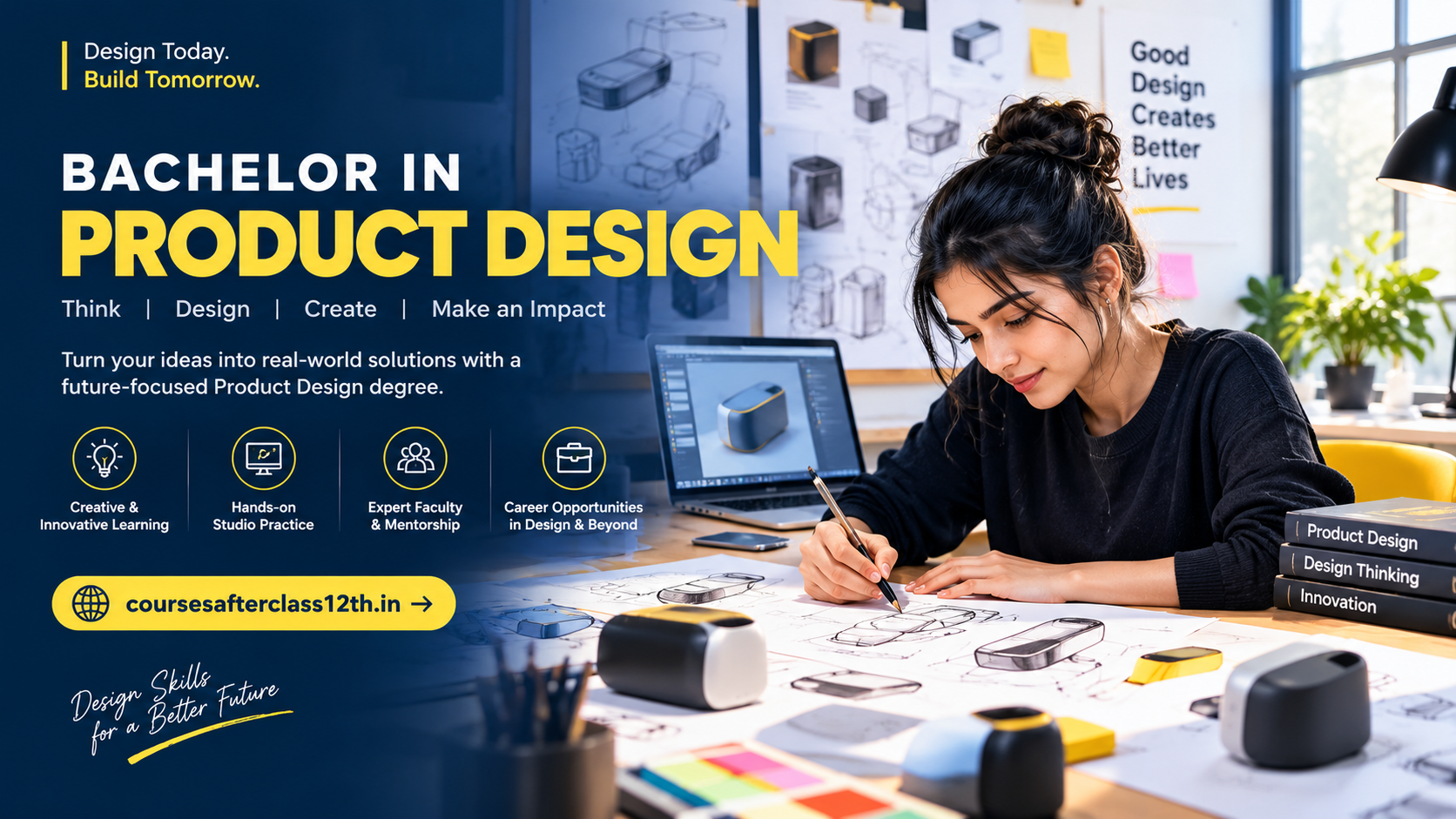
Bachelor in Product Design – Develop creative, practical and innovative design skills.
Bachelor in Product Design is an undergraduate design programme that focuses on creating, developing and improving products for people and businesses. The course combines creativity, design thinking, research, visualisation, materials, manufacturing knowledge, ergonomics, technology and problem-solving to help students understand how products move from an initial idea to a usable and commercially viable design.
Product design is involved in many objects used in everyday life. Furniture, consumer electronics, kitchen products, appliances, packaging-related products, lifestyle accessories, transportation components and many other physical products require thoughtful design. Modern product designers may also work with digital tools, 3D modelling, rapid prototyping, computer-aided design and emerging technologies.
A Bachelor in Product Design therefore goes beyond making an object look attractive. Students learn to consider function, usability, appearance, materials, manufacturing, user needs, cost and sustainability while developing a product.
The programme can be suitable for students who enjoy creativity but also like understanding how things work. It can be particularly relevant for students interested in industrial design, consumer products, furniture, mobility, electronics, lifestyle products and design innovation.
Depending on the institution, the programme may include studio projects, workshops, design research, model making, prototyping, internships and a final graduation project. The exact curriculum, duration, eligibility, admission process and fees vary between universities.
Students should therefore check the latest official information of the institution before applying.
Bachelor in Product Design – Quick Overview
| Particular | Details |
| Course Name | Bachelor in Product Design |
| Common Degree | B.Des Product Design / Bachelor of Design in Product Design |
| Course Level | Undergraduate |
| Duration | Commonly 4 years, depending on institution |
| Eligibility | Usually 10+2 or equivalent |
| Streams | Arts, Commerce and Science may be eligible depending on institution |
| Core Area | Product and Industrial Design |
| Learning Method | Studio, Theory, Projects and Practical Work |
| Major Skills | Design Thinking, Sketching, CAD, Prototyping, Research |
| Materials | Wood, Metal, Plastic, Fabric, Composite and other materials |
| Technology | CAD, 3D Modelling, Rendering and Digital Fabrication |
| Career Areas | Product Design, Industrial Design, Furniture, Consumer Products and Manufacturing |
| Portfolio | Highly important |
| Internship | May be included depending on programme |
| Higher Studies | M.Des and related postgraduate programmes |
| Suitable For | Students interested in creativity, products, technology and problem-solving |
What is Bachelor in Product Design?
A Bachelor in Product Design is an undergraduate programme that teaches students how to identify user needs and transform those needs into product concepts.
A product designer considers questions such as:
- Who will use the product?
- What problem does it solve?
- How will the user interact with it?
- What materials should be used?
- How should it be manufactured?
- How much should it cost?
- Is it comfortable and safe?
- How can its environmental impact be reduced?
- How should it look and feel?
Students learn to answer these questions through research, sketching, prototyping, testing and design development.
The field combines elements of industrial design, engineering awareness, visual design, ergonomics, manufacturing and business thinking.
Product Design and Industrial Design
The terms product design and industrial design are often used in overlapping ways.
Product design generally focuses on developing products for specific users and purposes. Industrial design traditionally covers the design of manufactured products and can include form, function, usability, materials and production considerations.
Depending on the university, a Product Design programme may include many industrial-design principles.
Students should therefore look at the actual curriculum rather than selecting a programme based only on its title.
Why Study Bachelor in Product Design?
Products influence everyday life, from simple household objects to sophisticated electronic devices.
Businesses need designers who can understand users and convert their needs into practical products. A designer can contribute to product appearance, functionality, usability, materials, manufacturing and user experience.
A Product Design degree can provide students with structured exposure to the complete design process.
Instead of learning only how to sketch products, students may progress through:
Research → Problem Identification → Ideation → Concept Development → Prototyping → Testing → Refinement → Final Product
This process helps students understand why a product should be designed in a particular way.
Who Should Choose Bachelor in Product Design?
The course may be suitable for students who enjoy:
- Designing objects
- Sketching
- Creativity
- Problem-solving
- Technology
- Understanding how products work
- Making physical models
- 3D design
- Furniture
- Consumer electronics
- Everyday products
- Innovation
- Sustainable design
Students do not need to know advanced CAD or professional design software before joining the programme. These skills can be developed during the course.
However, curiosity and willingness to experiment are important.
Bachelor in Product Design Eligibility
Eligibility requirements vary from one university to another.
Many undergraduate design programmes require completion of Class 12 or an equivalent qualification from a recognised board.
Some institutions may specify:
- Minimum percentage
- Entrance examination
- Design aptitude test
- Portfolio
- Interview
- Age requirements
General Eligibility Pattern
| Requirement | Typical Requirement |
| Educational Qualification | 10+2 or equivalent |
| Board | Recognised board |
| Minimum Marks | Institution-specific |
| Stream | May accept multiple streams |
| Entrance Test | Institution-specific |
| Portfolio | May be required |
| Interview | May apply |
| Age Limit | Institution-specific |
Students should always confirm the latest eligibility requirements directly from the university.
Can Arts Students Study Product Design?
Yes, Arts students may be eligible for many Product Design programmes.
An Arts background can provide useful exposure to creativity, visual communication and cultural understanding.
However, students should also be prepared to learn technical concepts such as materials, manufacturing processes, dimensions, ergonomics and CAD.
Can Commerce Students Study Product Design?
Commerce students may also be eligible depending on the university.
Commerce education can become useful later in a product-design career because commercial product development involves understanding markets, customers, pricing and business objectives.
A designer who understands both users and commercial considerations can contribute effectively to product development.
Can Science Students Study Product Design?
Science students may be eligible for Product Design programmes depending on institutional requirements.
Science students may find technical concepts such as materials, measurements, mechanics and manufacturing processes interesting.
However, creativity and design thinking remain equally important.
Bachelor in Product Design Course Duration
Many Bachelor of Design programmes in Product Design are structured as four-year undergraduate degrees.
A typical progression could look like this:
| Year | Possible Focus |
| Year 1 | Design Fundamentals, Drawing, Visualisation |
| Year 2 | Design Research, Materials, CAD and Product Development |
| Year 3 | Advanced Product Design, Manufacturing and Prototyping |
| Year 4 | Internship, Specialisation and Graduation Project |
The exact academic structure differs between institutions.
Bachelor in Product Design Admission Process
The admission process varies by university.
A typical process may involve:
- Checking eligibility.
- Selecting the desired institution.
- Filling out the application form.
- Appearing for a design entrance examination if required.
- Completing a portfolio assessment where applicable.
- Attending an interview or studio assessment if required.
- Receiving the admission decision.
- Completing documentation.
- Paying applicable fees.
- Beginning the academic programme.
Students should check the current admission notification because requirements can change.
Product Design Entrance Exams
Some design institutions use entrance examinations to assess applicants.
A design aptitude examination can test:
- Creativity
- Observation
- Visualisation
- Logical thinking
- Design awareness
- Problem-solving
- Drawing
- Spatial understanding
- General awareness
A candidate may also be asked to demonstrate creative thinking through practical or portfolio-based evaluation.
Bachelor in Product Design Subjects
The curriculum varies between institutions, but Product Design programmes can include a combination of design fundamentals, technical knowledge and professional practice.
| Subject Area | What Students May Learn |
| Design Fundamentals | Principles of design |
| Drawing | Product sketching and visualisation |
| Design Thinking | Human-centred problem-solving |
| Design Research | Understanding users and markets |
| Ergonomics | Designing for human interaction |
| Materials | Material properties and applications |
| Manufacturing | Production methods |
| CAD | Computer-aided design |
| 3D Modelling | Digital product development |
| Rendering | Product visualisation |
| Prototyping | Testing physical concepts |
| Model Making | Creating physical representations |
| Furniture Design | Furniture development |
| Consumer Product Design | Everyday products |
| Packaging | Product presentation and packaging |
| Sustainable Design | Environmentally responsible design |
| Product Development | From concept to final product |
| Professional Practice | Industry and business skills |
| Internship | Practical exposure |
| Graduation Project | Independent design project |
Design Fundamentals
Design fundamentals provide the foundation for later product development.
Students may study:
- Form
- Shape
- Proportion
- Balance
- Contrast
- Rhythm
- Scale
- Colour
- Composition
- Visual hierarchy
These principles help designers create products that are visually coherent and understandable.
Product Sketching
Sketching is an important communication tool in product design.
Designers often use sketches to communicate ideas quickly before investing time in detailed CAD modelling or physical prototypes.
Students may learn:
- Perspective
- Product proportions
- Ellipses
- Form construction
- Shading
- Highlights
- Exploded views
- Orthographic representation
- Concept sketches
Digital sketching may also be introduced alongside traditional methods.
Design Thinking
Design thinking focuses on understanding people and solving problems through an iterative design process.
A simplified process can involve:
Empathise → Define → Ideate → Prototype → Test
Students may use this approach to understand user behaviour and identify opportunities for product improvement.
User Research in Product Design
Good product design begins with understanding the user.
Research methods can include:
- Interviews
- Surveys
- Observation
- User testing
- Market research
- Competitor analysis
- Contextual research
Research helps designers avoid designing products based entirely on assumptions.
For example, a designer developing a kitchen appliance may need to understand how people store, operate and clean similar products.
Ergonomics in Product Design
Ergonomics focuses on the relationship between people and products.
A product should ideally accommodate the physical and cognitive characteristics of its intended users.
Students may consider:
- Grip
- Reach
- Posture
- Height
- Force
- Comfort
- Controls
- Visibility
- Accessibility
Ergonomics is particularly important for products used frequently or for extended periods.
Human-Centred Design
Human-centred design places users and their needs at the centre of the design process.
The designer studies how people interact with a product and identifies opportunities to improve that experience.
This approach can help designers create products that are not only visually appealing but also practical and understandable.
Materials in Product Design
Material selection can significantly influence the appearance, cost, weight, durability and manufacturing method of a product.
Students may explore:
- Wood
- Metals
- Plastics
- Glass
- Ceramics
- Textiles
- Rubber
- Composites
- Sustainable materials
Each material has different properties and production requirements.
Wood in Product Design
Wood is widely used in furniture and lifestyle products.
Students may learn about:
- Solid wood
- Engineered wood
- Finishes
- Joinery
- Cutting
- Sanding
- Assembly
Wood can provide opportunities for both traditional craftsmanship and contemporary product development.
Metal in Product Design
Metal is important in many manufactured products.
Commonly encountered materials can include:
- Steel
- Aluminium
- Brass
- Copper
Students may study metal forming, joining, finishing and fabrication processes depending on available workshops.
Plastics in Product Design
Plastics are used in numerous consumer products because they can be moulded into complex forms.
Students may learn about:
- Injection moulding
- Thermoforming
- Extrusion
- Plastic finishing
- Material selection
Understanding production methods helps designers create products that are feasible to manufacture.
Sustainable Materials
Sustainable product design considers environmental impact throughout a product’s life cycle.
Designers may explore:
- Recycled materials
- Renewable materials
- Recyclability
- Repairability
- Durability
- Material reduction
- Disassembly
Sustainability is increasingly relevant to product development.
CAD in Product Design
Computer-aided design, commonly known as CAD, is an important digital skill for many product designers.
CAD software can help designers:
- Develop accurate geometry
- Create 3D models
- Produce technical drawings
- Test dimensions
- Prepare designs for manufacturing
- Generate visualisations
Students should understand design principles alongside software skills.
3D Modelling
3D modelling allows designers to develop digital representations of products.
A 3D model can help communicate:
- Form
- Proportion
- Components
- Assembly
- Materials
- Surface details
Digital models can also support rendering, prototyping and manufacturing workflows.
Product Rendering
Rendering produces realistic or stylised visual representations of product concepts.
Students can use renders to communicate:
- Materials
- Colours
- Surface finishes
- Lighting
- Product proportions
- Product context
High-quality visualisation can be useful during presentations and design reviews.
Rapid Prototyping
Rapid prototyping allows designers to quickly create physical representations of product concepts.
Methods may include:
- 3D printing
- Laser cutting
- CNC fabrication
- Foam modelling
- Cardboard modelling
The exact techniques available depend on the institution’s facilities.
3D Printing in Product Design
3D printing allows digital models to be converted into physical objects.
Students can use prototypes to evaluate:
- Size
- Shape
- Grip
- Assembly
- Appearance
- Function
A prototype may reveal problems that are difficult to identify from a computer screen.
Model Making
Physical model making remains an important design skill.
Students may work with:
- Cardboard
- Foam
- Wood
- Clay
- Acrylic
- Paper
- Fabric
- Other workshop materials
Model making helps students understand scale, proportion and physical form.
Manufacturing Processes
Product designers should understand how products are manufactured.
Depending on the programme, students may study:
- Injection moulding
- Casting
- Machining
- CNC
- Sheet-metal fabrication
- Vacuum forming
- Woodworking
- 3D printing
- Assembly
Manufacturing knowledge helps designers develop concepts that are realistic to produce.
Product Development Process
A typical product-development workflow can involve several stages.
| Stage | Purpose |
| Research | Understand users and market |
| Problem Definition | Identify the design challenge |
| Ideation | Generate possible solutions |
| Concept Selection | Evaluate alternatives |
| Sketching | Communicate ideas |
| CAD | Develop detailed models |
| Prototype | Build physical representation |
| Testing | Evaluate performance |
| Refinement | Improve the design |
| Production | Prepare for manufacturing |
The process is usually iterative rather than strictly linear.
Consumer Product Design
Consumer product design covers products intended for everyday users.
Examples include:
- Kitchen appliances
- Personal accessories
- Furniture
- Household products
- Electronics
- Lifestyle products
Designers consider functionality, appearance, usability, production and market expectations.
Furniture Design
Furniture is an important specialisation within product design.
Students may develop:
- Chairs
- Tables
- Storage products
- Lighting
- Desks
- Seating systems
Furniture design involves ergonomics, materials, structure, manufacturing and aesthetics.
Electronic Product Design
Consumer electronics require close collaboration between designers and technical teams.
The designer may contribute to:
- Product form
- User interaction
- Controls
- Materials
- Surface finish
- Ergonomics
- User experience
Product designers may therefore work alongside engineers and technology professionals.
Packaging and Product Presentation
Although packaging can be a separate design specialisation, product designers may need to understand how products are presented, transported and protected.
Packaging considerations can include:
- Protection
- Storage
- Branding
- Usability
- Materials
- Sustainability
Sustainable Product Design
Sustainable design attempts to reduce unnecessary environmental impact.
A designer can consider sustainability at several stages:
Material Selection → Manufacturing → Transportation → Use → Repair → End of Life
Potential strategies include:
- Designing durable products
- Reducing material use
- Using recyclable materials
- Making products repairable
- Designing for disassembly
- Extending product lifespan
Circular Design
Circular design considers how products and materials can remain useful for longer.
Instead of a simple linear model of:
Make → Use → Dispose
circular approaches can consider:
Design → Make → Use → Repair → Reuse → Recover
Students may therefore study product life cycles and material recovery.
Smart Products
Modern products increasingly include sensors, connectivity and digital interfaces.
Product designers may collaborate with technology teams when developing:
- Smart appliances
- Wearable products
- Connected home devices
- Interactive products
This creates opportunities for designers who understand both physical and digital experiences.
AI in Product Design
Artificial intelligence can support parts of the design process.
AI-assisted tools may help with:
- Concept exploration
- Image generation
- Design alternatives
- Research organisation
- Visualisation
- Pattern development
- Generative design
However, designers still need to evaluate whether an AI-generated concept is practical, safe, manufacturable and suitable for users.
AI should therefore complement design thinking rather than replace fundamental design knowledge.
Virtual Reality in Product Design
Virtual reality can allow designers and clients to experience digital products or environments before physical production.
Possible applications include:
- Product presentation
- Virtual prototypes
- Ergonomic evaluation
- Design reviews
- User testing
The adoption of such technologies varies between organisations.
Internship During Bachelor in Product Design
Internships can help students understand how professional design teams operate.
Students may work with:
- Product design firms
- Manufacturing companies
- Furniture companies
- Consumer electronics companies
- Automotive suppliers
- Lifestyle brands
- Design consultancies
- Start-ups
During an internship, students may participate in research, ideation, CAD development, prototyping or design documentation.
Product Design Portfolio
A strong portfolio is essential for many design careers.
A Product Design portfolio can demonstrate the design process, not only final images.
A project can show:
Problem → Research → Sketches → Concepts → Prototypes → Testing → Refinement → Final Design
This demonstrates how the student thinks and solves problems.
How to Build a Product Design Portfolio
Students can follow a structured approach.
Select Meaningful Projects
Choose projects that demonstrate different skills.
Show the Process
Include research, sketches and prototypes.
Explain Design Decisions
Describe why particular materials, forms or mechanisms were selected.
Include Final Visuals
Use CAD renders, photographs and drawings.
Keep It Organised
Present projects in a logical sequence.
Bachelor in Product Design Career Options
Graduates can explore several design-related roles.
| Job Role | Main Responsibilities |
| Product Designer | Develops physical products |
| Industrial Designer | Designs manufactured products |
| Furniture Designer | Develops furniture products |
| Consumer Product Designer | Designs consumer goods |
| CAD Designer | Creates digital product models |
| 3D Designer | Develops three-dimensional concepts |
| Product Visualiser | Creates product renders |
| Design Researcher | Studies users and markets |
| Design Consultant | Supports product development |
| Prototype Designer | Develops physical prototypes |
| Packaging Designer | Works on product packaging |
| Innovation Designer | Explores new product concepts |
| UX/Product Designer | May work across physical-digital products |
| Design Entrepreneur | Develops independent products/business |
| Design Strategist | Connects design with business goals |
Product Designer
A product designer may work from initial research through concept development and refinement.
Responsibilities can include:
- User research
- Sketching
- Ideation
- CAD
- Prototyping
- Testing
- Presentation
The exact role varies by company.
Industrial Designer
Industrial designers focus on products intended for manufacturing and use.
They may work with engineers and manufacturing teams to develop products that balance appearance, functionality, usability and production requirements.
Furniture Designer
Furniture designers develop products such as:
- Chairs
- Tables
- Beds
- Cabinets
- Desks
- Storage systems
They need to consider ergonomics, materials, construction and aesthetics.
CAD Designer
A CAD designer develops accurate digital product models and drawings.
The role can involve:
- 3D modelling
- Technical drawings
- Dimensions
- Assembly
- Design revisions
CAD skills can be particularly valuable in product development environments.
Design Researcher
A design researcher investigates users, markets and behaviours.
Research can help organisations identify opportunities for new products or improvements to existing ones.
Product Visualiser
A product visualiser creates high-quality digital representations of products.
These visuals can be used for:
- Presentations
- Marketing
- Websites
- E-commerce
- Product launches
Design Entrepreneur
Product designers can also develop their own products.
Entrepreneurial opportunities can involve:
- Furniture brands
- Lifestyle products
- Consumer products
- Home accessories
- Sustainable products
- Design studios
Entrepreneurship requires business planning in addition to design expertise.
Product Design Salary
There is no fixed salary after completing a Bachelor in Product Design.
Earnings can vary according to:
- Job role
- Portfolio
- Experience
- Technical skills
- Specialisation
- Employer
- Industry
- Location
An entry-level designer and an experienced design specialist can have significantly different earning structures.
Students should therefore consider salary figures as indicative rather than guaranteed.
Factors Affecting Product Design Career Growth
Career development can depend on:
- Design fundamentals
- Portfolio quality
- CAD skills
- Prototyping ability
- Research skills
- Problem-solving
- Communication
- Industry experience
- Specialisation
- Business understanding
Designers who can communicate effectively with engineers, manufacturers and business teams may be able to contribute across more stages of product development.
Higher Studies After Bachelor in Product Design
Graduates can consider postgraduate education in areas such as:
- M.Des Product Design
- Industrial Design
- Interaction Design
- Transportation Design
- Furniture Design
- Design Management
- Design Strategy
- Innovation Design
- User Experience Design
The appropriate option depends on the student’s career goals.
Bachelor in Product Design vs B.Des Graphic Design
These programmes have different primary objectives.
| Feature | Product Design | Graphic Design |
| Physical Products | Core | Usually not core |
| Branding | Supporting | Core |
| Typography | Limited | Core |
| CAD | Important | Usually limited |
| Prototyping | Important | Limited |
| Materials | Important | Limited |
| User Research | Important | Important |
| Manufacturing | Relevant | Usually not central |
Bachelor in Product Design vs Bachelor of Interior Design
Product Design focuses primarily on products and objects, whereas Interior Design focuses on spaces and environments.
| Feature | Product Design | Interior Design |
| Objects | Core | Supporting |
| Spaces | Limited | Core |
| Furniture | Possible specialisation | Important |
| CAD | Common | Common |
| Materials | Important | Important |
| Ergonomics | Important | Important |
| Manufacturing | Relevant | Less central |
| Space Planning | Limited | Core |
Bachelor in Product Design vs B.Arch
Product Design and Architecture are different professional disciplines.
Architecture focuses on buildings and built environments, whereas Product Design focuses on products and objects.
| Area | Product Design | Architecture |
| Products | Core | Not core |
| Buildings | Not core | Core |
| CAD | Common | Common |
| Materials | Product materials | Building materials |
| Manufacturing | Relevant | Less central |
| Construction | Product production | Building construction |
| Ergonomics | Important | Important |
| Scale | Objects/products | Buildings/spaces |
Is Bachelor in Product Design Difficult?
The course can be demanding because students work across creative and technical areas.
They may need to combine:
- Drawing
- Research
- CAD
- Materials
- Manufacturing
- Prototyping
- Presentation
Design projects can also involve multiple revisions.
Regular practice and a willingness to learn from feedback can make the process easier.
Is Drawing Necessary for Product Design?
Drawing is useful because it helps designers communicate ideas quickly.
However, students do not need to be professional artists before entering the course.
Product sketching can be learned through structured practice.
Digital tools such as CAD and 3D modelling also become important parts of the workflow.
Is Product Design a Technical Course?
Product Design is an interdisciplinary field.
It combines:
Creative Design + Technology + Human Factors + Materials + Manufacturing + Business
Students need to understand both the visual and functional sides of a product.
Importance of Communication Skills
Product development is collaborative.
A designer may need to communicate with:
- Engineers
- Manufacturers
- Marketing teams
- Suppliers
- Researchers
- Clients
- Business managers
Clear presentations and documentation are therefore important professional skills.
Product Design and Manufacturing
Manufacturing knowledge allows designers to understand whether a proposed product can actually be produced.
For example, a product may look attractive on screen but become expensive or difficult to manufacture.
Designers therefore need to consider:
- Manufacturing method
- Material
- Number of components
- Assembly
- Tolerances
- Production volume
- Cost
Product Design and Cost
Cost is an important factor in commercial product development.
A designer may need to balance:
Design Quality + Functionality + Material + Manufacturing + User Needs + Cost
A premium material may improve appearance but increase manufacturing costs.
Design education can help students understand these trade-offs.
Product Testing
Testing allows designers to evaluate whether a product performs as intended.
Testing can examine:
- Usability
- Comfort
- Strength
- Dimensions
- Safety
- Assembly
- User interaction
Feedback from testing can lead to further design iterations.
Product Design and Accessibility
Inclusive design considers users with different abilities, ages and physical characteristics.
Designers may consider:
- Easy-to-use controls
- Clear visual information
- Comfortable grips
- Appropriate force requirements
- Accessibility of interfaces
Inclusive design can improve usability for a wider range of people.
Product Design and Innovation
Innovation does not always mean inventing something completely new.
It can also involve improving:
- Function
- Usability
- Materials
- Manufacturing
- Sustainability
- Cost
- User experience
Designers can therefore contribute to both new products and improvements to existing products.
How to Become a Product Designer After Class 12
A possible pathway is:
Class 12 → Bachelor in Product Design → Design Projects → CAD & Prototyping → Internship → Portfolio → Entry-Level Design Role → Specialisation
Students can also develop their skills through competitions, workshops, independent projects and internships.
Tips for Product Design Students
Observe Everyday Products
Look at how products work and identify areas for improvement.
Sketch Regularly
Practise communicating ideas quickly.
Learn CAD
Develop digital modelling skills.
Build Physical Prototypes
Do not rely entirely on computer models.
Study Materials
Understand why different materials are selected.
Learn Manufacturing
A good product concept should consider production.
Document Your Process
Maintain photographs and sketches for your portfolio.
Learn Presentation Skills
Designers must explain their decisions clearly.
How to Choose a Bachelor in Product Design College?
Students should consider several factors.
| Factor | What to Check |
| Curriculum | Subjects and specialisations |
| Faculty | Academic and industry experience |
| Studios | Design studio facilities |
| Workshops | Wood, metal or fabrication facilities |
| CAD Labs | Digital design infrastructure |
| Prototyping | 3D printing and fabrication facilities |
| Industry Exposure | Workshops and collaborations |
| Internship | Practical opportunities |
| Portfolio | Student work |
| Fees | Complete programme expenses |
| Location | Living and accessibility costs |
| Alumni | Career pathways |
Career Scope of Bachelor in Product Design
Product designers can work across many industries.
Consumer Goods
Household and lifestyle products.
Furniture
Furniture and interior-product development.
Electronics
Consumer electronic product development.
Automotive
Certain design roles related to vehicle products and components.
Healthcare
Medical and assistive products, subject to relevant technical collaboration and requirements.
Retail
Products developed for consumer markets.
Start-Ups
New products and innovative solutions.
Design Consultancies
Multiple client projects across industries.
Product Design in Consumer Electronics
Consumer electronics require careful integration of form and function.
Products such as smart devices, home appliances and personal electronics require consideration of:
- Ergonomics
- Materials
- Controls
- Form
- Manufacturing
- User experience
Designers often collaborate closely with engineering teams.
Product Design in Healthcare
Healthcare product design can include devices, equipment, accessories and assistive products.
This area requires careful consideration of:
- User needs
- Hygiene
- Safety
- Ergonomics
- Accessibility
- Regulatory requirements
Designers typically collaborate with technical and healthcare professionals.
Product Design in Automotive
Automotive design is a specialised field that can involve exterior, interior, components and user-facing systems.
Students interested in this area may pursue further specialisation after their undergraduate degree.
Product Design in Furniture
Furniture is a natural application of product-design skills.
Designers work with materials, ergonomics, manufacturing, structure and aesthetics to create useful products.
Product Design in Start-Ups
Start-ups often require designers to work across multiple stages.
A designer may contribute to:
- Research
- Concept development
- Prototyping
- Branding
- Product presentation
- User testing
This environment can provide broad practical exposure.
Advantages of Bachelor in Product Design
Potential advantages include:
- Combination of creativity and technology
- Practical project-based learning
- Multiple industries
- Portfolio development
- Product innovation opportunities
- Entrepreneurship possibilities
- Exposure to CAD and prototyping
- Scope for specialisation
Challenges of Bachelor in Product Design
Students should also understand the challenges.
Product Design can involve repeated iterations and revisions.
Physical prototyping may require time, materials and workshop access.
Students may also need to learn software, manufacturing concepts and presentation skills alongside creative design.
Competition for design roles can be significant, so portfolio quality and practical experience matter.
Future Scope of Product Design
Product design is evolving alongside technology and changing consumer expectations.
Future areas can include:
- Sustainable products
- Smart products
- Connected devices
- Wearable technology
- Digital fabrication
- 3D printing
- AI-assisted design
- Circular design
- Inclusive design
- Advanced materials
- Human-centred innovation
Designers who understand both traditional design fundamentals and emerging technology can explore different areas of the industry.
Friendly Quick Facts
Course: Bachelor in Product Design
Level: Undergraduate
Eligibility: Generally 10+2 or equivalent, subject to institution-specific requirements.
Duration: Commonly four years for B.Des programmes, although duration can vary.
Core Subjects: Design fundamentals, sketching, design research, ergonomics, materials, CAD, 3D modelling, prototyping and product development.
Career Options: Product Designer, Industrial Designer, Furniture Designer, CAD Designer, Product Visualiser, Design Researcher and Design Consultant.
Important Skills: Creativity, sketching, research, CAD, 3D modelling, prototyping, problem-solving and communication.
Portfolio: Highly important for design careers.
Higher Studies: M.Des and specialised postgraduate design programmes.
Frequently Asked Questions
1. What is Bachelor in Product Design?
Bachelor in Product Design is an undergraduate design programme focused on developing physical products through research, ideation, sketching, modelling, prototyping, testing and design refinement.
2. Can I pursue Product Design after Class 12?
Yes. Students who meet the eligibility requirements of the selected institution can apply after Class 12.
3. Can Arts students study Product Design?
Yes, Arts students may be eligible depending on the university’s admission requirements.
4. Can Commerce students study Product Design?
Yes. Commerce students may also be eligible where the institution accepts applicants from different Class 12 streams.
5. Can Science students study Product Design?
Yes, subject to the eligibility criteria of the institution.
6. What subjects are taught in Product Design?
Subjects may include design fundamentals, sketching, design research, ergonomics, materials, CAD, 3D modelling, prototyping, manufacturing and product development.
7. What is the duration of Bachelor in Product Design?
Many B.Des Product Design programmes are structured over four years, although the exact duration depends on the institution.
8. Is drawing necessary for Product Design?
Drawing is useful for communicating concepts, but students can develop product-sketching skills through practice.
9. Is CAD taught in Product Design?
Many Product Design programmes include CAD and digital 3D modelling, but the exact software and curriculum vary by institution.
10. What career options are available after Product Design?
Graduates can explore roles such as Product Designer, Industrial Designer, Furniture Designer, CAD Designer, Product Visualiser, Design Researcher and Design Consultant.
11. Can Product Design graduates work in furniture design?
Yes. Furniture design is one possible specialisation within the broader product-design field.
12. Can I work in consumer electronics?
Yes. Product designers can contribute to physical form, ergonomics, materials and user-facing aspects of electronic products.
13. Is a portfolio important for Product Design?
Yes. A portfolio can demonstrate how you research, develop and refine product concepts.
14. Can I become a freelance product designer?
Yes. Freelance designers can work with start-ups, brands, manufacturers and design consultancies depending on their skills and network.
15. Can I start my own product-design business?
Yes. Graduates with sufficient design, business and production knowledge can develop independent products or establish design consultancies.
16. What is the difference between Product Design and Industrial Design?
The terms can overlap. Product Design commonly focuses on developing products for users, while Industrial Design traditionally covers the design of manufactured products. The exact meaning depends on the institution and industry context.
17. Is Product Design a good option after Class 12?
It can be relevant for students interested in designing products, solving practical problems and combining creativity with technology.
18. Does Product Design include manufacturing?
Many programmes introduce manufacturing processes and materials, although the depth varies.
19. What software is used in Product Design?
Students may use CAD, 3D modelling, rendering and digital-visualisation tools. Specific software depends on the institution.
20. Can Product Designers work in start-ups?
Yes. Start-ups may require designers to participate in research, ideation, prototyping and product development.
21. Does Product Design involve mathematics?
Basic measurements, dimensions, proportions and technical understanding may be relevant. The exact mathematical requirements depend on the curriculum.
22. Is Product Design difficult?
The course can be demanding because it combines creativity, technical skills, research, prototyping and presentation.
23. Can Product Design graduates pursue higher studies?
Yes. Graduates can pursue M.Des and other postgraduate programmes in product design, industrial design, interaction design, design strategy and related fields.
24. Does Product Design guarantee a job?
No. Career outcomes depend on skills, portfolio quality, experience, specialisation, employer opportunities and other factors.
25. What skills are important for Product Design?
Important skills include design thinking, sketching, research, CAD, 3D modelling, prototyping, material understanding, problem-solving and communication.
Direct Answers
What is Bachelor in Product Design?
Bachelor in Product Design is an undergraduate programme that teaches students how to research, design, develop, prototype and refine physical products.
What can I do after Bachelor in Product Design?
Graduates can explore careers in product design, industrial design, furniture, consumer products, CAD, design research, product visualisation and design consultancy.
Is Product Design available after Class 12?
Yes. Students meeting the eligibility criteria of the selected institution can generally apply after Class 12.
Is drawing required for Product Design?
Drawing is useful for communicating ideas, but students can develop product-sketching skills through structured practice.
Does Product Design include CAD?
Many programmes include CAD and 3D modelling, although the exact curriculum differs between institutions.
Is a Product Design portfolio necessary?
A portfolio is highly useful because it demonstrates the student’s design process, problem-solving ability and final outcomes.
Can Product Designers work in different industries?
Yes. Product designers can work across consumer goods, furniture, electronics, lifestyle products, manufacturing, start-ups and design consultancies.