
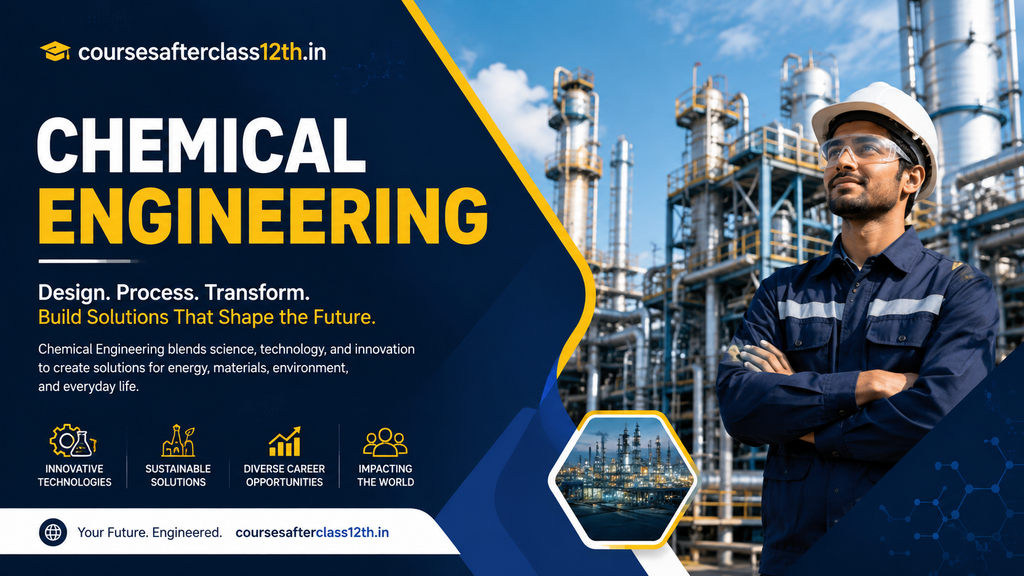
Chemical Engineering is an engineering discipline concerned with the transformation of raw materials into useful products through chemical, physical and biological processes. It combines chemistry, mathematics, physics, thermodynamics, fluid mechanics, heat transfer, mass transfer, reaction engineering, process control and engineering design. As a result, it has applications across industries such as petroleum, pharmaceuticals, chemicals, food processing, polymers, fertilizers, energy, biotechnology, environmental technology and advanced materials.
For students who have completed Class 12 with Physics, Chemistry and Mathematics (PCM), Chemical Engineering can be an undergraduate option for those interested in chemistry-based industrial processes, manufacturing, energy systems, materials, process design and large-scale production. However, the branch is not limited to laboratory chemistry. Instead, it focuses strongly on understanding and designing processes that can operate safely, efficiently and economically at industrial scale.
In India, students can pursue Chemical Engineering through undergraduate programmes such as Bachelor of Engineering (BE) in Chemical Engineering or Bachelor of Technology (BTech) in Chemical Engineering. The exact programme title, eligibility conditions, entrance examination, counselling procedure, fee structure and curriculum depend on the university, state, institution and admission route.
Therefore, students should examine the official admission information of the college or counselling authority before applying. For national-level engineering admissions, students should also verify the latest information released by the National Testing Agency (NTA) and the relevant counselling authorities. The official JEE Main website currently provides information and notices related to Paper 1 for B.E./B.Tech admissions.
This guide explains this field after 12th, including eligibility, entrance exams, admission process, course duration, subjects, specialisations, fees, practical training, internships, projects, career opportunities, salary factors, government jobs, private-sector roles, higher studies, emerging technologies and future scope.
Table of Contents
What Is Chemical Engineering?
This program applies engineering principles to the processing, conversion and production of materials. In simple terms, a chemical engineer studies how raw materials can be converted into useful products while maintaining quality, safety, efficiency and economic viability.
For example, an industrial plant may need to convert crude oil into fuels, process agricultural materials into food products, manufacture medicines, produce polymers or treat industrial wastewater. Such operations require more than knowledge of chemistry. Engineers must understand how fluids move through equipment, how heat is transferred, how reactions occur, how materials behave under different conditions and how an entire process can be controlled.
Consequently, this course sits at the intersection of chemistry and engineering. Chemistry helps explain the behaviour of substances, while engineering helps convert that knowledge into practical processes and industrial systems.
The discipline also involves significant mathematical modelling and quantitative analysis. Students learn to evaluate material flows, energy consumption, equipment performance, reaction rates and process conditions.
Modern course additionally connects with sustainability, renewable energy, biotechnology, advanced materials, process automation, data analysis and environmental management.
Why Choose Chemical Engineering After 12th?
The degree can be suitable for students who enjoy chemistry but also want to study engineering, mathematics, industrial processes and technology.
The field offers exposure to several industries rather than limiting graduates to one type of workplace. An engineering graduate may work in chemicals, petroleum, pharmaceuticals, food processing, polymers, fertilizers, energy, environmental services or manufacturing.
Furthermore, the discipline develops a process-oriented approach to problem solving. Students learn to understand how individual operations work and how they interact within a complete production system.
Major reasons to consider Chemical Engineering include:
| Reason | Explanation |
|---|---|
| Diverse industries | Graduates can explore chemical, pharmaceutical, energy, food, petroleum, polymer and manufacturing sectors. |
| Process knowledge | The course develops understanding of industrial processes and production systems. |
| Technical foundation | Students study thermodynamics, fluid mechanics, heat transfer, mass transfer and reaction engineering. |
| Practical exposure | Laboratories, simulations, projects and internships can connect theory with industrial applications. |
| Research opportunities | Higher studies can lead to research in energy, materials, biotechnology, catalysis and environmental engineering. |
| Sustainability relevance | Chemical engineers can contribute to cleaner processes, waste reduction, energy efficiency and resource recovery. |
| Technology integration | Modern process engineering increasingly uses simulation, automation, sensors and data-driven methods. |
However, students should not select the branch only because it appears to offer a broad career scope. Personal interest, academic strengths, college quality, practical exposure and preferred industry should also influence the decision.
Chemical Engineering Eligibility After 12th
Eligibility criteria differ among institutions and admission routes. Generally, undergraduate engineering programmes require students to complete Class 12 or an equivalent qualification with subjects relevant to engineering.
Physics and Mathematics are commonly important subjects for engineering admissions. Chemistry is also particularly relevant to this stream. However, the exact subject combination, minimum marks, category requirements and entrance examination conditions can vary.
Students should therefore check the current eligibility notification issued by the relevant university, state counselling authority or entrance examination body.
General eligibility overview
| Requirement | Typical expectation |
|---|---|
| Educational qualification | Class 12 or equivalent |
| Important subjects | Physics, Chemistry and Mathematics |
| Course level | Undergraduate |
| Programme | BE/BTech Chemical Engineering |
| Entrance requirement | Depends on institution and admission route |
| Minimum marks | Varies by institution and counselling system |
| Age requirement | Depends on applicable admission rules |
Important: The table is a general guide rather than a universal admission rule. Students should verify the current requirements before submitting an application.
Chemical Engineering Entrance Exams
Admission to the course may take place through national-level examinations, state-level examinations, university entrance tests, counselling systems or institution-specific processes where permitted.
One of the major national-level examinations relevant to B.E./B.Tech admissions is JEE Main. The official NTA portal provides information, notifications, documents and examination updates for Paper 1 B.E./B.Tech.
Apart from national-level admission, states and individual universities may have their own entrance or counselling systems. Therefore, students should not assume that one examination applies to every institution.
Possible admission routes
| Admission route | How it generally works |
|---|---|
| National entrance examination | Students appear for a national examination and participate in applicable counselling. |
| State entrance examination | Admission takes place according to state-specific rules. |
| University entrance examination | The institution conducts its own selection test where applicable. |
| Centralised counselling | Students submit preferences and receive seats according to rank, eligibility and availability. |
| Direct institutional route | Some institutions may permit admission according to their applicable rules. |
Admission procedures can change. Therefore, students should rely on the latest official notification rather than older admission information.
Chemical Engineering Admission Process
The admission process depends on whether the student applies through a national examination, state examination, university entrance test, counselling system or an institutional route.
Generally, students first need to identify eligible colleges and understand their admission requirements. Next, they complete the relevant examination or application process. After the result, eligible candidates may participate in counselling or institution-level selection.
Typical admission steps
- Check eligibility requirements.
- Identify relevant entrance examinations.
- Complete the application form.
- Appear for the examination, if required.
- Check the result or rank.
- Register for counselling where applicable.
- Fill preferred colleges and branches.
- Participate in seat allocation.
- Complete document verification.
- Pay the required admission fee.
- Report to the allotted institution.
Students should keep copies of application forms, scorecards, certificates and payment receipts for future reference.
Chemical Engineering Course Duration
A regular undergraduate BE or BTech in Chemical Engineering generally takes four years when completed through the standard full-time route.
The programme is usually divided into semesters. Early semesters often establish the fundamentals of engineering, mathematics, science and communication. Later semesters increasingly focus on Engineering subjects, laboratories, process design, simulation, electives, internships and major projects.
AICTE’s model curriculum illustrates this progression through subjects such as thermodynamics, material and energy balances, transport phenomena, heat transfer, mass transfer, fluid mechanics, reaction engineering, process control and design/simulation work.
Chemical Engineering Subjects
It involves a combination of fundamental sciences and specialised engineering subjects.
Common Engineering subjects include:
| Subject | What students generally learn |
|---|---|
| Engineering Mathematics | Mathematical methods used for engineering analysis and modelling. |
| Engineering Physics | Physical principles relevant to engineering systems. |
| Engineering Chemistry | Chemical principles and material behaviour. |
| Thermodynamics | Energy, heat, work and equilibrium in engineering processes. |
| Material and Energy Balances | Tracking material and energy flows through processes. |
| Fluid Mechanics | Behaviour and movement of fluids. |
| Heat Transfer | Transfer of thermal energy through different mechanisms. |
| Mass Transfer | Movement of components between phases. |
| Chemical Reaction Engineering | Analysis and design of chemical reactions and reactors. |
| Process Control | Monitoring and controlling industrial processes. |
| Process Design | Designing integrated industrial processes and equipment. |
| Process Economics | Understanding cost and economic considerations in process systems. |
| Numerical Methods | Applying computational techniques to engineering problems. |
| Chemical Engineering Laboratory | Practical investigation of process principles. |
| Design and Simulation | Modelling and evaluating chemical processes using engineering tools. |
These subjects show why Chemical Engineering is broader than simply studying chemistry.
Core Areas of Chemical Engineering
1. Thermodynamics
Thermodynamics helps engineers understand energy, heat, work, phase behaviour and equilibrium. These principles are important in designing and evaluating industrial processes.
For example, engineers may need to determine how much energy a process requires or how temperature and pressure affect a system.
2. Fluid Mechanics
Industrial processes often involve the movement of liquids and gases through pipes, pumps, compressors, reactors and other equipment.
Fluid mechanics helps engineers understand pressure, flow behaviour and equipment requirements.
Therefore, this subject is important for the design and operation of process plants.
3. Heat Transfer
Many industrial operations require heating or cooling.
Heat transfer studies how thermal energy moves through materials and fluids. Engineers use this knowledge when working with heat exchangers, boilers, condensers, reactors and cooling systems.
4. Mass Transfer
Mass transfer deals with the movement of chemical components between phases.
It is relevant to operations such as absorption, distillation, extraction, drying and separation.
As a result, mass transfer becomes an important part of many chemical processing industries.
5. Chemical Reaction Engineering
Chemical reactions are central to many manufacturing processes.
Reaction engineering focuses on reaction rates, reactor performance and the design of systems where chemical reactions occur.
Engineers use these concepts to improve productivity, safety and process efficiency.
6. Process Control
Industrial processes must operate within defined conditions.
Process control involves monitoring variables such as temperature, pressure, flow rate and composition. Sensors, instruments, controllers and automated systems can work together to maintain stable operation.
Modern process control also connects the program with automation, data analysis and industrial digitalisation.
Chemical Engineering Specialisations
The course offers several possible areas of specialisation. The availability of specific electives depends on the institution.
Common areas include:
- Process engineering
- Petroleum and petrochemical engineering
- Pharmaceutical engineering
- Polymer technology
- Biochemical engineering
- Environmental process engineering
- Energy engineering
- Materials processing
- Food process engineering
- Process safety
- Computational process engineering
- Nanotechnology-related applications
- Renewable energy systems
Students should examine the actual curriculum rather than choosing a college based only on a specialisation name.
Chemical Engineering Fees in India
The fees vary significantly between institutions.
Government colleges, state-funded institutions, private universities and autonomous institutions can have very different fee structures. In addition, hostel charges, examination fees, laboratory fees, development charges and other expenses may apply.
Major factors affecting fees
| Factor | Effect |
|---|---|
| Institution type | Government and private institutions may have different fee structures. |
| Location | Costs can vary by city and state. |
| Programme structure | Additional facilities and specialised laboratories can affect fees. |
| Hostel | Accommodation and food create additional expenses. |
| Scholarships | Eligible students may receive financial support. |
| Category | Applicable government or institutional policies may affect fees. |
Because fee structures change, students should check the latest official fee notice of the institution before making a decision.
Practical Learning in Chemical Engineering
The program is strongly connected with practical applications.
Classroom theory alone is not enough to understand industrial processes. Therefore, laboratories, simulations, plant visits, internships and projects can provide valuable practical exposure.
Students may perform experiments involving fluid flow, heat transfer, reaction systems, separation processes, material balances and process control.
In addition, simulation software can help students understand how industrial processes behave under different operating conditions.
Chemical Engineering Laboratory
Laboratory work helps students connect theoretical principles with measurable results.
A typical laboratory programme may involve:
- Fluid flow experiments
- Heat transfer experiments
- Distillation studies
- Absorption experiments
- Reaction kinetics
- Particle processing
- Process control
- Material balance calculations
- Process simulation
Laboratory work also teaches students how to follow safety procedures, record observations, analyse data and prepare technical reports.
Chemical Engineering Internship
An internship can help students understand how engineering knowledge is applied in professional environments.
During an internship, students may observe production processes, maintenance activities, quality systems, safety procedures, process monitoring and plant operations.
The quality of the internship matters more than simply completing one. A meaningful internship should provide exposure to actual engineering work, professional communication and industrial practices.
Internship areas can include:
- Chemical manufacturing
- Pharmaceuticals
- Petroleum
- Petrochemicals
- Fertilizers
- Food processing
- Water treatment
- Environmental services
- Polymer industries
- Energy companies
- Research laboratories
Students should maintain a record of their responsibilities and technical learning because this experience can strengthen future applications.
Chemical Engineering Projects
Projects provide students with an opportunity to apply engineering principles to a practical problem.
A good project should have a clearly defined objective, appropriate methodology, measurable results and a logical conclusion.
Possible project topics include:
| Project area | Example |
|---|---|
| Waste treatment | Study of a wastewater treatment process |
| Energy efficiency | Improving energy consumption in a process |
| Process simulation | Modelling an industrial process |
| Renewable energy | Evaluation of biofuel production |
| Materials | Study of polymer or composite materials |
| Process control | Automated monitoring of a process variable |
| Water management | Treatment and reuse of industrial water |
| Reaction engineering | Analysis of reactor performance |
A strong project can demonstrate technical understanding, problem-solving ability and teamwork.
Skills Required for Chemical Engineering
Successful graduate students generally develop a mixture of technical and professional skills.
Important technical skills
- Engineering mathematics
- Thermodynamics
- Fluid mechanics
- Process calculations
- Process design
- Process simulation
- Data analysis
- Process control
- Chemical process safety
- Technical documentation
Professional skills
- Communication
- Teamwork
- Problem solving
- Critical thinking
- Time management
- Project management
- Presentation skills
- Safety awareness
Moreover, digital skills are becoming increasingly useful. Familiarity with spreadsheets, programming, process simulation and data analysis can help students work more effectively.
Chemical Engineering Software and Digital Skills
Modern Chemical Engineering increasingly uses computational tools.
Students may encounter software related to:
- Process simulation
- Computer-aided design
- Data analysis
- Numerical modelling
- Process control
- Statistical analysis
- Programming
- Plant design
The exact software depends on the institution and job role.
For this reason, students should focus first on understanding engineering principles rather than simply collecting software certificates.
Chemical Engineering Career Options
The graduates can explore careers across several sectors.
Major career areas include:
| Career area | Possible roles |
|---|---|
| Process engineering | Process Engineer, Production Engineer |
| Quality | Quality Engineer, Quality Control roles |
| Operations | Plant Operations, Production roles |
| Petroleum | Process and production-related roles |
| Pharmaceuticals | Process, production and quality roles |
| Food processing | Production and process roles |
| Environmental | Water, waste and environmental process roles |
| Energy | Process and energy-related roles |
| Research | Research Assistant, R&D roles |
| Consulting | Engineering and process consulting |
| Safety | Process Safety-related roles |
| Technical sales | Technical Sales Engineer |
| Project management | Project coordination and engineering roles |
Job titles vary between companies. Therefore, students should examine actual job descriptions rather than assuming that every graduate will perform the same work.
Chemical Engineering Jobs in the Private Sector
Private-sector opportunities exist in industries that manufacture or process materials at scale.
Graduates may find roles in:
- Chemical plants
- Pharmaceutical companies
- Refineries
- Petrochemical companies
- Fertilizer industries
- Polymer manufacturers
- Food processing companies
- Energy organisations
- Environmental companies
- Engineering consultancy firms
- Manufacturing companies
Entry-level responsibilities can include process monitoring, production support, quality control, plant operations, safety documentation, data analysis and process improvement.
With experience, professionals may move toward senior engineering, project management, plant management, technical consulting or specialised engineering roles.
Chemical Engineering Government Jobs
The graduates can also explore government-sector opportunities.
Depending on the organisation and recruitment rules, opportunities may exist in areas such as:
- Public-sector industries
- Government research organisations
- Petroleum and energy organisations
- Manufacturing organisations
- Environmental departments
- Technical regulatory bodies
- Government laboratories
- Public infrastructure and utilities
Recruitment may take place through competitive examinations, organisation-specific recruitment or other approved selection procedures.
Students interested in government careers should monitor official recruitment notifications because eligibility, age limits, vacancies, examination patterns and selection procedures can change.
Chemical Engineering Salary in India
There is no single salary figure that applies to every Engineering graduate.
Starting salary can vary according to:
- College and academic background
- Job location
- Industry
- Employer
- Technical skills
- Internship experience
- Role
- Interview performance
- Market conditions
A graduate joining a manufacturing plant may have a different salary structure from someone entering consulting, pharmaceuticals, energy, software-related analytics or research.
Salary progression
| Career stage | Factors affecting salary |
|---|---|
| Entry level | College, skills, role and employer |
| Early career | Experience, technical competence and industry |
| Mid career | Specialisation, leadership and project responsibility |
| Senior level | Expertise, management responsibilities and business impact |
Students should compare starting salary, average salary, median salary and highest reported package separately. A college’s highest package should not be treated as the expected salary for every graduate.
Chemical Engineering Higher Studies
A postgraduate degree can be useful for students seeking deeper technical expertise, research opportunities, academic careers or specialised engineering roles.
Possible higher-study pathways include:
- MTech in Chemical Engineering
- ME in Chemical Engineering
- Process Engineering
- Environmental Engineering
- Energy Engineering
- Materials Engineering
- Biotechnology-related programmes
- Petroleum-related programmes
- Pharmaceutical engineering
- Management programmes
- Research degrees
Higher education can help students specialise in a specific technical area.
Research-oriented students may also explore areas such as catalysis, advanced materials, carbon management, renewable energy, process intensification, biotechnology and sustainable manufacturing.
Chemical Engineering and Research
Chemical Engineering has strong connections with research.
Research can focus on improving existing processes or developing new materials, technologies and production methods.
Research areas can include:
- Renewable fuels
- Hydrogen technologies
- Carbon capture
- Batteries
- Advanced materials
- Catalysis
- Nanomaterials
- Bioprocessing
- Wastewater treatment
- Process optimisation
- Sustainable manufacturing
- Energy efficiency
Students interested in research should develop skills in technical reading, experimentation, data interpretation and scientific communication.
Chemical Engineering and Sustainability
Sustainability has become increasingly important across industrial processes.
Chemical engineers can contribute to reducing energy use, minimising waste, recovering useful materials and improving resource efficiency.
For example, process optimisation can reduce raw-material consumption. Similarly, improved separation technologies can lower energy requirements.
Environmental engineering also overlaps with Chemical Engineering through wastewater treatment, waste management, emissions control and resource recovery.
Therefore, sustainability is not simply an additional topic; it can influence how industrial processes are designed and operated.
Chemical Engineering and Renewable Energy
The energy sector provides several areas where Chemical Engineering principles are relevant.
Engineers can contribute to:
- Biofuels
- Hydrogen production
- Battery materials
- Fuel processing
- Carbon capture
- Energy storage
- Biomass processing
- Solar-related materials
- Sustainable fuels
The exact role depends on the organisation and the graduate’s specialisation.
As energy systems evolve, Chemical Engineering can remain relevant through its focus on materials, reactions, separation processes, energy efficiency and process design.
Chemical Engineering and Biotechnology
Chemical Engineering principles are also applied in biotechnology.
Bioprocess engineers may work with biological materials, fermentation systems, downstream processing and production systems for pharmaceutical or industrial applications.
This creates opportunities at the intersection of:
Chemical Engineering + Biology + Process Engineering
Students interested in biotechnology should consider electives and higher-study programmes that provide appropriate biological and biochemical foundations.
Chemical Engineering vs Mechanical Engineering
Both branches involve engineering design and industrial applications, but their core academic focus differs.
| Factor | Chemical Engineering | Mechanical Engineering |
|---|---|---|
| Main focus | Chemical and physical processes | Machines, mechanics and thermal systems |
| Core subjects | Thermodynamics, mass transfer, reaction engineering | Mechanics, machine design, manufacturing |
| Typical industries | Chemicals, pharma, petroleum, food, energy | Automotive, manufacturing, aerospace, machinery |
| Process focus | High | Moderate to high |
| Equipment | Reactors, separators, heat exchangers | Engines, machines, mechanical systems |
| Materials | Important | Important |
| Automation | Relevant | Relevant |
Students should compare both branches based on their interests rather than choosing only according to perceived salary.
Chemical Engineering vs Computer Science Engineering
Chemical Engineering and computer science engineering lead toward very different academic and professional paths.
| Factor | Chemical Engineering | Computer Science Engineering |
|---|---|---|
| Main focus | Industrial processes and materials | Computing and software systems |
| Core areas | Thermodynamics, reactions, transport | Programming, algorithms, databases |
| Common industries | Chemical, energy, pharma, manufacturing | IT, software, technology |
| Laboratory work | Significant | Depends on programme |
| Process engineering | Central | Usually not central |
| Programming | Useful supporting skill | Core skill |
Students interested mainly in software development may prefer CSE, while those interested in physical processes, materials, energy and industrial manufacturing may find Chemical Engineering more suitable.
Chemical Engineering vs Electrical Engineering
Chemical Engineering and Electrical Engineering also differ in their core applications.
Electrical Engineering focuses on electricity, power systems, electrical machines, electronics-related systems and control technologies.
Chemical Engineering focuses on process systems, chemical reactions, materials, energy balances and industrial production.
However, modern industries can require professionals from both branches, particularly in automation, process control, energy management and industrial operations.
Modern Technology in Chemical Engineering
Digital technology is increasingly influencing process industries.
Industrial facilities can use sensors, automation systems, digital models and data analytics to monitor and optimise operations.
Chemical engineers therefore benefit from understanding:
- Process simulation
- Data analysis
- Industrial automation
- Sensors and instrumentation
- Process control
- Digital modelling
- Programming
- Predictive analysis
The purpose is not to turn every chemical engineer into a software developer. Instead, digital skills can help engineers interpret process data, improve efficiency and support better decisions.
Process Safety in Chemical Engineering
Safety is a fundamental part of Chemical Engineering.
Industrial plants may handle high temperatures, pressures, flammable materials, corrosive chemicals and hazardous substances. Therefore, engineers must understand process hazards and safety procedures.
Process safety can involve:
- Hazard identification
- Risk assessment
- Emergency planning
- Safe operating procedures
- Equipment protection
- Process monitoring
- Environmental controls
- Safety documentation
Students should treat safety as a core engineering responsibility rather than simply another examination subject.
Chemical Engineering Future Scope
The future scope of Chemical Engineering is connected with continuing demand for industrial production, energy systems, pharmaceuticals, advanced materials, environmental management and process technology.
At the same time, the profession is changing.
Future-focused Chemical Engineering increasingly connects with:
- Sustainable manufacturing
- Renewable energy
- Hydrogen
- Carbon management
- Advanced materials
- Biotechnology
- Battery technology
- Process automation
- Artificial intelligence
- Data analytics
- Waste-to-resource technologies
Consequently, students who combine a strong Chemical Engineering foundation with practical experience and relevant digital skills can broaden their career options.
Is Chemical Engineering a Good Career?
Chemical Engineering can be a good career option for students who genuinely enjoy chemistry, mathematics, physics, industrial processes and engineering problem solving.
It may be particularly suitable for students who are comfortable working with technical subjects and want to understand how products are manufactured on an industrial scale.
However, the branch may not suit students who dislike chemistry, thermodynamics, mathematical analysis or laboratory work.
Before choosing the course, students should examine the curriculum, laboratories, faculty expertise, internship opportunities, placement reports and industry connections of the college.
What are the advantages of Chemical Engineering?
Major advantages include:
- Multiple industries
Graduates can explore several industrial sectors. - Strong technical foundation
The programme develops knowledge of processes, materials and energy. - Research opportunities
Students can continue toward advanced research. - Sustainability applications
Chemical engineers can contribute to cleaner production and resource efficiency. - Technology integration
Digital tools, simulation and automation create additional skill opportunities. - International relevance
Process engineering principles are used across global manufacturing industries. - Specialisation options
Higher studies can lead to focused technical areas.
Challenges of Chemical Engineering
Students should also understand the challenges.
Some jobs may involve manufacturing plants, industrial sites or shift-based operations. Certain industries may require strict safety procedures and exposure to complex equipment.
In addition, the undergraduate curriculum can be demanding because it combines chemistry, mathematics, physics and engineering.
Therefore, students should select the branch after understanding the actual curriculum rather than relying only on general statements about career scope.
How to Choose the Best Chemical Engineering College?
Students should consider more than college brand name.
Important factors include:
| Factor | What to check |
|---|---|
| Accreditation/recognition | Verify current official status. |
| Curriculum | Check core and elective subjects. |
| Laboratories | Review laboratory facilities and equipment. |
| Faculty | Examine academic and industry experience. |
| Internships | Check whether students receive practical exposure. |
| Placements | Review branch-specific placement information. |
| Recruiters | Examine the types of companies hiring graduates. |
| Research | Check laboratories, publications and projects. |
| Location | Consider industrial exposure and living costs. |
| Fees | Compare total programme cost. |
Students should not select a college solely because it advertises the highest salary package.
Instead, examine placement percentage, median outcomes, role types, recruiter diversity and Chemical Engineering-specific recruitment data where available.
Chemical Engineering Career Skills Checklist
Before graduation, students can work toward developing the following skills:
Technical
- Material and energy balance
- Thermodynamics
- Fluid mechanics
- Heat transfer
- Mass transfer
- Reaction engineering
- Process control
- Process simulation
- Safety engineering
- Data analysis
Professional
- Communication
- Teamwork
- Report writing
- Presentation
- Problem solving
- Project management
- Analytical thinking
- Workplace safety
Digital
- Spreadsheet analysis
- Process simulation
- Basic programming
- Data visualisation
- Numerical methods
- Digital process monitoring
Chemical Engineering After 12th: Quick Overview
| Category | Details |
|---|---|
| Course | BE/BTech Chemical Engineering |
| Level | Undergraduate |
| Duration | Generally 4 years |
| Common Class 12 subjects | Physics, Chemistry and Mathematics |
| Entrance | National/state/university routes may apply |
| Core areas | Thermodynamics, fluid mechanics, heat transfer, mass transfer, reaction engineering |
| Practical learning | Laboratories, projects, simulations and internships |
| Industries | Chemical, pharma, energy, petroleum, food, polymers, environmental |
| Government opportunities | Available through applicable recruitment processes |
| Higher studies | ME/MTech, research and related specialisations |
| Digital skills | Simulation, data analysis, automation and process control |
| Future areas | Sustainability, energy, materials, biotechnology and advanced process technology |
Frequently Asked Questions About Chemical Engineering
1. What is Chemical Engineering?
Chemical Engineering is an engineering discipline that applies chemistry, physics, mathematics and engineering principles to the design and operation of industrial processes used to manufacture products and materials.
2. Can I pursue Chemical Engineering after Class 12?
Yes. Students who meet the applicable eligibility requirements can pursue BE or BTech programmes in Chemical Engineering after Class 12. Physics, Chemistry and Mathematics are commonly relevant subjects.
3. Is Chemical Engineering only about chemistry?
No. Chemical Engineering involves chemistry as well as mathematics, physics, thermodynamics, fluid mechanics, heat transfer, mass transfer, reaction engineering, process control and engineering design.
4. What is the duration of Chemical Engineering?
A regular undergraduate BE or BTech programme in Chemical Engineering generally takes four years.
5. Which subjects are important in Chemical Engineering?
Important subjects include thermodynamics, material and energy balances, fluid mechanics, heat transfer, mass transfer, reaction engineering, process control and process design.
6. Is JEE Main required for Chemical Engineering?
JEE Main is one important national-level route for B.E./B.Tech admissions, but it is not the only possible route. State examinations, university examinations and other admission systems may also apply. Students should check the requirements of their target institutions.
7. What jobs can Chemical Engineering graduates get?
Graduates can explore process engineering, production, quality, operations, pharmaceuticals, petroleum, chemicals, food processing, environmental services, energy, research, consulting and technical roles.
8. Is Chemical Engineering suitable for students who like chemistry?
It can be suitable, particularly if the student also enjoys mathematics, physics and engineering problem solving. The course involves significantly more than traditional chemistry.
9. Does Chemical Engineering have government jobs?
Yes. Graduates may be eligible for government and public-sector opportunities depending on the organisation, recruitment examination, vacancy and eligibility requirements.
10. What is the salary after Chemical Engineering?
Salary varies according to employer, industry, location, role, college, skills and experience. Students should compare reliable salary information rather than assuming one fixed figure.
11. Is Chemical Engineering good for higher studies?
Yes. Students can pursue postgraduate study and research in areas such as Chemical Engineering, process engineering, energy, materials, biotechnology, environmental engineering and related disciplines.
12. What are the future areas of Chemical Engineering?
Emerging areas include renewable energy, hydrogen, carbon management, advanced materials, biotechnology, batteries, sustainable manufacturing, process automation and data-driven process optimisation.