
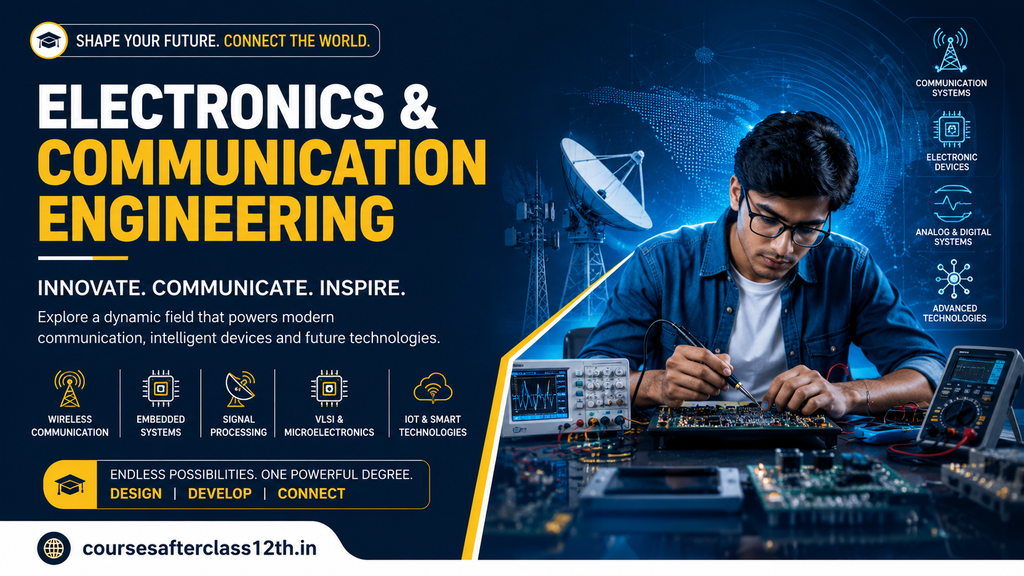
Electronics and Communication Engineering (ECE) is a branch of engineering that combines electronics, communication systems, electrical principles, digital technologies, signal processing, embedded systems, computer-based technologies, and communication networks. Therefore, Electronics & Communication Engineering after 12th is a popular engineering option for students interested in electronics, communication systems, embedded technology, telecommunications, and modern digital technologies. The field plays an important role in modern technology because electronic devices and communication systems are used in smartphones, computers, automobiles, satellites, healthcare equipment, industrial machines, telecommunications, consumer electronics, and many other applications.
For students who have completed Class 12 with Physics, Chemistry, and Mathematics (PCM), Electronics and Communication Engineering can be a suitable undergraduate option for those interested in electronics, communication technologies, embedded systems, computer hardware, automation, signal processing, networking, wireless systems, and emerging technologies.
In India, students can pursue ECE through undergraduate programmes such as Bachelor of Engineering (BE) in Electronics and Communication Engineering or Bachelor of Technology (BTech) in Electronics and Communication Engineering. The exact programme name, eligibility requirements, entrance examination, admission procedure, fee structure, curriculum, and counselling process vary according to the university, state, institution, and admission route.
This guide explains Electronics and Communication Engineering after Class 12, including eligibility, entrance exams, admission process, course duration, subjects, specialisations, fees, practical learning, internships, projects, skills, career options, salary factors, government jobs, private-sector opportunities, higher studies, emerging technologies, and future scope.
Table of Contents
What Is Electronics and Communication Engineering?
Electronics and Communication Engineering is the branch of engineering concerned with the design, development, testing, operation, and application of electronic devices, circuits, communication systems, signal-processing technologies, embedded systems, and related digital technologies.
The discipline combines concepts from electronics, electrical engineering, communication, computer technology, mathematics, physics, programming, and signal processing.
ECE engineers can work with systems that process information, transmit signals, control electronic equipment, collect data, connect devices, or support automated operations.
For example, electronic and communication technologies are used in:
- Smartphones
- Telecommunication networks
- Internet infrastructure
- Satellites
- Radar systems
- Television systems
- Medical equipment
- Automotive electronics
- Industrial automation
- Embedded devices
- Internet of Things (IoT)
- Consumer electronics
- Wireless communication
- Semiconductor systems
Therefore, ECE is closely connected with many technologies used in everyday life and modern industry.
Electronics and Communication Engineering in Simple Words
In simple terms, Electronics and Communication Engineering focuses on how electronic systems work and how information can be processed, transmitted, received, and controlled using electronic and digital technologies.
Electronics deals with components and circuits that control electrical signals. Communication engineering focuses on transmitting information through wired or wireless systems.
When these areas are combined, engineers can develop technologies such as communication devices, embedded systems, wireless networks, sensors, electronic control systems, and signal-processing applications.
| Area | Example Applications |
|---|---|
| Electronics | Circuits, devices and electronic systems |
| Communication | Wireless and wired communication |
| Embedded systems | Electronic devices with dedicated computing functions |
| Signal processing | Processing audio, video and communication signals |
| Semiconductor technology | Chips and electronic components |
| IoT | Connected sensors and smart devices |
| Networking | Communication between devices and systems |
| Automation | Electronic control and monitoring |
| Automotive electronics | Vehicle control and electronic systems |
| Consumer electronics | Phones, televisions and smart devices |
Why Choose Electronics and Communication Engineering After 12th?
Students should choose an engineering branch according to their interests, academic strengths, career objectives, and preferred working environment.
ECE can be suitable for students who enjoy Physics, Mathematics, electronics, technology, circuits, communication systems, programming, hardware, automation, and problem-solving.
One major advantage of ECE is its interdisciplinary nature. Students can develop knowledge of both hardware and software-related technologies.
Moreover, ECE has applications across telecommunications, electronics manufacturing, semiconductor technology, automotive systems, aerospace, defence-related technology, healthcare equipment, automation, networking, embedded systems, and consumer technology.
The field has also become increasingly connected with areas such as:
- Artificial Intelligence
- Internet of Things
- Robotics
- Embedded systems
- Semiconductor technology
- 5G and advanced communication
- Edge computing
- Wireless systems
- Autonomous systems
- Smart devices
However, students should not choose ECE solely because of its perceived job opportunities. Career outcomes depend on technical skills, practical exposure, college quality, internships, projects, communication abilities, specialisation, location, academic performance, and industry demand.
Electronics and Communication Engineering Course After 12th
Students who meet the applicable eligibility requirements can pursue an undergraduate degree in Electronics and Communication Engineering after Class 12.
Common degree formats include:
- BE Electronics and Communication Engineering
- BTech Electronics and Communication Engineering
The programme generally combines foundational engineering education with specialised electronics and communication subjects.
During the early semesters, students may study Mathematics, Physics, Chemistry, programming, engineering fundamentals, and basic electronics.
Later, they typically progress to subjects such as electronic circuits, digital electronics, communication systems, signals and systems, microprocessors, control systems, embedded systems, and other specialised areas.
Laboratory sessions, projects, internships, seminars, technical workshops, and practical assignments can help students connect theoretical knowledge with real-world applications.
ECE Course Overview
| Parameter | Typical Information |
|---|---|
| Course | BE/BTech Electronics and Communication Engineering |
| Level | Undergraduate |
| Duration | Usually 4 years |
| Eligibility | Class 12 with applicable subjects |
| Core subjects | Electronics, communication, signals, digital systems and embedded technology |
| Admission | Entrance examination, counselling or institution-specific route |
| Practical learning | Laboratories, projects and internships |
| Career sectors | Electronics, telecom, semiconductor, automotive, technology and automation |
| Higher studies | ME/MTech, MBA and specialised programmes |
| Emerging areas | IoT, AI, embedded systems, semiconductor technology and advanced communication |
Electronics and Communication Engineering Eligibility After 12th
Eligibility requirements vary between institutions and admission routes.
However, undergraduate ECE programmes generally require students to complete Class 12 or an equivalent qualification with subjects relevant to engineering.
Physics and Mathematics are commonly important requirements. Chemistry or another approved subject may also be required depending on the applicable admission rules.
The minimum percentage, entrance examination requirements, age conditions, domicile requirements, and other eligibility conditions may differ.
Therefore, students should check the latest eligibility criteria published by the relevant college, university, entrance examination authority, or counselling authority.
General Eligibility Table
| Requirement | General Information |
|---|---|
| Educational qualification | Class 12 or equivalent |
| Mathematics | Generally important |
| Physics | Generally important |
| Chemistry/approved subject | May be required |
| Minimum marks | Varies by institution |
| Entrance examination | Depends on admission route |
| Age requirement | May vary |
| Domicile | May apply in selected admission routes |
These requirements are general and should not be treated as universal admission rules.
Electronics and Communication Engineering Admission Process
The admission process depends on whether students apply through a national-level examination, state-level examination, counselling system, university entrance examination, or an institution-specific admission route.
A typical process may involve the following steps:
- Check the eligibility criteria.
- Identify suitable ECE colleges.
- Register for the applicable entrance examination if required.
- Appear for the examination.
- Check the result, rank, or merit status.
- Participate in counselling where applicable.
- Select preferred colleges and branches.
- Receive seat allocation or admission confirmation.
- Complete document verification.
- Pay applicable fees.
- Complete college registration.
- Begin the programme.
Common Documents
Students may be asked to provide:
- Class 10 certificate
- Class 12 marksheet
- Entrance examination scorecard
- Admit card
- Identity proof
- Passport-size photographs
- Transfer certificate
- Migration certificate where applicable
- Category certificate where applicable
- Domicile certificate where applicable
- Other documents specified by the institution
The required documents can vary, so applicants should follow the official admission instructions.
Electronics and Communication Engineering Entrance Exams
Admission to ECE programmes can take place through different examination and selection routes.
Depending on the institution and admission pathway, students may encounter:
- JEE Main
- JEE Advanced for applicable institutions
- State-level engineering entrance examinations
- University-level entrance examinations
- Institution-specific selection processes
- Other approved admission routes
The entrance examination required depends on the college and admission category.
Engineering entrance examinations commonly assess subjects such as Physics, Chemistry, and Mathematics, although the exact pattern, syllabus, eligibility and admission process vary.
Therefore, students should always check the examination requirements applicable to their preferred institution.
Electronics and Communication Engineering Course Duration
A regular undergraduate BE or BTech in Electronics and Communication Engineering generally takes four years.
The programme is usually divided into semesters.
Students generally begin with basic engineering and scientific concepts before moving towards specialised ECE subjects.
Typical Academic Progression
| Stage | Focus |
|---|---|
| Early semesters | Mathematics, Physics, Chemistry and engineering fundamentals |
| Second stage | Basic electronics, circuits and programming |
| Middle semesters | Digital electronics, signals and communication |
| Advanced semesters | Embedded systems, communication technologies and specialised subjects |
| Final stage | Projects, internships, electives and career preparation |
The actual curriculum differs among universities and institutions.
Electronics and Communication Engineering Subjects
ECE covers a wide range of technical subjects.
Common subjects may include:
- Engineering Mathematics
- Engineering Physics
- Engineering Chemistry
- Programming Fundamentals
- Basic Electrical Engineering
- Electronic Devices
- Electronic Circuits
- Analog Electronics
- Digital Electronics
- Signals and Systems
- Network Theory
- Communication Systems
- Digital Communication
- Analog Communication
- Electromagnetic Theory
- Microprocessors
- Microcontrollers
- Control Systems
- VLSI Design
- Embedded Systems
- Digital Signal Processing
- Antenna and Wave Propagation
- Computer Networks
- Wireless Communication
- Optical Communication
- Microwave Engineering
- Semiconductor Devices
- Instrumentation
- IoT
- Robotics
- Industrial Electronics
The exact subjects depend on the university curriculum.
Major Areas of Electronics and Communication Engineering
ECE is a broad discipline. Students can explore several technical areas according to their interests.
1. Analog Electronics
Analog Electronics deals with electronic circuits that process continuously varying signals.
Students learn about components and circuits such as:
- Diodes
- Transistors
- Amplifiers
- Operational amplifiers
- Filters
- Oscillators
- Power supplies
Analog electronics is important in communication systems, instrumentation, audio equipment, sensors, industrial systems, and many electronic devices.
2. Digital Electronics
Digital Electronics focuses on systems that process information using discrete digital signals.
Students may study:
- Logic gates
- Boolean algebra
- Flip-flops
- Counters
- Registers
- Multiplexers
- Digital circuits
- Memory systems
Digital electronics forms a foundation for computers, embedded systems, communication equipment, microprocessors, and many modern electronic devices.
Moreover, digital concepts are important for students interested in hardware design and embedded technology.
3. Communication Engineering
Communication Engineering focuses on the transmission and reception of information. In practice, communication systems can use different technologies, such as:
- Radio waves
- Optical fibre
- Satellite communication
- Cellular networks
- Microwave systems
- Wireless technologies
Students learn concepts related to modulation, signal transmission, antennas, channels, noise, communication networks, and signal processing.
Communication engineering has applications in telecommunications, broadcasting, satellite systems, networking, and wireless technologies.
4. Signal Processing
Signal Processing involves analysing and modifying signals to extract useful information or improve system performance.
Signals can include:
- Audio
- Images
- Video
- Sensor data
- Communication signals
- Biomedical signals
Digital Signal Processing can be used in:
- Speech processing
- Image processing
- Audio systems
- Medical technology
- Communication systems
- Radar
- Industrial monitoring
Students interested in mathematical and computational applications may find this area particularly useful.
5. Embedded Systems
Embedded systems combine hardware and software to perform specific functions.
Examples include electronic systems found in:
- Cars
- Washing machines
- Medical devices
- Industrial machines
- Smart appliances
- Cameras
- Consumer electronics
- Security systems
An embedded system may contain a microcontroller or processor, sensors, memory, communication interfaces, and software.
Therefore, embedded systems provide an opportunity for ECE students to combine electronics and programming.
6. Microprocessors and Microcontrollers
Microprocessors and microcontrollers are important components of modern electronic systems.
A microcontroller can integrate processing, memory, input/output functions, timers, and communication interfaces on a single chip.
Students can learn:
- Processor architecture
- Programming
- Memory organisation
- Input/output
- Timers
- Communication protocols
- Interfacing
This knowledge can be useful for embedded systems, robotics, IoT, industrial automation, and consumer electronics.
7. VLSI and Semiconductor Technology
VLSI stands for Very Large Scale Integration.
It involves designing and integrating large numbers of electronic components onto semiconductor chips.
VLSI-related areas include:
- Digital IC design
- Semiconductor devices
- Chip architecture
- Verification
- Physical design
- Hardware description languages
- Semiconductor manufacturing concepts
The semiconductor industry creates opportunities for engineers with relevant technical knowledge and specialised skills.
Students interested in chip design can consider developing skills in digital design, computer architecture, hardware description languages, verification, and semiconductor technologies.
8. Wireless Communication
Wireless communication enables information to be transmitted without a physical connection between communicating devices.
Applications include:
- Mobile communication
- Wi-Fi
- Bluetooth
- Satellite systems
- Wireless sensors
- IoT
- Navigation systems
Students learn about radio-frequency signals, antennas, propagation, modulation, wireless channels, and communication protocols.
The field continues to evolve as communication networks become faster and more connected.
9. Antenna and Microwave Engineering
Antenna engineering deals with the transmission and reception of electromagnetic waves.
Microwave technologies are used in areas such as:
- Radar
- Satellite communication
- Wireless communication
- Navigation
- Defence-related systems
- Industrial applications
Students interested in electromagnetic systems and communication infrastructure can explore this specialised field.
10. Internet of Things
The Internet of Things (IoT) involves connecting physical devices to communication networks so that they can collect, exchange, and sometimes analyse data.
IoT systems may include:
- Sensors
- Microcontrollers
- Communication modules
- Cloud platforms
- Data-processing systems
- Actuators
Examples include smart homes, industrial monitoring, connected vehicles, agriculture systems, and healthcare devices.
ECE students can work on the hardware, communication, sensor, embedded, and control aspects of IoT systems.
11. Robotics
Robotics combines electronics, mechanical systems, control engineering, programming, sensors, and computing.
ECE graduates can contribute to robotic systems through:
- Sensors
- Embedded controllers
- Motor control
- Communication systems
- Automation
- Machine vision
- Control algorithms
As a result, students interested in robotics can use ECE as a foundation for interdisciplinary learning.
Electronics and Communication Engineering Practical Learning
ECE is strongly connected with laboratory and practical work.
Students may perform experiments involving:
- Electronic circuits
- Digital logic
- Communication systems
- Microprocessors
- Microcontrollers
- Signal processing
- Sensors
- Control systems
- Embedded systems
- Digital communication
Laboratory work helps students understand how theoretical concepts behave in practical conditions.
For example, studying an amplifier in theory provides knowledge of its operation, while laboratory testing can help students understand gain, frequency response, noise, component limitations, and practical measurements.
Electronics and Communication Engineering Skills
A successful ECE career requires a combination of technical, digital, analytical, and professional skills.
Core Technical Skills
Students should develop knowledge of:
- Electronic circuits
- Digital electronics
- Communication systems
- Signals and systems
- Microcontrollers
- Embedded systems
- Semiconductor fundamentals
- Control systems
- Signal processing
- Communication networks
Programming Skills
Depending on their career goals, students can learn:
- C
- C++
- Python
- MATLAB
- Embedded programming
- Hardware description languages
Programming requirements differ by job role.
Software and Tools
Students can explore tools related to:
- Circuit simulation
- PCB design
- MATLAB/Simulink
- Embedded development
- VLSI design
- Digital system design
- Network simulation
- Signal processing
Students should prioritise practical understanding rather than collecting certificates without hands-on experience.
Electronics and Communication Engineering Internship
An internship can help students understand how ECE concepts are applied in professional environments.
Students may look for internships in:
- Electronics companies
- Semiconductor companies
- Telecommunication companies
- Embedded-system firms
- Automation companies
- Automotive companies
- Consumer electronics companies
- Networking companies
- Research organisations
- Technology companies
Internship exposure may include:
- Circuit testing
- PCB development
- Embedded programming
- Communication systems
- Hardware testing
- Automation
- Network monitoring
- Product development
- Technical documentation
In addition, internships can help students understand professional communication, project coordination, testing procedures, documentation, and workplace expectations.
Students should evaluate internships based on the quality of practical exposure rather than only the organisation’s name.
Electronics and Communication Engineering Projects
Projects allow students to apply their classroom knowledge to practical problems.
A strong project should identify a problem, explain the proposed solution, describe the methodology, present results, and discuss practical applications.
ECE Project Ideas
| Area | Example Project |
|---|---|
| IoT | Smart environmental monitoring system |
| Embedded systems | Microcontroller-based automation system |
| Communication | Wireless data transmission system |
| Electronics | Electronic monitoring circuit |
| Robotics | Sensor-based robotic system |
| VLSI | Digital circuit design |
| Signal processing | Audio or sensor signal analysis |
| Automation | Automated control system |
| Healthcare | Biomedical monitoring concept |
| Automotive | Vehicle monitoring system |
Students should select projects according to their academic level, available resources, and genuine interests.
Electronics and Communication Engineering Fees in India
ECE fees vary widely between colleges and universities.
The total cost can depend on:
- Institution type
- Location
- Facilities
- Laboratory infrastructure
- Admission category
- Hostel
- Transportation
- Academic resources
- Other institutional charges
Government institutions and private institutions may have different fee structures.
Additional Expenses
Students may also need to consider:
- Hostel fees
- Books
- Examination charges
- Laboratory expenses
- Transportation
- Equipment
- Student activities
- Internet and computing requirements
| Cost Factor | Why It Matters |
|---|---|
| Tuition | Main academic expense |
| Hostel | Accommodation cost |
| Food | Living expense |
| Transport | Daily commuting |
| Books | Study materials |
| Laboratory | Practical learning expenses |
| Equipment | Electronics projects may require components |
| Other charges | Institution-specific expenses |
Students should verify the latest fee structure directly with their chosen institution.
Electronics and Communication Engineering Career Options
ECE graduates can explore careers across technology and engineering industries.
Possible roles include:
- Electronics Engineer
- Electronics Design Engineer
- Communication Engineer
- Embedded Systems Engineer
- Hardware Engineer
- VLSI Engineer
- PCB Design Engineer
- Network Engineer
- RF Engineer
- Telecom Engineer
- Control Systems Engineer
- Automation Engineer
- IoT Engineer
- Test Engineer
- Semiconductor Engineer
- Firmware Engineer
- Electronics Testing Engineer
- Systems Engineer
The availability of roles depends on technical skills, employer requirements, experience, location, and specialisation.
Electronics Engineer Job Responsibilities
The responsibilities of an Electronics Engineer depend on the specific role.
An electronics design engineer may work on circuit design, component selection, testing, simulation, and documentation.
An embedded engineer may develop firmware and integrate microcontrollers with sensors, communication modules, and electronic components.
A hardware engineer may work on electronic system architecture, circuit boards, component testing, and product development.
A communication engineer may work with wireless, network, RF, or communication systems.
A VLSI engineer may work on chip design, verification, digital systems, or related semiconductor processes.
Therefore, the title “ECE Engineer” can represent many different career paths.
Electronics and Communication Engineering Salary in India
Salary varies according to experience, employer, technical skills, specialisation, location, industry, qualifications, and job role.
Fresh graduates generally begin in entry-level positions. Professionals with specialised skills and experience may progress into more advanced technical or managerial roles.
It is not advisable to present one fixed salary figure as applicable to every ECE graduate.
Factors That Influence Salary
| Factor | Impact |
|---|---|
| Experience | Can improve earning potential |
| Specialisation | Certain technical areas may have stronger demand |
| Employer | Compensation varies |
| Location | Job markets differ between locations |
| Technical skills | Relevant expertise can improve opportunities |
| Software skills | Useful for embedded, VLSI and technology roles |
| Industry | Semiconductor, telecom, automotive and technology sectors differ |
| Projects | Practical experience can strengthen a profile |
| Communication | Important for professional growth |
Therefore, students should compare salary information from reliable sources and distinguish between starting salary, average salary, median salary, and maximum reported package.
Government Jobs After Electronics and Communication Engineering
ECE graduates may explore government-sector opportunities depending on the eligibility requirements of individual organisations and recruitment processes.
Potential areas include:
- Telecommunications
- Railways
- Defence-related organisations
- Public-sector technology organisations
- Electronics organisations
- Government research institutions
- Communication departments
- Public infrastructure
- Technical government departments
Recruitment can take place through competitive examinations, organisation-specific recruitment, or other approved selection processes.
Students interested in government careers should monitor official recruitment notifications because eligibility, age limits, examination patterns, vacancies, and selection procedures can change over time.
Private-Sector Jobs After ECE
The private sector provides career opportunities across many technology industries.
Potential employers include:
- Semiconductor companies
- Electronics manufacturers
- Telecommunication companies
- Automotive technology companies
- Embedded-system companies
- Consumer electronics companies
- Automation companies
- Networking companies
- Technology companies
- Engineering consultancies
Private-sector career growth can depend on technical performance, specialisation, practical skills, communication, project experience, and continuous learning.
Higher Studies After Electronics and Communication Engineering
ECE graduates can pursue postgraduate education to develop deeper expertise.
Possible options include:
- ME Electronics
- MTech Electronics and Communication
- VLSI Design
- Embedded Systems
- Communication Engineering
- Signal Processing
- Microelectronics
- RF and Microwave Engineering
- Wireless Communication
- Control Systems
- Robotics
- IoT
- Semiconductor Technology
- Artificial Intelligence
- Data-related programmes
- MBA
A postgraduate degree can be particularly useful for students seeking deeper technical expertise, research opportunities, academic careers, or specialised engineering roles.
ECE Specialisations
Students can specialise in different areas depending on their career interests.
| Specialisation | Main Focus |
|---|---|
| VLSI | Integrated circuits and chip design |
| Embedded Systems | Hardware-software systems |
| Communication | Information transmission |
| Wireless Communication | Wireless networks and systems |
| Signal Processing | Processing digital and analogue signals |
| RF Engineering | Radio-frequency systems |
| Microwave Engineering | High-frequency electromagnetic systems |
| IoT | Connected electronic devices |
| Robotics | Sensors, control and automation |
| Semiconductor Technology | Electronic devices and chip technologies |
| Control Systems | Automated system control |
| Electronics Design | Electronic circuits and systems |
The availability of specialisations varies among institutions.
ECE and Semiconductor Industry
The semiconductor industry is an important area related to electronics engineering.
Semiconductors are used in:
- Smartphones
- Computers
- Cars
- Medical devices
- Industrial machines
- Communication systems
- Consumer electronics
- IoT devices
ECE graduates with suitable knowledge may explore areas such as:
- Digital design
- Verification
- Semiconductor testing
- Physical design
- Embedded systems
- Electronics design
- Hardware engineering
Students interested in semiconductor careers should develop strong knowledge of digital electronics, computer architecture, circuits, programming, and relevant design tools.
ECE and Embedded Systems
Embedded systems are a major career area for ECE graduates.
An embedded system combines hardware and software to perform a dedicated function.
For example, a vehicle control module may collect sensor information, process the data, and control a particular function.
Embedded engineers may work with:
- Microcontrollers
- Sensors
- Communication protocols
- Firmware
- Real-time systems
- Digital circuits
- Interfaces
- Testing
ECE students interested in this field should develop both electronics and programming skills.
ECE and Internet of Things
IoT connects physical devices through communication networks.
An IoT system may contain:
- Sensors
- Microcontrollers
- Communication modules
- Software
- Cloud or edge systems
- Data-processing tools
Applications include:
- Smart homes
- Smart agriculture
- Industrial monitoring
- Healthcare
- Smart buildings
- Connected vehicles
Therefore, ECE graduates can contribute to IoT through electronics, embedded systems, communication, sensors, and control technologies.
ECE and Artificial Intelligence
Artificial Intelligence can be combined with electronics and communication systems in several ways.
AI applications may support:
- Signal classification
- Image processing
- Predictive maintenance
- Sensor-data analysis
- Communication optimisation
- Autonomous systems
- Industrial automation
- Intelligent devices
ECE students interested in AI can develop additional skills in:
- Python
- Machine learning
- Data analysis
- Signal processing
- Embedded AI
However, students should maintain strong electronics fundamentals while developing AI skills.
ECE and Robotics
Robotics is an interdisciplinary field involving:
- Electronics
- Mechanical systems
- Programming
- Sensors
- Control systems
- Embedded technology
- Artificial intelligence
ECE engineers can contribute to robotic systems by designing control electronics, sensor interfaces, embedded controllers, communication systems, and motor-control systems.
Students interested in robotics should therefore consider combining ECE fundamentals with programming, control systems, sensors, and automation.
ECE and Automotive Electronics
Modern vehicles use a large number of electronic systems.
These may include:
- Sensors
- Electronic control units
- Infotainment
- Navigation
- Driver-assistance systems
- Battery systems
- Communication networks
- Electric-drive systems
ECE graduates can explore automotive electronics, embedded systems, vehicle communication, testing, and control-related roles.
The growth of connected and electric vehicles has also increased the importance of electronics and embedded technologies in the automotive sector.
ECE and Telecommunication
Telecommunication is one of the traditional career areas for ECE graduates.
Communication engineers may work with:
- Mobile networks
- Wireless systems
- Fibre-optic communication
- Radio-frequency systems
- Network equipment
- Communication infrastructure
- Satellite communication
The communication sector continues to evolve with improvements in wireless connectivity and digital infrastructure.
Students interested in this field should develop knowledge of communication systems, networking, signal processing, wireless technologies, and relevant tools.
ECE and 5G and Advanced Communication
Modern communication networks require engineers with knowledge of wireless systems, signal processing, antennas, networking, and communication theory.
Advanced mobile communication technologies can support applications such as:
- High-speed connectivity
- IoT
- Industrial communication
- Connected vehicles
- Smart infrastructure
- Remote systems
Students interested in advanced communication can build knowledge in wireless communication, RF engineering, signal processing, antennas, networking, and communication protocols.
Electronics and Communication Engineering Practical Exposure
Practical exposure can make ECE education more meaningful.
Students can gain practical experience through:
- Electronics laboratories
- Embedded projects
- Internships
- Industrial visits
- Technical competitions
- Workshops
- Research projects
- Simulation exercises
In addition, practical exposure can help students understand testing, troubleshooting, documentation, component selection, circuit design, programming, and teamwork.
Students should focus on learning how to solve technical problems rather than simply completing assignments.
Electronics and Communication Engineering Research
ECE offers several research opportunities.
Possible research areas include:
- Semiconductor devices
- VLSI
- Wireless communication
- Signal processing
- Embedded systems
- IoT
- Robotics
- Artificial intelligence
- Biomedical electronics
- Antenna design
- Microwave systems
- Energy-efficient electronics
- Autonomous systems
Students interested in research should develop skills in technical reading, experimentation, simulation, data analysis, scientific writing, and presentation.
ECE and Biomedical Electronics
Electronics plays an important role in healthcare technologies.
Biomedical electronic systems can involve:
- Sensors
- Monitoring equipment
- Signal processing
- Medical imaging
- Wearable devices
- Patient monitoring systems
ECE graduates can contribute to the electronics and signal-processing aspects of healthcare technologies.
Students interested in this field can explore biomedical instrumentation, sensors, signal processing, embedded systems, and medical-device technologies.
ECE and Industrial Automation
Industrial automation uses electronic systems to monitor and control industrial processes.
ECE engineers can work with:
- Sensors
- PLCs
- Controllers
- Industrial communication
- Embedded systems
- Automation systems
- Human-machine interfaces
Automation can improve consistency, monitoring, productivity, and process control.
Therefore, students interested in manufacturing and industrial technologies may consider automation as a career direction.
Electronics and Communication Engineering Entrepreneurship
ECE can also provide a foundation for entrepreneurship.
Graduates with relevant technical and business knowledge may explore opportunities related to:
- Electronics design
- Embedded systems
- IoT solutions
- Automation services
- PCB design
- Electronics repair
- Technical consultancy
- Product development
- Electronics manufacturing
- Training and technical services
Entrepreneurship requires more than technical knowledge. Business planning, market research, financial management, compliance, customer understanding, and product development are also important.
Advantages of Electronics and Communication Engineering
Wide Technology Applications
ECE is connected with communication, electronics, computing hardware, automation, automotive systems, healthcare equipment, and semiconductor technology.
Interdisciplinary Learning
Students can develop skills in electronics, programming, communication, mathematics, hardware, and digital systems.
Multiple Career Paths
Graduates can explore telecom, embedded systems, semiconductor technology, electronics design, automation, networking, automotive electronics, and research.
Emerging Technologies
ECE connects with IoT, AI, robotics, electric vehicles, advanced communication, and smart devices.
Higher Education Opportunities
Students can pursue postgraduate specialisations in VLSI, communication, embedded systems, signal processing, robotics, semiconductor technology, and related areas.
Challenges in Electronics and Communication Engineering
Students should also understand the challenges associated with the field.
ECE requires a good understanding of:
- Mathematics
- Physics
- Electronic circuits
- Programming
- Technical problem-solving
- Signal concepts
Some specialised careers may also require extensive practical learning and software-tool knowledge.
Technology changes rapidly. Therefore, engineers need to continue learning new tools and technologies throughout their careers.
For example, a student who learns only basic electronics but does not develop practical skills in embedded systems, programming, communication technologies, or relevant tools may have fewer options than a student who combines core knowledge with current technical skills.
Electronics and Communication Engineering vs Other Branches
Students should compare ECE with other engineering branches before selecting a programme.
| Engineering Branch | Primary Focus |
|---|---|
| Electronics & Communication Engineering | Electronics, communication, embedded systems and signals |
| Electrical Engineering | Electricity, power systems, machines and control |
| Computer Science Engineering | Software, computing and digital systems |
| Mechanical Engineering | Machines, manufacturing and mechanical systems |
| Civil Engineering | Construction, infrastructure and built environment |
| Information Technology | Computing, software and information systems |
The best branch depends on the student’s interests and career objectives rather than simply the popularity of the programme.
How to Build a Strong ECE Career
Build Core Knowledge
Develop a strong understanding of electronic circuits, digital systems, communication, signals, microcontrollers, and embedded systems.
Learn Programming
Programming can be valuable for embedded systems, automation, signal processing, IoT, and many technology roles.
Develop Practical Skills
Work on circuits, microcontrollers, sensors, communication modules, and other practical systems.
Complete Projects
Build projects that demonstrate your ability to solve technical problems.
Gain Internship Experience
Look for internships that provide genuine hands-on exposure.
Choose a Specialisation
Explore areas such as embedded systems, VLSI, communication, IoT, robotics, or semiconductor technology.
Improve Communication
Technical knowledge needs to be communicated clearly through reports, presentations, documentation, and professional discussions.
ECE Career Roadmap
| Stage | Recommended Focus |
|---|---|
| Class 11–12 | Physics and Mathematics |
| First year | Engineering fundamentals and programming |
| Second year | Electronics and digital systems |
| Third year | Communication, embedded systems and specialisation |
| Final year | Project, internship and placement preparation |
| 0–2 years | Entry-level technical position |
| 2–5 years | Technical specialisation |
| 5+ years | Senior technical or managerial responsibilities |
| Long term | Leadership, research, consultancy or entrepreneurship |
This is a general roadmap and actual career progression varies.
ECE Placement Preparation
Students preparing for placements should focus on both technical and professional preparation.
Technical Topics
Revise:
- Electronic Devices
- Analog Electronics
- Digital Electronics
- Communication Systems
- Signals and Systems
- Microprocessors
- Microcontrollers
- Embedded Systems
- Network Theory
- Control Systems
- Semiconductor Fundamentals
Practical Skills
Learn relevant software and hardware-development tools.
Project Preparation
Students should be able to explain:
- Why they selected the project
- What problem it solved
- Their individual contribution
- Technologies used
- Challenges encountered
- Results achieved
- Possible improvements
Interview Skills
Students should prepare for both technical and behavioural questions.
ECE Resume Skills
Students can include relevant skills such as:
- Digital Electronics
- Analog Electronics
- Embedded Systems
- Microcontrollers
- Communication Systems
- PCB Design
- MATLAB
- C/C++
- Python
- VLSI
- IoT
- Signal Processing
- Networking
- Electronics Testing
- Circuit Simulation
- Automation
Only genuine and demonstrable skills should be listed.
Future Scope of Electronics and Communication Engineering
The future scope of ECE is influenced by the continued development of digital technology, communication infrastructure, electronic devices, semiconductor systems, automation, and connected devices.
Several areas are likely to remain important for engineers:
Semiconductor Technology
Modern computing, communication, automotive, industrial, and consumer technologies depend on semiconductor devices.
Embedded Systems
Electronic products increasingly contain processors, sensors, communication interfaces, and software.
IoT
Connected devices are being used in homes, industries, agriculture, healthcare, and infrastructure.
Advanced Communication
Wireless communication continues to develop to support growing connectivity requirements.
Automotive Electronics
Vehicles increasingly depend on electronic control systems, sensors, connectivity, and embedded technology.
Robotics and Automation
Automation requires electronics, sensors, controllers, communication systems, and software.
Artificial Intelligence
AI can be integrated with electronic systems, sensors, embedded devices, and communication technologies.
Is Electronics and Communication Engineering a Good Career?
ECE can be a suitable career for students who are interested in electronics, communication, technology, hardware, programming, embedded systems, and problem-solving.
The field offers several career directions rather than one fixed professional path.
Some graduates work in electronics design, while others enter embedded systems, VLSI, telecommunications, semiconductor technology, automation, networking, automotive electronics, or software-related roles.
However, students should understand that career outcomes are not guaranteed by the degree alone.
Strong career development usually requires a combination of:
- Engineering qualification
- Technical fundamentals
- Practical projects
- Internships
- Relevant software skills
- Programming
- Communication skills
- Specialised knowledge
- Continuous learning