
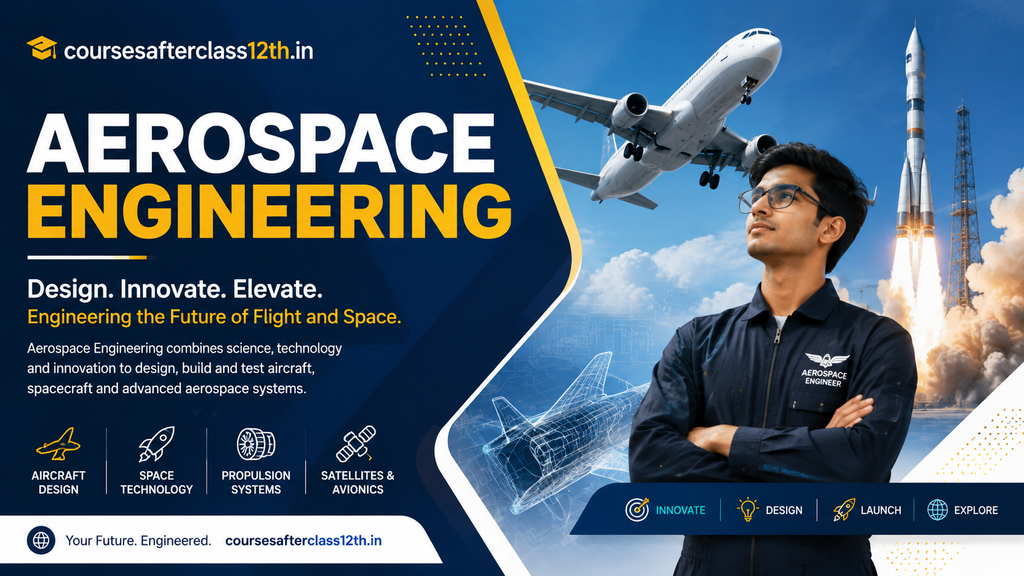
Aerospace Engineering is a specialised branch of engineering that focuses on the design, development, testing, manufacturing and operation of aircraft, spacecraft and related systems. The discipline combines mathematics, physics, mechanics, materials science, aerodynamics, propulsion, electronics, control systems and computer-based engineering methods.
For students who have completed Class 12 with Physics, Chemistry and Mathematics (PCM), Aerospace Engineering can be an attractive undergraduate option for those interested in aircraft, spacecraft, aviation technology, propulsion systems, aerodynamics, flight systems, drones and space-related technologies.
In India, students can pursue Aerospace Engineering through undergraduate programmes such as Bachelor of Engineering (BE) in Aerospace Engineering or Bachelor of Technology (BTech) in Aerospace Engineering. Depending on the institution, related programmes may also be offered under names such as Aeronautical Engineering or Aerospace and related engineering disciplines.
The exact eligibility requirements, entrance examinations, admission process, fees, curriculum and counselling procedure vary according to the university, state, institution and admission route. Therefore, students should verify the latest requirements directly with their preferred institution or applicable counselling authority before applying.
This guide explains this program after 12th, including eligibility, entrance exams, admission process, course duration, subjects, specialisations, fees, practical learning, internships, projects, skills, career options, salary factors, government opportunities, higher studies, emerging technologies and future scope.
Table of Contents
What Is Aerospace Engineering?
Aerospace Engineering deals with engineering systems that operate within the atmosphere and beyond it. The field is commonly divided into two closely related areas: aeronautical engineering, which focuses mainly on aircraft and atmospheric flight, and astronautical engineering, which focuses on spacecraft and systems operating in space.
The subject therefore covers a wide range of engineering challenges. This course may work on aircraft structures, propulsion systems, aerodynamic performance, flight controls, navigation systems, materials, manufacturing processes, testing or spacecraft components.
Unlike some engineering disciplines that concentrate mainly on a single type of machine or system, Aerospace Engineering combines multiple engineering areas within highly integrated systems.
For example, an aircraft must be structurally strong while remaining sufficiently lightweight. Its engines must generate adequate thrust while meeting efficiency and safety requirements. Its aerodynamic design must support stable and efficient flight. At the same time, electronic, control and communication systems must work together reliably.
Consequently, this course requires engineers to understand how different technical components interact within a complete system.
Why Choose Aerospace Engineering After 12th?
This course can be suitable for students who have a strong interest in aviation, aircraft, space technology, engineering design and advanced mechanical systems.
The discipline provides exposure to several areas of engineering rather than focusing on only one subject. Students can study aerodynamics, propulsion, structures, materials, flight mechanics, control systems and manufacturing.
Furthermore, the skills developed through Aerospace Engineering can have applications beyond traditional aircraft manufacturing. Aerospace-related engineering knowledge can also connect with drones, defence technology, robotics, advanced manufacturing, automotive systems, computational engineering and space technologies.
Major reasons to consider Aerospace Engineering
| Reason | Explanation |
|---|---|
| Aviation interest | Suitable for students fascinated by aircraft and flight technology. |
| Space technology | Provides a foundation for studying spacecraft and space systems. |
| Multidisciplinary learning | Combines mechanics, electronics, materials, mathematics and computing. |
| Advanced technology | Involves simulation, testing, modelling and modern engineering tools. |
| Research opportunities | Supports higher studies and research in specialised engineering fields. |
| Manufacturing exposure | Connects engineering design with production and testing. |
| Emerging applications | Aerospace skills can overlap with drones, robotics and advanced mobility technologies. |
However, students should not choose the course simply because aerospace sounds prestigious. The programme can be academically demanding and requires a strong foundation in mathematics, physics and engineering concepts.
Aerospace Engineering Eligibility After 12th
Eligibility criteria differ between institutions and admission routes. Generally, this undergraduate Engineering programmes require students to have completed Class 12 or an equivalent qualification with subjects relevant to engineering.
Physics and Mathematics are commonly important requirements. Chemistry may also form part of the required subject combination, depending on the institution and admission route.
The minimum percentage, entrance examination requirements, category-related rules and other conditions can vary.
General eligibility overview
| Requirement | Typical expectation |
|---|---|
| Educational qualification | Class 12 or equivalent |
| Important subjects | Physics and Mathematics |
| Commonly relevant subject | Chemistry |
| Course level | Undergraduate |
| Programme | BE/BTech Aerospace Engineering |
| Entrance examination | Depends on admission route |
| Minimum marks | Institution-specific |
| Age requirement | Depends on applicable rules |
Students should treat this table as a general guide rather than a universal admission rule.
Aerospace Engineering Entrance Exams
Admission to this course can take place through national-level examinations, state-level examinations, university entrance tests, counselling systems or institution-specific admission processes.
For institutions that use national engineering admission routes, JEE Main may be relevant for B.E./B.Tech admissions. Students should check the latest official examination and counselling information before applying.
Other institutions may have their own admission criteria or accept scores from particular examinations.
Possible admission routes
| Route | Description |
|---|---|
| National entrance examination | Admission may depend on a national-level engineering examination and subsequent counselling. |
| State-level examination | Some institutions may participate in state-specific admission systems. |
| University entrance test | An institution may conduct its own examination where applicable. |
| Centralised counselling | Candidates select preferred branches and institutions according to counselling rules. |
| Institution-level admission | Certain institutions may offer admission through their applicable selection process. |
Since entrance rules can change from one admission cycle to another, students should always consult the latest official notification.
Aerospace Engineering Admission Process
The admission process depends on the institution and the selected admission route.
Generally, students first confirm eligibility and identify suitable colleges. They then complete the relevant entrance examination or application process. After receiving a score or rank, eligible students may participate in counselling or institution-level selection.
Typical steps include:
- Complete Class 12 with the required subjects.
- Check Aerospace Engineering eligibility.
- Identify relevant entrance examinations.
- Register for the applicable examination.
- Appear for the examination, if required.
- Check the result or rank.
- Register for counselling where applicable.
- Select preferred colleges and branches.
- Participate in seat allocation.
- Complete document verification.
- Pay the required admission fee.
- Report to the allotted institution.
Students should keep their academic certificates, identification documents, photographs, examination records and counselling documents ready.
Aerospace Engineering Course Duration
A regular undergraduate BE or BTech in Aerospace Engineering generally takes four years through the standard full-time route.
The course is usually divided into multiple semesters. The early part of the programme may focus on engineering mathematics, physics, chemistry, mechanics, programming and basic engineering subjects.
Later semesters generally introduce specialised this subjects such as aerodynamics, propulsion, aircraft structures, flight mechanics, aerospace materials, control systems and aerospace design.
Laboratory work, technical projects, internships, simulation exercises and final-year projects can provide additional practical exposure.
Aerospace Engineering Subjects
This program involves a combination of foundational science and specialised engineering subjects.
Common subjects may include:
| Subject | What students generally study |
|---|---|
| Engineering Mathematics | Mathematical methods used in engineering analysis. |
| Engineering Physics | Physical principles relevant to aerospace systems. |
| Engineering Mechanics | Forces, motion and mechanical systems. |
| Thermodynamics | Energy, heat and thermodynamic processes. |
| Fluid Mechanics | Behaviour and movement of fluids. |
| Aerodynamics | Airflow and aerodynamic forces around aircraft. |
| Aircraft Structures | Design and analysis of aircraft structural components. |
| Aerospace Materials | Materials used in aircraft and spacecraft. |
| Propulsion | Engines and systems that generate thrust. |
| Flight Mechanics | Aircraft motion, stability and performance. |
| Aircraft Design | Integration of different systems into aircraft design. |
| Control Systems | Monitoring and controlling aerospace systems. |
| Avionics | Electronic systems used in aircraft and spacecraft. |
| Computational Methods | Numerical and computer-based engineering analysis. |
| Aerospace Manufacturing | Processes used to manufacture aerospace components. |
The exact subject list varies between universities.
Core Areas of Aerospace Engineering
1. Aerodynamics
Aerodynamics focuses on how air moves around aircraft and other bodies.
Engineers study concepts such as lift, drag, pressure distribution, flow behaviour and aerodynamic stability.
The principles of aerodynamics influence aircraft shape, wing design, efficiency and performance.
Computational tools and wind-tunnel testing can help engineers analyse aerodynamic behaviour.
2. Aircraft Structures
Aircraft structures must provide adequate strength while controlling weight.
Structural engineering in aerospace therefore involves analysing wings, fuselage sections, landing systems and other structural components.
Engineers need to understand stresses, strains, fatigue, vibration, material properties and structural safety.
Because weight directly influences aircraft performance, aerospace structural design often requires careful optimisation.
3. Propulsion
Propulsion deals with systems that generate thrust.
Depending on the aircraft or vehicle, propulsion technologies can include piston engines, gas turbines, turbofans, turbojets, rockets and other advanced propulsion systems.
Students may study thermodynamics, combustion, fluid mechanics and engine performance as part of propulsion-related subjects.
4. Flight Mechanics
Flight mechanics examines how aircraft move and respond during flight.
Students may study aircraft performance, stability, control, take-off, landing, climbing, cruising and manoeuvring.
Understanding flight mechanics is important for evaluating whether an aircraft can achieve its intended performance under different conditions.
5. Avionics
Avionics refers to electronic systems used in aircraft and spacecraft.
These systems can support:
- Navigation
- Communication
- Flight control
- Monitoring
- Instrumentation
- Guidance
- Data processing
Graduate engineers may work alongside electronics and control specialists when developing integrated flight systems.
Aerospace Engineering Specialisations
This course provides opportunities to develop specialised knowledge through electives, projects, internships and higher studies.
Possible specialisation areas include:
- Aerodynamics
- Propulsion
- Aircraft structures
- Flight mechanics
- Avionics
- Aerospace materials
- Aircraft design
- Spacecraft engineering
- Guidance and control
- Computational fluid dynamics
- Aerospace manufacturing
- Unmanned aerial systems
- Space propulsion
- Aerospace systems engineering
The availability of these areas depends on the institution.
Aerospace Engineering Fees in India
The course fees vary widely among colleges and universities.
Government institutions, private universities and specialised institutes can have different tuition structures. Students should also consider hostel, examination, laboratory, transportation and other educational expenses.
Factors affecting total cost
| Factor | Possible impact |
|---|---|
| Institution type | Government and private institutions may have different fee levels. |
| Location | Living costs vary between cities. |
| Laboratory facilities | Advanced facilities may influence programme costs. |
| Hostel | Accommodation and food add to total expenses. |
| Scholarships | Eligible students may receive financial assistance. |
| Other charges | Examination, development and laboratory charges may apply. |
Students should compare the total four-year cost, not only the tuition fee.
Practical Learning in Aerospace Engineering
The program has a strong practical component because students need to understand how theoretical principles translate into real systems.
Laboratory sessions may involve fluid mechanics, materials, propulsion, aerodynamics, structures, instrumentation and control systems.
Students can also gain practical experience through:
- Aircraft design projects
- Simulation
- Wind-tunnel experiments
- CAD modelling
- Structural analysis
- Manufacturing exercises
- Technical competitions
- Internships
- Research projects
Practical exposure can be particularly valuable when students later apply for engineering internships or entry-level technical positions.
Aerospace Engineering Internship
An internship can help students understand how this degree concepts are applied in professional environments.
Depending on the organisation, interns may gain exposure to design, testing, simulation, manufacturing, maintenance, quality assurance, research or documentation.
Possible internship areas
| Area | Possible exposure |
|---|---|
| Aircraft design | CAD, modelling and design analysis |
| Manufacturing | Aerospace component production |
| Maintenance | Aircraft systems and maintenance processes |
| Aerodynamics | Computational or experimental analysis |
| Structures | Structural modelling and testing |
| Propulsion | Engine-related analysis and testing |
| Avionics | Electronic and control systems |
| Research | Experimental or computational projects |
| Drones | UAV design and testing |
| Space technology | Spacecraft or propulsion-related research |
Students should focus on gaining meaningful technical experience rather than completing an internship only for a certificate.
Aerospace Engineering Projects
Projects allow students to apply engineering knowledge to practical challenges.
A strong aerospace project generally includes a clearly defined problem, engineering methodology, analysis, testing or simulation and measurable results.
Project ideas
| Project area | Example |
|---|---|
| Aerodynamics | Analysis of wing performance |
| UAV | Design and testing of a small drone |
| Structures | Structural analysis of an aircraft component |
| Propulsion | Performance analysis of a propulsion system |
| CFD | Computational analysis of airflow |
| Materials | Study of lightweight aerospace materials |
| Flight control | Simulation of aircraft control systems |
| Space systems | Conceptual analysis of a small satellite system |
| Manufacturing | Aerospace component manufacturing study |
Projects can also help students demonstrate technical skills during interviews.
Skills Required for Aerospace Engineering
This degree require a combination of technical knowledge and professional skills.
Technical skills
- Engineering mathematics
- Physics
- Mechanics
- Aerodynamics
- Thermodynamics
- Fluid mechanics
- CAD
- Structural analysis
- Computational methods
- Simulation
- Control systems
- Materials science
Professional skills
- Problem solving
- Communication
- Teamwork
- Technical writing
- Presentation
- Project management
- Attention to detail
- Safety awareness
Digital skills
Modern aerospace engineering increasingly involves computational tools.
Students can benefit from developing knowledge of:
- CAD software
- Simulation
- Computational Fluid Dynamics
- Programming
- Data analysis
- Numerical modelling
- Digital manufacturing
Aerospace Engineering Software
Digital engineering tools play an important role in modern aerospace development.
Depending on the programme and career area, students may encounter software for:
- Computer-aided design
- Computational fluid dynamics
- Structural analysis
- Flight simulation
- Numerical modelling
- Programming
- Data analysis
- Manufacturing
Students should understand the underlying engineering principles before focusing heavily on software certifications.
A software tool is valuable when an engineer understands what problem it is solving and how to interpret its results.
Aerospace Engineering Career Options
The graduates can explore careers across aircraft, aerospace manufacturing, defence-related industries, research organisations, aviation technology, drones and advanced engineering sectors.
Common career areas
| Career area | Possible roles |
|---|---|
| Aircraft design | Design Engineer |
| Aerodynamics | Aerodynamics Engineer |
| Structures | Structural Engineer |
| Propulsion | Propulsion Engineer |
| Manufacturing | Manufacturing Engineer |
| Testing | Test Engineer |
| Quality | Quality Engineer |
| Avionics | Aerospace systems-related roles |
| UAVs | Drone/UAV Engineer |
| Research | R&D Engineer |
| Simulation | Simulation Engineer |
| Maintenance | Aerospace maintenance-related roles |
| Systems | Systems Engineer |
Actual job titles and eligibility requirements vary among organisations.
Aerospace Engineering Jobs in the Private Sector
Private-sector opportunities can exist in aerospace manufacturing, aviation technology, engineering services, defence-related manufacturing, drones, space technology and advanced manufacturing.
Graduates may work in:
- Aircraft manufacturing
- Aerospace component manufacturing
- Aviation companies
- Drone companies
- Engineering consultancy
- Defence technology
- Space technology
- Advanced manufacturing
- Simulation and engineering software
Entry-level responsibilities may include design support, CAD modelling, testing, quality analysis, production support, simulation and documentation.
With experience, engineers may progress toward specialised technical roles, project management or engineering leadership.
Aerospace Engineering Government Jobs
Government and public-sector organisations can provide career opportunities in aerospace, defence, aviation, research and space technology.
Depending on eligibility and recruitment rules, graduates may explore opportunities in organisations associated with:
- Space research
- Defence research
- Aerospace manufacturing
- Government aviation
- Public-sector engineering
- Research laboratories
- Technical services
Recruitment can take place through organisation-specific recruitment, competitive examinations or other approved selection processes.
Students interested in government careers should monitor official recruitment notifications because eligibility, age limits, vacancies, examination patterns and selection procedures can change.
Graduate Engineering Salary in India
It is not advisable to present one fixed salary figure as applicable to every engineering graduate.
Salary can vary depending on:
- Employer
- Job role
- Location
- College
- Technical skills
- Internship experience
- Academic performance
- Specialisation
- Industry demand
- Professional experience
For example, a graduate entering aerospace design may have a different salary structure from someone working in manufacturing, quality, simulation, research or an adjacent engineering sector.
Salary factors
| Factor | Why it matters |
|---|---|
| Technical skills | Specialised skills can influence job opportunities. |
| Experience | Professional experience generally affects career progression. |
| Employer | Salary structures vary between organisations. |
| Location | Compensation can differ by city and industry cluster. |
| Role | Design, testing, manufacturing and research roles may differ. |
| Higher education | Advanced qualifications can support specialised careers. |
Students should compare starting salary, median salary, average salary and highest reported package separately.
The Engineering Higher Studies
A postgraduate degree can be useful for students who want deeper technical expertise, research opportunities, academic careers or specialised aerospace roles.
Possible higher-study options include:
- MTech in Aerospace Engineering
- ME in Aerospace Engineering
- Aeronautical Engineering
- Propulsion
- Aerodynamics
- Aerospace Structures
- Avionics
- Flight Mechanics
- Space Technology
- Computational Fluid Dynamics
- Materials Engineering
- Systems Engineering
Higher studies can allow students to move into specialised technical and research-oriented roles.
Aerospace Engineering Research Opportunities
The Engineering has significant research potential because aircraft and spacecraft technologies continue to evolve.
Research areas can include:
- Advanced aerodynamics
- Electric propulsion
- Sustainable aviation
- Hypersonic flight
- Lightweight materials
- Composite structures
- Autonomous aircraft
- Unmanned aerial vehicles
- Space propulsion
- Satellite systems
- Computational fluid dynamics
- Flight control
- Artificial intelligence in aerospace
Students interested in research should develop strong mathematical, analytical, experimental and programming skills.
Aerospace Engineering and Drones
Unmanned Aerial Vehicles (UAVs), commonly known as drones, have created additional applications for aerospace engineering.
Drones can be used in areas such as:
- Surveying
- Agriculture
- Infrastructure inspection
- Mapping
- Photography
- Disaster management
- Logistics
- Industrial monitoring
- Defence applications
- Research
The grdauates can contribute to UAV design, aerodynamics, propulsion, flight control, structures and systems integration.
Aerospace Engineering and Space Technology
The prgram also connects with space technology.
Spacecraft operate in extremely demanding conditions and require carefully designed structures, propulsion systems, thermal management, communication systems and control technologies.
Students interested in this area can develop knowledge in:
- Spacecraft structures
- Orbital mechanics
- Space propulsion
- Guidance and control
- Satellite systems
- Thermal systems
- Space materials
- Mission design
Space-related careers can be highly specialised, so postgraduate education and research experience can be valuable.
Aerospace Engineering and Sustainable Aviation
Environmental sustainability is becoming an important engineering consideration in aviation.
Researchers and engineers are exploring ways to improve aircraft efficiency, reduce emissions and develop alternative propulsion and fuel technologies.
Potential areas include:
- Sustainable aviation fuels
- Electric propulsion
- Hybrid propulsion
- Lightweight materials
- More efficient aircraft designs
- Improved engine technologies
- Alternative energy systems
Consequently, this program is increasingly connected with environmental and energy-related engineering challenges.
Aerospace Engineering and Artificial Intelligence
Artificial intelligence and data-driven technologies are increasingly relevant to aerospace applications.
Possible applications include:
- Predictive maintenance
- Autonomous flight
- Flight optimisation
- Image analysis
- Aircraft health monitoring
- Simulation
- Design optimisation
- Navigation support
However, AI does not replace fundamental aerospace knowledge. Engineers still need to understand aerodynamics, structures, propulsion, control systems and safety requirements.
Aerospace Engineering and Advanced Materials
Aircraft and spacecraft require materials that offer suitable combinations of strength, weight, durability, temperature resistance and reliability.
Modern engineering therefore uses advanced materials and composites.
Students can explore:
- Composite materials
- Lightweight alloys
- Ceramic materials
- High-temperature materials
- Smart materials
- Advanced manufacturing materials
Material selection can significantly influence aircraft weight, performance and safety.
Aerospace Engineering and Manufacturing
Design is only one part of aerospace engineering.
Aircraft and spacecraft components must also be manufactured accurately and consistently.
Aerospace manufacturing can involve:
- Precision machining
- Composite manufacturing
- Additive manufacturing
- Assembly
- Quality inspection
- Non-destructive testing
- Surface treatment
Manufacturing engineers must ensure that components meet design specifications and quality requirements.
Aerospace Engineering vs Mechanical Engineering
Aerospace and Mechanical Engineering share several fundamentals, particularly mechanics, thermodynamics, fluid mechanics and materials.
However, the course applies these principles specifically to aircraft and spacecraft.
| Feature | Aerospace Engineering | Mechanical Engineering |
|---|---|---|
| Main focus | Aircraft and spacecraft | Machines and mechanical systems |
| Aerodynamics | Major area | Supporting area |
| Propulsion | Aerospace propulsion | Engines and thermal systems |
| Structures | Aircraft/spacecraft structures | Mechanical structures |
| Industries | Aerospace, aviation, defence, space | Manufacturing, automotive, machinery |
| Space technology | Direct relevance | Possible through specialisation |
Students should compare the curriculum of individual colleges because programme structures can vary.
Aerospace Engineering vs Automobile Engineering
Both fields involve mechanical systems and vehicle technology, but their applications differ.
The course focuses on aircraft and spacecraft, while Automobile Engineering concentrates primarily on road vehicles.
Students interested in aircraft, drones and space systems may prefer Aerospace Engineering. Those interested mainly in cars, engines and automotive manufacturing may find Automobile Engineering more aligned with their interests.
Aerospace Engineering vs Mechanical Engineering: Which Is Better?
There is no universal answer.
A student interested specifically in aircraft, flight, spacecraft and aerospace systems may prefer Aerospace Engineering.
A student who wants a broader mechanical foundation with applications across manufacturing, automotive, energy and machinery may prefer Mechanical Engineering.
Therefore, students should compare:
- Curriculum
- Laboratory facilities
- Internship opportunities
- Placement records
- Industry exposure
- Higher-study options
- Personal interests
Is Aerospace Engineering Difficult?
Aerospace Engineering can be academically demanding.
Students need to work with mathematics, physics, mechanics, fluid dynamics, thermodynamics and specialised engineering subjects.
However, difficulty varies with individual preparation and interest.
Students who develop strong fundamentals, practise numerical problems and participate in practical projects can gradually build confidence.
Good time management and consistent study are particularly important because many aerospace subjects are interconnected.
Is Aerospace Engineering a Good Career?
Aerospace Engineering can be a suitable career for students who have a genuine interest in aviation, aircraft, space technology and advanced engineering systems.
It may provide opportunities in aerospace manufacturing, research, defence technology, aviation, drones, advanced manufacturing and related engineering sectors.
However, students should understand that aerospace is a specialised field and job opportunities may depend strongly on location, employer demand, technical skills, academic background and experience.
Students should therefore select the course because the subject and career direction match their interests rather than simply because the field sounds attractive.
Advantages of Aerospace Engineering
1. Specialised technical knowledge
Students develop knowledge of advanced engineering systems.
2. Multidisciplinary education
The course combines mechanics, materials, electronics, computing and physics.
3. Aviation and space applications
Students can work toward careers connected with aircraft and spacecraft.
4. Research opportunities
The field supports advanced study in aerodynamics, propulsion, structures and space technology.
5. Emerging technologies
Drones, autonomous systems, advanced materials and sustainable propulsion are creating new technical applications.
6. Transferable engineering skills
Skills in mathematics, modelling, simulation, design and problem solving can be useful beyond aerospace.
Challenges of Aerospace Engineering
Students should also understand the challenges before selecting the branch.
Aerospace Engineering can involve complex mathematical and technical concepts. Certain jobs may require specialised knowledge, strict quality standards and extensive testing.
The aerospace sector can also have specific hiring requirements for certain technical roles.
Therefore, students should research actual job descriptions and industry requirements before deciding their long-term career direction.
How to Choose the Best Aerospace Engineering College
Students should compare colleges systematically.
Important factors
| Factor | What to evaluate |
|---|---|
| Curriculum | Core aerospace subjects and electives |
| Faculty | Academic and industry expertise |
| Laboratories | Aerodynamics, propulsion, structures and other facilities |
| Workshops | Manufacturing and practical training |
| Internship | Industry and research opportunities |
| Placements | Aerospace-specific placement information |
| Recruiters | Companies and organisations hiring graduates |
| Projects | Student research and technical projects |
| Fees | Complete four-year cost |
| Location | Access to industry and research ecosystems |
Do not evaluate a college only on its advertised highest salary package.
Instead, look for branch-specific placement data, job roles, internship opportunities and the percentage of students receiving relevant technical employment.
Aerospace Engineering Career Preparation
Students can begin career preparation well before graduation.
First year
Focus on:
- Mathematics
- Physics
- Basic engineering
- Programming
- Communication
Second year
Develop:
- CAD skills
- Mechanics
- Fluid mechanics
- Materials knowledge
- Laboratory skills
Third year
Focus on:
- Specialisation
- Simulation
- Projects
- Internships
- Technical competitions
Final year
Work on:
- Major project
- Internship
- Technical portfolio
- Resume
- Interview preparation
- Higher-study planning
This gradual approach can help students build a stronger professional profile.
Aerospace Engineering After 12th: Quick Overview
| Category | Details |
|---|---|
| Course | BE/BTech Aerospace Engineering |
| Level | Undergraduate |
| Duration | Generally 4 years |
| Common background | Physics, Chemistry and Mathematics |
| Entrance | Depends on institution and admission route |
| Core subjects | Aerodynamics, propulsion, structures, flight mechanics |
| Practical learning | Laboratories, projects, simulations and internships |
| Career sectors | Aerospace, aviation, defence, drones, manufacturing and research |
| Government opportunities | Available through applicable recruitment routes |
| Higher studies | MTech/ME and specialised research programmes |
| Key skills | Mathematics, mechanics, CAD, simulation and problem solving |
| Emerging areas | UAVs, sustainable aviation, space technology and autonomous systems |
Frequently Asked Questions About Aerospace Engineering
1. What is Aerospace Engineering?
Aerospace Engineering is a branch of engineering concerned with the design, development, testing and operation of aircraft, spacecraft and related systems.
2. Can I pursue Aerospace Engineering after 12th?
Yes. Students who satisfy the applicable eligibility requirements can pursue undergraduate BE or BTech programmes in Aerospace Engineering after Class 12.
3. Which subjects are required for Aerospace Engineering?
Physics and Mathematics are commonly important for engineering admissions, while Chemistry may also be part of the required Class 12 subject combination. Exact requirements depend on the institution and admission route.
4. What is the duration of Aerospace Engineering?
A regular undergraduate BE or BTech Aerospace Engineering programme generally takes four years.
5. What subjects are taught in Aerospace Engineering?
Common subjects include aerodynamics, aircraft structures, propulsion, flight mechanics, thermodynamics, fluid mechanics, aerospace materials, avionics, control systems and aircraft design.
6. Is Aerospace Engineering only about aircraft?
No. Aerospace Engineering covers both atmospheric flight and space-related engineering. Depending on the specialisation, students can study aircraft, spacecraft, UAVs, propulsion and related systems.
7. What jobs can Aerospace Engineering graduates get?
Graduates can explore roles in aerospace design, aerodynamics, propulsion, structures, manufacturing, testing, quality, simulation, UAVs, research and aerospace systems.
8. Can Aerospace Engineering graduates work in the space sector?
Yes. Graduates with relevant qualifications and skills can explore space-related engineering and research opportunities. Specialised roles may require postgraduate education or specific recruitment qualifications.
9. Is Aerospace Engineering good for higher studies?
Yes. Higher studies can help students specialise in aerodynamics, propulsion, structures, avionics, flight mechanics, space technology and other technical areas.
10. Is Aerospace Engineering difficult?
The course can be challenging because it involves mathematics, physics, mechanics, fluid dynamics and specialised engineering subjects. Consistent study and strong fundamentals can help students manage the curriculum.
11. What is the salary after Aerospace Engineering?
There is no single salary applicable to every graduate. Compensation depends on employer, role, location, technical skills, experience, academic background and industry conditions.
12. What is the future scope of Aerospace Engineering?
Future areas include sustainable aviation, drones, autonomous systems, advanced materials, electric and hybrid propulsion, space technology, simulation, AI-assisted engineering and advanced manufacturing.