
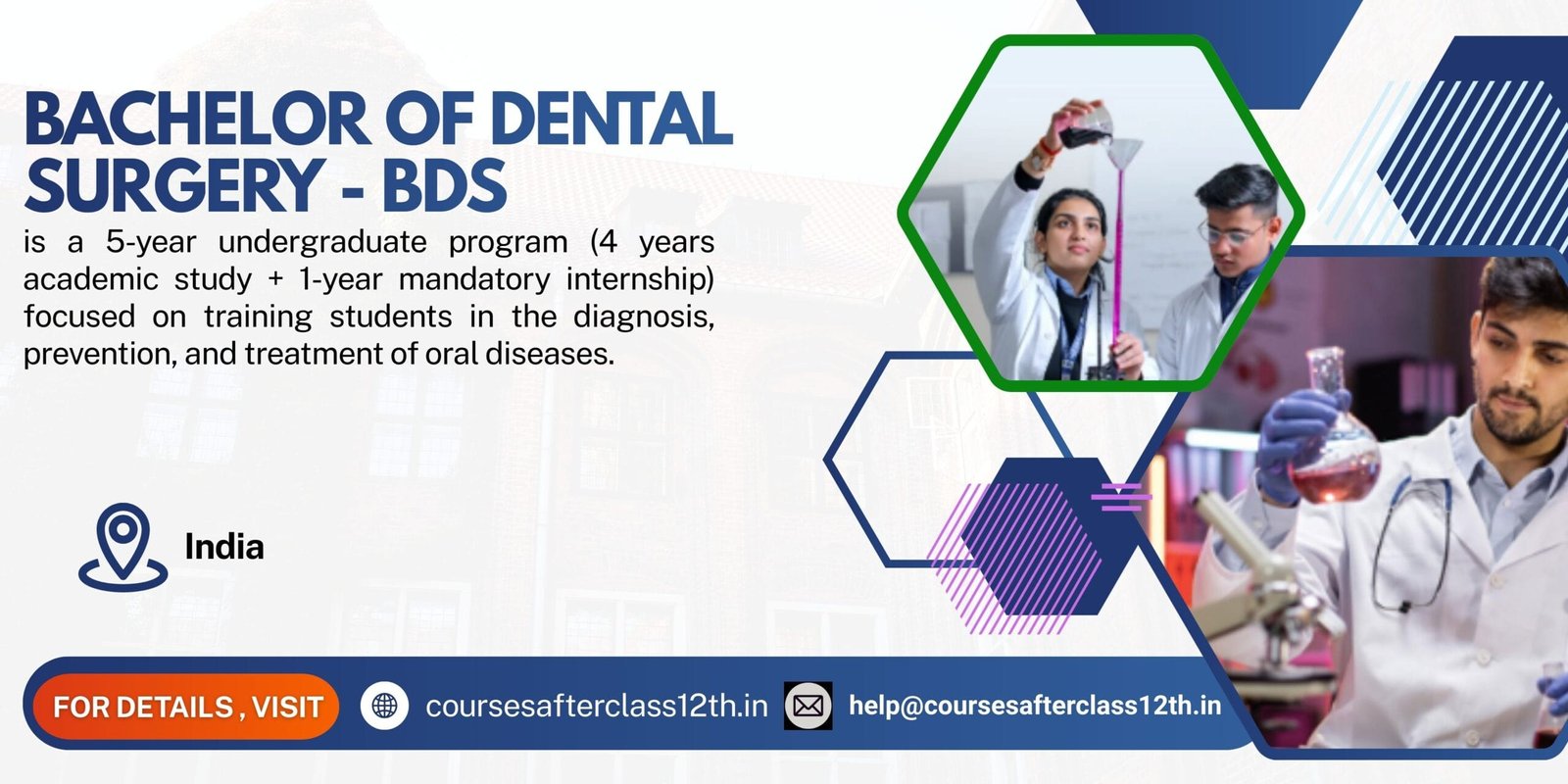
The Bachelor of Dental Surgery (BDS) is the primary undergraduate degree required to become a licensed dental practitioner in India. Regulated by the Dental Council of India (DCI), the course combines medical science, dental theory, and hands-on clinical training, preparing students for professional dental practice or higher specialization.
is among the most preferred medical courses after Class 12 for students interested in oral healthcare, surgery, and patient-centric clinical work.
BDS Course Overview
| Particulars | Details |
|---|---|
| Course Name | Bachelor of Dental Surgery (BDS) |
| Course Duration | 5 years (4 years academic + 1 year internship) |
| Eligibility | Class 12 with Physics, Chemistry, Biology |
| Entrance Exam | NEET-UG |
| Regulatory Body | Dental Council of India (DCI) |
| Admission Process | Central/State NEET Counselling |
| Career Path | Dentist, Specialist, Academic, Research |
BDS Eligibility Criteria
To be eligible for admission into BDS, candidates must meet the following criteria:
- Passed Class 12 (10+2) with Physics, Chemistry, and Biology as compulsory subjects
- Minimum 50% aggregate marks (40% for reserved categories)
- Must qualify NEET-UG in the year of admission
- Minimum age: 17 years as of 31 December of the admission year
Admission Process
- Appear for NEET-UG
- Qualify with required cutoff score
- Register for All India Quota (AIQ) or State Counselling
- Choice filling and seat allotment
- Document verification and college reporting
Admissions are strictly merit-based through centralized counselling.
BDS Syllabus – Year & Semester Wise
The BDS curriculum progresses from foundational medical sciences to advanced dental clinical practice.
First Year
- General Anatomy (including Embryology & Histology)
- General Physiology & Biochemistry
- Dental Anatomy & Histology
Second Year
- General Pathology & Microbiology
- General Pharmacology
- Dental Materials
- Pre-Clinical Conservative Dentistry
Third Year
- General Medicine
- General Surgery
- Oral Pathology & Oral Microbiology
Final Year
- Orthodontics & Dentofacial Orthopaedics
- Oral & Maxillofacial Surgery
- Conservative Dentistry & Endodontics
- Prosthodontics & Crown Bridge
- Periodontology
- Public Health Dentistry
- Pedodontics & Preventive Dentistry
Compulsory Internship (1 Year)
- Rotational clinical training in all dental specialties
Top BDS Colleges in India – State Wise (Indicative)
Government Colleges
- Delhi – Maulana Azad Institute of Dental Sciences
- Maharashtra – Government Dental College, Mumbai
- Tamil Nadu – Government Dental College, Chennai
- Karnataka – Government Dental College, Bengaluru
- Rajasthan – RUHS College of Dental Sciences
Private Colleges
- Manipal College of Dental Sciences
- Sri Ramachandra Dental College
- SDM College of Dental Sciences
- Amrita School of Dentistry
(Students should always verify latest NEET cutoffs and seat availability during counselling.)
BDS vs MDS – Career Comparison
| Factor | BDS | MDS |
|---|---|---|
| Level | Undergraduate | Postgraduate |
| Duration | 5 Years | 3 Years |
| Focus | General Dentistry | Specialization |
| Career Roles | General Dentist | Specialist Dentist |
| Average Salary | ₹3–6 LPA | ₹6–15+ LPA |
| Academic Scope | Limited | High (Teaching & Research) |
BDS is sufficient for private practice, while MDS is recommended for specialization, academic roles, and higher earnings.
Career Options After BDS
After completing BDS, graduates can pursue:
- Private Dental Practice
- Hospital-based Dentist
- Government Dental Officer
- MDS (Specialization)
- Teaching & Academics
- Dental Research
- Medical Writing & Healthcare Consulting
- Public Health Dentistry (MPH)
Salary After BDS
- Freshers: ₹20,000 – ₹40,000 per month
- Experienced Dentists: ₹6–10 LPA
- Specialists (MDS): ₹10–20 LPA (varies by specialization & location)
Income increases significantly with experience, specialization, and private practice.
Dental Courses After Class 12 (BDS Cluster)
- BDS – Bachelor of Dental Surgery
- Dental Hygienist Courses
- Dental Technician Diploma
- Oral Health Technology Programs
Among these, BDS is the only degree that allows independent dental practice.
FAQs – Bachelor of Dental Surgery (BDS)
Yes. With increasing awareness of oral health, dentistry offers stable career growth, especially for specialists and private practitioners.
Yes. Admission to BDS in India is strictly through NEET-UG.
Yes. After completing internship and registering with the State Dental Council, graduates can start private practice.
BDS graduates must clear country-specific licensing exams (NBDE, ORE, ADC, etc.) to practice abroad.
No. MDS is optional but recommended for specialization, higher salary, and academic careers.